



What is a slew bearing with internal gear? It is a large-diameter rotation bearing with gear teeth cut on the inside of the inner ring, so the drive pinion sits inside the bore. The gear and raceway share one part. That keeps the package compact and shields the mesh from dirt, spray and accidental contact.
Here is the sourcing risk. Most mesh problems are written into the RFQ, not made on the shop floor. If the quote request leaves out module, profile shift or the backlash method, you can receive a bearing that fits the bolt circle but grinds against your pinion. Fixing that after delivery means re-cutting a hardened gear or redesigning the pinion mount.
I have spent more than 30 years on the design side of slewing bearings, slew drives and worm gear reducers. The same few gaps show up in RFQs again and again. This guide turns them into fields you can fill in and documents you can ask for before you approve a supplier.
Four RFQ Gaps That Cause Rough Mesh
An internal mesh behaves differently from an external one. The pinion is surrounded by the ring gear, so tooth count, profile shift and center distance leave little room for error. A small mistake in one of them can cause tip interference or uneven contact.
- Sending only outside diameter and bolt pattern. These dimensions make the bearing fit the frame. They say nothing about whether the teeth will mesh with your pinion.
- Leaving profile shift out. Internal gears often use addendum modification to avoid interference. Without the coefficient, two suppliers can quote the same module and produce different tooth forms.
- Specifying one backlash number with no method. Backlash changes around the ring because of runout and mounting stiffness. A single value with no measurement position is hard to accept or reject.
- Accepting "hardened teeth" as a complete heat treatment note. It does not state hardness, depth or where the raceway soft spot sits relative to the gear.
Each of these gaps is cheap to close at RFQ stage. Each becomes expensive after the first assembly.
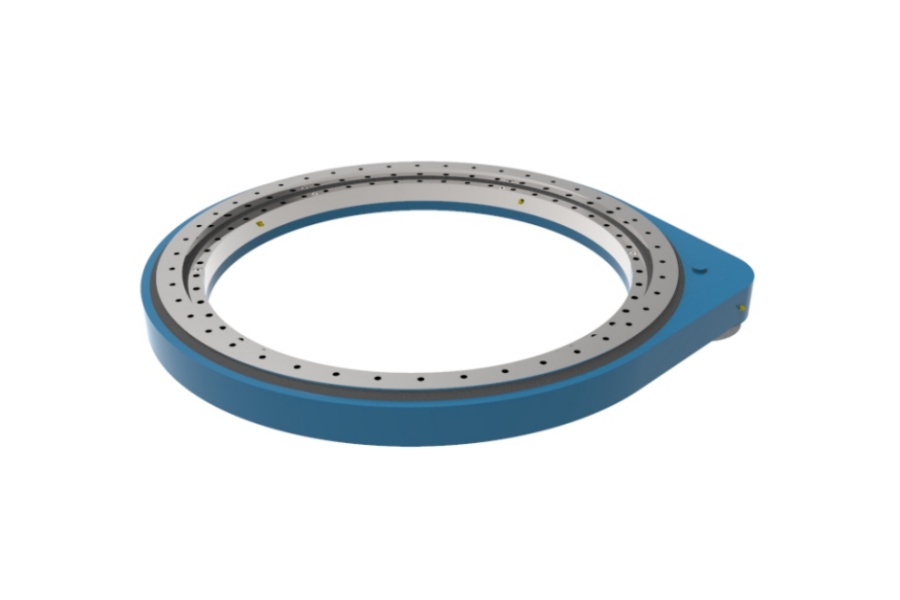
Sourcing Checklist: Tooth Module, Backlash, Pinion Compatibility, Heat Treatment and Gear Inspection Evidence
Use the table below as the gear section of your RFQ. Every row has a field to fill in and a reason to fill it in. The last column shows where the rule does not apply, so you do not over-specify a simple job. The same checks apply whether the bearing is a crossed roller slewing bearing or a three-row roller slewing bearing.
| Item | What to put in the RFQ | Why it matters | Limit or exception |
|---|---|---|---|
| Tooth module and tooth form | Module, pressure angle, tooth count, profile shift coefficient, face width | These set whether the ring teeth and your pinion can mesh without interference | If you buy the pinion from the same supplier, send the load case and let them propose the pair |
| Backlash | Minimum and maximum backlash, the measurement position, and the checking method | Runout makes backlash vary around the ring, so the tightest point should be defined | For slow, one-direction rotation, a wider band may be acceptable |
| Pinion compatibility | Pinion drawing, center distance, mounting tolerance, rotation direction, stiffness of the pinion support | Mounting error shifts the contact pattern even with perfect teeth | If the pinion is still under design, mark it "TBD" and ask for a gear data sheet first |
| Heat treatment | Base material, tooth hardening method, surface hardness range, hardened depth, soft spot position | Hardness and depth control tooth wear and pitting life under cyclic load | Light-duty, low-speed jobs may not need hardened teeth, but state that choice |
| Gear inspection evidence | Named accuracy standard and grade, tooth profile, pitch and runout reports, hardness records | Without records you cannot tell a good tooth form from a marginal one | For a first prototype, a sample report may be enough, with full reports for production |
| Raceway soft spot | Position marked on the drawing, relative to the main load zone and the gear | It keeps the unhardened gap out of the highest-load area | Not an issue if the supplier's process leaves no gap, so ask them to confirm |
One more decision comes before the table. An internal mesh is not always the right choice. If your pinion must be larger than the bore allows, or if you need easy access for lubrication and tooth inspection, an external gear is simpler. An internal gear fits best where compact size and a protected mesh matter more than easy access.
Documents to Request Before You Approve a Supplier
A drawing tells you what the supplier intends to make. Inspection records tell you what they actually made. Ask for both, in this order.
- Gear data sheet. It should list module, tooth count, profile shift, pressure angle, tip and root diameters, and the tolerance standard used. Compare it to your pinion data line by line.
- Material certificate. Confirm that the ring material matches the grade in your drawing. Our slewing bearing range is built from ductile cast iron, alloy steel, stainless steel and forged alloy steel, chosen by load, speed and environment.
- Heat treatment record. It should show the hardening method, the measured surface hardness and the hardened depth. Ask for the soft spot position as marked on the part.
- Gear inspection report. Agree in advance whether you need profile, pitch and runout data, and on how many teeth.
- Backlash check record. It should state the position and method, and ideally the tightest point found.
- Trial mesh or contact pattern check. If a mating pinion is available, ask for a contact pattern photo or a rolling test at assembly.
If a supplier says they cannot provide one of these, ask what they use instead. The answer tells you how they control the gear. Our own approach to slew drive quality control is built around measurement records, which is why we suggest settling the report scope early.
Request Your Custom Slew Drive or Bearing Spec
Tell us your load, speed, and environment — receive a tailored 100–5000 mm slewing drive or slewing bearing proposal with 3D drawings within 24 hours.
What Luoyang Slewing Bearing Can Show for Gear-Related Work
Luoyang Slewring Bearing Co., Ltd. was established in 2012. We run 6 production lines in an 8,000 m² facility, with CNC machining centers and CMM three-coordinate inspection. Our quality system is ISO 9001:2015 certified, and we hold CE marking for the European market. Factory audit reports are available on request.
Every slewing bearing we ship passes CMM three-coordinate inspection and dynamic load testing. Our stated failure rate is below the 0.5% industry standard. Those are general quality facts. For an internal-gear order, ask us to state which gear checks are included in the quote.
On gear-mesh work specifically, our cases are slew drives, not internal-gear bearings. We do not have an internal-gear case to cite, and we will not present these as one. They do show how we handle tight gear-mesh requirements in heavy equipment:
- South Korean port equipment manufacturer: a 20-unit repeat order of WEA9-62-25HR single worm slew drives for port cranes, with tracking precision of 0.15° or better and IP65 sealing.
- British Columbia, Canada forestry equipment manufacturer: 30 units of WED14-86-25BHR.5 double worm slew drives for grapple machines, with precision of 0.13° or better.
- Houston, Texas engineering machinery manufacturer: 100 units of SEA21-125-25HR(2) for slewing platform and turntable systems.
If your design is closer to a geared drive than a bare bearing, our slew drive range may fit better. A drive combines the bearing, gearing and housing, so mesh and backlash are set at the factory instead of at your assembly line. It has limits, though: you give up the freedom to choose your own pinion and motor arrangement.
Cooperation Terms and What Still Needs Agreement
The terms below come from our company brief. Treat them as the starting point for your RFQ, not as a promise for every drawing.
| Term | What we state | What to confirm for an internal-gear order |
|---|---|---|
| Minimum order | 1 set for standard products, 5 sets for customized products | Whether your gear spec counts as standard or customized |
| Samples | Sample orders are welcome for testing and evaluation | Which gear reports come with the sample |
| Technical response | Technical proposal within 24 hours, 48-hour technical response | Which drawings and data you must send for the proposal |
| Lead time | 3-day rapid prototyping, 9-day standard production cycle | The confirmed schedule for your gear cutting and heat treatment |
| Warranty | 2-year extended quality warranty, free replacement for confirmed manufacturing defects | How a mesh defect is confirmed, and who checks pinion fit |
Several matters are not covered by standard terms, so settle them in writing. These include the backlash acceptance method, the scope of the gear inspection report, and who supplies the mating pinion. Also agree on who is responsible if the mesh fails with a pinion made by someone else. For non-standard teeth or housings, our customized slew drive process is the usual route, and the 5-set minimum applies.
RFQ Package: What to Send for a Useful Quote
A complete package shortens the back-and-forth. Here is the order I would use.
- Send the application and load case: axial, radial and moment loads, speed, duty cycle and operating environment.
- Send the bearing envelope: inner and outer diameter, height, mounting hole pattern and seal requirements.
- Fill in the gear fields from the table above, even if some values are marked "TBD".
- Attach the pinion drawing or the pinion data, with center distance and support stiffness.
- List the inspection reports you want, and the standard and grade for gear accuracy.
- State quantity, sample needs and target delivery window.
- Send everything to our engineering team at Luoyang Slewring Bearing Co., Ltd. so we can reply with a technical proposal, or with a short list of missing items.
A clean mesh comes from matching data on both sides of the contact: the ring gear and the pinion. The fewer fields you leave open, the fewer surprises you meet at first assembly.
Request Your Custom Slew Drive or Bearing Spec
Tell us your load, speed, and environment — receive a tailored 100–5000 mm slewing drive or slewing bearing proposal with 3D drawings within 24 hours.
 WhatsApp

 +8613903880726