



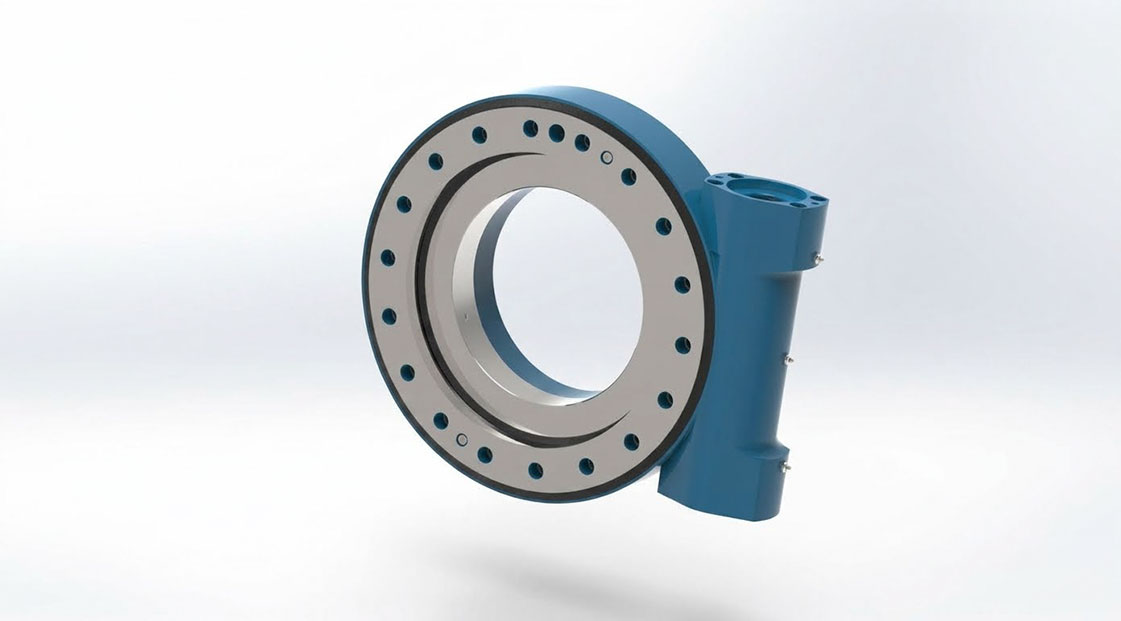
What is a slew bearing? It is a large-diameter rolling bearing that lets one structure rotate on another while carrying axial force, radial force, and tilting moment at the same time. Cranes, excavators, solar trackers, and turntables all depend on it.
Here is the question most engineers hit before design release: does the number printed on the slew bearing datasheet actually cover your load case? A catalog rating is not a verdict. It is a reference point that you must convert, combine, and compare.
This guide gives you a repeatable check. You start with a shortlisted bearing and a set of machine loads. You finish with a clear pass, fail, or "ask the maker" decision.
What You Need Before You Open the Datasheet
Gather the inputs first. Missing one of them is the most common reason a check gets redone late in the project.
| Input | Why it matters | Can it wait? |
|---|---|---|
| Axial load (Fa), including dead weight | Sets the vertical point on the load curve | No. It blocks the check. |
| Overturning moment (M), with lever arm | Sets the horizontal point on the load curve | No. It blocks the check. |
| Radial load (Fr) and height above the bearing plane | Adds to the moment and is converted by a catalog factor | Only if the radial load is small |
| Required safety factor from your design standard or customer spec | Defines what "pass" means | No |
| Duty: rotation speed, cycles, shock, temperature | Decides whether a static check is enough | Partly. Confirm with the maker. |
| Mounting stiffness and bolt pattern | Affects raceway load distribution | Yes, until the bearing passes |
You also need the full datasheet, not a one-line summary. Look for the static limit load curve, the gear data if the bearing has teeth, and any notes on how the curve was built.
Reconcile Datasheet Units, Combined Loads, and Safety Factors
This is where most catalog checks go wrong. The three items below must agree before you compare anything.
Step A: Put every value in the same unit
A load case from a structural team may use kgf or tons. A datasheet may use kN and kN·m. Convert first, compare second.
| If your drawing says | Datasheet needs | Conversion |
|---|---|---|
| kgf | kN | Multiply by 9.81, then divide by 1,000 |
| Metric ton (mass) | kN | 1 t of mass is about 9.81 kN of weight |
| lbf | kN | 1 lbf = 4.448 N |
| kip | kN | 1 kip = 4.448 kN |
| N·mm | kN·m | Divide by 1,000,000 |
| lbf·ft | kN·m | 1 lbf·ft = 1.356 N·m |
Step B: Combine the loads, do not check them one by one
A bearing that passes on axial load alone and on moment alone can still fail under both together. Datasheets usually show this as a curve with axial load on one axis and tilting moment on the other. Your load case is one point, and it must sit inside the curve.
Radial load needs extra care. Many catalogs convert it into an equivalent axial load with a factor, so follow the formula printed for that bearing type. Also add any moment that the radial force creates when it acts above the bearing plane.
Step C: Find out whether the safety factor is already inside the curve
Some curves show the raw limit. Others already include a factor. If you apply your own factor on top of a curve that has one built in, you over-size the bearing. If you skip it on a raw curve, you under-size it.
- Raw limit curve: divide the curve value by your required factor, or divide it into the ratio you calculate.
- Curve with a stated factor: compare directly, and confirm the stated factor meets your standard.
- No note at all: do not guess. Ask the manufacturer in writing.
This applies to static checks. A bearing under continuous rotation or heavy cyclic duty needs a life check from the maker, and a static curve will not replace it.
Request Your Custom Slew Drive or Bearing Spec
Tell us your load, speed, and environment — receive a tailored 100–5000 mm slewing drive or slewing bearing proposal with 3D drawings within 24 hours.
A Worked Load-Case Check, Step by Step
The numbers below are for illustration only. They are not a rating for any specific product. Use them to see the method.
- Convert the weight. The structure above the bearing weighs 4,000 kgf. That is 4,000 × 9.81 ÷ 1,000 = 39.2 kN of axial load.
- Calculate the moment. A 20 kN working load acts 3 m from the rotation center. That gives 60 kN·m.
- Add the radial effect. A radial force of 8 kN acts 0.5 m above the bearing plane. That adds 4 kN·m, so total moment is 64 kN·m.
- Read the curve. At 39.2 kN axial, suppose the raw static limit curve shows 110 kN·m.
- Find the ratio. 110 ÷ 64 = 1.72.
- Compare with your requirement. If your standard asks for 1.5 on a raw curve, this case passes the static check. If it asks for 2.0, it fails and you need a larger bearing or a different row arrangement.
Checkpoint: write down which loads you included and which you left out. If the load case has shock or an emergency stop, run the same steps with those peak loads as a second case.
After the static check, move to the parts of the datasheet that curves do not cover. Check the bolt count and grade, raceway hardness depth, and gear strength if the bearing is geared. A bearing can pass the curve and still fail at a bolt or a tooth.
Common Mistakes That Pass the Desk Check but Fail Later
- Mixing mass and force. Entering 4,000 as kN instead of converting from kgf makes the load about 100 times too high, and the opposite error makes it look safe. Both happen when units are copied from a spreadsheet without a label.
- Using peak moment on one case and average axial load on another. The point on the curve must come from the same load condition.
- Ignoring dead weight. Teams often count only the payload. The structure itself is part of Fa.
- Applying the safety factor twice. This sends you to a bearing that is larger and more costly than you need.
- Reading the wrong curve. Ball, crossed roller, and three-row roller bearings have different curves, and a single-row curve does not apply to a double-row part.
- Skipping the mounting structure. A thin or uneven support ring changes how loads spread across the raceway, and the datasheet usually assumes a rigid one.
If a datasheet from any supplier lacks a load curve, a unit note, or a factor definition, treat that as missing data. Do not fill the gap with assumptions.
Completion Check and Recovery
You are done when all five statements below are true. If one fails, the table tells you where to go back.
| Completion check | If it fails, revisit |
|---|---|
| All loads are in kN and kN·m with a labeled source | Unit table and the load case spreadsheet |
| Fa, Fr, and M come from the same load condition | Load case definition |
| The load point sits inside the correct curve for the bearing type | Bearing row type and size |
| The safety factor is applied once and meets the standard | Curve notes and design standard |
| Bolts, gear, and duty were checked separately | Datasheet gear and bolt data, or a maker review |
Real projects show why the gear and duty checks matter. A Houston, Texas engineering machinery manufacturer ordered 100 units of SEA21-125-25HR(2) for slewing platform systems, where both the load curve and the drive side had to be aligned. A South Korean port equipment manufacturer placed a 20-unit repeat order for WEA9-62-25HR single worm drives with ≤0.15° tracking precision, where positioning and self-locking mattered as much as raw capacity.
At Luoyang Slewring Bearing Co., Ltd., we run an ISO 9001:2015 quality system, and our bearings go through CMM inspection. You can read how that works on our Slew Drive Quality Control page. When a customer sends a load case, we return a technical proposal within 24 hours and answer technical questions within 48 hours.
Variations That Change the Procedure
The steps above stay the same for most bearings, but three situations change what you check.
Different bearing row types
A Crossed Roller Slewing Bearings design suits moderate loads and tight space. A Three-row Roller Slewing Bearings design carries higher axial and moment loads. Always use the curve for the exact type, because the same diameter can carry very different limits. For a broader view of the range, see our Slewing Bearing page.
Slew drive instead of a bare bearing
A Slew Drive adds a gear and housing, so the datasheet has more limits to check: holding torque, output torque, and self-locking. A British Columbia forestry equipment maker used 30 units of WED14-86-25BHR.5 double worm drives for grapple machines with ≤0.13° precision, which meant checking backlash and torque as well as load.
Harsh environments
Our slew drives offer protection up to IP66 and anti-corrosion ratings up to C4H. A US renewable energy equipment manufacturer ordered 50 units of SP-I 0841 for utility-scale trackers with IP65 sealing for desert sites. In that case, sealing and temperature belong in the check next to the static load.
If your load case is ready, send it with the shortlisted model and your required safety factor. Our engineers will check it against the datasheet with you, and a Customized Slew Drive can be quoted when no standard size fits.
Request Your Custom Slew Drive or Bearing Spec
Tell us your load, speed, and environment — receive a tailored 100–5000 mm slewing drive or slewing bearing proposal with 3D drawings within 24 hours.
 WhatsApp

 +8613903880726