



What is a slew bearing datasheet? It is a manufacturer's summary of a bearing's size, gear data, mounting pattern, and rated loads, measured under defined test conditions. Engineers use it to screen options fast. The real question is where that page stops being enough to approve a design.
I have spent over 30 years on the design side of heavy equipment, and the pattern is consistent. A catalog number is a starting point for a calculation. It is not proof that the bearing will survive your machine.
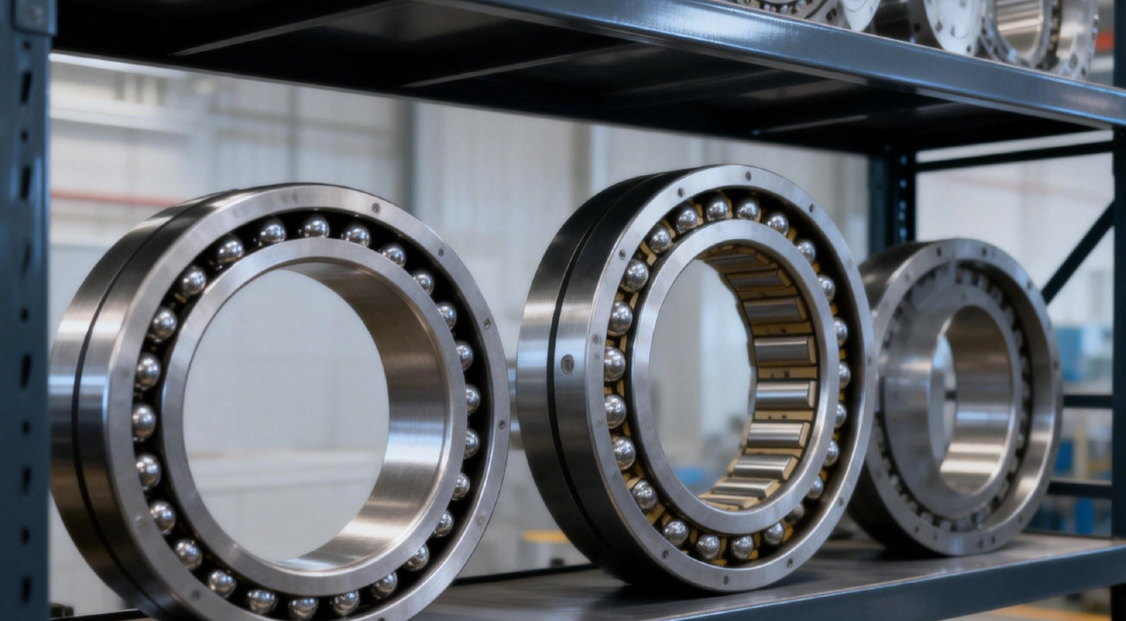
What Does a Slew Bearing Datasheet Actually Tell You?
A datasheet tells you what the bearing is and what it can carry under reference conditions. It does not tell you how it will behave inside your structure. That gap is where most specification errors start.
Typical datasheet content covers the raceway type, outer and inner diameters, bolt hole layout, gear module and tooth count, and static and dynamic load ratings. For a slewing bearing, the load curve is usually drawn for a rigid, flat mounting surface. For a slew drive, you may also see output torque, holding torque, and ratio.
Those figures are valid. But they are valid for the test setup, not for your crane, tracker, or turntable.
Which Catalog Numbers Can You Trust Directly?
You can trust geometry and interface data almost as printed. You should treat load and life figures as screening values. The table shows how we separate the two.
| Datasheet item | Safe to use directly? | Limit to remember |
|---|---|---|
| Diameters, bolt circle, hole count | Yes | Check against your actual machined surface, not the drawing alone |
| Gear module, tooth count, ratio | Yes | Confirm pinion match and backlash target |
| Static load rating or load curve | Screening only | Assumes rigid supports and defined bolt preload |
| Output torque, holding torque | Screening only | Depends on duty cycle and shock level |
| Ingress protection and corrosion rating | Partly | Rated for a defined test, not for every washdown or dust type |
| Operating temperature range | Partly | Grease and seal choices change the real limit |
The conclusion is simple. Use the first two rows to shortlist. Use the rest only to rule options out, never to rule them in.
Where Catalog Data Cannot Validate the Design Alone
Four conditions break the link between published data and real performance: nonstandard duty cycles, mounting distortion, contamination, and custom interfaces. If any one applies, the datasheet alone cannot validate your design. You need engineering evidence on top of it.
| Boundary condition | What the catalog assumes | What can go wrong | Evidence to ask for |
|---|---|---|---|
| Nonstandard duty cycle | Moderate, steady rotation with normal start-stop | Frequent reversals, shock, or long hold under load shorten raceway and gear life | Load spectrum review, life calculation, shock factor assumptions |
| Mounting distortion | Rigid, flat, stiff support structure | A flexible frame tilts the raceway, concentrates load, and raises wear | Flatness and stiffness requirements, bolt preload guidance, deflection check |
| Contamination | Clean or lightly dusty air | Sand, mud, salt spray, or washdown water attack seals and grease | Seal and grease selection, protection rating basis, corrosion coating options |
| Custom interfaces | Standard bolt pattern, standard pinion | Modified flanges, motor mounts, or gear data change stiffness and load path | Drawing review, interface tolerance check, prototype or sample test |
Here is the reasoning. A published rating is a single point on a curve built under clean, rigid conditions. Your machine moves that point. A 100-unit slewing platform order, such as the SEA21-125-25HR(2) units a Houston, Texas engineering machinery manufacturer sourced from us, is the kind of application where the supporting structure and load pattern deserve a real review, not a catalog lookup.
This does not apply to every project. A light, slow, well-supported rotation with a standard interface may be fine on catalog data. The more of the four conditions you have, the less you should rely on the page.
Request Your Custom Slew Drive or Bearing Spec
Tell us your load, speed, and environment — receive a tailored 100–5000 mm slewing drive or slewing bearing proposal with 3D drawings within 24 hours.
What Documents Should You Request Before Final Specification?
Ask for documents that show how the supplier verified the product, not only what it claims. The list below is what we would want if we were buying.
- Dimensioned drawing with tolerances, hardness zones, and gear data.
- Load calculation for your actual load case, not only the catalog curve.
- Bolt and mounting guidance covering preload, surface flatness, and support stiffness.
- Material and heat treatment statement for the ring and gear. Our materials include ductile cast iron, alloy steel, stainless steel, and forged alloy steel, chosen per load, speed, and environment.
- Inspection records. At our plant, every slew bearing passes CMM three-coordinate inspection and dynamic load testing.
- Sealing and corrosion data tied to your site, such as IP66 protection or C4H anti-corrosion on slew drives where the environment calls for it.
- Quality system proof. Our facility is ISO 9001:2015 certified, and factory audit reports are available on request.
If a supplier cannot produce items 2 and 3, the datasheet is carrying more weight than it should.
How Does the Review Change for Slew Drives Versus Bearings?
A slew drive adds a gearbox, so the review adds torque, backlash, and self-locking behavior. A bearing alone needs load path and mounting checks. The questions differ, and so does the evidence.
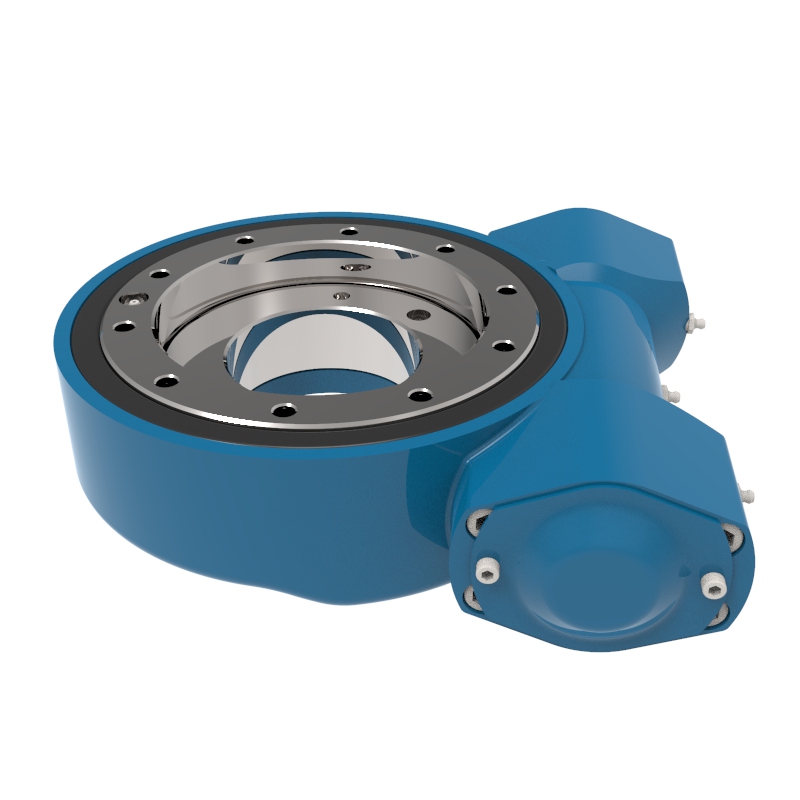
For a worm gear slew drive, ask about holding torque and self-locking under your load. A South Korean port equipment manufacturer reordered 20 units of WEA9-62-25HR single worm drives for port cranes, where tracking precision of 0.15° or better, IP65 sealing, and self-locking were the stated needs. Those are three separate requirements, and none comes from a headline capacity figure.
For heavier shock or higher output, a double worm slew drive may fit better. A British Columbia forestry equipment manufacturer uses 30 units of WED14-86-25BHR.5 on grapple machines at 0.13° precision or better. An Australian heavy equipment manufacturer uses HWE21-94-25HR.1 double worm drives on mining excavators.
Solar trackers raise a different question: environment. US and South American projects use SP-I spur gear drives such as the SP-I 0841 and SP-I 0229. For a US utility-scale tracker order of 50 units, IP65 protection mattered for desert sites. You can see the family on our SP-I slew drive page.
These examples show what each customer specified. They are not guarantees for your project, since your loads and site will differ.
What Mistakes Do Engineers Make When Reading Catalog Data?
- Comparing peak ratings across brands. Test methods differ, so equal numbers may not mean equal capacity.
- Ignoring the frame. A strong bearing on a flexible base still fails early.
- Reading the protection rating as a site guarantee. An IP rating covers a lab test, not years of sand and salt.
- Skipping the duty cycle. Holding a load for hours is a different job from rotating it.
- Changing the interface late. A modified flange or motor mount after approval resets the review.
- Assuming a bigger bearing is safer. Oversizing can add weight, cost, and stiffness mismatch with the structure.
What Should You Send for a Technical Review?
Send the load case, the environment, and the interface drawing. With those three, an engineer can say whether the catalog option works or whether the design needs changes. Without them, any answer is a guess.
- Axial, radial, and tilting moment loads, including peak and holding conditions
- Rotation speed, duty cycle, and number of reversals
- Site conditions: temperature, dust, moisture, salt, washdown
- Mounting structure drawing and any known deflection
- Required precision, self-locking need, and motor interface
- Quantity and target delivery
Here is what we commit to, kept separate from general advice. We issue a technical proposal within 24 hours and answer technical questions within 48 hours. Standard products start at an MOQ of 1 set, and customized products at 5 sets, so a sample order for testing is possible. Rapid prototyping takes 3 days and standard production runs 9 days, though your own timeline depends on the design. Confirmed manufacturing defects are replaced free, and we back our products with a 2-year extended quality warranty.
If the standard range does not fit your interface, a customized slew drive is the route. Our process behind the numbers is described under slew drive quality control. Luoyang Slewring Bearing Co., Ltd. has worked on slew bearing and slew drive development for more than 15 years, so we can tell you quickly whether the page in front of you answers your question, or whether you need the next layer of evidence.
Request Your Custom Slew Drive or Bearing Spec
Tell us your load, speed, and environment — receive a tailored 100–5000 mm slewing drive or slewing bearing proposal with 3D drawings within 24 hours.
 WhatsApp

 +8613903880726