



What is a slew ring bearing for demolition shear? It is a large-diameter rotation bearing that lets the shear body turn on the excavator stick. Every jaw impact, crushing reaction and side load passes through its raceways. When the raceway wears early, the question is whether the bearing was weak or the load path was bad.
In our experience reviewing returned rings, the second answer is more common than people expect. A bearing can be sound and still fail if the mounting plate is distorted or the bolts clamp unevenly. This guide gives a diagnosis order you can follow in the shop, with observable criteria at each step.

Separate the Symptom From the Suspected Cause
Start by writing down what you actually see. Typical symptoms are rough or notchy rotation, growing tilt play at the shear, metal fines in the grease, and visible pitting on the raceway. These are observations. They are not causes.
Early damage on a working demolition attachment usually has several possible causes. Shock loads above the design rating, poor lubrication, seal failure, a distorted mounting surface and loose bolts can all leave similar marks. The goal of the investigation is to tell them apart before anyone approves a replacement or a design change.
Stop conditions. Take the shear out of service if you find a cracked ring, a cracked mounting plate, a broken or missing bolt, or rotation that binds. Running on a damaged raceway can turn a bearing replacement into a structural repair.
Preliminary Checks Before Touching the Bearing
These checks need no disassembly. They fit a service manager or OEM quality engineer with basic shop access.
- Collect the records. Pull the bolt grade, torque values, tightening sequence and last re-torque date. Note hours in service and the material demolished (concrete, rebar, structural steel).
- List recent changes. Look for a new shear model, a welded repair on the adapter plate, a changed stick, or a bolt supplier change. Any of these can alter the load path.
- Inspect the joint from outside. Look for rust-colored powder or shiny rub marks at the ring-to-plate interface. These suggest fretting, which means the joint is moving under load.
- Check the bolts. Mark each bolt and re-check torque on a few. Wide variation from bolt to bolt points to uneven clamping. Do not simply tighten them and move on; record what you found first.
- Sample the grease. A little dark paste is normal. Visible metal flakes or glitter point to raceway surface fatigue.
If the records are missing, that is a finding in itself. You cannot confirm that the original clamping was correct.
How Mounting-Surface Flatness and Bolt Preload Prevent Raceway Edge Loading
A slewing ring is thin compared with its diameter. It takes the shape of whatever it is bolted to. If the plate is not flat, tightening the bolts pulls the ring into that shape, and the rolling elements no longer run in the center of the raceway.
Repeated jaw impacts make this worse. Each shock briefly lifts or compresses part of the joint. Where the clamp force is low, the joint opens slightly, and the load shifts to the raceway edge. Where the clamp force is high, the contact stays stable. That is why even preload and a flat seat matter more on a shear than on a slow-moving platform.
Use the table below as a diagnosis order. Work from top to bottom and stop at the first step that gives a clear finding.
| Step | What to check | What you observe | What it may indicate | Next action |
|---|---|---|---|---|
| 1 | Bolt torque and stretch consistency, sampled around the ring | Some bolts clearly looser than others, or loose bolts clustered in one zone | Uneven preload, loss of clamp in the impact zone | Record values, replace suspect bolts, review tightening sequence. Re-check after a short work period. |
| 2 | Fretting marks at the joint | Rust-colored powder or polished patches at the interface | Joint moving under impact; clamp not holding | Inspect seat surfaces for damage before reassembly. |
| 3 | Mounting plate flatness with a straightedge and feeler gauge | Visible gap, rocking, or a wavy surface, especially near weld seams | Distorted plate pulling the ring out of shape | Compare to the drawing tolerance. If no tolerance exists, request one. Re-machine or replace the plate if out of tolerance. |
| 4 | Raceway wear pattern after removal | Wear band pushed to one edge, or dents repeating at bolt spacing | Edge loading from distortion; local stress at bolt zones | Match the pattern to plate flatness and bolt records. |
| 5 | Soft-spot position on the ring | Marked soft zone sitting in the main load area | Installation orientation issue, not clamping | Re-orient per the bearing drawing before concluding anything else. |
| 6 | Everything above checks out | Flat plate, even preload, correct orientation, but raceway still damaged | Overload, lubrication failure or an undersized bearing | Escalate for load review and bearing selection. |
When this does not apply. Flatness and preload explain edge loading. They do not explain damage from sealed-in contamination or from shock loads well above the rated capacity. If the wear band is centered and even, look elsewhere.
Request Your Custom Slew Drive or Bearing Spec
Tell us your load, speed, and environment — receive a tailored 100–5000 mm slewing drive or slewing bearing proposal with 3D drawings within 24 hours.
Reading the Raceway: Diagnostic Branches
Once the bearing is off the machine, the raceway tells you more than the bolts do. Compare what you see with the branches below. Treat each as a likely explanation, not a proven one, until the plate and bolt data agree.
| Observation | Likely cause | Evidence that supports it | Evidence that argues against it |
|---|---|---|---|
| Wear band shifted to one raceway edge | Edge loading from plate distortion or tilt | Plate gap under straightedge; uneven bolt torque on the same side | Flat plate and even preload |
| Dents repeating at bolt spacing | Local stress from bolt zones or a stiff-soft pattern in the support structure | Marks line up with bolt holes or weld ribs | Random, scattered pitting |
| Wear concentrated in one arc of the ring | Dominant load direction, or soft spot in the load zone | Arc matches the jaw impact side; soft-spot mark in that area | Even wear around the full circle |
| Uniform dull wear with dark grease | Lubrication or seal problem | Dry or contaminated grease, damaged seal | Fresh grease and intact seals |
| Deep spalling plus broken bolts | Severe overload or long-term loose joint | Bolt fractures at the thread run-out; history of impacts on rigid obstacles | Stable torque records and moderate duty |
Keep alternative explanations open. Two causes often work together, for example a slightly warped plate plus a missed re-torque. If the evidence does not settle the cause, say so in your report.
Corrective Action and How to Check the Result
Match each action to a cause, then define how you will verify it. A repair without a result check is a guess.
- Distorted plate: Re-machine the seat or replace the plate. Verify flatness against the drawing before the new ring goes on. After 50 to 100 working hours, as a practical first interval, inspect for fretting and re-check torque.
- Uneven preload: Replace stretched or damaged bolts, clean the threads, and tighten in a cross pattern over several passes to the specified torque. Verify by marking bolts and re-checking after the first work shift.
- Wrong orientation: Re-install so the soft spot sits outside the main load zone, as shown on the drawing.
- Overload or undersized bearing: Review the real load case. A heavy load slewing bearing or a different raceway type may be the right choice, but only after the mounting structure is confirmed sound.
For rings that carry large tilting moments, a three-row roller slewing bearing offers more raceway capacity than a single-row ball design. It does not fix a bad mounting surface. A stronger bearing on a warped plate can still edge-load.
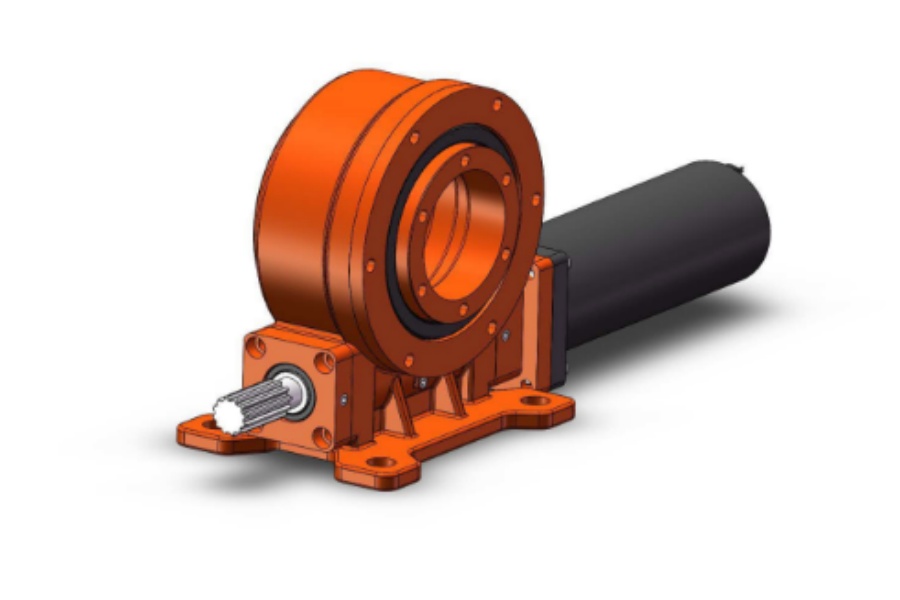
For an example of heavy-duty duty cycles, one of our Australian customers uses HWE21-94-25HR.1 double worm slew drives on mining excavators. That is not a demolition application, and we do not claim the same results here. It does show that rotation units in rough service depend on the same basics: a rigid seat and controlled bolt clamping.
Common Mistakes That Repeat the Damage
- Replacing the bearing without checking the plate. The new ring inherits the same distortion and fails the same way.
- Re-using stretched bolts. They cannot hold the same clamp force, especially under repeated impact.
- Tightening in a circle instead of a cross pattern. This pulls the ring unevenly and builds in a clamp imbalance.
- Welding near the seat after installation. Heat distorts the plate and alters the contact.
- Skipping the first re-torque. Bolts settle in the first working hours; the early check catches this.
- Blaming the manufacturer, or the operator, by default. Neither assumption is supported until the records and measurements agree.
Prevention Checklist and When to Escalate
Use this list at installation and at each scheduled service on the rotation unit.
- Confirm the mounting plate flatness against the drawing tolerance, and record it.
- Use new or verified bolts of the specified grade, and apply the specified torque in several cross-pattern passes.
- Check the soft-spot orientation before final tightening.
- Re-torque after the first work shift and at set intervals. Log each reading.
- Grease per the schedule and inspect seals for cracks.
- Photograph the wear pattern whenever the ring is removed.
Escalate when you find a cracked ring or plate, repeated bolt failure after correct installation, or damage that continues with a flat plate and even preload. At that point you need a load review, not another retighten.
When you contact us, send the following: shear model and weight, stick or adapter drawing, bearing drawing or part number, bolt grade and torque records, hours in service, grease sample photos, and photos of the raceway wear pattern. With these, our engineers can respond within 48 hours. Our Luoyang Slewring Bearing team works under an ISO 9001:2015 quality system. Each slewing bearing goes through CMM three-coordinate inspection and dynamic load testing, as described on our slew drive quality control page.
Confirmed manufacturing defects are covered by a 2-year extended quality warranty and free replacement. Cases caused by mounting or load conditions are handled by a joint review of the records. If your application needs a different ring size, raceway type or mounting interface, a customized slew drive or a custom slewing bearing can be quoted. The minimum order is 5 sets for custom products, and we can provide a technical proposal within 24 hours. If you are looking for a supplier for a slew ring bearing for demolition shear applications, contact us for the latest product quote.
Request Your Custom Slew Drive or Bearing Spec
Tell us your load, speed, and environment — receive a tailored 100–5000 mm slewing drive or slewing bearing proposal with 3D drawings within 24 hours.
 WhatsApp

 +8613903880726