



What is a slewing ring? It is a rotary bearing that supports axial, radial, and overturning loads while allowing controlled rotation between two structures. In a radar gimbal, it can support the rotating antenna or sensor assembly, but its suitability depends on the full mechanical and control design.
Before placing an RFQ or purchase order, buyers should ask one question: can the supplier prove the quoted product meets the application requirement? A catalog drawing, a low price, and a general statement about precision are not enough. A slewing ring for radar gimbal systems should be assessed through inspection records, test evidence, traceable materials, and agreed acceptance criteria.
Luoyang Slewring Bearing Co., Ltd. supplies Slewing Bearing, Slew Drive, and Customized Slew Drive products for industrial rotation and transmission applications. For overseas procurement teams, the practical task is not simply selecting a supplier. It is confirming whether the supplier can provide records that match the bearing structure, gear arrangement, environment, and motion requirement of the planned gimbal.
Start with the operating requirement, not the catalog model
A supplier can only quote the right bearing when the buyer defines the actual duty condition. Radar gimbals may rotate slowly, index repeatedly, track continuously, or hold position against wind and cable resistance. These conditions produce different demands on bearing clearance, friction behavior, gear engagement, mounting stiffness, and corrosion protection.
The first conclusion is simple: do not approve a ring only because its outside diameter or bolt pattern fits the preliminary drawing. Dimensional fit is necessary, but it does not confirm whether the bearing will maintain acceptable motion after installation. This matters most when the antenna, camera, or sensor payload needs repeatable pointing performance.
Information to include in the first technical inquiry
- Load data: Provide axial load, radial load, overturning moment, and any shock or wind-induced loading. If the load changes by position, provide the worst-case condition and the normal operating condition.
- Motion profile: State rotation angle, speed range, start-stop frequency, direction changes, and expected operating cycle. A bearing used for occasional indexing should not be evaluated by the same criteria as one used for continuous tracking.
- Accuracy target: Define whether the system requirement concerns bearing runout, rotational resistance, gear backlash, pointing error, or a combined system result. These are related but not interchangeable measurements.
- Mounting structure: Share the upper and lower mounting drawings, available bolt locations, flange thickness, and flatness requirements. A well-made bearing can still perform poorly on a flexible or uneven support structure.
- Environment: Identify indoor, coastal, desert, marine, cold-weather, or high-humidity exposure. Also state whether the assembly receives a final enclosure or depends on the bearing’s own protection features.
- Drive arrangement: Clarify whether the ring uses an external pinion, internal gear, direct drive motor, or an enclosed drive unit. Gear inspection evidence is relevant only when a geared interface is part of the supplied item.
This information lets the supplier determine whether a standard bearing is a reasonable starting point or whether a custom design is needed. Luoyang Slewring Bearing Co., Ltd. offers customized products with a stated MOQ of five sets, while standard products can be ordered from one set. That makes a small qualification order possible when the design is already sufficiently defined, but it does not remove the need to agree on acceptance criteria first.
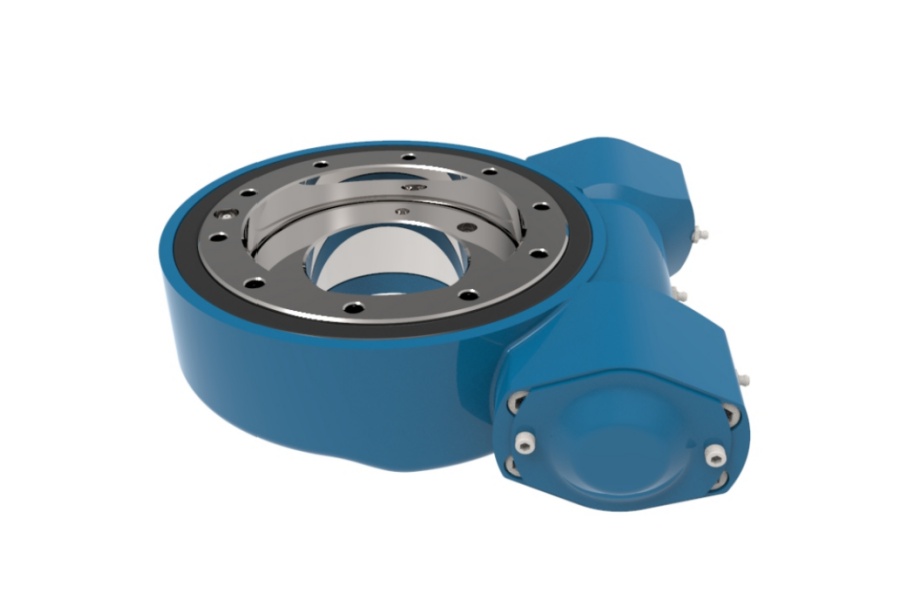
For a gimbal with a bearing-only architecture, a Slewing Bearing may be evaluated with the buyer’s selected motor, encoder, and pinion system. For applications that need an enclosed worm transmission, a Slew Drive is a different product decision because the drive housing, worm gear, and output behavior become part of the mechanical system. Neither format is automatically better; the correct choice follows the control layout and load case.
Match each supplier claim to a record you can review
Terms such as “high precision,” “heavy duty,” and “corrosion resistant” have little purchasing value without records. Buyers should convert every important claim into a document request before comparing quotations. If a supplier cannot provide the relevant record, treat the claim as unverified rather than assuming it is false or true.
| Supplier claim | Evidence to request | What the buyer should check | When the evidence is most relevant |
|---|---|---|---|
| Accurate rotation | Runout map or inspection report | Measurement locations, reference surface, instrument identification, and the result against the agreed limit | Pointing, scanning, antenna alignment, and sensor positioning systems |
| Controlled rotational resistance | Torque record | Test condition, lubrication state, direction of rotation, recorded values, and acceptance range | Low-speed tracking or systems with limited motor torque margin |
| Reliable gear engagement | Gear inspection report | Gear type, inspection method, measured values, and the drawing requirement used for acceptance | Internal-gear or external-gear rings driven by a pinion |
| Outdoor corrosion resistance | Coating report | Coating system, coverage area, specified corrosion class, and any excluded machined surfaces | Coastal, marine, humid, and exposed installations |
| Specified material construction | Traceable material certificate | Material designation, heat or batch identification, part traceability, and match to the approved drawing | All custom bearings and safety-sensitive assemblies |
| Load capability | Load calculation and applicable test evidence | Whether the record applies to the quoted configuration rather than a visually similar catalog product | High moment loads, cyclic loading, and wind-exposed gimbals |
Do not confuse a material certificate with a completed-bearing inspection report. The material certificate supports traceability of the starting material, while the final inspection record supports the condition of the completed part. Both may be needed, especially if the purchase order includes custom geometry, a geared ring, or special coating requirements.
Likewise, dynamic load testing and runout inspection answer different questions. Dynamic load testing relates to behavior under a defined test load. A runout map shows geometric measurement results at identified points. A supplier should not substitute one document for the other when the application requires both types of confirmation.
Luoyang Slewring Bearing Co., Ltd. states that every slewing bearing passes CMM three-coordinate inspection and dynamic load testing. The company also operates an ISO 9001:2015-certified quality management system. Those are meaningful starting points, but the buyer should still ask which part-specific records can be supplied with the quoted radar-gimbal configuration and how the acceptance limits will be written into the order.
Use a factory evidence checklist before approving a supplier
The following checklist identifies the distinct factory evidence buyers should request, including runout maps, torque records, gear inspection, coating reports, and traceable material certificates. Send it with the RFQ, not after the supplier has already produced the order. Early alignment prevents disputes over what “passed inspection” means.
| Evidence item | Request from the supplier | Buyer decision use | Limit of the record |
|---|---|---|---|
| Approved drawing | Revision-controlled drawing showing dimensions, mounting holes, gear details, material, and inspection references | Confirms both parties are quoting the same configuration | Does not prove the finished ring was made to the drawing |
| Runout map | Measured values at defined angular positions, plus datum and measurement method | Supports evaluation of rotational geometry and mounting-face condition | Does not prove system pointing accuracy after assembly |
| Torque record | Starting and running torque data, test condition, lubrication condition, and acceptance range | Helps size the motor and identify abnormal rotation resistance | Must be interpreted with the actual mounting and preload condition |
| Gear inspection | Inspection report tied to the gear drawing requirement | Helps assess pinion-to-ring compatibility and motion transmission quality | Not applicable to non-geared bearing arrangements |
| Coating report | Coating description, protected surfaces, batch identification, and agreed corrosion requirement | Confirms the protection scope for outdoor or marine service | Does not cover damage caused after installation or unprotected interfaces |
| Material certificate | Traceable certificate linked to the ring or component batch | Supports material verification and purchase-order traceability | Does not replace final dimensional or functional inspection |
| Final inspection release | Part number, serial or batch identification, inspector approval, and inspection date | Creates a shipment-level quality record | Only has value if it references defined acceptance requirements |
A good practice is to place each required record in a purchase-order quality clause. List the document name, required language, link to the drawing revision, and whether the buyer must approve it before shipment. This approach fits projects where the gimbal is part of a defense-adjacent, communications, weather-monitoring, or industrial sensing system with controlled documentation needs.
It may not be necessary for a low-risk prototype that is only checking mechanical fit. In that case, request the drawing, basic inspection confirmation, and material traceability first, then add more documentation once the system design is frozen. The limit is clear: reduced paperwork lowers early cost and time, but it also reduces the evidence available to support later supplier comparison.
Request Your Custom Slew Drive or Bearing Spec
Tell us your load, speed, and environment — receive a tailored 100–5000 mm slewing drive or slewing bearing proposal with 3D drawings within 24 hours.
Check whether the inspection method matches the gimbal risk
Not every measured feature has the same effect on field performance. Procurement teams should ask engineering to rank the features that can cause pointing error, unstable motion, high motor current, or early wear. Then request evidence for those features rather than collecting generic quality documents that do not influence the design decision.
Common verification mistakes to avoid
- Accepting a general brochure as a test report: A brochure may describe a product range, but it does not identify the part number, drawing revision, or inspected production batch.
- Using a catalog load figure without the actual mounting case: Gimbal loads include moment effects from offset payloads and wind. The bearing selection should be reviewed against the buyer’s stated load condition, not only a catalog maximum.
- Requesting “precision” without defining the measurement: Specify whether the concern is face runout, radial runout, rotational torque, gear quality, backlash, or completed-system pointing behavior.
- Ignoring the mounting structure: Flange stiffness, bolt tightening, surface flatness, and bracket alignment can change installed bearing behavior. The component report cannot certify the complete assembly.
- Assuming a corrosion claim covers every surface: Ask which surfaces receive coating and which machined areas, gear teeth, or interfaces require protection during assembly.
- Comparing quotes with unequal documentation: One quote may include testing and traceability while another only includes the bearing. Normalize documentation scope before deciding which price is lower.
Where a geared ring is required, the supplier should know the pinion data and intended center distance or mounting arrangement. A gear inspection report is useful, but it cannot compensate for an incorrectly matched pinion or an installation that permits the motor bracket to flex. The same limit applies to torque records: they support component selection, not complete servo tuning.
Luoyang Slewring Bearing Co., Ltd. has six production lines, CNC machining centers, and CMM three-coordinate inspection capability within an 8,000 m² manufacturing facility. For buyers, the relevant next question is not simply whether those resources exist. Ask which inspection outputs will be tied to your quoted part number and supplied with the shipment.

Compare supplier quotations on total verification scope
The lowest unit price can become the highest project cost if the bearing arrives without the records needed for approval, integration, or customer audit. Compare quotations line by line. Separate the mechanical product price from engineering documents, inspections, packing, coating scope, and any custom tooling or design work.
| Quotation item | What to compare | Why it affects the purchase decision |
|---|---|---|
| Product configuration | Drawing revision, gear arrangement, material, mounting pattern, and lubrication provision | Prevents a low quote for a different or simplified ring |
| Inspection package | Included CMM report, runout map, torque record, gear inspection, and material certificate | Shows whether the supplier has priced verification or only the physical part |
| Coating scope | Coated surfaces, corrosion requirement, masking requirements, and touch-up responsibility | Prevents later disagreement over exposed interfaces |
| Prototype and production terms | MOQ, drawing approval point, sample status, and production timing | Helps match the purchase plan to the project stage |
| Warranty and defect process | Warranty period, technical response arrangement, and confirmed-defect replacement terms | Defines support boundaries before a field issue occurs |
Luoyang Slewring Bearing Co., Ltd. states a three-day rapid prototyping capability and a nine-day standard production cycle. These figures should be treated as supplier capabilities, not as an automatic delivery commitment for every radar-gimbal order. Custom engineering scope, drawing approval, requested reports, material availability, and shipping arrangements must still be confirmed in the quotation.
The company also offers a two-year extended quality warranty, a stated 48-hour technical response, and free replacement for confirmed manufacturing defects. Buyers should clarify how a defect is confirmed, what evidence is required, and whether the warranty applies to the supplied component only or to an assembled gimbal system. A bearing supplier cannot reasonably accept responsibility for errors caused by mounting design, drive tuning, or field damage outside the part’s manufacturing condition.
For applications with higher load or larger support structures, a Heavy load slewing bearing may be relevant for comparison. For compact assemblies with lower structural loads, a Light Load Slewing Bearing may better match the package size and procurement target. The final selection still requires the actual load, mounting, environmental, and accuracy data.
Set a clear approval sequence for prototypes and production orders
A documented approval sequence reduces uncertainty for both the procurement team and the supplier. The purpose is to identify design gaps before material is committed and before an inspection disagreement becomes expensive. This is especially useful when a customized ring must fit an existing antenna bracket, sensor platform, or gearbox interface.
- Issue a controlled RFQ package. Include load cases, motion profile, environment, mounting drawings, gear or drive details, and the required evidence list.
- Review the supplier’s technical proposal. Luoyang Slewring Bearing Co., Ltd. states that technical proposals are available within 24 hours. Confirm that the proposal addresses your actual configuration rather than a nearby catalog size.
- Freeze the approved drawing and acceptance criteria. State which measurements matter, the applicable limits, and the required reports for the part.
- Agree on prototype status. Define whether the prototype is for fit checking, functional testing, environmental exposure, or final design validation. Do not treat a fit-check sample as proof of full production acceptance.
- Review final records before shipment. Verify that the reports identify the ordered part and match the approved drawing revision.
- Inspect after installation. Record mounting conditions, bolt tightening procedure, alignment observations, and system-level movement results. This separates supplier-related issues from installation-related issues.
For a slewing ring for radar gimbal use, the strongest supplier is not necessarily the one with the longest catalog. It is the supplier willing and able to connect the quoted design to identifiable inspection evidence. Luoyang Slewring Bearing Co., Ltd. supports standard and customized rotation products, with sample orders available for testing and evaluation, but the buyer should define the test purpose and record package before placing that sample order.
A practical RFQ should ask for the proposed bearing type, load assessment basis, drawing revision, available inspection records, coating scope, material traceability, MOQ, production timing, and warranty terms. That request gives procurement teams a fair basis for comparing overseas suppliers and helps engineering avoid approving a component based on unsupported catalog language.
Request Your Custom Slew Drive or Bearing Spec
Tell us your load, speed, and environment — receive a tailored 100–5000 mm slewing drive or slewing bearing proposal with 3D drawings within 24 hours.
 WhatsApp

 +8613903880726