



What is a slew bearing? It is a large rolling bearing that supports axial load, radial load, and overturning moment while allowing one structure to rotate against another. In wind equipment, this bearing may be used in blade pitch systems, nacelle yaw systems, service platforms, or related rotating assemblies.
The key question is not simply whether a slew bearing for wind turbine has a hardened raceway. The real question is whether its raceway treatment, material, rolling-element arrangement, and mounting conditions match the actual load cycle. A bearing can appear suitable by diameter and static capacity, yet face early raceway damage when it repeatedly oscillates through a narrow angle under high load.
For design engineers and technical buyers, raceway hardening should be reviewed as a durability requirement when the bearing will see repeated pitch motion, uneven load distribution, vibration, contamination risk, or difficult access for service. Luoyang Slewring Bearing Co., Ltd. supports bearing selection from drawing review through production, with material choices that include ductile cast iron, alloy steel, stainless steel, and forged alloy steel according to working conditions.
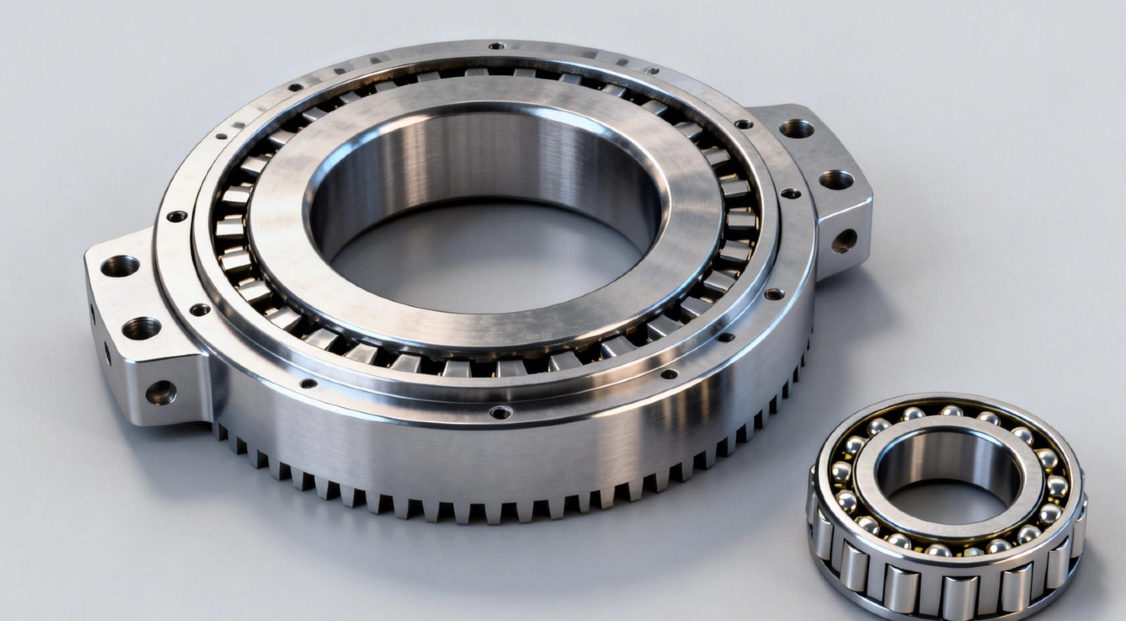
What does raceway hardening do in a wind turbine bearing?
Raceway hardening increases the surface resistance of the rolling paths where balls or rollers transfer load into the bearing rings. The purpose is to reduce surface deformation, wear, and fatigue damage in the loaded contact zones. It is most relevant when contact loads repeat many times at the same or nearly the same positions.
A wind turbine bearing does not always make full continuous rotations. Blade pitch bearings often move back and forth through limited angles to adjust blade position. This can repeatedly load a small sector of the raceway, unlike an application where rolling elements travel around the full circumference and spread contact exposure more evenly.
Hardening alone is not a complete answer. The ring material, raceway geometry, rolling-element type, preload or clearance strategy, lubrication plan, sealing, bolt pattern, and support structure stiffness also affect service life. Specify the heat-treatment approach only after these factors are reviewed together.
| Operating factor | Why it affects the raceway | What to review during specification |
|---|---|---|
| Repeated pitch oscillation | Rolling elements revisit the same raceway sector and concentrate fatigue exposure. | Motion angle, frequency, dwell periods, load direction, and expected duty cycle. |
| High overturning moment | Load may shift toward a limited portion of the bearing ring. | Ring support stiffness, bolt layout, mounting-face flatness, and load distribution. |
| Localized contact stress | High contact pressure can damage a small raceway zone before the rest of the ring is heavily used. | Rolling-element arrangement, raceway profile, ring material, and hardening depth requirement. |
| Slow movement with vibration | Small movements can disrupt lubricant film formation and promote fretting or false brinelling. | Lubricant selection, relubrication access, seals, vibration exposure, and storage conditions. |
| Corrosive outdoor exposure | Moisture and contamination can damage the raceway and lubricant. | Seal design, corrosion protection, drainage, inspection intervals, and enclosure design. |
For a yaw system that performs broad, regular rotation under well-distributed loading, standard raceway treatment may be adequate if the bearing supplier verifies the full operating spectrum. For a pitch system with high-cycle oscillation and concentrated loading, a more detailed raceway review is normally justified. The difference is the contact pattern, not merely the equipment label.
When is standard raceway hardening insufficient?
Standard raceway hardening can be insufficient when the application produces high-cycle pitch motion and localized contact stress in the same raceway sectors. In that condition, the bearing is not using its full circumference evenly. A standard solution selected mainly for static load or overall ring size may not address repeated rolling contact at a narrow set of positions.
This does not mean every wind bearing requires the same advanced hardening specification. It means the engineering team should compare the real motion and load history against the supplier’s supported design limits. If the operating data is incomplete, a conservative design review is safer than assuming that a general-purpose construction will perform well.
Which operating boundary should trigger a deeper review?
- High-cycle pitch motion: Treat repeated short-angle oscillation as a warning condition because the same rolling elements and raceway segments can see repeated contact. This is especially relevant when blade control actions occur frequently. It may not apply to a bearing that rotates broadly and distributes rolling contact around the ring.
- Localized contact stress: Review hardening when overturning moment, asymmetric structure loading, or support deflection shifts load to one area. A nominal load rating alone may not reveal this concentration.
- High loads during limited movement: A bearing that moves very little under substantial load may have greater raceway risk than a similar bearing with continuous rotation. Confirm the actual operating positions, not only the maximum rotational speed.
- Variable environmental exposure: Water ingress, abrasive dust, salt-laden air, and poor lubricant retention can worsen surface damage. Hardening does not replace effective sealing and corrosion control.
- Difficult maintenance access: If inspection or relubrication is limited, specify the bearing, seals, lubricant ports, and mounting arrangement with longer service intervals in mind. This is less significant where regular inspection is practical and documented.
A useful boundary question is simple: will the rolling elements repeatedly pass over the same loaded raceway zone while the bearing carries meaningful moment load? If the answer is yes, ask the supplier to assess raceway treatment and contact distribution specifically for that motion profile. Do not accept a generic statement that the raceway is “hardened” without understanding what duty it was designed to support.
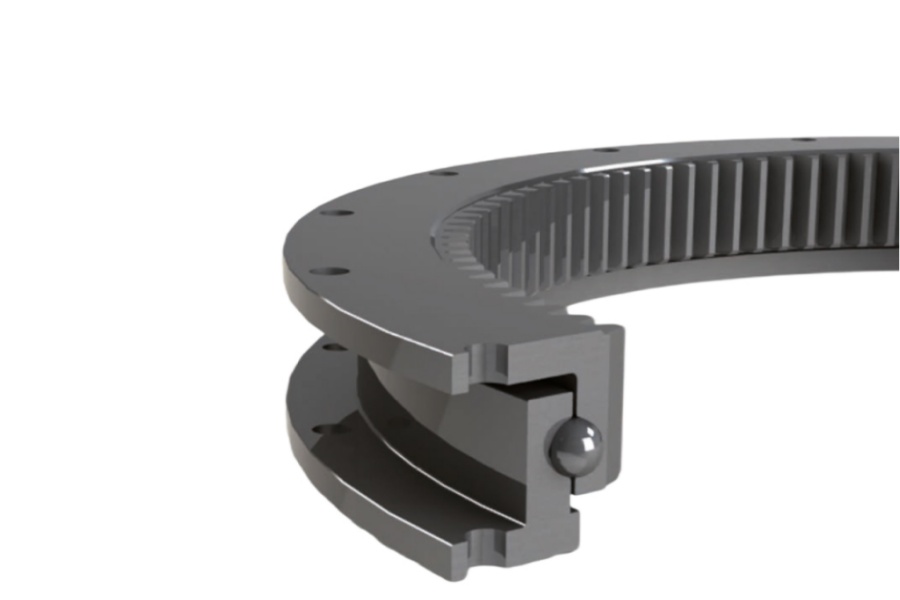
Gothic-arch raceways are sometimes considered for ball-bearing designs because their contact geometry can support combined loading. However, the raceway profile must be evaluated with the rolling element, internal clearance, load direction, and manufacturing control. It is not a universal replacement for proper sizing or a stiff mounting structure.
Which bearing construction should be compared for pitch and yaw duties?
Start by separating the functional duty. Blade pitch and nacelle yaw systems may both rotate, but their load spectrum, motion range, control behavior, and maintenance access can differ sharply. The bearing design should follow the duty rather than a familiar product category.
| Construction option | Best fit | Why it may help | Limit or check required |
|---|---|---|---|
| Single-row ball construction | Moderate combined loads where compact arrangement is needed. | It can provide axial, radial, and moment support in one bearing arrangement. | Check contact stress and raceway loading under limited-angle oscillation; compact size does not guarantee fatigue resistance. |
| Crossed-roller construction | Applications requiring controlled rotational accuracy and combined load support. | Rollers can provide line contact and support load from several directions. | Confirm suitability for the required load cycle, lubrication method, and structural support conditions. |
| Three-row roller construction | Heavy-duty assemblies with high combined loads and large moments. | Separate rolling paths can be arranged to carry different load components. | It is not automatically necessary for every turbine application; evaluate space, mass, mounting, and actual loading. |
| Customized bearing design | Nonstandard interfaces, unusual motion profiles, or site-specific environmental demands. | Ring geometry, gear form, sealing, and material selection can be aligned with the assembly. | Requires complete input data and technical review before production. |
For general construction comparison, review Single Row Slewing Ring Ball Bearings when space and combined loading are central concerns. For higher combined-load applications where design accuracy matters, a Crossed Roller Slewing Bearing may warrant evaluation. Heavy equipment layouts with major moment loads may also require a review of Three-row Roller Slewing Bearings.
The right conclusion is not “rollers are always better” or “balls are always enough.” Select the construction after comparing the actual axial load, radial load, overturning moment, motion range, operating frequency, mounting stiffness, and required positioning behavior. If one of these inputs is missing, the final bearing recommendation remains provisional.
Request Your Custom Slew Drive or Bearing Spec
Tell us your load, speed, and environment — receive a tailored 100–5000 mm slewing drive or slewing bearing proposal with 3D drawings within 24 hours.
How should engineers specify raceway hardening during design review?
Specify the operating condition first, then ask for the bearing solution. A purchase description that lists only outside diameter, bolt holes, and gear teeth does not give the supplier enough information to judge concentrated raceway loading. The following process creates a clearer technical request.
- Define the bearing function. State whether the bearing serves blade pitch, nacelle yaw, a service platform, or another rotating mechanism. Include whether motion is continuous, intermittent, or short-angle oscillation.
- Provide the applied load cases. Identify axial load, radial load, overturning moment, load direction changes, shock events, and parked conditions. Include the load combinations that occur during control actions, not only a single maximum value.
- Describe the duty cycle. State how often the bearing moves, the typical movement range, dwell periods, and whether repeated movements occur at the same positions. This information is central to assessing localized contact stress.
- Show the mounting arrangement. Supply ring support dimensions, bolt pattern, mounting-face details, and nearby structural stiffness information. Poor support can distort the ring and concentrate raceway load.
- Identify the environment. Include temperature exposure, humidity, salt, dust, vibration, and maintenance access. These conditions affect sealing, lubrication, corrosion protection, and material choice.
- Request documented verification. Ask the supplier to confirm the selected construction, raceway treatment approach, inspection scope, and limits of the recommendation. If the duty changes after approval, repeat the review.
A detailed drawing package is especially useful for customized designs. Luoyang Slewring Bearing Co., Ltd. offers technical proposals within 24 hours and has a 3-day rapid prototyping capability for applicable projects. Standard production is listed as a 9-day cycle, but final timing should still be confirmed against the drawing, material, inspection needs, and order quantity.
Our standard product MOQ is one set, while customized product MOQ is five sets. This can help engineering teams obtain samples for fit-up and evaluation before larger purchasing decisions. A sample confirms physical interface and assembly practice, but it does not replace a proper load and fatigue assessment.
What mistakes cause raceway problems even when hardening is specified?
The most common errors occur outside the heat-treatment specification. A correctly treated raceway can still suffer if loads are concentrated by poor mounting, contamination reaches the rolling path, or lubrication does not reach the working contact zones. Preventive design review should include the full bearing system.
- Selecting by static capacity only: This misses the effect of repeated oscillation and changing moment load. Use static capacity as one input, not the only acceptance condition.
- Ignoring support-structure stiffness: Flexible or uneven supports can distort the bearing rings. Review mounting-face flatness, bolt tightening practice, and structural deflection together.
- Using an undefined “hardened” requirement: This does not tell the supplier which duty must be supported. Describe the load, motion range, environmental exposure, and expected service conditions.
- Assuming sealing solves every contamination issue: Seals reduce exposure, but installation damage, pressure washing, poor drainage, and damaged housings can still admit contaminants. Plan inspection points and replacement practice.
- Skipping lubricant planning: Grease selection and relubrication access matter most where motion is slow or limited. Confirm ports are reachable after installation and that the service team can follow the maintenance plan.
- Changing the application after approval: A bearing selected for one motion pattern may not suit a later change in control logic, load, or mounting structure. Recheck the design when duty changes.
Quality evidence should also be part of the comparison. Luoyang Slewring Bearing Co., Ltd. operates an ISO 9001:2015-certified facility and uses CNC machining centers plus CMM three-coordinate inspection. The company states that every slewing bearing passes CMM inspection and dynamic load testing, and a 2-year extended quality warranty applies with free replacement for confirmed manufacturing defects.
For buyers reviewing supplier controls, the available Slew Drive Quality Control information can support a wider audit discussion. Ask how inspection records connect to the approved drawing, raceway requirements, material selection, and final bearing identification. A test record is useful only when it is tied to the part and conditions being accepted.
What should a technical buyer ask before approving the bearing?
Approve the design only when the supplier has enough information to address the real operating boundary. The checklist below separates a basic catalog selection from an application-specific review. It is suitable for RFQ preparation, drawing approval, and supplier meetings.
| Buyer question | Why the answer matters | Acceptable next action if unclear |
|---|---|---|
| Is the motion full rotation or repeated short-angle pitch movement? | This determines whether contact is distributed or concentrated in limited raceway sectors. | Provide the motion profile and request a revised bearing assessment. |
| Where does the highest overturning moment occur? | Moment load can create localized contact stress and ring deflection. | Share load cases and mounting drawings for engineering review. |
| What raceway treatment is proposed, and what duty is it intended to support? | A general hardening statement is not enough for high-cycle oscillation. | Request written clarification tied to the project duty cycle. |
| How will mounting distortion be controlled? | Uneven support can concentrate load regardless of bearing construction. | Review mounting-face requirements, bolts, and support stiffness. |
| How will lubrication and sealing be maintained in service? | Slow oscillation and outdoor exposure can create lubrication and contamination risks. | Confirm grease access, seal arrangement, and maintenance responsibility. |
| What inspection is included before shipment? | Dimensional and functional verification helps confirm conformance to the approved design. | Request inspection scope and records for the ordered part. |
For a custom assembly, include the interface drawing and the load spectrum with the RFQ. Luoyang Slewring Bearing Co., Ltd. has six production lines, an 8,000 m² manufacturing facility, and annual capacity of 100,000 sets. Those production resources are useful, but the engineering input remains the deciding factor when a wind application operates near the boundary where standard raceway hardening may no longer be sufficient.
The practical rule is clear: treat raceway hardening as a critical specification when repeated pitch motion, high load, and localized contact occur together. When the application rotates broadly, loads are well distributed, mounting is stiff, and service is controlled, a standard treatment may be suitable after verification. The bearing should be approved on the evidence of its duty cycle, not on the word “hardened” alone.
Request Your Custom Slew Drive or Bearing Spec
Tell us your load, speed, and environment — receive a tailored 100–5000 mm slewing drive or slewing bearing proposal with 3D drawings within 24 hours.
 WhatsApp

 +8613903880726