



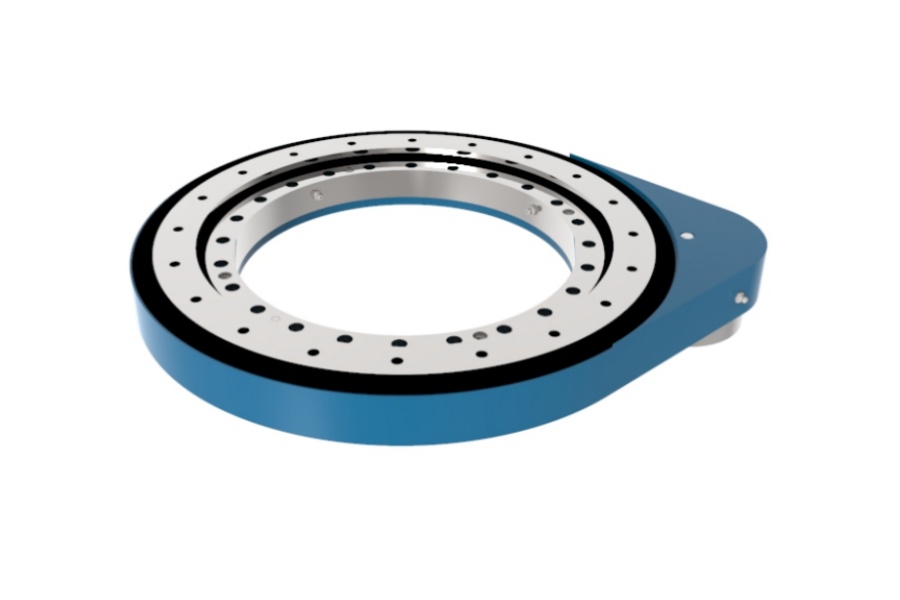
What is a slew drive? It is a compact rotation unit that combines a slewing bearing, a gear (usually a worm or spur set), a housing and a motor interface. It carries load and turns it in one package. Because it does two jobs, its datasheet lists several ratings, and each one answers a different question.
So which number should decide your slew drive selection? Often the one printed in bold is not the one that limits the machine. This article separates the ratings, shows where they get mixed up, and lists the evidence a technical buyer can request before approving a shortlist.
Why Two Datasheets Can Look Equal and Perform Differently
Most supplier pages list axial load, radial load, tilting moment, output torque and holding torque. They often put them side by side as if they were one scale. They are not.
Some ratings describe a part at standstill. Others describe life under rotation. Others describe what the gear set can transmit. A unit can be strong in one and marginal in another.
We should be clear about scope. The points below are general engineering practice, not a market survey. Search results for this topic mostly offer generic checklists (load, torque, shock, reduction ratio, application fit). That tells us what is commonly written, not what causes field failures. Treat it as a hint about where buyers look, nothing more.
Our own experience supports one narrow observation. The projects we have supplied for ports, marine cranes, solar trackers and turntables all came with a load description that mattered more than any single catalog number. The sections below build on that.
Comparison: Static Capacity, Dynamic Capacity, Gearbox Torque and Load Spectra
This is the core of the issue. Each rating belongs to a different failure mode. Use the table to match the rating to the requirement.
| Rating | What it describes | Which requirement it answers | Where it misleads |
|---|---|---|---|
| Static capacity (axial, radial, tilting moment) | Load the raceway and structure can carry at rest or very slow rotation without permanent deformation, usually with a safety factor applied | Peak or parked load, such as wind on a boom or a stowed crane | Says little about wear over millions of turns. Safety factors differ between suppliers. |
| Dynamic capacity | Basis for rated bearing life under rotation, tied to a reference number of revolutions | Service life when the unit turns often under load | The reference life and calculation method vary. Two "dynamic" numbers may not be comparable. |
| Gearbox torque (output, rated, peak) | Torque the worm or spur gear set can deliver at the output | Whether the drive can start, accelerate and slew the load | Says nothing about the bearing. Rated and peak values are often not labeled clearly. |
| Holding torque / self-locking | Resistance to back-driving when the motor is off | Load holding on slopes, in wind or during power loss | Depends on gear geometry, lubrication and vibration. Self-locking is not guaranteed under all conditions. |
| Application load spectrum | Real mix of loads, speeds, duty cycles and shocks over time | Choosing which rating governs | Rarely on the datasheet. The buyer must supply it. |
The practical rule: static capacity checks survival, dynamic capacity checks life, gearbox torque checks motion, and the load spectrum tells you which of the three controls. A light-duty tracker may be limited by wind (static). A port crane that slews all day may be limited by life (dynamic). A heavy-duty wheel steering unit may be limited by peak torque at the gear.
This does not apply cleanly if the supplier will not define its terms. In that case, treat the number as unverified until they do.
Request Your Custom Slew Drive or Bearing Spec
Tell us your load, speed, and environment — receive a tailored 100–5000 mm slewing drive or slewing bearing proposal with 3D drawings within 24 hours.
How Catalog Ratings Hide the Gap
Why do these gaps exist? There are documented causes and plausible ones. We keep them apart.
Documented in how datasheets are built
- Different safety factors. One supplier may publish raw capacity and another a derated figure. The larger number is not always the stronger part.
- Different test or calculation bases. Dynamic ratings depend on a reference life and method. Ask which one was used.
- Combined or single ratings. A table may show tilting moment with a given axial load, or alone. The conditions change the meaning.
Plausible, but not proven
- Some buyers may rely on the largest number because it is easy to compare. We cannot say how common this is.
- Application engineers may not share the full load spectrum with procurement. That would explain mismatches, but other causes (poor installation, lubrication, bolt preload) are just as possible.
A field failure is not always a rating problem. Mounting-surface flatness, bolt tension and sealing also decide life. So a datasheet review reduces risk. It does not remove it.
Worked Scenarios: Which Rating Governed the Choice
These cases show how the governing requirement differed by application. They are scoped illustrations from our shipped orders, not proof of an industry trend.
- South Korean port equipment manufacturer. A 20-unit repeat order of WEA9-62-25HR single worm units for port crane systems. The requirements were tracking precision of 0.15° or better, IP65 sealing and self-locking. Here, precision and holding behavior carried as much weight as raw load capacity.
- US renewable energy manufacturer. 50 units of SP-I Slew Drive for utility-scale solar trackers at desert sites. Sealing at IP65 mattered because of dust. Static load from wind and daily low-speed cycles shaped the review.
- British Columbia forestry equipment manufacturer. 30 units of WED14-86-25BHR.5 double worm drives for forestry grapple machines, with precision of 0.13° or better. Variable, shock-prone loading makes peak torque and the load description more important than average figures.
- Houston engineering machinery manufacturer. 100 units of SEA21-125-25HR(2) for slewing platform systems. A turntable carries moment loads continuously, so tilting moment and life both need checking.
Notice what repeats: each buyer started from the duty, not from the largest catalog value. That is the habit worth copying. For heavier gear loads, a Double Worm Slew Drive is one option. For common crane and marine duties, a Worm Gear Slew Drive is typical. Neither is automatically better. The load spectrum decides.
Step-by-Step: Turning a Load Spectrum into a Rating Check
- List load cases. Include working, parked, wind, transport and emergency conditions. Give axial force, radial force and tilting moment for each.
- Mark the peak case. Compare it to static capacity with the supplier's stated safety factor.
- Estimate turns and duty. Count revolutions or oscillations per day and the share of time at each load. Compare this to the dynamic rating and its stated reference life.
- Check the gear set. Compare starting, peak and shock torque with the output torque rating. Confirm whether the number is rated or peak.
- Check holding. If the load must stay put when power is off, ask how self-locking was verified and under what vibration.
- Confirm the environment. Match sealing and corrosion protection to the site. Our drives are offered with protection up to IP66 and corrosion rating up to C4H, so state which level you need.
Limit: this is a screening method. For high-consequence lifting or personnel applications, final sizing should be done by the equipment designer with the supplier's engineering data and applicable standards.
Evidence to Request Before You Approve a Supplier
A good slew drive selection ends with documents, not claims. Use this checklist and note which decision each item affects.
| Ask for | Decision it affects |
|---|---|
| Definition of each capacity, safety factor and reference life | Whether two datasheets can be compared at all |
| Rated versus peak output torque, with test or calculation basis | Motor and gearbox sizing, shock tolerance |
| Self-locking and holding torque conditions | Safety on slopes, in wind, or at power loss |
| Inspection records (dimensional checks, dynamic load testing) | Batch consistency and risk of early failure |
| Sealing and corrosion level for your site | Maintenance interval and service life |
| Backlash or precision grade | Positioning accuracy for trackers, cranes, antennas |
| Warranty terms and technical response time | Post-installation support cost |
On our side, Luoyang Slewring Bearing Co., Ltd. operates under ISO 9001:2015 and holds CE marking for the European market. Every slew bearing passes CMM three-coordinate inspection and dynamic load testing. We state a failure rate below the 0.5% industry standard and give a 2-year extended warranty. You can read how we approach this on our Slew Drive Quality Control page, and factory audit reports are available on request. Please treat these as company statements to verify, the same way you would treat anyone else's.
Common Mistakes in Reading Slewing Unit Ratings
- Comparing static numbers to dynamic numbers. A high static figure does not prove long life.
- Using torque to judge the bearing. Gearbox torque and bearing capacity are separate limits. A Slewing Bearing can pass while the gear set fails, or the reverse.
- Ignoring shock. Average load hides short peaks, which often govern grapples, excavators and marine cranes.
- Skipping the mounting structure. Thin or uneven flanges reduce real capacity below the catalog value.
- Treating self-locking as a brake. Where a drop or roll-away is unsafe, add a separate holding device, as the application standard may require.
- Accepting an unlabeled "max" rating. If it does not say static, dynamic, rated or peak, ask.
What a Datasheet Still Cannot Tell You
Some questions stay open even with good documents. Real life depends on lubrication, installation quality and duty that may change after commissioning. A single case, ours or anyone's, does not prove a general rule.
Signals that should change your assessment: a supplier that cannot define a rating, test data that differs from the published figure, or a duty cycle that shifts from the one used in sizing. In those cases, run a sample test before volume orders. Our standard products start at an MOQ of 1 set and customized ones at 5 sets, so sample orders for evaluation are practical.
For non-standard loads, a Customized Slew Drive may fit better than forcing a catalog size. We can send a technical proposal within 24 hours and respond to technical questions within 48 hours. If you are looking for a slew drive supplier, send us your load cases, duty cycle and site conditions. We will reply with a matched recommendation and an up-to-date quote.
Request Your Custom Slew Drive or Bearing Spec
Tell us your load, speed, and environment — receive a tailored 100–5000 mm slewing drive or slewing bearing proposal with 3D drawings within 24 hours.
 WhatsApp

 +8613903880726