



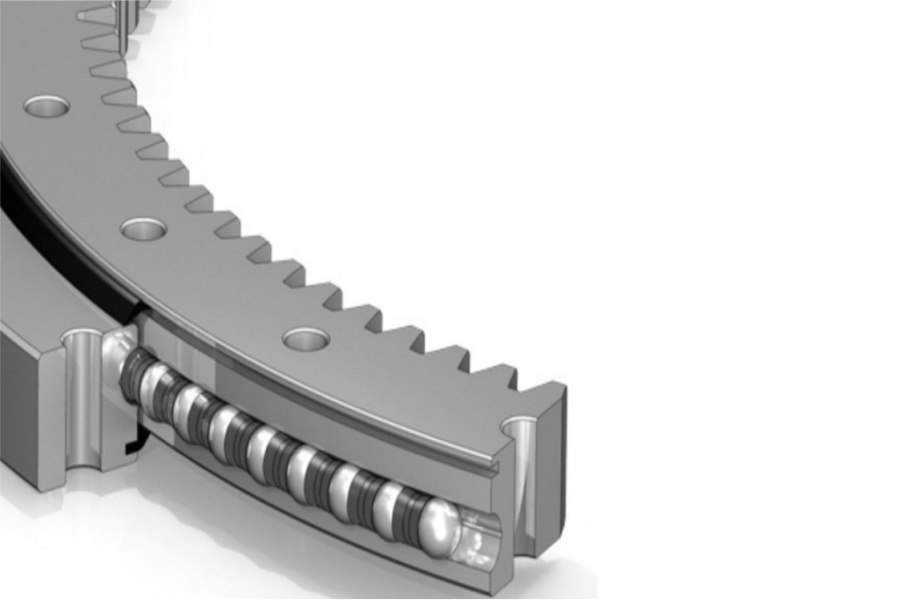
What is a slew drive? A slew drive is a compact rotary unit that combines a slewing bearing, gear system, housing, and mounting interfaces to turn or hold a load. It is used where equipment needs controlled rotation, such as solar trackers, cranes, turntables, mining equipment, and automated platforms.
The key question behind slew drive features is often not only torque or size. Maintenance planners and OEM engineers also need to decide whether a more sealed housing or a more accessible housing best fits the operating environment. That decision affects contamination risk, inspection work, lubrication planning, and the type of downtime a machine may face.
This is an evergreen engineering trade-off rather than proof of a market-wide change. Closed housings can help protect internal parts from harsh exposure, while accessible designs can simplify field checks and certain service tasks. Neither approach is automatically better. The right choice depends on where the equipment works, how often it can be stopped, and who will maintain it.
Start with the operating condition rather than the housing preference
A housing decision should begin with the actual exposure around the machine. Dust, rain, washdown, salt air, fertilizer residue, and airborne abrasive particles create different risks. A design that works well on a sheltered indoor turntable may require a different protection plan on a ship deck crane or a desert solar tracker.
For exposed equipment, the main concern is preventing contamination from reaching functional surfaces and lubricated areas. For equipment that runs in a controlled facility, the stronger concern may be fast inspection access when a maintenance technician has limited time to diagnose a problem. These are different failure-prevention strategies.
Luoyang Slewring Bearing Co., Ltd. selects materials according to working conditions, including load, speed, and environment. Available materials include ductile cast iron, alloy steel, stainless steel, and forged alloy steel. Housing design should be evaluated together with these material and environment choices, not as a separate purchasing item.
For example, an OEM building outdoor positioning equipment may prioritize an enclosed Slew Drive with a documented protection level. An automation OEM placing units inside a guarded production cell may instead give more weight to grease-point access, cover removal time, and visual inspection routes.
Separate observed evidence from possible interpretations
The available customer cases show that environment-specific protection is relevant to real equipment programs, but they do not prove one housing style is best for every application. A U.S. renewable energy equipment manufacturer ordered 50 SP-I 0841 units for utility-scale solar tracker systems, with IP65 protection specified for desert sites. That case supports the need to define exposure conditions before selecting the drive.
Another example involves UK Ocean Marine Systems, which ordered 20 WEA17-104-25H-R-REV.D units for marine crane systems. Marine equipment may face moisture and corrosive exposure, but the case does not state that every marine application needs the same housing arrangement. Buyers should still define splash exposure, storage conditions, cleaning methods, and planned service intervals in their own specification.
Compare sealed and accessible housing designs before setting the service plan
A sealed housing generally puts more emphasis on limiting outside contamination. An accessible housing generally puts more emphasis on reaching inspection and service points with less disassembly. These descriptions are functional categories, so buyers should confirm the actual cover design, seals, grease fittings, fasteners, and inspection points on the supplier drawing.
| Evaluation point | More sealed housing design | More accessible housing design | Buyer decision impact |
|---|---|---|---|
| Contamination exposure | Better suited to applications where dust, moisture, or debris exposure is a primary concern, provided seals and interfaces are correctly specified. | May require greater attention where covers, access points, or service openings face external contaminants. | Favor sealing when the machine operates outdoors or near process debris. |
| Inspection access | Internal inspection may require opening covers or following a planned shutdown procedure. | Service points and selected visual checks can be easier to reach. | Favor access when technicians need frequent checks during scheduled stops. |
| Lubrication needs | Lubrication still requires a documented method and interval; a sealed housing does not eliminate lubrication planning. | Grease points and service areas may be easier to inspect, but access paths must remain protected from contamination. | Confirm fitting locations, grease routes, and responsibility for servicing. |
| Service downtime | May reduce unplanned contamination-related intervention when exposure is severe, but internal access can take longer if service is required. | Can shorten planned inspection work, but exposure-related maintenance may increase if protection is not adequate. | Compare planned labor time against the cost of an unplanned machine stop. |
The practical conclusion is simple. Select a more sealed arrangement when outside exposure is difficult to control and the machine cannot tolerate contamination entering service areas. This does not apply automatically to every outdoor machine, because a sealed design can still be a poor fit if the maintenance team cannot reach required fittings or follow the service procedure safely.
Select a more accessible arrangement when frequent inspection is part of the normal maintenance method and the equipment operates in a cleaner or protected area. This option is less suitable when the access arrangement itself is likely to collect abrasive dust, water, or corrosive residue. The housing must match the full duty cycle, not just the initial installation environment.
Do not confuse IP protection with maintenance-free operation
An IP rating is a stated level of enclosure protection, not a blanket promise that the drive will never need inspection. Buyers should ask what surfaces and openings are covered by the rating, whether the rating applies to the supplied configuration, and how cable entries, mounting interfaces, and service points are handled.
Luoyang Slewring Bearing Co., Ltd. supplies slew drives with protection up to IP66 and anti-corrosion protection up to C4H. These are useful specification options for harsh industrial conditions, but the selected level should be tied to the actual machine exposure. A covered machine parked indoors between shifts may need a different solution than a unit left outdoors through its operating life.
For worm-driven equipment, also assess whether the drive needs self-locking behavior, tracking accuracy, or higher rotational stability. A South Korean port equipment manufacturer placed a repeat order for 20 WEA9-62-25HR single worm drives for port crane systems, specified with IP65 sealing, self-locking, and tracking precision of no more than 0.15°. That is a defined application result, not a universal specification for all crane drives.
Where dual-worm layout is needed for the application, review a Double Worm Slew Drive alongside the housing question. The drive arrangement, mounting stiffness, operating load, and maintenance access should be reviewed as one engineering package.
Request Your Custom Slew Drive or Bearing Spec
Tell us your load, speed, and environment — receive a tailored 100–5000 mm slewing drive or slewing bearing proposal with 3D drawings within 24 hours.
Use a requirement sheet that links protection to field service
The best time to resolve this trade-off is before the RFQ is released. If a buyer merely asks for “sealed” or “easy maintenance,” different suppliers may interpret those terms differently. A short, measurable requirement sheet reduces that risk.
- Map exposure zones. Identify where the drive will see dust, water, salt air, process residue, direct spray, or ultraviolet exposure. Separate normal operation from transport, storage, and cleaning conditions.
- Define the maintenance method. State who lubricates the drive, how often the equipment can be stopped, and whether the technician can reach fittings from a safe position.
- Set protection expectations. Specify the requested IP protection level only after defining the real exposure. Ask the supplier to identify which supplied interfaces are included in that protection arrangement.
- Request service-access details. Ask for grease fitting locations, cover removal requirements, tool clearance, and any inspection points that must remain reachable after installation.
- Check the mounting design. Confirm that brackets, guards, hydraulic lines, electrical conduits, and surrounding structure do not block service access or create water traps.
- Plan verification. Include receiving inspection, installation checks, initial lubrication confirmation, and a record of the selected service interval.
This procedure fits OEMs specifying new equipment and maintenance teams replacing an existing unit. It does not replace application engineering where load cases, mounting bolts, rotational speed, or safety functions require a full design review. In those cases, provide drawings and operating data for a technical proposal.
Luoyang Slewring Bearing Co., Ltd. can provide a technical proposal within 24 hours and offers 3-day rapid prototyping for applicable development work. Standard production is listed at a 9-day cycle, while customized products have a minimum order quantity of 5 sets. Those planning facts can help an OEM decide whether to validate a revised housing concept before a larger release.
Check lifecycle cost instead of comparing the unit price alone
The lower purchase price is not always the lower operating cost. A housing arrangement can change how often technicians inspect the unit, how long a planned service stop takes, and how exposed the drive is between service events. The proper comparison is the expected cost of keeping the machine available.
| Lifecycle cost item | Questions for a sealed-focused design | Questions for an access-focused design |
|---|---|---|
| Initial engineering | Are seals, interfaces, and protection requirements documented for the real environment? | Are service openings, covers, and fittings positioned after final machine assembly? |
| Installation labor | Can technicians install the drive without damaging seals or blocking protected interfaces? | Can technicians reach service points after guards, hoses, and covers are installed? |
| Routine maintenance | What inspection can be completed externally, and what requires opening the housing? | Will frequent access expose service areas to dirt, wash water, or accidental damage? |
| Unplanned downtime | What contamination paths remain at mounting, wiring, and service interfaces? | What environmental exposure remains when access features are repeatedly used? |
| Replacement planning | Can the replacement unit match the required protection configuration? | Can the replacement be installed without redesigning guards or access paths? |
Consider a solar tracker installed at a remote outdoor site. The maintenance team may have limited access and many drives to inspect, so contamination control and predictable service planning can carry more value than quick internal access to one unit. The referenced South American solar projects in Brazil, Argentina, and Chile used SP-I 0229 spur gear slew drives for single-axis trackers and reported energy yield increases up to 40%. That reported result belongs to those projects and should not be used as a general yield promise.
Now consider an automated indoor turntable system. The operating area may be cleaner, while maintenance personnel can stop the machine during planned windows. Manchester, UK, automation equipment production included 100 units of SP-I 0841-32.1 for automated turntable systems. This type of application should still be assessed individually, but it illustrates why access planning can matter even when severe outdoor exposure is not the main concern.
For a project that needs changed housing geometry, fitting locations, coatings, or mounting interfaces, a Customized Slew Drive may be more appropriate than forcing a standard unit into a poor service layout. Standard products are available from one set, and sample orders are welcome for testing and evaluation.
Avoid common specification mistakes that create service problems later
- Requesting “IP protected” without describing exposure. State whether the risk is windblown dust, direct rain, washdown, salt air, or process debris. The conclusion is that the protection request must match the exposure; a generic label is not enough.
- Assuming a closed housing removes lubrication work. Confirm lubrication points, lubricant method, service responsibility, and interval. A sealed arrangement may reduce ingress risk, but it does not erase the need for planned maintenance.
- Blocking fittings during machine assembly. Review the final machine model with guards, hoses, motors, and brackets installed. This check matters most where technicians have limited physical access, but it may be less restrictive on open-frame equipment.
- Using an isolated customer case as a universal requirement. A port crane specification does not automatically fit a solar tracker, forestry grapple, or indoor turntable. Use cases as reference points, then verify load, speed, environment, and service conditions.
- Evaluating the drive without its mounting structure. The housing, bearing, gear system, fasteners, and supporting frame work together. If the machine frame traps water or permits movement, a higher stated protection level alone may not solve the problem.
Quality verification should also be part of the sourcing decision. Our ISO 9001:2015 certified facility uses CNC machining centers and CMM three-coordinate inspection. Every slewing bearing is subject to CMM inspection and dynamic load testing under our stated quality process, and confirmed manufacturing defects are covered by a 2-year extended quality warranty.
Buyers can review the production and inspection approach through our Slew Drive Quality Control information. This evidence supports supplier evaluation, but it does not remove the buyer’s responsibility to define application-specific housing, protection, and maintenance requirements.
Use these decision signals to choose between protection and access
The strongest signal for a sealed-focused design is uncontrolled exposure combined with high disruption from an unplanned stop. This often fits outdoor equipment, marine machinery, mining equipment, and sites where abrasive or corrosive material can reach the drive. It may not be the best answer if the machine design prevents required inspection or lubrication work.
The strongest signal for an access-focused design is a controlled environment combined with frequent scheduled inspection. This often fits protected automation equipment or machinery maintained by an on-site technical team. It becomes a weaker choice when washdown, dust, or debris can enter through the access arrangement.
Before selecting the unit, ask the supplier for the outline drawing, mounting information, protection configuration, material recommendation, lubrication access plan, and inspection method. Luoyang Slewring Bearing Co., Ltd. operates six production lines in an 8,000 m² manufacturing facility with annual capacity of 100,000 sets. For buyers balancing lifecycle service against environmental protection, those engineering details should be reviewed before purchase order release, not after the machine is in the field.

Request Your Custom Slew Drive or Bearing Spec
Tell us your load, speed, and environment — receive a tailored 100–5000 mm slewing drive or slewing bearing proposal with 3D drawings within 24 hours.
 WhatsApp

 +8613903880726