



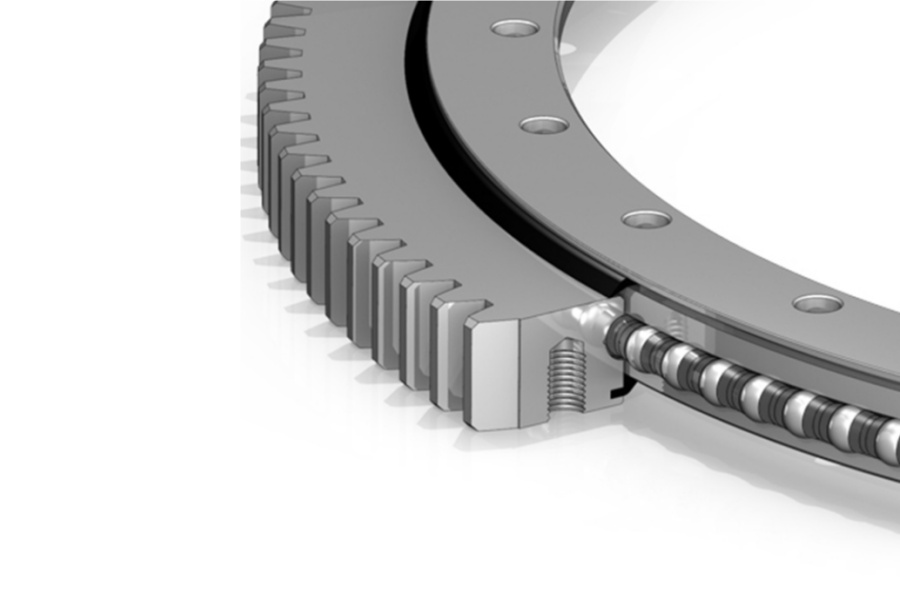
What is a slew drive? A slew drive is a compact rotation unit that combines a slewing bearing, a gear (usually worm or spur), a housing, and a motor interface in one sealed package. It carries axial, radial, and tilting-moment loads while turning the load. Good slew drive selection on a variable-duty machine means more than matching a catalog torque number.
Here is the gap we see most often. The peak torque looks fine, but the unit runs hot, loses efficiency, or wears early because the machine starts, stops, and reverses all day. This guide shows a design engineer how to turn a real duty cycle into selection limits before shortlisting any slew drive.
Inputs to Collect Before You Compare Catalog Torque
You do not need a final design to start. You need a short list of facts about how the machine really moves. Some items block progress, and others can wait until the supplier review.
| Input | Why it matters | Blocks selection? |
|---|---|---|
| Axial, radial, and tilting-moment loads (working and peak) | Sizes the bearing raceway and sets the static safety check | Yes |
| Output torque at each phase of the cycle | Feeds the equivalent torque check and the heat estimate | Yes |
| Time spent in each phase (move, hold, idle) | Separates continuous duty from intermittent duty | Yes |
| Starts and reversals per hour | Drives heat and shock loading in stop-start duty | Yes |
| Rotation angle (full turns or small oscillation) | Small angles load the same raceway spot over and over | Yes |
| Ambient temperature, dust, water, salt | Sets the sealing level, coating, and cooling margin | Can wait for a first shortlist |
| Holding or self-locking need | Narrows the drive type | Can wait, but decide it early |
| Motor, brake, and mounting interface | Affects fit, not the first sizing | Can wait |
If you only have estimates, write them down and mark them as estimates. A supplier can still return a useful technical proposal from a rough duty sheet. At Luoyang Slewring Bearing Co., Ltd., we send a proposal within 24 hours, and a clear duty sheet shortens that loop.
Build a Duty Profile From Real Operating Data
Follow these steps in order. Each one depends on the step before it.
- Split one full machine cycle into phases. Typical phases are acceleration, steady slew, braking, hold, and idle. Success looks like phase times that add up to the real cycle time, not an idealized one.
- Assign a torque and a time to each phase. Use measured data from a similar machine if you have it. A common mistake is entering only the peak phase and ignoring the long, light phases.
- Calculate equivalent torque. Use Teq = √(Σ(T² × t) ÷ Σt). This gives a time-weighted torque you can compare with a continuous rating.
- Check the peak separately. The highest single-phase torque must stay inside the unit's maximum output and static limits. Equivalent torque never replaces this check.
- Count starts and reversals per hour. Keep this number. You will use it in the thermal section below.
Worked example (illustrative numbers, not product ratings). A 10-minute cycle has 2 minutes at 6 kN·m, 3 minutes at 3 kN·m, and 5 minutes of light holding at 0.5 kN·m. The sum is (36 × 2) + (9 × 3) + (0.25 × 5) = 100.25. Divide by 10 minutes and take the square root, and Teq is about 3.2 kN·m.
Now the trap. A unit sized only on 3.2 kN·m would be undersized for the 6 kN·m peak. A unit sized only on 6 kN·m may be oversized, heavier, and costlier than needed. You must pass both checks.
Equivalent torque is a starting filter, not a life calculation. It does not capture heat from frequent starts or the wear pattern of small oscillations. That is why the next section exists.
Request Your Custom Slew Drive or Bearing Spec
Tell us your load, speed, and environment — receive a tailored 100–5000 mm slewing drive or slewing bearing proposal with 3D drawings within 24 hours.
When Intermittent or Stop-Start Duty Requires Thermal Derating Beyond Nominal Torque
A nominal torque rating assumes steady conditions. Variable duty breaks that assumption in three ways. Heat builds faster than it leaves, lubricant film thins at hot spots, and reversals add shock. In my design work, this is the most common reason a "correctly sized" unit fails early.
Use the table below as a screening tool. If you land in the right-hand column, ask the supplier for a duty-cycle or thermal rating in writing. Do not assume the catalog number covers you.
| Duty condition | Nominal torque check is usually enough when... | Thermal derating review is needed when... |
|---|---|---|
| Intermittent moves | Long idle gaps let the housing cool between moves | Moves are close together, or the unit holds load under power between them |
| High-cycle operation | Cycles are few per hour | Cycles run all shift, with little rest time |
| Stop-start and reversing | Motion is smooth, with soft ramps | Frequent hard starts, reversals, or braking against inertia |
| Worm gear drive | Duty is short and light | Duty is continuous or heavy, because worm sliding contact makes more heat |
| Hot or enclosed site | Ambient is mild and airflow is open | Direct sun, enclosures, or hot sites reduce heat rejection |
| Small-angle oscillation | Angle covers a wide raceway area | The same raceway section takes the load repeatedly |
Checkpoints. Record the housing temperature after a representative run on a prototype. Compare it with the lubricant and seal limits from the supplier. If temperature is still climbing at the end of the run, the unit is not in thermal balance.
Limits. This table is a screen, not a derating factor. We do not publish a universal derating percentage because it depends on drive type, lubricant, and mounting. Get the number for your specific model and duty.
Match Drive Type and Material to the Duty
Once the thermal risk is known, the drive type becomes easier to pick. The right choice depends on holding needs, efficiency, and precision. Here is how the main options compare.
| Drive type | Fits best | Watch out for |
|---|---|---|
| Worm gear slew drive | Self-locking holds, moderate duty, compact space | Lower efficiency means more heat in continuous duty |
| Double worm slew drive | Heavier loads and tighter backlash control | Still a worm mesh, so heat review still applies |
| Spur gear slew drive | Higher efficiency, longer run times | Not self-locking, so you may need a brake |
Real projects show the pattern. A South Korean port equipment manufacturer reordered 20 units of WEA9-62-25HR single worm slew drives for port cranes, where self-locking and tracking precision of 0.15° or better mattered. A US renewable energy manufacturer chose 50 units of SP-I 0841 for utility-scale solar trackers, with IP65 sealing for desert sites. Different duty, different drive type.
Material follows the load, speed, and environment. We work in ductile cast iron, alloy steel, stainless steel, and forged alloy steel. For harsh sites, our slew drives are available with protection up to IP66 and anti-corrosion ratings up to C4H.
If no standard unit fits your cycle, a customized slew drive may be faster than redesigning your frame. Our customized MOQ is 5 sets, and standard products start at 1 set.
Completion Check and Recovery
You are done when your shortlist passes every check below. If one fails, go back to the step in the right column.
| Check | Pass condition | If it fails, revisit |
|---|---|---|
| Peak torque | Highest phase torque is inside the unit's maximum rating | Step 2 and 4 of the duty profile |
| Equivalent torque | Time-weighted torque sits under the continuous rating | Step 3, or choose a larger frame |
| Thermal review | Supplier confirms duty-cycle limits for your starts per hour | The thermal table and drive type |
| Bearing loads | Axial, radial, and moment loads pass the static check | Load inputs; consider a heavier slewing bearing section |
| Environment | Seal rating and coating match the site | Material and IP or corrosion rating |
| Holding | Self-locking or brake plan is defined | Drive type |
Common mistakes and how to spot them
- Sizing on peak torque only. Effect: oversized, costly unit. Fix: run the equivalent torque check.
- Sizing on average torque only. Effect: gear damage on the peak phase. Fix: always run the separate peak check.
- Ignoring starts per hour. Effect: a hot housing and early lubricant breakdown. Fix: log reversals and ask for a duty-cycle rating.
- Assuming a worm drive suits nonstop duty. Effect: thermal runaway in a sealed enclosure. Fix: review a spur gear option or reduce duty.
- Skipping a prototype run. Effect: surprises at commissioning. Fix: test and measure housing temperature.
Quality records also belong on your checklist. Every bearing we make passes CMM three-coordinate inspection and dynamic load testing, and our facility is ISO 9001:2015 certified. You can read more about our slew drive quality control process, and factory audit reports are available on request.
Variations That Change the Procedure
Only a few situations change the steps above. Handle them before you freeze the shortlist.
- Small-angle oscillation. Add a raceway wear check. The same few degrees of raceway carry every load, so verify with the supplier.
- Very heavy, repeated cycles. A wheel steering platform is an example. A Houston, Texas manufacturer ordered 150 units of WED17-104-25HR double worm slew drives for heavy-duty wheel steering systems. Ask for duty confirmation at that volume.
- Mining or outdoor duty. An Australian manufacturer uses HWE21-94-25HR.1 double worm slew drives on mining excavators. Dust and shock raise the sealing and material questions before sizing is final.
- Automated turntables. A Manchester, UK manufacturer ordered 100 units of SP-I 0841-32.1 for automated turntables. Frequent indexing makes the starts-per-hour count the main input.
To finish, send your duty sheet with phases, torques, times, and starts per hour. Our engineers give a 48-hour technical response, and standard lead time is 9 days with 3-day rapid prototyping available. Covered by a 2-year extended quality warranty, confirmed manufacturing defects are replaced free.
Your selection is complete when peak torque, equivalent torque, and the thermal review all pass on paper. A measured prototype run should then confirm it.
Request Your Custom Slew Drive or Bearing Spec
Tell us your load, speed, and environment — receive a tailored 100–5000 mm slewing drive or slewing bearing proposal with 3D drawings within 24 hours.
 WhatsApp

 +8613903880726