



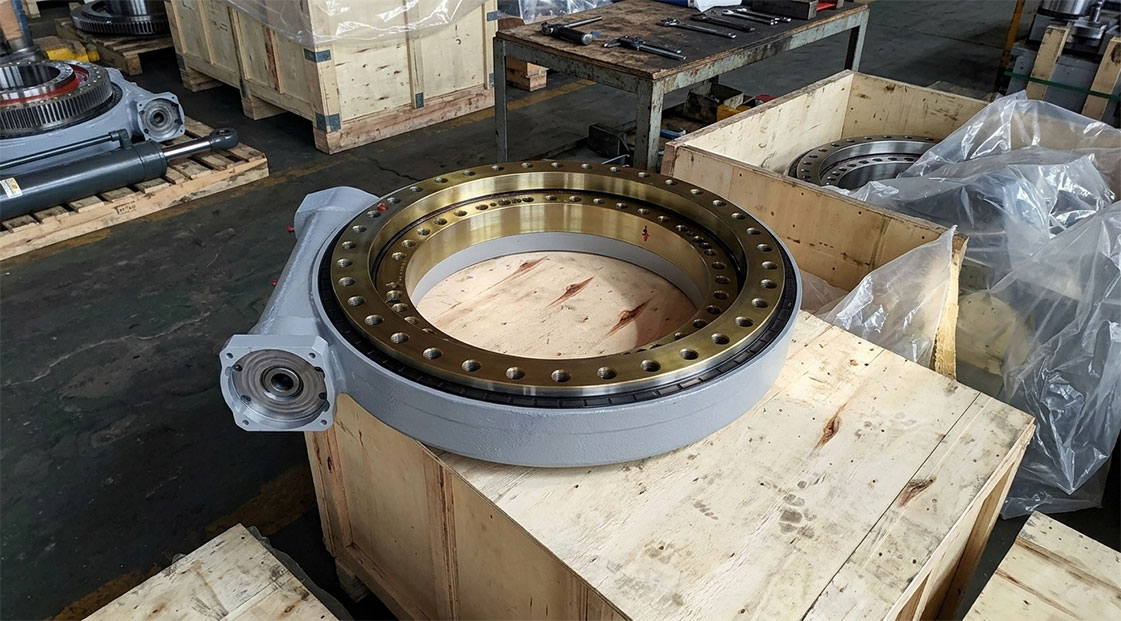
What is a slew drive? A slew drive is a compact rotation unit that combines a slewing bearing, a gear set (usually a worm or spur gear), a housing, and a motor interface. It turns heavy loads and carries axial, radial, and tilting forces at the same time. The key question for outdoor and high-duty equipment is simple: does the slew drive clearance you measure on a cold bench still hold after the unit warms up under load?
Often it does not, at least not exactly. Backlash, starting torque, and bearing preload can all move as parts heat and expand at different rates. This article explains what changes, why a single catalog number cannot capture it, and what data to ask a supplier for before you build a prototype.
Why a Cold-Set Number Is Only Half the Specification
Most clearance values on drawings are set at room temperature with no load. That is the right condition for assembly and inspection, because it is repeatable. But your machine will not run at room temperature for long.
Sun on a solar tracker, hydraulic heat near a crane, and friction in the gear mesh all push temperatures up. Parts that heat faster than their neighbors grow faster too. The gap you set on the bench becomes a different gap in service.
This is an evergreen engineering issue, not a market report. We do not cite a dated study showing a shift in the industry. What we can say is that the effect follows from basic thermal growth, and that it matters most when precision, duty cycle, or temperature swing is high.
What We Can and Cannot Claim From the Evidence
Scope matters, so here are the boundaries. Public pages on this topic mostly cover clearance categories, nominal tolerance values, and how flexible a bearing is in operation. Few of them explain how a clearance set at assembly changes after temperature rise and duty-cycle loading.
That is an observation about published content, not proof of a field trend. It tells us the gap in information exists. It does not tell us how often the effect causes failures.
The size of the shift also depends on the design. Housing material, gear type, sealing, grease, and mounting structure all change it. Any universal "safe hot limit" you see quoted deserves a question about the test conditions behind it.
Comparison: Cold-Set vs Operating-Temperature Clearance Behavior
The table below shows the direction of each effect. It does not give numeric limits, because those depend on the specific unit and test setup.
| Parameter | Cold-set condition (bench) | Operating temperature (steady state) | What to ask the supplier |
|---|---|---|---|
| Backlash (gear mesh) | Measured with no load and uniform temperature. Repeatable and easy to verify. | Can tighten or open. It depends on whether the worm shaft, housing, or gear ring heats faster, and how each is constrained. | Was backlash re-measured after warm-up? At what housing temperature? |
| Starting torque | Cold grease is stiff, so breakaway torque can be high after a cold soak. | Grease thins and friction often drops. But if thermal growth reduces clearance, torque can rise again. | Is torque reported at cold start and at steady state? |
| Bearing preload / raceway clearance | Set by assembly and raceway geometry. Close to the design value. | An inner ring that runs hotter than the outer ring tends to add preload. Uneven heating can also change contact angle. | How is preload verified, and does it change with temperature? |
| Gear contact pattern | Checked at assembly under light load. | Housing deflection and thermal growth can shift the pattern toward one end of the tooth. | Is the contact pattern checked after a loaded run? |
| Seals and grease | Seal lip load is at its design value. | Seals soften and grease can migrate. Both affect friction and protection. | What grease and seal temperature range was tested? |
Two points deserve a closer look. First, backlash does not move in a fixed direction. A drive with a stainless steel component paired with ductile iron or alloy steel may behave differently from an all-steel unit, because austenitic stainless generally expands more than carbon or alloy steel.
Second, starting torque has two competing effects. Grease viscosity lowers torque as temperature rises. Reduced clearance raises it. Which effect wins depends on the unit, so one torque reading cannot be treated as both a cold and a hot figure.
Drivers, and Other Explanations You Should Rule Out
Thermal growth is the documented physical driver. But when a prototype shows different backlash or torque after a run, temperature is not always the cause. Treat it as one hypothesis among several.
- Run-in wear. New gear surfaces settle in during the first hours, which can change backlash even at constant temperature.
- Mounting surface flatness. A warped or uneven mounting face deforms the bearing ring and changes clearance and torque. This can look like a thermal effect.
- Load deflection. Tilting loads flex the structure. Backlash measured under load will differ from the unloaded reading.
- Grease condition. Fill amount, grease type, and churning heat all affect torque and temperature.
- Measurement method. Where you place the indicator and where you read temperature can change the result by more than the effect you are chasing.
The practical lesson: log housing temperature, load, and mounting condition with every clearance reading. Without that record you cannot separate thermal effects from the rest. Careful reading of our own slew drive quality control records follows the same principle, because a number without its test conditions is hard to act on.
Request Your Custom Slew Drive or Bearing Spec
Tell us your load, speed, and environment — receive a tailored 100–5000 mm slewing drive or slewing bearing proposal with 3D drawings within 24 hours.
Which Applications Need Hot-State Data Most
Not every project needs a thermal test. A low-duty unit that runs indoors at a steady temperature may be fine with a cold-set specification. The need grows with precision demands, temperature swing, and duty cycle.
| Condition | Hot-state data needed? | Reasoning and limit |
|---|---|---|
| Outdoor, direct sun, wide daily temperature swing | Yes | Housing and gear ring can heat unevenly. Does not apply if the unit is shaded and runs rarely. |
| Tight tracking precision (a fraction of a degree) | Yes | Small backlash changes show up directly in pointing error. |
| High duty cycle, continuous swing | Yes | Friction heat builds up. A short test may not reach steady state. |
| Intermittent, low-speed, indoor positioning | Usually no | Cold-set data plus a short warm-up check is often enough. |
| Self-locking or holding duty | Case by case | Backlash matters less than torque, but a tight clearance can still raise drive load. |
Real Application Contexts, Scoped Carefully
These projects show the kind of equipment where this question can arise. They are not evidence that clearance shifts caused any problem, and we do not present them as proof of an industry trend.
- Port cranes, South Korea. A manufacturer placed a 20-unit repeat order for WEA9-62-25HR single worm slew drives, specified for tracking precision of 0.15° or better, IP65 sealing, and self-locking. Tight precision on an outdoor machine is the case where hot-state backlash deserves a check.
- Forestry grapple machines, British Columbia. A forestry equipment manufacturer ordered 30 units of WED14-86-25BHR.5 double worm slew drives with precision of 0.13° or better. Double worm designs use two worms to manage backlash, so the way each worm is adjusted and constrained matters for temperature behavior.
- Solar trackers, USA and South America. A US renewable energy manufacturer ordered 50 units of SP-I 0841 for utility-scale trackers, with IP65 protection for desert sites. Projects in Brazil, Argentina, and Chile used SP-I 0229 spur gear slew drives. Sun-exposed housings and large daily swings make these good candidates for warm-up testing.
Evaluation Checklist Before Prototype Testing
Use these questions to validate a specification on paper. Each one is tied to the decision it affects.
- At what temperature was backlash measured? This decides whether the number can be compared with your operating range.
- Was it re-measured after a loaded warm-up? This tells you whether the supplier has seen the hot-state shift.
- Are cold-start and steady-state torque both reported? This sizes your motor and gearbox, and protects against undersizing at cold start.
- How is preload verified? This affects service life under heavy cyclic loads.
- What is the material pairing? Ductile cast iron, alloy steel, forged alloy steel, and stainless steel grow differently. This is where mixed-material housings need extra attention.
- What mounting conditions were used in the test? A test on a rigid fixture may not match your real structure.
- What grease and seal ratings apply? This sets your minimum and maximum temperature limits.
Request supplier test data when your unit sees direct sun or a wide temperature swing, when precision is tight, or when duty is continuous. If a supplier cannot state the test conditions behind a number, treat that number as a cold-set reference only.
Common Mistakes When Specifying Clearance
- Copying a nominal clearance from a catalog and assuming it holds at operating temperature.
- Reading backlash once after a cold start and calling it final.
- Testing on a stiff fixture, then mounting the unit on a flexible frame.
- Reducing clearance to improve precision without checking the torque rise when hot.
- Ending a thermal test before the housing reaches steady temperature.
- Ignoring a mixed-material housing and gear ring combination.
What We Can Support, and What Stays Uncertain
At Luoyang Slewring Bearing Co., Ltd., our slew drive and slewing bearing production runs under an ISO 9001:2015 quality system. Every slewing bearing passes CMM three-coordinate inspection and dynamic load testing. Our standard order starts at 1 set, and a customized slew drive starts at 5 sets, so a sample can be tested before volume orders.
For prototypes, we offer 3-day rapid prototyping, a technical proposal within 24 hours, and a 48-hour technical response. Our slew drives reach protection up to IP66 and anti-corrosion ratings up to C4H. We also offer a 2-year extended quality warranty and free replacement for confirmed manufacturing defects. These terms do not replace thermal test data, but they shorten the loop for getting it.
Some questions remain open. There is no universal hot-clearance limit that applies to every design, and we do not claim one. Your actual shift depends on your housing, mounting, duty cycle, and climate.
Several signals would change our assessment. If a warm-up test shows backlash change within your tolerance, a cold-set specification is enough. If torque at steady state differs strongly from cold start, you need to resize the drive or adjust the clearance. If results vary between identical units, look first at mounting flatness and assembly, not temperature.
To get a useful technical proposal, send your operating temperature range, duty cycle, load case, and required precision. With those four inputs, our engineers can recommend a configuration and the test conditions that fit it.
Request Your Custom Slew Drive or Bearing Spec
Tell us your load, speed, and environment — receive a tailored 100–5000 mm slewing drive or slewing bearing proposal with 3D drawings within 24 hours.
 WhatsApp

 +8613903880726