



What is a slew drive? A slew drive is a compact rotary transmission unit that combines a slewing bearing, gear system, housing, seals, and drive connection to rotate equipment under load. It is commonly used on solar trackers, cranes, aerial platforms, excavators, turntables, and material-handling equipment.
Maintenance teams often face the same question after finding abnormal noise, excess play, oil or grease leakage, rough rotation, or poor positioning accuracy: repair the unit or install a replacement? The correct answer depends less on the visible symptom and more on where the damage is located.
This guide explains how to replace slew drive units after a structured inspection. It also separates faults that may be repaired externally from internal gear, bearing, and housing damage that usually creates unacceptable reliability and downtime risk.
Start With the Failure Location Rather Than the Symptom
Noise, backlash, leakage, and slow rotation are warning signs, not final diagnoses. A leaking seal may be a contained service issue. The same leakage can also allow water, dust, or abrasive particles into the bearing and gear cavity, where it can cause much more serious damage.
The first decision is simple: determine whether the fault is external and isolated, or internal and load-bearing. External faults can often be corrected if contamination has not reached the gear or bearing raceway. Internal faults need a more cautious decision because the unit may no longer carry its rated working load safely.
Use a controlled inspection before authorizing repair work. Isolate the machine, support the rotating structure if needed, remove stored hydraulic or electrical energy, and follow the equipment manufacturer’s lockout procedure. Do not judge bearing condition by turning an unloaded platform by hand alone.
Initial inspection sequence for maintenance teams
- Record the operating symptom. Note when noise, vibration, poor rotation, drift, leakage, or positioning error occurs.
- Check external fasteners. Look for missing, loose, stretched, corroded, or damaged mounting bolts.
- Inspect seals and grease condition. Check for torn seals, hardened seal lips, grease loss, water entry, or visible debris.
- Inspect the motor and drive connection. Confirm that the hydraulic motor, electric motor, gearbox connection, coupler, and control system are functioning as intended.
- Measure movement under controlled load. Compare rotational play and tilt movement against the machine’s approved maintenance limits.
- Check for internal evidence. Metal particles in lubricant, repeated binding, gear tooth damage, raceway noise, or housing cracks require deeper review.
- Review operating history. Consider shock loads, overload events, poor lubrication, extended storage, water exposure, or operation in abrasive dust.
This sequence fits crane, tracker, turntable, and mobile-equipment applications. It does not replace the machine manufacturer’s service manual, especially where the slew drive supports personnel, lifting equipment, or a suspended load.
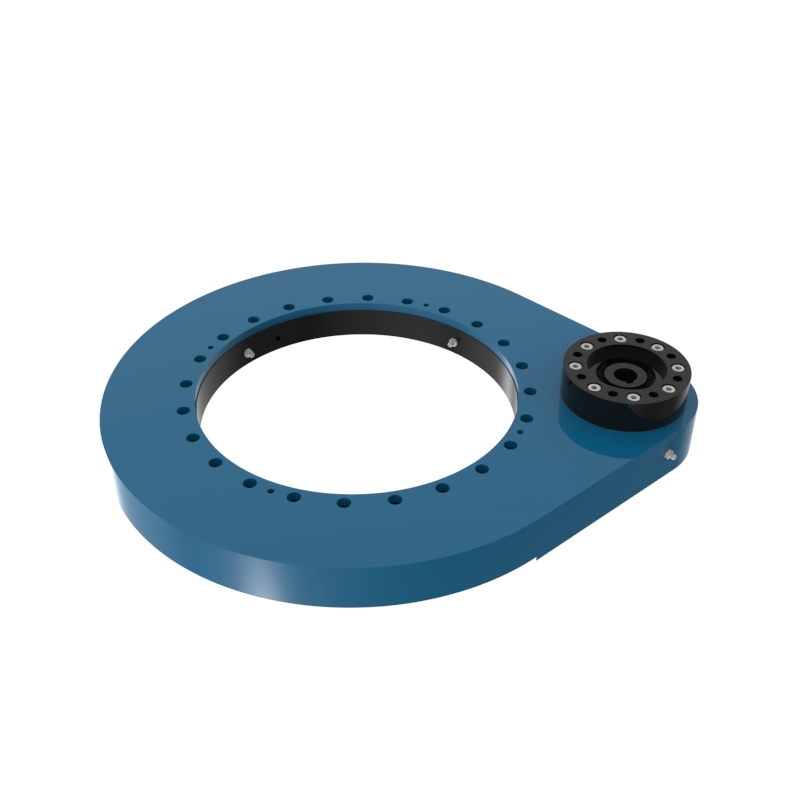
For equipment using a worm transmission, inspect the selected Worm Gear Slew Drive configuration as a complete load path. The worm, gear teeth, bearing raceway, mounting interface, and housing work together. Replacing only one visible component may not restore safe operation if another internal surface has already been damaged.
Comparison Between Repairable External Faults and Replacement-Level Damage
The repair-or-replace decision should be based on evidence, not only the cost of a replacement unit. External service work can be sensible when the fault is isolated and the internal condition is verified as acceptable. Replacement is usually the safer choice when damage affects the parts that transmit load, hold gear alignment, or maintain bearing geometry.
| Failure area | Typical evidence | Usual decision direction | Why the decision changes | Limits and checks |
|---|---|---|---|---|
| Seal | Grease leakage, cracked or worn seal lip, no metal debris found | Repair may be practical | A seal is an external service part if contamination has not damaged internal components. | Do not repair only the seal if water, dirt, or metal particles are present inside the unit. |
| Motor or motor connection | No rotation, low speed, motor noise, hydraulic or electrical fault | Repair may be practical | The motor can be separate from the bearing and gear system. | Confirm the drive was not overloaded by internal binding before fitting a replacement motor. |
| Mounting fasteners | Loose bolts, corrosion, damaged threads, movement at the mounting interface | Repair may be practical after inspection | Fasteners can be renewed if the mounting faces and threaded holes remain sound. | Replacement is more likely if bolt holes are elongated, cracked, or unable to hold the required clamp load. |
| Internal gear teeth | Repeated knocking, tooth pitting, chipped teeth, binding at one rotation point | Replacement is normally preferred | Gear damage affects torque transfer and can spread through the gear mesh. | A detailed engineering assessment is needed if the drive is purpose-built and internal parts are available. |
| Slewing bearing raceway or rolling elements | Excessive play, grinding noise, uneven rotation, metallic contamination | Replacement is normally preferred | Internal bearing damage changes load distribution and may lead to sudden worsening under cyclic load. | Do not rely on a visual external inspection to rule out raceway damage. |
| Housing | Cracks, deformation, broken mounting ears, distorted bore alignment | Replacement is normally required | The housing holds the bearing and gear in alignment. Structural damage can affect the entire unit. | A repair may be considered only when a qualified engineering review confirms the housing can be restored safely. |
The key distinction is load path integrity. A seal or motor can be changed without automatically changing bearing geometry. A damaged raceway, gear mesh, or housing changes the way torque and load move through the assembly.
This is especially relevant for equipment that sees repeated starts, stops, reversing loads, shock loading, or outdoor exposure. A short-term repair that does not address contamination or internal damage can create a second shutdown soon after restart.
Luoyang Slewring Bearing Co., Ltd. supplies Slew Drive units and customized solutions for different load, speed, and environmental conditions. Material selection can include ductile cast iron, alloy steel, stainless steel, or forged alloy steel according to the application requirements.
Request Your Custom Slew Drive or Bearing Spec
Tell us your load, speed, and environment — receive a tailored 100–5000 mm slewing drive or slewing bearing proposal with 3D drawings within 24 hours.
Use Downtime Risk to Compare Repair and Replacement Costs
A repair quote can look less expensive than a new unit because it covers fewer parts. That comparison is incomplete if the equipment must be removed twice, if replacement parts are uncertain, or if the repair cannot confirm the condition of the internal bearing and gear system.
Compare the total shutdown exposure, not just the service invoice. This is useful for operations managers who need to keep cranes, solar tracking rows, automated turntables, or mobile equipment available for scheduled work.
| Cost or risk item | Repair scenario | Replacement scenario | Decision impact |
|---|---|---|---|
| Diagnosis time | May increase if internal condition is uncertain | Still required to confirm replacement cause | Do not skip failure analysis when ordering a new unit. |
| Parts availability | Depends on seals, motors, gears, bearing components, and service capability | Depends on matching the complete replacement specification | Choose the route with the clearer supply path. |
| Removal and installation labor | May require removal and later rework if the repair does not solve the root cause | Usually one planned changeout if the replacement is correctly specified | High labor-access cost often favors a verified replacement. |
| Reliability after restart | Depends on the actual extent of damage and repair quality | Depends on correct application matching and installation control | Both options require documented inspection and commissioning. |
| Unplanned downtime exposure | Higher when internal wear remains uncertain | Lower only if the new unit matches load, mounting, motor, and environmental requirements | A new unit is not a cure for an incorrect application design. |
Replacement is often the better decision when access is difficult, the machine supports production throughput, or failure could interrupt lifting or positioning work. Repair can still be the right choice where the issue is clearly isolated to a serviceable motor, seal, or fastener and inspection finds no internal contamination or structural damage.
Lead time also matters. Luoyang Slewring Bearing Co., Ltd. offers a technical proposal within 24 hours, a standard production cycle of 9 days, and rapid prototyping in 3 days for suitable projects. These are production and engineering capabilities, not a guarantee that every replacement will fit without a complete review of the original unit and operating conditions.
Collect the Right Data Before Ordering a Replacement Unit
A replacement slew drive must match the application, not merely resemble the failed unit. Nameplate data is useful, but it may not show the full duty cycle, actual load direction, mounting condition, required rotation speed, or environmental exposure.
Send a structured data package to the supplier. This reduces the risk of receiving a drive with the wrong mounting interface, rotation direction, gear arrangement, motor connection, or protective level.
Replacement buyer checklist
- Product identification: Record the manufacturer, part number, serial number, and clear photographs of all labels.
- Mounting interface: Measure bolt-hole pattern, mounting faces, center diameter, overall envelope, and bolt condition.
- Drive arrangement: Identify worm or spur gear design, single or double worm arrangement, motor type, motor mounting, and rotation direction.
- Application load: Describe axial load, radial load, tilting moment, shock loading, rotation frequency, and whether the unit holds position under load.
- Operating environment: Identify dust, rain, salt spray, washdown, high or low temperatures, and corrosion exposure.
- Failure evidence: Provide photos of leakage, damaged teeth, metal debris, cracked housings, damaged fasteners, and worn mounting surfaces.
- Machine constraints: State available installation time, lifting access, control-system requirements, and any needed certification documentation.
For outdoor equipment, ingress protection and corrosion exposure should be part of the request. Luoyang Slewring Bearing Co., Ltd. can provide slew drives with protection up to IP66 and anti-corrosion performance up to C4H, subject to the selected product configuration and working conditions.
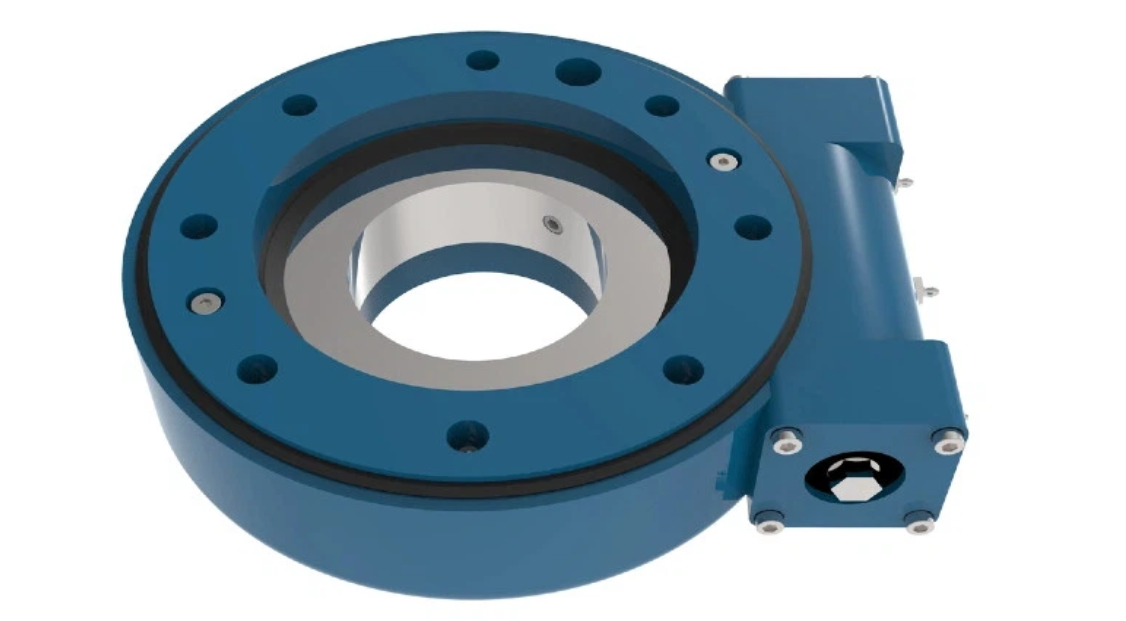
For high-load or reversing-duty machinery, consider whether a Double Worm Slew Drive is appropriate. A double-worm design may fit applications that need higher torque handling or improved stability, but it is not automatically better for every machine. The correct selection depends on actual load, accuracy, speed, duty cycle, and integration space.
Follow a Controlled Replacement Procedure During Shutdown
Installing a new unit without correcting the cause of the old failure can waste the replacement investment. For example, a damaged drive may have resulted from loose mounting bolts, misaligned structure, water entry, improper lubrication, overload, or a motor problem that created abnormal loading.
Use the following procedure as a planning framework. The machine-specific installation instructions, approved lifting plan, bolt specification, and commissioning requirements must take priority.
- Confirm the replacement specification. Verify model, mounting interface, drive direction, motor arrangement, protection needs, and application duty before shipment approval.
- Secure the equipment. Lock out power, relieve stored energy, support the rotating structure, and prevent unexpected movement.
- Inspect the mating structure. Check mounting faces for corrosion, burrs, distortion, cracking, and damage around bolt holes.
- Remove the failed unit carefully. Preserve evidence such as damaged lubricant, broken fasteners, and tooth debris for root-cause review.
- Correct the original cause. Repair the mounting structure, sealing path, motor issue, lubrication issue, or control issue before fitting the new drive.
- Install and tighten as specified. Use the approved fastener grade, tightening sequence, and torque procedure from the equipment and drive documentation.
- Perform low-speed commissioning. Run without production load first, observing smooth rotation, noise, leakage, mounting movement, and motor performance.
- Verify under controlled working conditions. Check operation at the expected duty level, then document the inspection results for future maintenance.
Do not use a new drive to compensate for an uneven or cracked mounting surface. Housing alignment and bolt clamp load affect bearing and gear behavior. If the base structure has moved or distorted, the machine structure may need repair before the new unit is installed.
Use Quality Evidence and Application History in the Final Decision
A supplier’s inspection process matters most when the application cannot tolerate repeated shutdowns. Ask what checks are performed on the finished unit, how the load condition is reviewed, and what warranty support applies if a confirmed manufacturing defect is found.
At Luoyang Slewring Bearing Co., Ltd., every slewing bearing passes CMM three-coordinate inspection and dynamic load testing according to the company’s stated quality process. The company is ISO 9001:2015 certified and provides a 2-year extended quality warranty, with free replacement for confirmed manufacturing defects.
These controls support supplier evaluation, but they do not remove the buyer’s responsibility to provide correct application data. A high-quality replacement can still fail early if it is installed on a damaged structure, operated beyond its intended load condition, or exposed to contamination that the selected seal arrangement cannot manage.
Application examples can help buyers frame the discussion without treating one project as proof for every machine. A South Korean port equipment manufacturer placed a repeat order for 20 WEA9-62-25HR single-worm slew drives for port crane systems, specified with IP65 sealing, self-locking capability, and tracking precision of no more than 0.15 degrees. That example shows the importance of matching protection, holding behavior, and positioning needs to the real duty cycle.
For solar equipment, a U.S. renewable energy equipment manufacturer ordered 50 SP-I 0841 units for utility-scale solar tracker systems with IP65 protection for desert sites. Buyers replacing tracker drives should therefore examine dust exposure, sealing condition, alignment, and control behavior rather than assuming a rotation fault always begins inside the drive.
If the inspection shows a serviceable external problem, repair can reduce immediate cost and keep a sound unit in service. If it shows internal gear wear, bearing damage, housing deformation, or contamination that cannot be verified as contained, replacement usually offers the more defensible maintenance decision.
For special mounting patterns, nonstandard motor connections, or unusual duty cycles, a Customized Slew Drive may be more suitable than adapting a standard unit. Standard product MOQ is 1 set, while customized product MOQ is 5 sets, which can support both maintenance replacement planning and equipment-builder sourcing.
Request Your Custom Slew Drive or Bearing Spec
Tell us your load, speed, and environment — receive a tailored 100–5000 mm slewing drive or slewing bearing proposal with 3D drawings within 24 hours.
 WhatsApp

 +8613903880726