



What is a slew bearing? It is a large-diameter ring bearing that lets one structure rotate on another while carrying axial load, radial load and tilting moment at the same time. Cranes, excavators, solar trackers and turntables all depend on it.
Two quotes arrive for the same outer diameter. One is far cheaper. Before you shortlist on that gap, you need to know whether the slew bearing price in each quote covers the same capacity, the same machining and the same delivery terms. Usually it does not.
This article shows how to turn two unlike quotes into one fair comparison. It is written for OEM sourcing and engineering teams that are building a supplier shortlist.
Why Diameter Is a Weak Price Yardstick
Diameter tells you the size of the ring. It does not tell you how much load the ring can carry. Two bearings with the same outer diameter can differ widely in rolling element type, number of rows, ring section height and heat treatment.
In my three decades of mechanical design on cranes, port equipment and automation lines, I have seen diameter used as a shortcut again and again. It works only when every other variable is held equal. In real quotes, almost none are.
Here is the practical rule. Diameter is a size input, not a capacity input. Compare price only after you convert each quote to a common load basis.
The limit of this rule is narrow product families. If two suppliers quote the identical catalog model with the identical drawing, diameter-based comparison is fine, because capacity is already fixed.
What a Quoted Price Actually Covers
A single unit price hides several decisions. Sort every line into confirmed, estimated or unresolved before you compare anything.
| Item | Status in a typical quote | What to ask |
|---|---|---|
| Ex-works unit price | Confirmed, but only for stated quantity, currency and date | Quantity break, price validity, currency |
| Rated load capacity | Often missing or stated on different bases | Static axial and moment rating, safety factor used |
| Raceway and gear hardening | Sometimes implied, rarely written out | Hardened depth, hardness range, gear included or not |
| Material grade | Estimated from the drawing if not stated | Alloy steel, forged alloy steel, stainless or ductile cast iron |
| Packaging and freight | Quote-dependent, often excluded | Incoterm, port, crate type, weight |
| Inspection and documents | Unresolved unless requested | Dimensional report, load test, material certificate |
| Duties and local handling | Unresolved, buyer side | Import tax rate, broker fee |
A confirmed driver is not a confirmed price. A supplier may confirm that raceway hardening affects cost without telling you what it adds. Treat any blank cell as an open question, not as zero.
Also never add figures that use different currencies, quantities or Incoterms into one total. Convert them to one basis first, or ask both suppliers to requote on the same terms.
A Normalized Cost-per-Capacity Formula for Slew Bearing Quotes
This is the section that replaces the diameter shortcut. The idea is simple: divide the full delivered cost by the capacity you actually receive, then adjust for how long the part will last.
Step 1. Build the landed cost per set.
Landed cost = ex-works price + packaging + freight + insurance + duties + inspection or document fees.
Step 2. Pick one capacity basis.
Use the same static moment capacity and axial capacity for both quotes, calculated at the same safety factor. If a supplier gives only a catalog size, ask for the rating basis in writing.
Step 3. Calculate cost per unit of capacity.
Normalized cost = landed cost per set ÷ rated capacity at your required safety factor.
Step 4. Adjust for service life.
Life-adjusted cost = normalized cost ÷ expected service life, in cycles, hours or years that match your duty cycle. Treat life as an estimate unless the supplier shows test or field data.
| Variable | How it enters the formula | Common error |
|---|---|---|
| Diameter | Fixed by your envelope. It sets mounting space, not capacity. | Using it as the denominator |
| Load rating | Denominator. Must come from the same basis for every quote. | Comparing catalog ratings with calculated ratings |
| Raceway design | Changes the rating. A change in rows or roller type changes capacity. | Treating ball and roller designs as equal |
| Machining | Adds to landed cost: gear cutting, hardening, hole pattern, flatness. | Leaving gear teeth out of one quote |
| Freight | Adds to landed cost. Heavy rings ship by weight and crate size. | Comparing ex-works with delivered prices |
| Expected service life | Final divisor. Depends on load spectrum, sealing and lubrication. | Assuming equal life for equal price |
Worked scenario. Suppose Quote A is a single-row ball design and Quote B is a three-row roller design, both at the same diameter and bolt pattern. Quote A has the lower unit price. If your moment load, at your safety factor, exceeds what A can carry, A is not a valid option and its price is irrelevant. If both meet the load, compare landed cost, then life.
Where this does not apply: very small production runs, prototypes or one-off repairs. There, fit and lead time often outweigh cost per capacity.
Request Your Custom Slew Drive or Bearing Spec
Tell us your load, speed, and environment — receive a tailored 100–5000 mm slewing drive or slewing bearing proposal with 3D drawings within 24 hours.
Raceway Design and Material: Where Price Gaps Come From
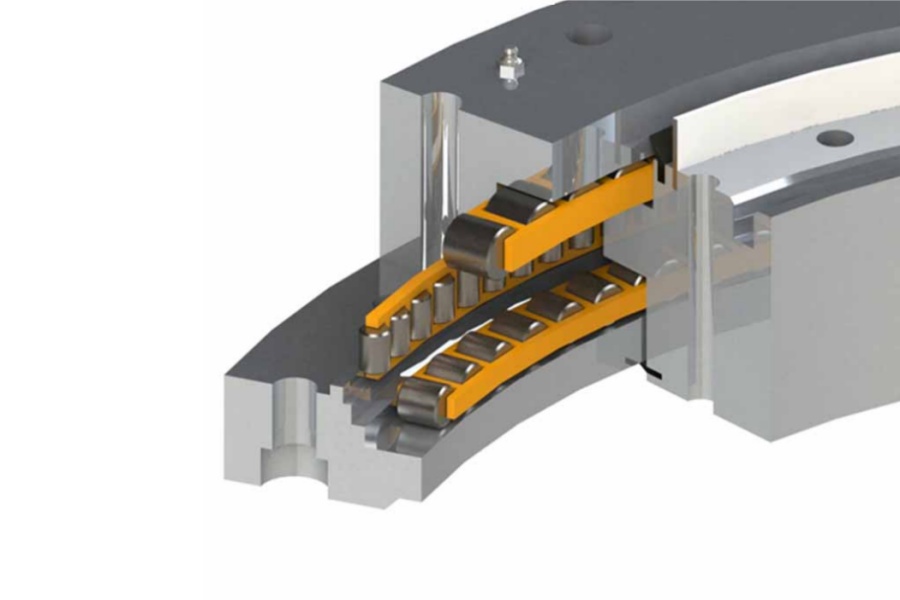
Raceway design is the largest source of price difference at a fixed diameter. Each type packs a different amount of load capacity into the same envelope. Our product range covers the main options, including Single Row Slewing Ring Ball Bearings, Crossed Roller Slewing Bearings and Three-row Roller Slewing Bearings.
| Design | Typical fit | Price direction at same diameter | When it is the wrong choice |
|---|---|---|---|
| Single row ball | Light to moderate loads, compact machines | Lower | High tilting moment or shock loads |
| Crossed roller | Higher rigidity and precision needs | Middle | Very heavy moment loads |
| Three-row roller | Heavy-duty cranes and large excavators | Higher | Light-duty use where capacity goes unused |
Material adds a second layer. We select among ductile cast iron, alloy steel, stainless steel and forged alloy steel based on load, speed and environment. A stainless or forged part costs more than a standard alloy ring, and that cost is justified only when corrosion or load demands it.
For heavy-duty applications, review a heavy load slewing bearing against a lighter option on rated capacity, not on ring size.
Budget Sensitivity and Legitimate Lower-Cost Choices
A lower quote is not automatically a corner-cutting quote. Several legitimate changes can reduce cost without hurting performance.
- Right-size the raceway. If your load analysis shows margin, a lighter design such as a light load slewing bearing may meet the need.
- Relax unneeded precision. Tighter flatness or runout tolerances raise machining cost. Specify them only where the application needs them.
- Use a standard hole pattern. A standard design avoids tooling and setup. Our standard product MOQ is 1 set, and customized MOQ is 5 sets.
- Consolidate orders. A single larger order can share freight and packaging.
Common mistakes to avoid:
- Comparing ex-works and delivered prices as if they were equal.
- Letting one supplier omit gear teeth, seals or hardening from scope.
- Accepting a rated capacity with no stated safety factor.
- Choosing the cheapest option and ignoring the load spectrum.
- Skipping inspection documents, then finding out-of-tolerance parts at assembly.
Quality evidence matters here, because a low price with no inspection record shifts risk to you. Every slew bearing we make passes CMM three-coordinate inspection and dynamic load testing, and we back it with a 2-year extended warranty. Our slew drive quality control process is described on our site, and factory audit reports are available on request. We work under an ISO 9001:2015 quality system, and we hold CE marking for the European market.
Real orders show how requirements differ. A Houston, Texas engineering machinery manufacturer ordered 100 units of SEA21-125-25HR(2) slew drives for slewing platform systems. A South Korean port equipment manufacturer placed a 20-unit repeat order of WEA9-62-25HR for port cranes, with tracking precision of 0.15° or better. Those are slew drive projects, but the lesson carries over: the duty cycle and precision target set the spec, and the spec sets the price. When a drive and bearing must work as one unit, a customized slew drive can be quoted as a single package.
Inputs Needed for a Comparable Quotation
To make a quote usable, give every supplier the same package. Use this checklist before you send an inquiry.
- Drawing or envelope: outer diameter, inner diameter, height and bolt pattern.
- Load case: axial load, radial load and tilting moment, including shock or peak loads.
- Duty cycle: rotation speed, hours per day and expected life target.
- Gear requirement: internal, external or none, and the accuracy grade.
- Environment: temperature range, corrosion exposure, washdown or desert dust.
- Material preference: or leave it open for the supplier to propose against load and environment.
- Commercial terms: quantity, Incoterm, destination port, currency and price validity.
- Documents: inspection report, material certificate, load test record.
With these inputs, our engineers return a technical proposal within 24 hours. Prototyping takes 3 days, and the standard production cycle is 9 days. These are our company timelines, and a specific order's schedule depends on size, material and quantity.
Once the quotes come back, apply the formula: landed cost, then capacity, then life. If a supplier cannot supply the inputs for that math, treat the gap as part of the price. Send us your drawing and load case, and we will return a quote on the same basis you plan to use to compare us with everyone else.

Request Your Custom Slew Drive or Bearing Spec
Tell us your load, speed, and environment — receive a tailored 100–5000 mm slewing drive or slewing bearing proposal with 3D drawings within 24 hours.
 WhatsApp

 +8613903880726