



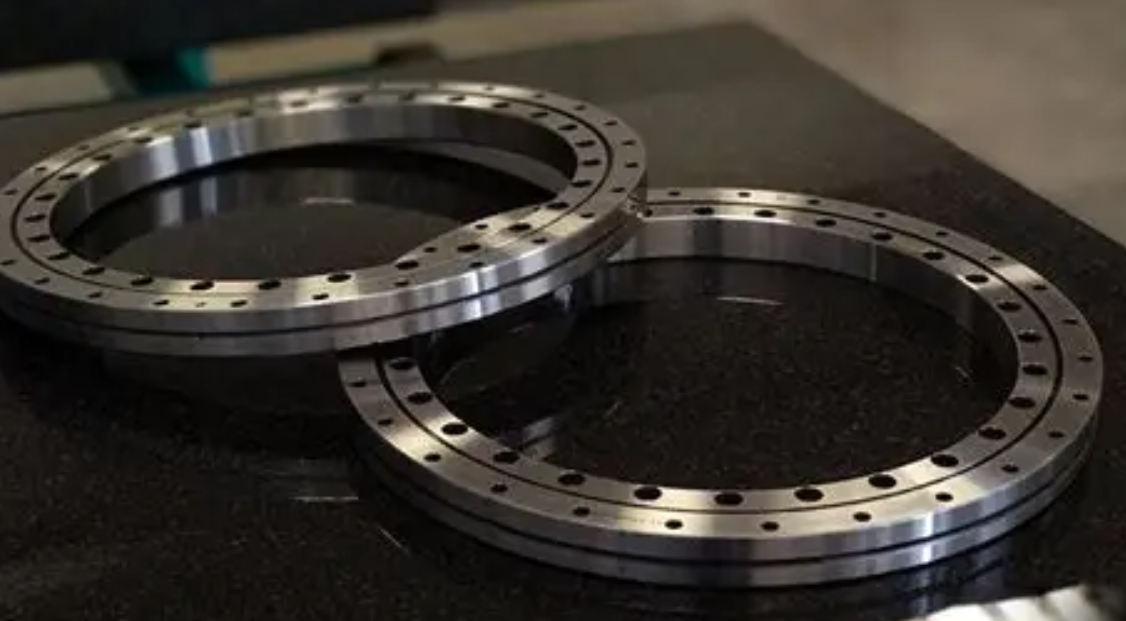
What is a slewing ring? A slewing ring, also called a slewing bearing, is a large rotational bearing that supports axial load, radial load, and overturning moment while allowing a machine structure to rotate. It is commonly used in cranes, excavators, industrial turntables, aerial work platforms, and material-handling equipment.
When you purchase slewing ring products for an OEM project, the lowest unit quotation is rarely the lowest acquisition cost. A quote can exclude tooling, inspection scope, export packing, freight, import duties, or the cost effect of a supplier’s minimum order quantity. Procurement teams should compare the full delivered and accepted cost before selecting a supplier.
Define the Bearing Requirement Before Comparing Supplier Quotes
Start with the actual working condition, not a catalog image or a previous purchase order alone. Two rings with a similar outside diameter can have different raceway structures, gear forms, mounting patterns, materials, and load capacity. Those differences can change both price and service life.
The first decision is whether the application needs a standard bearing or a custom design. Standard products usually fit replacement work, common machinery layouts, or prototypes where the mounting interface already matches an existing part. A custom bearing is a better fit when the bolt pattern, gear arrangement, load direction, installation space, or operating environment differs from available catalog products.
| Buyer input | Why it affects cost | Best fit | Limit or question to resolve |
|---|---|---|---|
| Axial, radial, and moment load data | Determines bearing type, raceway design, and material selection | All new equipment projects | Do not select by diameter alone when combined loads are present |
| Gear type and drive arrangement | Internal gear, external gear, or gearless construction changes machining scope | Rotating platforms and driven structures | Confirm tooth data and mating pinion details before release |
| Mounting hole pattern | Changes drilling, fastening layout, and possible tooling needs | Retrofit and replacement orders | Verify drawings against the installed machine, not only old part numbers |
| Environment and corrosion exposure | Influences material and surface protection selection | Marine, outdoor, dusty, or wet applications | Protection requirements must match the actual exposure condition |
| Expected order quantity | Spreads one-time engineering and tooling cost across more units | OEM repeat programs | Low-volume custom orders can have a higher cost per unit |
For lighter rotating structures, a Light Load Slewing Bearing may be suitable when the loads and overturning moment are within the selected bearing’s limits. This is not the right choice for equipment with heavy cyclic loading, high shock, or major overturning moment. In those cases, a Heavy load slewing bearing should be evaluated against the machine load calculation.
Luoyang Slewring Bearing Co., Ltd. supports Slewing Bearing, Slew Drive, and Customized Slew Drive requirements. Material can be selected from ductile cast iron, alloy steel, stainless steel, or forged alloy steel according to load, speed, and environment. Buyers should still provide the operating data needed to confirm that selection; material names alone do not prove application suitability.
Build a Landed-Cost Model Instead of Comparing Unit Prices Alone
The correct cost comparison separates each expense that occurs before the bearing is accepted at the buyer’s destination. This makes a domestic quotation and an export quotation easier to compare on the same basis. It also prevents a low ex-works price from hiding charges that appear later in the project.
Use this working formula: landed cost per accepted bearing = unit price + allocated tooling + allocated inspection + allocated freight and export charges + duties and import charges + internal receiving cost + expected cost of rejected or delayed units. The final two terms vary by buyer location and internal process, so they should not be guessed by a supplier.
| Cost element | What to request or calculate | Why buyers miss it | MOQ effect |
|---|---|---|---|
| Unit price | Price per bearing at the stated trade term and quantity | Quotes may use different delivery terms | Often falls as quantity increases, but compare the full total |
| Tooling | One-time cost for special machining, fixtures, or other custom production needs when applicable | May be listed separately or embedded in the unit price | A fixed charge has more impact on a small order |
| Inspection | Included inspection scope, reports, and any buyer-requested additional checks | “Tested” does not identify the inspection method or documentation | Per-unit inspection costs can differ by order scope |
| Freight and export charges | Packing, inland transport, port handling, ocean or air freight, and insurance if needed | Freight can change between quote date and shipment date | Small shipments may carry a higher freight cost per unit |
| Duties and import charges | Destination tariff classification, duty rate, customs brokerage, and local taxes | These are destination-specific, not universal supplier charges | Usually calculated from shipment value rather than production quantity |
| Minimum-order effect | Total order value divided by the quantity actually needed | Buyers may purchase surplus stock only to meet MOQ | Can outweigh a lower quoted piece price |
The conclusion is straightforward: select the quote with the lowest accepted delivered cost for the required quantity and delivery condition, not automatically the lowest line-item price. This approach fits procurement teams comparing domestic stock offers with direct export production. It does not replace a technical review, because an incorrectly specified bearing is expensive even when freight and duty are low.
MOQ is especially important in a custom project. Luoyang Slewring Bearing Co., Ltd. states a standard product MOQ of 1 set and a customized product MOQ of 5 sets. A buyer requiring one custom replacement should therefore first confirm whether an existing standard design can meet the requirement, rather than assuming a custom one-piece order is available.
Worked comparison for a small OEM requirement
Consider a buyer who needs four rings for a pilot machine build but receives a custom supplier quote based on the supplier’s five-set minimum. The procurement calculation should divide the full purchase cost by the four units used now only if the fifth unit has no planned value. If the fifth ring is retained as a qualified spare for the same machine, it should be treated as usable inventory rather than waste.
The right decision depends on the program forecast. Ordering five units makes sense when the next build, service stock plan, or validation process will use the additional ring. It does not make sense merely because the quoted unit price appears lower while the extra unit will remain obsolete or tie up cash.
Request Your Custom Slew Drive or Bearing Spec
Tell us your load, speed, and environment — receive a tailored 100–5000 mm slewing drive or slewing bearing proposal with 3D drawings within 24 hours.
Check Engineering Scope, Quality Evidence, and Acceptance Terms
A bearing quotation should identify what is being supplied and how conformity will be checked. Ask for the product drawing or confirmed dimensional information, gear details where applicable, material selection basis, inspection scope, packing condition, delivery term, and warranty terms. If any item is absent, the quote is not yet ready for an equal comparison.
Luoyang Slewring Bearing Co., Ltd. operates an ISO 9001:2015 quality management system certified facility and has CE marking for the European market. The company also states that factory audit reports are available on request. These records can support supplier qualification, but buyers should verify whether their own equipment, market, or customer contract requires additional documentation.
For quality control, the company states that every slewing bearing passes CMM three-coordinate inspection and dynamic load testing. This is relevant when a buyer needs objective verification before accepting bearings for heavy equipment. The remaining question is the project-specific acceptance criteria, which should be agreed before ordering rather than assumed from a general statement.

Our facility includes CNC machining centers and CMM three-coordinate inspection equipment, with six production lines in an 8,000 m² manufacturing facility. Annual capacity is stated as 100,000 sets. Capacity information helps a buyer assess supplier fit for ongoing demand, but it does not by itself reserve production capacity for a particular project; delivery planning should be confirmed in the quotation.
The company offers a 3-day rapid prototyping capability and a 9-day standard production cycle. These time frames are useful planning references for suitable orders, not blanket guarantees for every bearing design, inspection requirement, or freight route. Custom geometry, special requirements, and destination logistics can change the final schedule.
Match Bearing Construction to the Machine Instead of the Catalog Price
Buyers should compare bearing types based on load path and operating duty. A single-row ball bearing can suit applications with moderate combined loads, while other arrangements are selected when load distribution, rigidity, or higher capacity is needed. The choice should come from the machine calculation and installation design.
- Single-row ball design: Consider it for applications with moderate combined loading and a need for a compact arrangement. Do not use catalog familiarity as proof that it will handle high overturning moment.
- Double-row ball design: Consider it when the application benefits from a larger load-carrying arrangement than a basic single-row option. Confirm mounting stiffness and the full combined load condition.
- Crossed-roller design: Consider it where rotational accuracy and rigidity are important. It may not be the lowest-cost answer for simple, low-demand rotation.
- Three-row roller design: Consider it for heavy-duty machinery with demanding load conditions. It can be unnecessary for a low-load platform where a simpler bearing meets the design requirement.
For a project that needs a bearing-only component, review the available Slewing Bearing options before adding a drive assembly. For an application that needs controlled rotation with an integrated worm transmission, a Worm Gear Slew Drive may better match the requirement. These are different procurement scopes, so their quotations should not be compared as if they deliver the same assembly.
Luoyang Slewring Bearing Co., Ltd. has focused on slewing bearing and slew drive research and development for more than 15 years, supporting more than 2,000 heavy-equipment projects. This background is useful for buyers sourcing designs that need coordination between the bearing and drive system. It does not remove the need for the buyer to provide interface dimensions, load conditions, and application limits.
Use Real Project Evidence to Assess Supplier Fit
Relevant case evidence is more useful than broad claims about industry coverage. For example, a Houston, Texas engineering machinery manufacturer ordered 100 units of SEA21-125-25HR(2) for slewing platform and turntable systems. This supports the company’s experience with repeated industrial turntable supply, but it should not be treated as proof that the same model fits another platform.
For higher-load drive requirements, an Australian heavy equipment manufacturer used HWE21-94-25HR.1 double worm slew drives for mining excavators. In British Columbia, a forestry equipment manufacturer ordered 30 WED14-86-25BHR.5 double worm slew drives for forestry grapple machines, with tracking precision stated at no more than 0.13°. These cases are relevant when evaluating double-worm designs for demanding equipment, not as universal performance values for all products.
The company also supplied 20 units of WEA9-62-25HR single worm slew drives to a South Korean port equipment manufacturer for port crane systems. The case specifies no more than 0.15° tracking precision, IP65 sealing, and self-locking for that application. Buyers with port, crane, or marine requirements should compare their own precision, sealing, and duty-cycle needs against the proposed configuration.
For buyers needing a nonstandard drive interface rather than a standard bearing, the Customized Slew Drive scope may be appropriate. The custom MOQ is 5 sets, and sample orders are welcome for testing and evaluation. Sampling is useful when the buyer needs to validate fit or function, but it should not be used as a substitute for defining acceptance criteria before production.
Use This RFQ Checklist to Avoid Cost Gaps and Rework
A clear RFQ reduces the chance of receiving quotations that look comparable but cover different products or responsibilities. Send the same information to each supplier, then record each answer in one comparison sheet. That gives procurement and engineering teams a shared basis for approval.
- Provide the bearing drawing, interface dimensions, mounting-hole pattern, gear requirement, and desired rotation arrangement.
- State axial load, radial load, overturning moment, rotation speed, duty cycle, and environmental exposure.
- Identify whether the need is a standard replacement, prototype, pilot build, or repeat OEM program.
- Request the unit price and list any tooling, special inspection, packing, freight, or export-related charges separately.
- State the delivery destination and ask the supplier to identify the trade term used in the quotation.
- Calculate duties, brokerage, taxes, and local receiving costs using the buyer’s own import information.
- Confirm the applicable MOQ and decide whether surplus units will be usable production stock or spare inventory.
- Agree on drawings, inspection records, acceptance criteria, warranty scope, and responsibility for nonconforming products before placing the order.
Luoyang Slewring Bearing Co., Ltd. provides a technical proposal within 24 hours and a 48-hour technical response. The company also offers a 2-year extended quality warranty and free replacement for confirmed manufacturing defects. These terms are relevant to supplier selection, while the exact product configuration, shipping responsibility, and project acceptance requirements still need to be confirmed in the order documents.
A sound decision to purchase slewing ring products combines engineering fit with a transparent landed-cost calculation. Compare the bearing scope, MOQ impact, inspection evidence, delivery condition, and import exposure in one sheet. That process helps procurement teams select a supplier based on the actual cost and risk of putting the correct part into service.
Request Your Custom Slew Drive or Bearing Spec
Tell us your load, speed, and environment — receive a tailored 100–5000 mm slewing drive or slewing bearing proposal with 3D drawings within 24 hours.
 WhatsApp

 +8613903880726