



What is an OEM slew bearing? It is a slewing bearing specified or adapted for an equipment manufacturer’s own load, mounting, rotation, gear, and operating requirements rather than selected only by outside diameter or a catalog reference.
The sourcing risk starts before the first quote. A buyer may receive several apparently suitable offers, then find that one supplier assumed a different mounting interface, load direction, duty cycle, or acceptance method. That can produce a bearing that fits the drawing but does not fit the machine.
For a first custom RFQ, the right goal is not to collect the lowest unit price first. The goal is to make every supplier quote the same engineering requirement. Luoyang Slewring Bearing Co., Ltd. supports Slewing Bearing, slew drive, and customized slew drive requirements for equipment builders that need this level of definition.
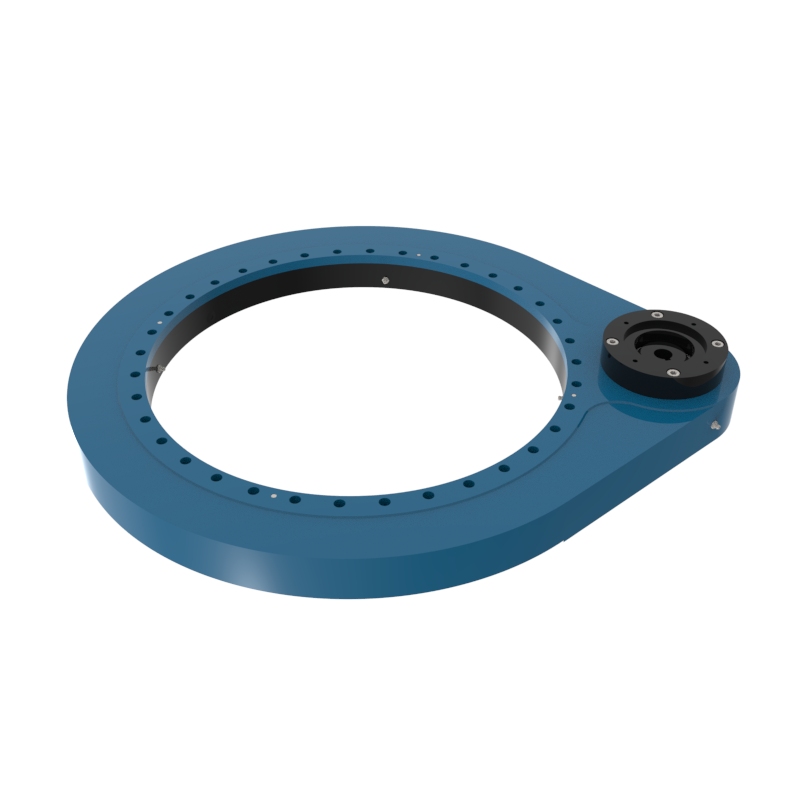
Decide whether a custom bearing is necessary before requesting quotations
The first decision is simple: use a standard product when the machine can accept an existing mounting pattern, gear form, load range, and operating arrangement. Specify a custom design when one or more of those conditions cannot be changed without redesigning the machine structure around it.
A custom request fits equipment such as a crane turntable, excavator attachment, industrial positioning platform, forestry grapple, or marine deck system where interface limits can control the selection. It does not automatically apply just because the application is heavy-duty. A standard bearing may still be the better commercial option if it matches the actual load and mounting needs.
| Buyer condition | Recommended sourcing route | Reason | Limit to verify |
|---|---|---|---|
| Existing equipment uses a known bearing reference | Start with a standard replacement comparison | The interface and envelope may already be proven in service. | Confirm the old reference reflects the current load and duty cycle, not an outdated machine version. |
| New platform has fixed bolt circles or limited installation space | Prepare a custom slewing bearing RFQ | The mounting interface can rule out catalog sizes even when load requirements appear moderate. | Do not define the bearing from dimensions alone; include load directions and gear needs. |
| Machine needs controlled rotation with a drive assembly | Evaluate a bearing and drive system together | The bearing, gear engagement, drive torque, and sealing requirements affect each other. | A bearing-only quote is not enough if the equipment requires an integrated drive. |
| Application has unusual environment exposure | Identify environmental conditions in the RFQ | Material and protection choices must match moisture, corrosion, dust, or temperature exposure. | Do not assume a standard seal arrangement is suitable for every site. |
Luoyang Slewring Bearing Co., Ltd. has operated since 2012 with six production lines and an 8,000 m² manufacturing facility. For buyers, this matters when a request needs both engineering discussion and a production path, rather than a reseller quote based only on a partial drawing.
The company’s scope includes bearing design and worm gear drive production. Where the application needs a rotating assembly instead of a free slewing ring, review the available Slew Drive options before separating the bearing and drive into unrelated RFQs.
Build a pre-RFQ data package that prevents mismatched custom designs
The most useful first-RFQ deliverable is a controlled data package, not a one-line request for “custom bearing pricing.” The conclusion is clear: provide load spectra, mounting interfaces, duty cycles, and approval sample requirements together. Each item closes a different gap that could otherwise lead to mismatched quotations.
This approach fits new equipment programs and replacement projects where the old bearing failed, the frame changed, or the machine will enter a different service condition. It is less necessary for a direct replacement with a fully verified part number, but even then the buyer should confirm that the service profile has not changed.
| Pre-RFQ item | What the buyer should provide | How it prevents a mismatch | Question that remains if omitted |
|---|---|---|---|
| Load spectrum | Axial, radial, and overturning moment loads by operating condition, including peak events and direction changes | It lets suppliers assess the bearing against actual working loads instead of a single incomplete load figure. | Was the quote based on normal operation, a peak lift, transport, shock, or another assumption? |
| Mounting interface | Installation drawing, bolt-circle details, mounting surface dimensions, available height, gear position, and adjacent component clearance | It checks physical fit before a design is priced. | Can the proposed unit be installed and serviced inside the existing structure? |
| Duty cycle | Rotation pattern, operating hours, starts and stops, direction reversals, idle periods, and expected operating environment | It distinguishes occasional positioning from repeated cyclic use. | Is the quoted design suitable for the machine’s real operating pattern? |
| Approval sample plan | Whether a sample is required, what documents accompany it, what the inspection points are, and who gives final approval | It makes acceptance criteria visible before volume production is discussed. | Will the sample be judged by dimensions, fit-up, motion, inspection records, or all of these? |
| Application details | Machine type, end-use sector, target market, expected service environment, and related drive arrangement | It gives context for material and protection selection. | Has the design been quoted without knowing the actual working condition? |
Load information should show more than a maximum value. A crane, for example, may see a high overturning moment only during part of a lift cycle, while an automation table may operate under lower loads but with frequent starts, stops, and reversals. Both situations can require different design decisions.
Mounting drawings should identify the upper and lower structures that contact the ring. Include available machining space and any interference zones from hydraulic lines, guards, motors, or cable routing. A bearing can be mechanically capable yet still be unsuitable if tooling cannot reach mounting fasteners after assembly.
Approval samples should be treated as a commercial and technical agreement, not a vague request. Luoyang Slewring Bearing Co., Ltd. welcomes sample orders for testing and evaluation, while customized products have a stated MOQ of five sets. The buyer and supplier still need to agree on sample scope, acceptance criteria, documentation, and responsibility before the order is placed.
Use a controlled requirement sheet for every supplier
- Assign one internal drawing revision and one RFQ reference number.
- List load cases separately rather than combining all conditions into one unexplained value.
- Attach interface drawings and clearly mark dimensions that cannot change.
- Describe the actual rotation cycle and site environment.
- State whether the request is for a bearing only, a geared bearing, or a drive assembly.
- Define what documents and inspection evidence are required before acceptance.
- Send the identical package to each qualified supplier for a like-for-like response.
This sequence is practical for engineering and sourcing teams working together. It does not replace the supplier’s design review, and it should not be used to force a supplier to match an incomplete legacy drawing when the field application has changed.
Request Your Custom Slew Drive or Bearing Spec
Tell us your load, speed, and environment — receive a tailored 100–5000 mm slewing drive or slewing bearing proposal with 3D drawings within 24 hours.
Compare supplier evidence instead of comparing bearing prices alone
The best supplier comparison starts with evidence that supports the quoted design. Price matters, but a lower figure has limited value when the quotation does not confirm inspection scope, production capability, material selection basis, or the exact assumptions behind the load rating.
Luoyang Slewring Bearing Co., Ltd. is ISO 9001:2015 certified and provides CE marking for the European market. Factory audit reports are available on request. These points are relevant when a buyer needs documented supplier qualification, but they do not remove the need to validate the specific product against the application.
Quality evidence should also connect to the component being purchased. The company states that every slewing bearing passes CMM three-coordinate inspection and dynamic load testing. This is useful for buyers who need a defined inspection basis; however, the RFQ should still identify any project-specific dimensions, reports, or acceptance records required by the customer.
| Comparison point | What a buyer should request | Why it matters | Limit |
|---|---|---|---|
| Design response | Written confirmation of load assumptions, interface assumptions, and proposed bearing arrangement | It reveals whether the supplier interpreted the RFQ correctly. | A short response may be sufficient for a standard replacement, not for a new machine design. |
| Inspection evidence | Inspection scope and available records for the ordered product | It supports receiving inspection and acceptance planning. | Generic quality claims do not identify project-specific checkpoints. |
| Production readiness | Lead-time basis, MOQ, and capacity information | It helps separate prototype needs from recurring production needs. | Capacity is not a substitute for a confirmed production schedule. |
| Material proposal | Material selection linked to load, speed, and environment | It makes the design basis visible. | Material names alone do not prove application suitability. |
| Warranty and support | Warranty terms and technical response terms in the order documentation | It clarifies post-delivery responsibilities. | Coverage must be reviewed against the final order conditions. |
The company selects from ductile cast iron, alloy steel, stainless steel, and forged alloy steel according to load, speed, and environment. That is a useful design basis for custom work. It should not be interpreted as a reason to preselect a material before the load cases and environmental conditions are known.
For high-load equipment, bearing arrangement is part of the supplier evaluation. Buyers can review Heavy load slewing bearing options when comparing design directions, especially where sustained cyclic loads or large moments are expected. The final arrangement should remain tied to the submitted application data.
Use relevant project evidence to assess application fit
Real application references are more useful when they resemble the intended equipment. The conclusion is to ask whether the supplier has evidence in a similar loading, motion, and environmental condition, rather than asking only for a list of industries served.
For port crane systems, a South Korean port equipment manufacturer placed a repeat order for 20 WEA9-62-25HR single worm slew drives. The stated project requirements included tracking precision of no more than 0.15°, IP65 sealing, and self-locking. This reference is relevant for crane rotation and controlled drive applications, but it is not proof that the same drive fits another crane without separate load and interface review.
For mining equipment, an Australian heavy equipment manufacturer used HWE21-94-25HR.1 double worm slew drives for mining excavators. For forestry equipment, a manufacturer in British Columbia, Canada used 30 WED14-86-25BHR.5 double worm slew drives for grapple machines with stated precision of no more than 0.13°. These examples help a buyer identify similar equipment categories, not copy a part number without engineering confirmation.
Solar and automation projects show a different operating profile. A U.S. renewable energy equipment manufacturer ordered 50 SP-I 0841 units for utility-scale solar tracker systems, with IP65 protection for desert sites. A Manchester, UK automation equipment manufacturer ordered 100 SP-I 0841-32.1 units for automated turntable systems. These cases show that motion pattern and environment can be as important as headline load when selecting a slewing solution.

Set commercial terms and technical acceptance before issuing the purchase order
Once the design direction is selected, the purchase order should repeat the approved technical scope rather than referring only to an informal email thread. The conclusion is to connect the quotation, drawing revision, inspection expectations, packaging needs, delivery requirement, and warranty terms in one controlled order record.
Luoyang Slewring Bearing Co., Ltd. states a three-day rapid prototyping capability and a nine-day standard production cycle. These are useful planning indicators, especially for a buyer comparing development and recurring-order needs. They are not a substitute for confirming the lead time for a specific custom configuration, quantity, drawing status, and approval requirement.
Standard products have an MOQ of one set, while customized products have an MOQ of five sets. This distinction matters early. A buyer needing only one custom validation unit should discuss whether a sample order is possible and what conditions apply instead of assuming that standard-product terms cover a custom build.
The company offers a two-year extended quality warranty, a 48-hour technical response, and free replacement for confirmed manufacturing defects. These terms are meaningful only when the order clearly identifies the approved product configuration and the conditions under which a defect determination will be made.
Buyer checklist before releasing a custom order
- Confirm the final drawing revision and part identification on the purchase order.
- Confirm all load cases and the duty cycle used for the design proposal.
- Confirm mounting interfaces, gear requirements, and installation clearances.
- Confirm whether the order covers a bearing, a Customized Slew Drive, or another assembly.
- Confirm sample, inspection, and approval requirements before production release.
- Confirm MOQ, order quantity, delivery basis, and the quoted lead-time conditions.
- Confirm applicable warranty terms and the process for technical support.
- Retain supplier inspection records and the accepted drawing with the equipment file.
Avoid the RFQ mistakes that create costly rework
The most common mistake is requesting a quote using only outside diameter, height, and a photo of an old part. That may work for a confirmed replacement, but it does not define load direction, mounting rigidity, duty cycle, or operating environment. The result can be a quote that looks comparable but is based on different assumptions.
- Comparing unit price before technical scope: Compare design assumptions first. Price comparison is meaningful only after suppliers quote the same load and interface requirements.
- Using one “maximum load” without a load spectrum: Separate normal, peak, directional, and cyclic conditions. A single number can hide the operating case that governs the design.
- Leaving bolt details off the drawing: Provide mounting information and access constraints. This applies whenever the bearing mounts inside a restricted frame or turntable.
- Assuming an old part is automatically correct: Verify the current machine configuration. This does not apply only when the replacement is confirmed identical in use and interface.
- Requesting a sample without acceptance criteria: Define what will be checked before the sample is ordered. Otherwise, both parties may judge the same part by different standards.
- Ignoring installation and maintenance access: Review the full assembly, not the bearing envelope alone. A suitable bearing can still create avoidable assembly problems.
For OEM engineering teams, a well-prepared RFQ reduces the chance that technical review starts after an order is released. It also gives procurement a stronger basis for comparing supplier capability, inspection evidence, MOQ, lead-time conditions, and documented support terms.
Luoyang Slewring Bearing Co., Ltd. is a practical fit when the buyer can provide a defined load and interface package and needs support across slewing bearings, slew drives, or custom drive arrangements. The remaining work is application-specific: confirm the load spectrum, mounting structure, operating cycle, environment, acceptance method, and final order conditions before selecting the design.
Request Your Custom Slew Drive or Bearing Spec
Tell us your load, speed, and environment — receive a tailored 100–5000 mm slewing drive or slewing bearing proposal with 3D drawings within 24 hours.
 WhatsApp

 +8613903880726