



What is a slew bearing? A slew bearing is a large-diameter rolling bearing that supports axial load, radial load, and overturning moment while allowing a machine structure to rotate. It is commonly used in cranes, excavators, turntables, material handling equipment, aerial platforms, and solar tracking systems.
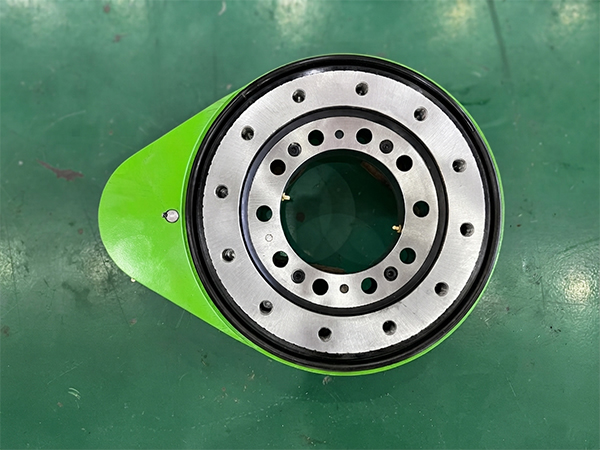
When you see a slew bearing for sale in a catalog, the main risk is assuming that a similar outside diameter means the part is a safe replacement. It may not be. A bearing can look correct in a product photo and still have the wrong bolt pattern, gear position, height, load arrangement, or mounting interface.
For procurement managers, the decision is not simply stock versus custom. The real question is whether a catalog unit is dimensionally interchangeable and suitable for the machine’s operating condition. Luoyang Slewring Bearing Co., Ltd. supplies Slewing Bearing products, Slew Drive products, and Customized Slew Drive solutions for buyers who need to confirm that fit before placing an order.
Start with the replacement risk rather than the catalog price
A low catalog price only helps when the bearing can be installed without changes to the host machine. If the replacement ring requires new adapter plates, altered bolts, changed gear engagement, or modified seals, the apparent savings can disappear quickly.
The best use case for an in-stock catalog bearing is a replacement with a documented drawing, a known model number, and a matching installation interface. It is less suitable when the original unit has an unknown internal structure, a special gear design, nonstandard mounting holes, or a machine duty cycle that differs from the catalog application.
Before comparing suppliers, separate the request into two categories:
- Direct replacement request: The buyer has an OEM drawing, a legible nameplate, or an existing bearing that can be measured. A catalog alternative may work if all interface and operating checks match.
- Functional replacement request: The buyer knows the machine function but lacks complete bearing data. This usually needs engineering review before a stocked model can be approved.
- New machine or redesign request: The machine design is still open, or the available space and load path are changing. A made-to-order bearing is often the safer choice because the interface can be designed around the machine.
Do not treat a product image, outer diameter, or basic bearing series as approval evidence. A similar ring may be intended for a lighter load path, a different gear drive arrangement, or a different mounting stiffness condition.
For applications with a separate drive unit, the bearing selection must also match the torque and mounting arrangement of the drive. Buyers sourcing both components can review the available Slew Drive range alongside the bearing requirement instead of evaluating the rotating interface in isolation.
Verify eight interchangeability points before accepting a catalog replacement
The clear conclusion is simple: approve a catalog unit only after the mounting, gear, and working-condition interfaces have been checked together. This fits emergency replacements and repeat equipment builds. It does not apply when a supplier has only the outer diameter and a photograph.
- Confirm the bearing arrangement. Identify whether the original uses a ball, crossed roller, double-row ball, or roller arrangement. The arrangement affects how the bearing carries combined loads. A different type should not be treated as a direct replacement without design review.
- Check outside diameter, bore diameter, and total height. These dimensions determine whether the ring can physically enter the machine envelope. Matching one diameter is not enough because the central opening and assembled height also affect nearby structures.
- Match the mounting-hole pattern. Confirm the quantity of holes, hole diameter, pitch circle diameter, thread form where applicable, and hole spacing. A ring can have the same diameters but a different bolt circle.
- Confirm gear location and gear form. Verify internal gear, external gear, or gearless construction. Then compare the mating pinion arrangement. A gear position mismatch can prevent assembly even if the bearing mounts correctly.
- Identify the load direction. Record axial load direction, radial load, overturning moment, and whether these loads occur at the same time. This matters for crane booms, excavator upper structures, rotating platforms, and offset loads.
- Review rotation speed and duty cycle. A bearing used for occasional positioning is not automatically suitable for repeated cyclic rotation. Share the operating pattern rather than providing only a maximum speed.
- Review the environment. Dust, water exposure, salt air, temperature changes, and corrosion conditions can affect seal and material choices. This check is especially relevant for marine, port, mining, and outdoor equipment.
- Confirm installation conditions. The flatness and rigidity of the mounting surfaces, bolt tightening method, and gear backlash all influence service behavior. A good bearing cannot correct a distorted mounting structure.
Use the original drawing whenever possible. If it is unavailable, provide clear photos of both bearing faces, the gear side, the nameplate, and measured dimensions. Also identify the machine model and the failure mode of the old unit, such as gear tooth damage, rough rotation, loosened bolts, or seal deterioration.
For a bearing carrying high combined loads, buyers may need a dedicated heavy-duty design rather than a general-purpose ring. The product category for Heavy load slewing bearing applications is a useful starting point, but the final selection still depends on the actual mounting and duty data.
Comparison between catalog-stock and made-to-order bearings
Choose a catalog-bearing option when verified interchangeability is available and the machine duty remains within the supplier’s confirmed application scope. Choose a made-to-order bearing when the fit, load path, gear arrangement, or documentation is uncertain. The table below shows where each option has limits.
| Decision factor | Catalog-stock bearing | Made-to-order bearing | Buyer decision limit |
|---|---|---|---|
| Dimensional interchangeability | Suitable when diameters, height, bolt pattern, gear position, and mounting faces match the required unit. | Can be designed around a nonstandard envelope, hole pattern, gear arrangement, or connection interface. | Do not approve catalog stock based on outside diameter alone. |
| Lead time | May reduce sourcing time if the exact model is available for release. | Requires engineering confirmation and production planning for the requested design. | Confirm actual availability before promising a maintenance shutdown date. |
| Traceability | Buyer should request model identification, inspection records, and confirmation of the delivered configuration. | Buyer should agree the approved drawing, material selection basis, inspection scope, and configuration before production. | A part number without a controlled drawing may not identify every functional feature. |
| Application-risk limit | Best for established replacement applications with known operating conditions. | Better for unusual loads, special environments, changed machine geometry, or uncertain OEM interfaces. | Do not substitute either option without reviewing the machine duty and installation condition. |
| Order quantity | Useful for maintenance needs and small replacement quantities where an approved model is available. | Useful when the design requirement justifies a dedicated configuration. | Luoyang Slewring Bearing Co., Ltd. states a standard product MOQ of 1 set and a customized product MOQ of 5 sets. |
This comparison is not a rule that custom is always safer. A proven catalog bearing can be the correct solution for a repeat replacement. The limit is that “proven” must refer to the actual machine interface and work condition, not only to a familiar product series.
Request Your Custom Slew Drive or Bearing Spec
Tell us your load, speed, and environment — receive a tailored 100–5000 mm slewing drive or slewing bearing proposal with 3D drawings within 24 hours.
Use bearing type to narrow the supplier comparison
After confirming whether stock or made-to-order sourcing is appropriate, compare the bearing construction against the machine’s load behavior. The following options are not interchangeable by default. Each has a different purpose and should be selected against the machine design.
| Bearing option | Where it can fit | Why a buyer may select it | When not to assume it fits |
|---|---|---|---|
| Single Row Slewing Ring Ball Bearings | General rotating equipment with a defined combined-load requirement. | They provide a common structural format for many slewing applications. | Do not replace a multi-row or roller design without checking the original design basis. |
| Crossed Roller Slewing Bearings | Applications where rotational guidance and stiffness requirements need review. | The arrangement may suit equipment that needs controlled rotational support. | Do not select from diameter alone or assume the mounting holes match another series. |
| Double Row Ball Slewing Ring Bearing | Equipment with a load distribution requirement that differs from a single-row design. | It offers an alternative bearing arrangement for application-specific loads. | Do not use it as a direct upgrade unless the machine structure and drive interface are checked. |
| Three-row Roller Slewing Bearings | Heavy equipment where load directions may need to be considered separately. | They are relevant when the project calls for a heavy-duty roller arrangement. | They may require a different installation envelope and cannot be assumed to replace a ball bearing ring. |
The practical buying rule is to compare the original bearing structure first, then compare dimensions and mounting details. Selecting a heavier-looking bearing does not automatically improve the equipment. It can create new fit, gear, or bolt-load issues.
Check supplier evidence, production scope, and quality controls
A supplier comparison should include more than catalog breadth. Ask what evidence supports the supplied configuration, what inspection is available, and what quality terms apply if a confirmed manufacturing defect is found.
Luoyang Slewring Bearing Co., Ltd. operates an 8,000 m² manufacturing facility with six production lines and an annual capacity of 100,000 sets. The company states a 3-day rapid prototyping capability, a 9-day standard production cycle, and a technical proposal within 24 hours. These points are relevant when a buyer has complete input data and needs a supplier able to move from review to production planning.
The facility is ISO 9001:2015 certified and provides CE marking for the European market. It also states that factory audit reports are available on request. For a buyer managing supplier qualification, those documents can support an internal review, but they do not replace machine-specific engineering approval.
Quality evidence should be tied to the actual part supplied. Luoyang Slewring Bearing Co., Ltd. states that every slewing bearing passes CMM three-coordinate inspection and dynamic load testing. Its stated quality terms include a 2-year extended warranty, a 48-hour technical response, and free replacement for confirmed manufacturing defects.
These controls address a real procurement concern: a replacement ring needs to match the ordered drawing or confirmed specification. They do not prove that an incomplete RFQ is safe. The buyer still needs to provide the operating requirement and confirm the final configuration before release.

Apply real project evidence to the right application
Relevant project history can help a buyer judge whether a supplier has handled comparable equipment. It should not be used to transfer a result from one machine directly to another. Port cranes, shipboard cranes, solar trackers, and mining excavators have different duty cycles and environmental demands.
- Port crane systems: A South Korean port equipment manufacturer placed a repeat order for 20 WEA9-62-25HR single worm slew drives. The stated application involved IP65 sealing, self-locking, and tracking precision of no more than 0.15°. This supports relevance for similar crane-drive requirements, not for every rotating platform.
- Solar tracker systems: South American solar projects in Brazil, Argentina, and Chile used SP-I 0229 spur gear slew drives for single-axis trackers, with reported energy yield improvement of up to 40%. That result belongs to those projects and should not be treated as a general yield promise.
- Mining excavators: An Australian heavy equipment manufacturer used HWE21-94-25HR.1 double worm slew drives for mining excavators. This example can inform a discussion of demanding equipment, but the excavator geometry and duty cycle must still be reviewed.
- Forestry grapples: A British Columbia manufacturer ordered 30 WED14-86-25BHR.5 double worm slew drives for forestry grapple machines, with stated precision of no more than 0.13°. This is relevant where repeatable positioning is required, not as a universal precision claim.
For buyers comparing a bearing with an integrated drive approach, product selection should include the drive type as well as the ring. A Double Worm Slew Drive may be relevant for certain equipment configurations, while a standalone bearing may better suit a machine with its own pinion and drive train.
Send an RFQ package that allows a safe yes-or-no answer
The fastest way to receive a useful technical proposal is to send enough information for the supplier to confirm or reject a catalog substitute. A short request that says “same as photo” often creates repeated questions and delays the sourcing decision.
- Provide the OEM part number, existing supplier model, or original drawing if available.
- Include measured outside diameter, bore diameter, overall height, bolt pattern, hole details, and gear location.
- Provide photos of the upper face, lower face, gear area, nameplate, and installed bearing position.
- State the machine type, application, load direction, rotation pattern, operating environment, and expected service duty.
- Identify whether the request is a direct replacement, a redesign, or a new machine build.
- State the required quantity, target delivery date, destination market, and whether a sample order is needed for evaluation.
- Ask the supplier to identify any mismatch between the catalog proposal and the original requirement before order confirmation.
For standard products, Luoyang Slewring Bearing Co., Ltd. accepts orders from 1 set. Sample orders are welcome for testing and evaluation. For customized products, the stated MOQ is 5 sets. These terms can fit maintenance buyers, wholesalers, and equipment builders, but final delivery timing and acceptance requirements should be agreed for the specific order.
A catalog bearing is a good purchasing option when it is verified as an actual replacement. If the dimensions, gear interface, loading condition, or installation arrangement remain uncertain, request a technical comparison instead of approving the lowest-priced listing. That step protects the machine, the maintenance schedule, and the procurement budget.
Request Your Custom Slew Drive or Bearing Spec
Tell us your load, speed, and environment — receive a tailored 100–5000 mm slewing drive or slewing bearing proposal with 3D drawings within 24 hours.
 WhatsApp

 +8613903880726