



You have three quotations on your desk for what appears to be the same slewing bearing. The specifications match, but the prices are thousands of dollars apart. Choosing the lowest bid seems logical, but it’s a significant risk. An artificially low price often hides costs in freight, tooling, or insufficient quality control that will surface later, leading to project delays and budget overruns. A true comparison of slewing ring bearing cost requires looking beyond the unit price and normalizing each quote.
As an engineer who has designed and specified power transmission systems for over 30 years, I’ve seen countless procurement teams fall into this trap. The key is to break down each proposal into its fundamental components—from the bearing’s material and precision to the commercial terms that define the total cost of ownership. This guide provides a structured framework for doing just that.
About the Author
Lewis is a Senior Mechanical Design Engineer with three decades of experience in heavy machinery and power transmission. He works across concept sketching, detailed CAD modeling, tolerance verification, and material selection, and has led the mechanical design of more than 200 heavy-equipment projects spanning construction machinery, port cranes, and industrial automation.
What Key Factors Drive the Initial Bearing Price?
Before you can normalize quotes, you must first understand the technical drivers behind the base price. Two bearings with the same outer diameter can have vastly different costs based on their internal design, materials, and manufacturing precision. When sending out an RFQ, ensure your technical specifications are clear on these points to receive comparable bids.
Here is a checklist of the primary technical cost drivers:
- Internal Structure: The type of rolling element and raceway design directly impacts load capacity and cost. A simple Single Row Slewing Ring Ball Bearings is more economical than a high-capacity Three-row Roller Slewing Bearings designed for heavy axial and moment loads.
- Material and Heat Treatment: The choice of raw material, such as standard carbon steel versus forged 42CrMo alloy steel, is a major cost factor. Furthermore, the depth and method of raceway and gear hardening (e.g., induction hardening) are critical for service life but add to the manufacturing expense.
- Precision Grade: Tighter tolerances mean more processing steps and higher rejection rates, increasing cost. A standard P0-grade bearing for a simple turntable is much less expensive than a P4-grade precision bearing required for a medical imaging gantry or a high-accuracy port crane. Our localized production of German-standard SE/WE series slew drives achieves these precision grades at a 30-50% cost savings compared to imported brands.
- Gear Type and Quality: An ungeared bearing is the simplest. Adding internal or external gearing increases cost. The precision of that gear (ISO/AGMA grade), whether it is ground or milled, and post-machining treatments all contribute to the final price.
- Sealing and Corrosion Protection: The operating environment dictates the required protection. A basic NBR seal for an indoor application is standard. However, a bearing for a marine crane, like the WEA17 units we supplied to UK Ocean Marine Systems, requires advanced multi-lip seals and special surface treatments (up to C4H anti-corrosion rating) to achieve an IP66 rating, which adds to the cost but is essential for reliability.
How to Normalize Supplier Quotes for an Apples-to-Apples Comparison
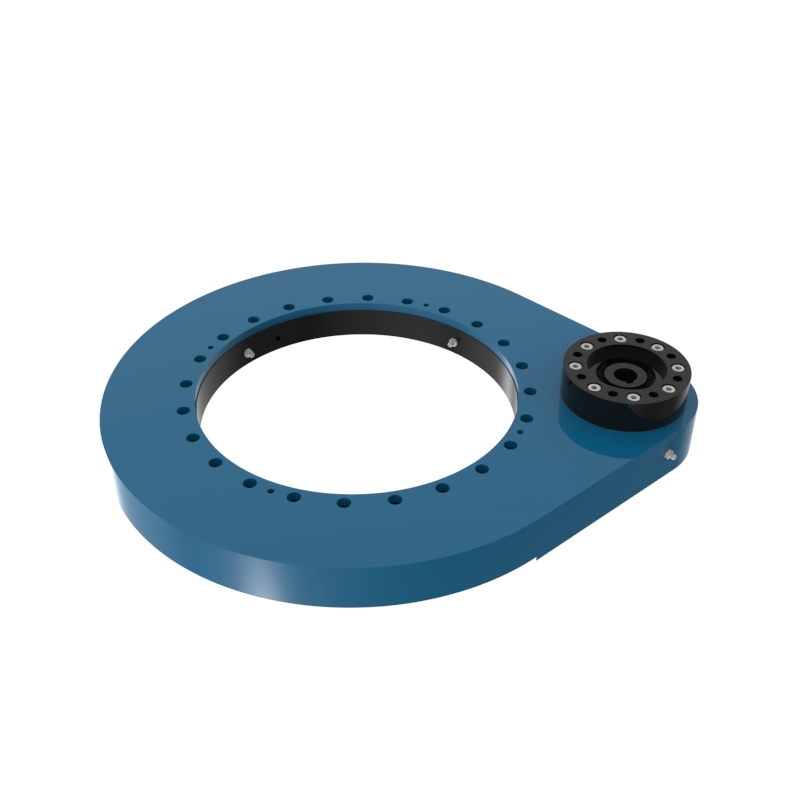
Once you are confident the technical specifications are aligned, the next step is to deconstruct the commercial terms. Hidden variables here often account for the largest price discrepancies. Use the following table as a guide to ask suppliers pointed questions and standardize their proposals into a format you can accurately compare.
| Line Item | What to Ask the Supplier | Why It Matters for Total Cost |
|---|---|---|
| Incoterms | "Is your price FOB (Free on Board), EXW (Ex Works), or DDP (Delivered Duty Paid) to our facility?" | A low EXW price is misleading. It excludes shipping, insurance, customs clearance, and duties, which can add 15-25% or more to the final landed cost. DDP is the most inclusive and easiest to compare. |
| Tooling / NRE Costs | "For this custom part, are all non-recurring engineering (NRE) and tooling costs included in the unit price, or will they be billed separately?" | For customized products, some suppliers amortize tooling costs into the unit price, while others charge a large one-time fee. This can make one supplier seem cheaper per unit but more expensive overall for small production runs. |
| Inspection & Documentation | "Does the price include a full dimensional report from a CMM, material certificates (3.1), and a heat treatment report?" | Basic inspection may be included, but critical documentation often costs extra. At Luoyang Slewring Bearing, our military-grade quality control means every bearing passes CMM inspection and dynamic load testing, with reports provided. This level of Slew Drive Quality Control prevents costly on-site failures. |
| Packaging | "Is the bearing packed in an export-grade, fumigated wooden crate with VCI anti-rust protection?" | Inadequate packaging for international sea freight can lead to damage from moisture or handling. The cost to repair or replace a rusted or damaged bearing far exceeds the cost of proper export packaging. |
| Warranty Terms | "What is the exact warranty period, and what does it cover? Who pays for shipping on a warranty claim?" | A 1-year warranty is standard, but a longer term indicates confidence in quality. We back our products with a 2-year extended warranty and offer free replacement for confirmed manufacturing defects, reducing your long-term risk. |
Request Your Custom Slew Drive or Bearing Spec
Tell us your load, speed, and environment — receive a tailored 100–5000 mm slewing drive or slewing bearing proposal with 3D drawings within 24 hours.
Common Sourcing Mistakes That Inflate Total Cost of Ownership
Focusing narrowly on the upfront slewing ring bearing cost is a classic procurement error. The total cost of ownership (TCO) includes the purchase price plus the costs of failure, downtime, and support. Avoiding these common mistakes is essential for making a sound investment.
- Assuming "Standard" Quality is Sufficient. Many suppliers can produce a bearing that meets basic dimensional requirements. Far fewer can guarantee the raceway hardness, gear precision, and material purity needed for heavy-duty cyclic loads. A bearing that fails prematurely in a mining excavator or port crane can cause catastrophic damage and weeks of downtime. This is why our military-grade quality control processes are non-negotiable, resulting in a failure rate below the 0.5% industry standard.
- Ignoring Lead Time and Production Capacity. A low price is irrelevant if the supplier cannot meet your project timeline. A supplier with limited capacity might offer an attractive price but then face delays. With 6 production lines and an annual capacity of 100,000 sets, we can commit to reliable delivery schedules, including a 3-day rapid prototyping service and a 9-day standard production cycle.
- Overlooking MOQ and Sample Policies. Some suppliers are only interested in high-volume orders, making it difficult to procure single units for prototypes or small projects. We support projects of all sizes with a standard product MOQ of just one set and welcome sample orders for testing and evaluation. This flexibility allows your engineering team to validate performance without a large capital commitment.
- Neglecting After-Sales Technical Support. When an installation question or a performance issue arises, who can you call? A low-cost supplier may not have an experienced engineering team available to help. A quick resolution is vital. We guarantee a 48-hour technical response from our experienced engineers to help you troubleshoot issues quickly and minimize downtime.
Real-World Examples: How Specifications Impact Final Price
The relationship between specification, quality, and price is not abstract. It plays out in real-world applications where performance is directly tied to safety and profitability. Here are a few examples from our projects that show why the "cheapest" option is rarely the best value.
Scenario 1: High Precision for Marine and Port Cranes
A South Korean port equipment manufacturer required slew drives for new crane systems. The critical specification was a tracking precision of ≤0.15° to ensure precise container handling. They chose our WEA9-62-25HR single worm slew drives, which are IP65 sealed for the marine environment. Achieving this level of precision requires advanced gear-hobbing machines and rigorous CMM verification. While this adds to the manufacturing cost, it is a non-negotiable requirement for the application's safety and efficiency. We have since received a 20-unit repeat order, confirming the value of this investment. Similarly, our Truck Crane Slewing Bearings are specified for a similar level of reliability for manufacturers like the one we supply in the Netherlands.
Scenario 2: Durability for Utility-Scale Solar Trackers
For large-scale solar projects in the deserts of South America and the United States, equipment reliability is paramount. A US-based renewable energy equipment manufacturer sourced 50 units of our SP-I 0841 spur gear slew drives for their solar tracker systems. The key challenge was the harsh desert environment—extreme temperatures and abrasive, wind-blown sand. The higher cost for IP65-rated sealing was essential to prevent contamination and ensure a 25-year design life. This upfront investment in durability directly translates to a higher energy yield (up to 40% more than fixed-tilt systems) and lower maintenance costs over the project's lifetime.
Scenario 3: High Torque for Heavy-Duty Machinery
A Canadian forestry equipment manufacturer needed a compact drive with extremely high holding torque and precision for their grapple machines. A standard single-worm drive could not meet the demands. They selected our WED14-86-25BHR.5 double worm slew drives. The dual-worm design engages the slewing ring at two points, increasing the contact area and delivering significantly higher torque and precision (≤0.13°). This advanced design carries a higher price tag than a single-worm unit, but it was the only way to achieve the required performance for safely manipulating heavy logs, demonstrating a clear case where a higher initial cost delivered superior operational capability.
Request Your Custom Slew Drive or Bearing Spec
Tell us your load, speed, and environment — receive a tailored 100–5000 mm slewing drive or slewing bearing proposal with 3D drawings within 24 hours.
 WhatsApp

 +8613903880726