



What is a heavy duty slew drive for mining? It is a compact rotation unit that combines a slewing bearing, a gear set (usually worm or spur) and a housing with a motor interface. It carries the load and turns it in one package. In mining, it sits under or inside excavator swing systems, drill rigs and other machines that rotate heavy structures in dust, mud and shock.
The sourcing risk is simple. If your RFQ lists only "high torque, heavy duty," every supplier will quote something different, and you will not know which quote fits your machine. The fix is to send load data in a form the supplier can turn into a drive specification. This guide shows how, and what to check about the supplier before you commit.
Why Mining Duty Cycles Break Underspecified Drives
Mining machines do not run at steady load. A swing drive on an excavator sees start-stop cycles, side loads when the bucket drags, and impact when it hits rock. Average load tells you very little about whether the drive will survive.
Three failure patterns show up again and again. Raceways pit when the tilting moment is higher than the bearing was sized for. Gear teeth wear early when peak torque is underestimated. Seals fail when dust and water reach the worm housing.
Every one of these starts with missing data at the RFQ stage. That is why the next section is built as a data-to-specification matrix.
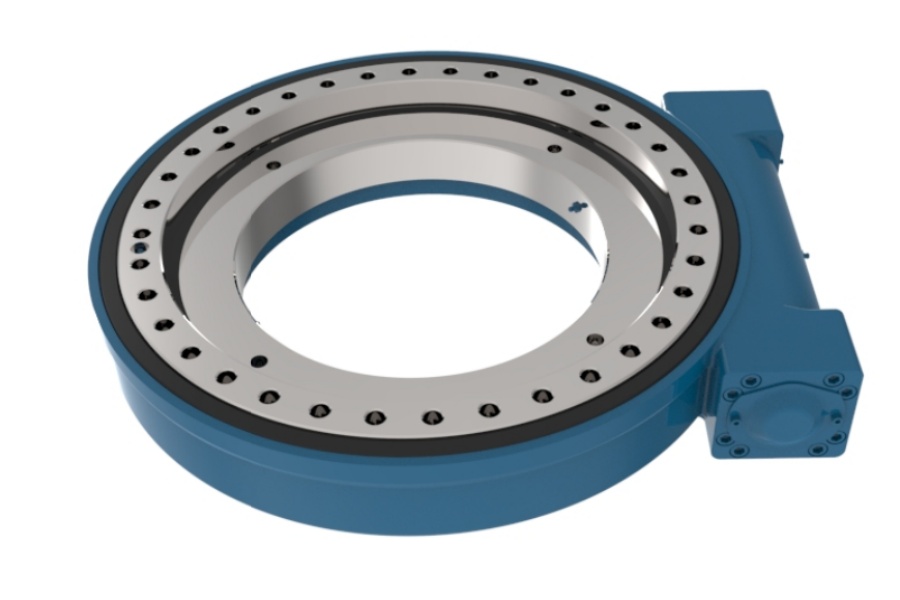
Sourcing Matrix: Converting Radial, Axial, Tilting-Moment and Shock-Load Data into Drive Specifications
Use the table below to translate your machine data into what the drive must deliver. The left column is what your engineers already have. The right columns show what that data decides and what to put in the RFQ.
| Load input | What it decides in the drive | What to send in the RFQ | Limit or trap |
|---|---|---|---|
| Axial load (vertical weight plus working force) | Bearing raceway type and size; number of roller or ball rows | Maximum static and working axial load, in kN, with direction (compression or lift-off) | Do not send machine weight alone. Add payload and any downward digging force. |
| Radial load (side force on the rotating axis) | Raceway contact angle and housing stiffness | Maximum radial force and where it acts on the structure | Radial load is often ignored on slope-working machines. Include it if the machine tilts. |
| Tilting moment (load times its distance from the axis) | Bearing diameter and row configuration; usually the sizing driver | Peak moment in kN·m, plus the load arm length and boom positions | A drive can pass on axial load and still fail on moment. Always send both. |
| Shock load (rock impact, sudden stops, bucket snag) | Gear material and heat treatment, worm configuration, safety margin | Peak torque or peak moment, how often it occurs, and the event that causes it | Send the peak, not the average. Tell the supplier if peaks come every cycle or once a shift. |
| Rotation speed and duty cycle | Worm ratio, motor interface, thermal behavior | Target rpm, hours per day, start-stop count if known | Worm drives generate heat in continuous rotation. Say so if your machine rotates without pause. |
| Holding requirement (stopping on a slope or under wind) | Self-locking need, brake choice | Whether the drive must hold position without a brake | Do not assume self-locking. Confirm it for the exact model and ratio. |
Once you fill this table, the supplier can compare your numbers with the bearing capacity curve and the gear torque rating. It also lets the supplier apply a service factor for mining. We confirm that factor in the technical proposal, so you can check our assumptions against yours.
One limit applies. This matrix gives you inputs, not a final size. A supplier still has to check the bearing curve, bolt pattern and mounting stiffness against your actual structure.
Single Worm, Double Worm or Spur Gear: Which Fits Your Machine
The gear type changes torque density, efficiency and holding behavior. Choose it after you know your peak torque and your holding need.
| Drive type | Best fit | Strength | When it does not fit |
|---|---|---|---|
| Worm Gear Slew Drive (single worm) | Medium-load swing and positioning, moderate shock | Compact; can provide self-locking depending on ratio | Very high peak torque or continuous fast rotation |
| Double Worm Slew Drive | Heavy swing duty with high peak torque and shock | Two worms share the load, so torque goes up in a similar footprint | Tight space or cost-driven light-duty use |
| Spur Gear Slew Drive | Higher-efficiency, higher-speed rotation such as solar trackers | Efficient power transfer | Applications that need self-locking without an added brake |
For most mining swing systems, the double worm option is the first one to evaluate. A real example: an Australian heavy equipment manufacturer sourced HWE21-94-25HR.1 double worm slew drives for mining excavators from us. A broader slew drive range is available if your machine needs a different size or interface.
Double worm is not automatically the answer. If your machine has a low peak torque and a tight envelope, a single worm unit may be the better fit and the lower cost.
Request Your Custom Slew Drive or Bearing Spec
Tell us your load, speed, and environment — receive a tailored 100–5000 mm slewing drive or slewing bearing proposal with 3D drawings within 24 hours.
Sealing, Corrosion and Material Choices for Mine Sites
Mine sites are hard on seals. Fine dust acts like grinding paste if it reaches the worm and gear teeth. Wet sites add corrosion on top of that.
Our slew drives are available with protection up to IP66 and an anti-corrosion rating up to C4H. Pick the rating from your site, not from the catalog. A dry open-pit site and a humid coastal site do not need the same finish.
Material also matters. We select among ductile cast iron, alloy steel, stainless steel and forged alloy steel based on load, speed and environment. As a rule of thumb, higher shock calls for forged or alloy steel in the load-bearing parts. Stainless steel suits wet or chemical conditions.
- Dusty, dry site: prioritize sealing grade and lubrication access.
- Wet or coastal site: prioritize the anti-corrosion class and material choice.
- High-shock site: prioritize gear material and safety margin.
One limit: a higher protection rating does not fix an undersized gear set. Seals protect the drive from the environment. They do not protect it from overload.
What Evidence to Ask a Supplier For
A confident quote means little without proof behind it. Ask for evidence that matches your requirement, and be clear about what each item does and does not show.
- Quality system: Luoyang Slewring Bearing Co., Ltd. holds ISO 9001:2015 certification and CE marking for the European market. Factory audit reports are available on request.
- Inspection method: every slew bearing passes CMM three-coordinate inspection and dynamic load testing. Our reported failure rate is below the 0.5% industry standard. See our Slew Drive Quality Control page for details.
- Project record: our team has 15+ years focused on slew bearing and slew drive R&D, validated across 2,000+ heavy-equipment projects.
- Repeat orders: a South Korean port equipment manufacturer placed a 20-unit repeat order of WEA9-62-25HR drives, with tracking precision of 0.15° or better and IP65 sealing. A Houston, Texas manufacturer ordered 150 units of WED17-104-25HR double worm drives for heavy-duty wheel steering.
Be careful how you read these. The port and wheel-steering cases show repeat purchasing and heavy-duty double worm experience. Only the Australian case is a mining excavator. Ask any supplier, including us, for the case closest to your machine and the load data behind it.
Cooperation Terms: MOQ, Lead Time and Warranty
Procurement teams need these terms early. Here is what applies to us, and what still needs to be agreed per project.
| Term | What applies | To confirm per order |
|---|---|---|
| MOQ | 1 set for standard products; 5 sets for customized products | Whether your design counts as standard or customized |
| Technical proposal | Within 24 hours | Completeness of your load data |
| Prototype | 3-day rapid prototyping | Whether a prototype is needed for your design |
| Standard production | 9-day standard production cycle | Confirmed lead time after the design is frozen |
| Warranty and support | 2-year extended quality warranty; 48-hour technical response; free replacement for confirmed manufacturing defects | Acceptance criteria and who inspects on failure |
Sample orders are welcome for testing and evaluation. If your machine needs a non-standard flange, ratio or motor interface, a Customized Slew Drive route applies. Lead time for custom work depends on the design, so agree it in writing.
The warranty covers confirmed manufacturing defects. It does not cover damage from loads above the specified values, which is why accurate RFQ data protects both sides.
Common RFQ Mistakes That Lead to the Wrong Drive
- Sending only torque. The bearing is usually sized by tilting moment, not torque.
- Using average load. Mining peaks decide life. Report peak values and how often they occur.
- Skipping the load arm. A moment value without the boom geometry cannot be checked.
- Leaving out the environment. Dust, water, temperature range and salt exposure change sealing and finish.
- Assuming self-locking. Specify the holding need and confirm it for the exact model.
- Ignoring the mounting structure. A stiff drive on a flexible frame still fails early. Share the flange and bolt details.
RFQ Checklist: What to Send Before Requesting a Quote
If you are specifying a heavy duty slew drive for mining, gather the items below. With them, we can return a technical proposal within 24 hours. Without them, expect clarification rounds first.
- Machine type and application, such as excavator swing or drill rig rotation.
- Maximum axial, radial and tilting-moment loads, with the load arm and boom positions.
- Peak shock torque or moment, and how often it occurs.
- Target speed, daily operating hours and start-stop frequency.
- Holding requirement: self-locking, brake or neither.
- Site conditions: dust, moisture, temperature range, corrosion exposure.
- Mounting details: bolt circle, flange dimensions, motor interface.
- Quantity, delivery timing and whether you want samples for testing first.
You may also need the matching bearing separately, for example for a swing ring replacement. Our Slewing Bearing range covers that case, including excavator-specific designs.
If your requirement is still open, send what you have. Tell us which items in the checklist are not yet known. We will flag the gaps and tell you what to measure before a quote can be firm.
Request Your Custom Slew Drive or Bearing Spec
Tell us your load, speed, and environment — receive a tailored 100–5000 mm slewing drive or slewing bearing proposal with 3D drawings within 24 hours.
 WhatsApp

 +8613903880726