



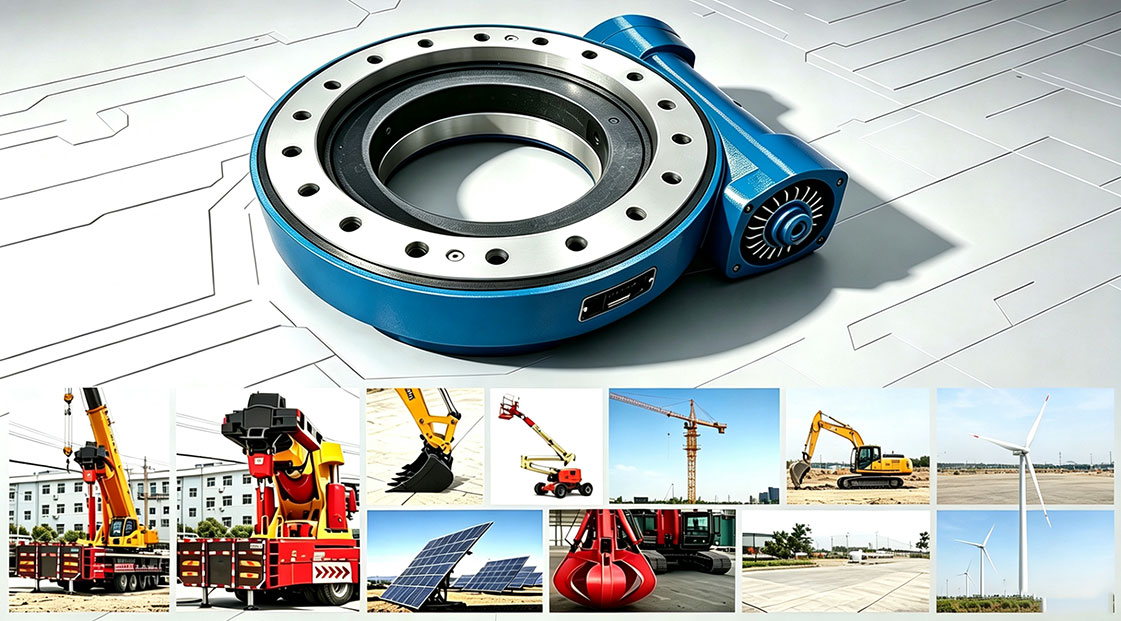
What is a slew drive? It is a compact rotary transmission unit that combines a slewing bearing, gear set, housing, and drive input to rotate a load under controlled torque. When an electric motor is added, the unit becomes a powered rotation system for equipment such as solar trackers, cranes, turntables, mining machinery, and automation platforms.
Before issuing an RFQ, procurement teams should avoid comparing electric drive prices as if every offer covers the same scope. A low-priced quotation may include only the base drive, while another may include a motor, brake, encoder, wiring requirements, higher sealing, mounting changes, and validation work. The result is not a fair comparison.
Luoyang Slewring Bearing Co., Ltd. supplies Slew Drive, Slewing Bearing, and Customized Slew Drive products for industrial equipment manufacturers. Our role is to help buyers define the mechanical and electrical scope clearly enough that quoted offers can be checked side by side.
Start the RFQ with the load case rather than the motor model
The first buying decision is drive size, not motor brand or motor wattage. The base drive must support the applied axial load, radial load, overturning moment, rotation duty, and operating environment. If the base unit is undersized, fitting a larger motor does not correct the bearing or gear loading problem.
For a crane, excavator attachment, or large turntable, overturning moment often drives selection because the load acts away from the centerline. For a solar tracker, rotation frequency, holding behavior, wind loading, and tracking accuracy may have more influence. These are different applications and should not use the same RFQ assumptions.
Information to provide before requesting a drive size
- Load direction: State axial load, radial load, and overturning moment separately when available.
- Load position: Identify the distance between the load center and the rotating centerline.
- Rotation range: Confirm whether the equipment makes partial turns, repeated indexing movements, or continuous rotation.
- Duty cycle: State operating hours, starts per hour, run time per cycle, and idle periods.
- Speed requirement: Give the required output speed, not only the motor speed.
- Holding requirement: Explain whether the load must remain fixed during power loss, wind events, or equipment shutdown.
- Site conditions: Include dust, rain, salt exposure, temperature conditions, and corrosion risk.
A worm drive is often a suitable choice where controlled rotation and self-locking behavior are needed, such as certain crane and positioning applications. However, self-locking performance depends on the design and working condition, so it should be specified and reviewed rather than assumed. Buyers evaluating this configuration can review our Worm Gear Slew Drive range for the relevant product format.
For applications with high moment loading or a need for improved torque distribution, a double-worm arrangement may be considered. It does not automatically fit every project, because it can add cost and may not be necessary for lighter equipment. Our Double Worm Slew Drive options are more relevant when the equipment load case supports that selection.
Use a quote-cost model that separates every price-changing input
The most useful quotation format separates the base mechanical drive from the options required to make it an operating assembly. This prevents the common mistake of treating two different technical packages as competing versions of the same product. Ask each supplier to identify what is included, excluded, and still subject to engineering confirmation.
| Quote component | What changes the cost | What the buyer should state | When it may not apply |
|---|---|---|---|
| Base drive size | Bearing capacity, gear arrangement, housing size, and required output torque. | Load data, moment, output speed, duty cycle, and installation space. | Do not select by outside dimensions alone when load data is available. |
| Motor power | Motor type, power requirement, torque-speed match, and operating duty. | Required output speed, power supply, start frequency, and load resistance. | A larger motor is not a substitute for a correctly sized drive. |
| Brake | Brake-equipped motor selection and holding requirement. | Whether the load must hold during power loss or stop at a fixed position. | It may not be needed for applications where external holding is already provided. |
| Encoder | Feedback device selection, interface needs, and positioning requirement. | Required position feedback, control system interface, and accuracy target. | It may not apply to simple manual-position or non-feedback rotation. |
| Voltage | Motor winding and electrical configuration. | Available supply voltage, frequency, phase, and regional electrical standard. | Do not leave this blank if equipment is exported across regions. |
| Sealing level | Protection requirement for dust, water, and external exposure. | Indoor, outdoor, marine, desert, washdown, or high-dust conditions. | A higher protection level may not be justified for a protected indoor enclosure. |
| Custom mounting | Modified bolt pattern, interface geometry, brackets, shafts, or adapters. | Mounting drawing, bolt specification, clearance limits, and mating part details. | Standard mounting may be better when the equipment can accept it. |
| Quantity | Material planning, setup allocation, and production scheduling. | Prototype quantity, first order quantity, and expected annual demand. | Quantity should not remove the need for technical acceptance criteria. |
| Validation testing | Additional inspection, documentation, or agreed test scope. | Required records, acceptance method, and responsibility for approval. | Do not assume nonstandard validation is included without listing it in the RFQ. |
The conclusion is simple: compare base drive pricing separately from electrical and project-specific additions. This method fits procurement teams receiving several offers from different slew-drive manufacturers. It does not replace engineering review, because the motor and drive still need to work together under the actual load condition.
Luoyang Slewring Bearing Co., Ltd. can provide a technical proposal within 24 hours when the key application inputs are available. That timing is useful for early supplier screening, but a proposal can only be as accurate as the load, mounting, and electrical information supplied by the buyer.
Choose motor, brake, encoder, and voltage as one system
Motor selection should start with required output motion. The motor must deliver suitable input torque and speed through the drive ratio while meeting the duty cycle. Selecting a motor only by rated power can produce poor starting behavior, unwanted heat, or insufficient torque at the required operating point.
A brake is usually specified when the equipment must hold position after power is removed. This can matter for elevated loads, boom systems, rotating platforms, and exposed outdoor equipment. It may be unnecessary where the machine already has a separate mechanical holding system and the application analysis confirms that arrangement.
An encoder is relevant where the controller needs position feedback for repeatable indexing, tracking, or synchronized movement. The buyer should identify the control interface and the required feedback function before asking for an encoder option. An encoder alone does not guarantee system accuracy because mounting stiffness, backlash, control logic, and load movement also affect final position.
Voltage and frequency are not minor administrative details. A motor configured for one electrical supply may not suit another installation location. For export equipment, list the destination electrical requirement in the RFQ and confirm whether the machine builder, panel supplier, or drive supplier is responsible for final electrical integration.

For solar applications, the drive layout may differ from a crane or industrial turntable. Our SP-I Slew Drive products are used in solar tracker applications, while a worm-based design may suit equipment requiring a different torque and holding approach. The best fit depends on the full system requirement, not the industry name alone.
Request Your Custom Slew Drive or Bearing Spec
Tell us your load, speed, and environment — receive a tailored 100–5000 mm slewing drive or slewing bearing proposal with 3D drawings within 24 hours.
Match sealing and materials to the actual operating environment
Environmental requirements change the quotation because they affect protection, corrosion measures, material selection, and maintenance expectations. State whether the unit will work indoors, outdoors, near saltwater, in desert dust, or around washdown exposure. “Outdoor use” alone is usually too broad for a reliable comparison.
Our slew drives can be specified with protection up to IP66 and anti-corrosion rating up to C4H for suitable working conditions. These options fit harsh industrial environments where water ingress, dust, or corrosion exposure is a real risk. They should not be specified automatically for every indoor machine because the added scope may not bring useful value.
Material selection also depends on load, speed, and environment. Luoyang Slewring Bearing Co., Ltd. uses materials including ductile cast iron, alloy steel, stainless steel, and forged alloy steel according to the working condition. Buyers should state corrosive exposure and mechanical loading together, since corrosion resistance alone does not define the needed structural capacity.
Check supplier evidence that relates to your application
A quotation should be supported by evidence that addresses the risk in the project. For a buyer concerned about dimensional control, inspection capability matters. For a buyer sourcing equipment for heavy cyclic loads, the supplier should explain the applicable drive selection and agreed acceptance scope rather than relying on a catalog image.
Our facility is certified to ISO 9001:2015, and CE marking is available for the European market. We operate six production lines in an 8,000 m² manufacturing facility, supported by CNC machining centers and CMM three-coordinate inspection. These facts help buyers assess manufacturing and quality-control capability, but they do not remove the need to approve the exact product specification.
For slewing bearings, every unit passes CMM three-coordinate inspection and dynamic load testing under our stated quality-control program. Buyers with bearing-specific requirements can review our Slew Drive Quality Control information and define any project-specific documentation before ordering. Do not assume that a general quality statement covers special witness testing, third-party inspection, or custom reporting unless it is included in the agreed scope.
Relevant application evidence from supplied projects
- Port crane systems: A South Korean port equipment manufacturer placed a repeat order for 20 WEA9-62-25HR single-worm units with IP65 sealing, self-locking, and tracking precision of no more than 0.15°.
- Marine crane systems: UK Ocean Marine Systems ordered 20 WEA17-104-25H-R-REV.D units for shipboard crane systems.
- Mining excavators: An Australian heavy-equipment manufacturer used HWE21-94-25HR.1 double-worm units for mining excavators.
- Utility-scale solar trackers: A U.S. renewable-energy equipment manufacturer ordered 50 SP-I 0841 units with IP65 protection for desert sites.
- Automated turntables: A Manchester automation equipment manufacturer ordered 100 SP-I 0841-32.1 units for automated turntable systems.
These examples show application fit for defined customer projects, not a universal specification for every crane, tracker, excavator, or turntable. A buyer should use them to frame questions about sealing, drive arrangement, quantity, and position requirements, then submit the actual machine data for review.
Prevent quote gaps with an RFQ review checklist
The most common purchasing problem is an RFQ that lists only a model reference and requested quantity. That approach can work for an identical replacement unit with confirmed specifications. It is not enough for a new machine design, a modified mounting interface, or a motorized drive that must connect to a defined control system.
- State the equipment type and describe the rotation function.
- Provide axial load, radial load, overturning moment, and load position if available.
- Specify output speed, rotation range, operating duty, and holding requirement.
- List motor voltage, frequency, phase, and control requirements.
- Confirm whether a brake and encoder are required, then state their intended function.
- Attach the mounting drawing, bolt pattern, envelope dimensions, and mating-part details.
- Describe the installation environment and required sealing or corrosion protection.
- State prototype, sample, and production quantities separately.
- Identify required inspection records, test scope, and acceptance responsibility.
- Ask the supplier to separate the base drive price from each option and customization item.
This checklist fits both new sourcing projects and quote comparisons for existing equipment. It is less relevant only when the buyer is ordering an unchanged, fully documented part number with no motor, mounting, or environmental changes. Even then, confirming voltage and configuration avoids costly replacement errors.
Standard products from Luoyang Slewring Bearing Co., Ltd. have an MOQ of one set, while customized products have an MOQ of five sets. Sample orders are welcome for testing and evaluation, and standard production is stated as a nine-day cycle. These are useful cooperation terms for buyers planning prototype and production stages, but final timing should still be confirmed against the selected configuration and order scope.
Set commercial boundaries before placing the purchase order
Price is only one part of supplier fit. The purchase order should identify the approved drawing or model, included motor options, sealing target, inspection scope, packaging needs, delivery terms, and acceptance method. If any part is unclear, the buyer cannot tell whether a later change is a correction or a new customization request.
Luoyang Slewring Bearing Co., Ltd. offers a two-year extended quality warranty, a 48-hour technical response, and free replacement for confirmed manufacturing defects. These terms are relevant to risk planning after delivery. They do not define responsibility for incorrect selection, installation error, unsuitable operating conditions, or unagreed application changes, so those boundaries should be addressed in the commercial agreement.
For procurement teams, the practical conclusion is to compare quotations by scope, not by one total number. A properly specified powered rotation unit can be evaluated on drive size, electrical configuration, environmental protection, custom interfaces, quantity, and agreed validation. That approach gives management a clearer basis for approving cost, technical fit, and supplier risk.
Request Your Custom Slew Drive or Bearing Spec
Tell us your load, speed, and environment — receive a tailored 100–5000 mm slewing drive or slewing bearing proposal with 3D drawings within 24 hours.
 WhatsApp

 +8613903880726