



What is a slew bearing? It is a large-diameter bearing that lets one part of a machine rotate against another while carrying axial load, radial load and tipping moment at the same time. Cranes, excavators, solar trackers and turntables all depend on one. Ball and roller designs each handle those loads differently.
That difference is why slew bearing price varies so much between quotes. A single-row ball unit and a three-row roller unit can have similar outer diameters but very different costs. The cheaper one is not a bargain if it cannot carry your combined load. This guide shows what drives the gap and how to pick a design before you send an RFQ.
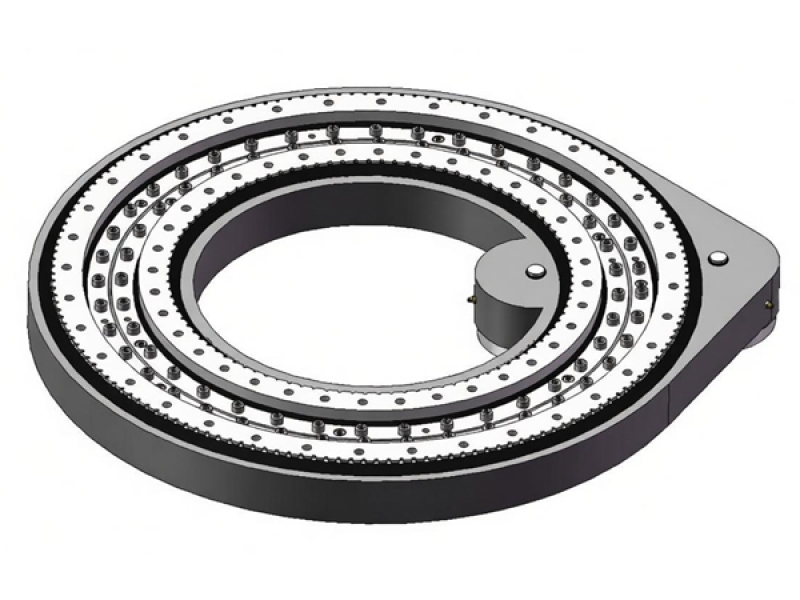
The Quick Selection Rule Before You Request Quotes
Start with the load case, not the catalog. Here is a rule we use when engineers ask where to begin.
- Light to moderate loads, slow rotation, cost-sensitive: start with a single-row ball design.
- Higher axial load or moment in a limited diameter: look at double-row ball.
- High rigidity and precise rotation in a compact section: look at crossed-roller.
- Heavy, shock-prone, cyclic duty: go to three-row roller.
This rule has limits. It assumes you know your axial force, radial force and overturning moment. If you only know the machine type, you cannot yet pick a design with confidence. In that case, send the application and let engineering calculate the load case first.
Comparison: Design-Type Matrix for Price Drivers, Load Capability and Machining
The table below compares four designs under the same conditions: a similar outer diameter, a standard gear option, and a normal industrial duty. It shows relative position only. Real quotes depend on size, material and quantity, so we do not list fixed dollar figures.
| Design | Typical price position | Main price drivers | Load capability | Machining requirements | Choose when |
|---|---|---|---|---|---|
| Single Row Slewing Ring Ball Bearings | Lowest of the four | Raceway size, ball set, gear option | Light to moderate combined loads | One raceway pair; simplest turning and grinding | Loads are modest and budget leads |
| Double Row Ball Slewing Ring Bearing | Above single-row | Extra raceway, larger cross-section, more balls | Higher axial and moment capacity than single-row | Two raceways; tighter control of alignment between them | Single-row is undersized but roller cost is too high |
| Crossed Roller Slewing Bearings | Mid to upper range | Roller and spacer quality, raceway precision, preload | Strong rigidity and moment handling in a compact section | Tight raceway geometry and surface finish | Rotation accuracy and stiffness matter most |
| Three-row Roller Slewing Bearings | Highest of the four | Three raceways, large roller sets, material volume, heat treatment | Highest capacity for heavy axial, radial and moment loads | Most complex; three raceways, deep hardening, strict inspection | Duty is heavy, cyclic or shock-prone |
Read the table from right to left. Match the "choose when" column to your duty first. Then check whether the price position fits your budget. If it does not, the answer is rarely to downgrade the design. It is usually to review the load assumptions, the gear option or the material grade.
Request Your Custom Slew Drive or Bearing Spec
Tell us your load, speed, and environment — receive a tailored 100–5000 mm slewing drive or slewing bearing proposal with 3D drawings within 24 hours.
What Actually Moves the Quote
Design type sets the baseline. Several other items then raise or lower the final figure. A fair slew bearing price comparison needs these items to match on every quote.
- Size and cross-section. Larger rings use more steel and need larger machines for turning, gear cutting and grinding.
- Material. We select from ductile cast iron, alloy steel, stainless steel and forged alloy steel based on load, speed and environment. Forged alloy steel and stainless steel cost more than standard alloy grades.
- Gear option. External gear, internal gear or no gear changes machining time and heat treatment.
- Sealing and corrosion protection. Outdoor, marine or desert sites need better seals and coatings than an indoor turntable.
- Inspection scope. Full CMM three-coordinate inspection and dynamic load testing add cost. They also reduce the risk of field failure.
- Quantity. Our standard MOQ is 1 set and our customized MOQ is 5 sets. Larger batches spread setup cost across more units.
One warning: do not compare a quote with full inspection to a quote with none. The cheaper figure may simply leave out work that you need.
Trade-offs by Situation
When a lower-cost ball design is the right call
A light-duty turntable on an automation line is a good fit. Loads are steady, speeds are low and shock is rare. A single-row ball design usually covers this, and paying for roller capacity adds cost without adding value. It fails as a choice when the machine sees overload events or heavy tipping moment.
When precision outranks raw capacity
Rotary tables and imaging platforms care about smooth, stiff rotation. Crossed-roller designs suit them because the rollers resist tilting in a small package. Their raceways need tighter machining, so the quote rises. If your machine only needs to carry load and not hold position closely, this extra cost may be wasted.
When heavy duty decides the question
Heavy cyclic load is where the cheapest option often costs the most. Mining excavators are an example. One of our Australian heavy equipment customers uses HWE21-94-25HR.1 double worm slew drives on mining excavators, and for duty like that the load case settles the bearing discussion, not the catalog price. For this class of machine, see our heavy load slewing bearing range or the excavator slewing bearing page.
The opposite holds too. A three-row roller bearing in a light application is overbuilt. It adds weight, mounting cost and quote value that the machine never uses.
When the bearing should come with a drive
Sometimes the better question is not which bearing, but whether to buy a bearing and gearbox separately. A slew drive integrates the bearing, worm or spur gearing and housing in one unit. Our customer cases show this approach in several markets. A Houston, Texas engineering machinery manufacturer ordered 100 units of SEA21-125-25HR(2) for slewing platform systems. A UK marine customer ordered 20 units of WEA17-104-25H-R-REV.D for shipboard cranes. If your design needs a gear stage anyway, compare the full installed cost, and review our slew drive options.
Common Mistakes When Comparing Bearing Quotes
- Comparing different designs as if they were equal. A single-row quote beside a three-row quote tells you about design, not supplier pricing.
- Ignoring moment load. Many RFQs list only weight. Tipping moment often decides the design.
- Leaving out the gear option. Gear type, module and hardening change both cost and lead time.
- Skipping environment details. Dust, salt spray and washdown change sealing and coating needs.
- Treating the lowest slew bearing price as the lowest total cost. A bearing that wears early costs more in downtime and replacement than the savings on the quote.
- Unclear inspection scope. Ask what is measured and what is tested before shipping.
Selection Rule and What to Confirm Before You Order
Choose a single-row ball design when loads are light to moderate, shock is rare and cost control comes first. Choose double-row ball when single-row capacity is not enough but the duty does not justify rollers. Choose crossed-roller when rigidity and rotation accuracy matter more than maximum load. Choose three-row roller when loads are heavy, cyclic or shock-prone, and failure would be expensive.
Before you send the RFQ, collect this checklist:
- Axial load, radial load and overturning moment, including peak values
- Rotation speed and duty cycle
- Mounting diameter and bolt pattern limits
- Gear requirement: external, internal or none
- Operating environment and corrosion needs
- Required inspection and test documents
- Quantity, and whether the part is standard or custom
What we cannot decide for you is your real peak load. If you have only estimates, say so in the RFQ so engineering can add a safety review.
Our factory is ISO 9001:2015 certified and we run CMM three-coordinate inspection and dynamic load testing on every slewing bearing. We back each order with a 2-year extended warranty and free replacement for confirmed manufacturing defects. For custom designs, we typically return a technical proposal within 24 hours, with 3-day rapid prototyping and a 9-day standard production cycle. You can read more on our slew drive quality control page.
If you want a drawing-based option with matched load data, our slewing bearing and customized slew drive teams at Luoyang Slewring Bearing Co., Ltd. can compare designs against your actual duty. Send your load case and we will respond with options and a quote.
Request Your Custom Slew Drive or Bearing Spec
Tell us your load, speed, and environment — receive a tailored 100–5000 mm slewing drive or slewing bearing proposal with 3D drawings within 24 hours.
 WhatsApp

 +8613903880726