



What is a slewing ring bearing? It is a large-diameter bearing that carries axial load, radial load and tilting moment at the same time, so a boom, platform or turntable can rotate on a fixed base. Most designs add a gear on the inner or outer ring, or pair the bearing with a drive unit.
Every drawing that reaches a buyer carries a hidden decision: pay for extra capacity now, or risk a redesign later. Slewing ring bearing cost moves with a handful of specification choices, and each one has a clear engineering reason behind it. This article compares those choices side by side so you can freeze a specification that meets the load case without paying for margin you will never use.
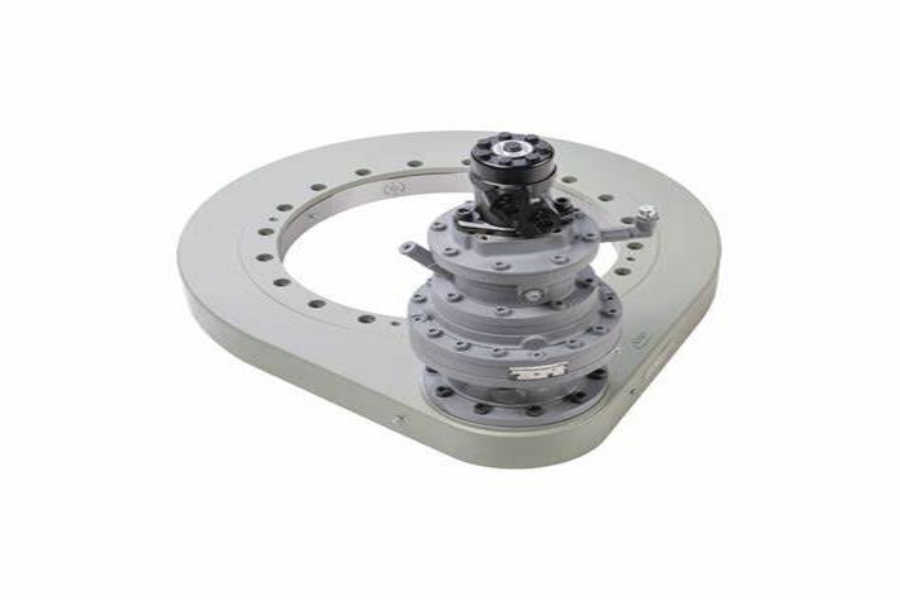
Start with the load case, not the catalog price
The most useful selection rule is simple. Choose the lightest bearing type that passes your static and dynamic load check with a defined safety factor, then add gearing and sealing only where the application demands them. Anything beyond that is cost without a matching benefit.
This rule has limits. If your duty cycle is unclear, or the machine will see shock loads you have not measured, a cheaper bearing is a false saving. In that case, resolve the load data first. A quote built on guessed moments will not hold up.
Before comparing any quotes, collect these inputs:
- Axial load, radial load and tilting moment, both static and working
- Rotation speed and duty cycle (continuous, intermittent, or oscillating)
- Mounting space: outer diameter, inner diameter and height limits
- Environment: dust, water, salt, temperature range
- Positioning accuracy or backlash requirements
Which specifications actually change the quote
Not every line on a drawing moves the price. Material and machining time drive most of it. A larger raceway needs more forged ring stock, more heat treatment and more grinding time. A tighter accuracy requirement adds inspection and rework risk.
From my design work across 200+ heavy-equipment projects, four choices cause most of the gap between two quotes for what looks like the same bearing:
- Rolling element layout: ball, crossed roller, or multi-row roller.
- Gear arrangement: no gear, external gear, internal gear, or a complete drive.
- Raceway size and ring section: diameter, cross-section and hardened depth.
- Sealing and corrosion protection: standard seals versus higher protection grades.
Material grade also matters. We select ductile cast iron, alloy steel, stainless steel or forged alloy steel according to load, speed and environment. Stainless steel suits corrosive sites but costs more than alloy steel, so use it only where corrosion is a real failure mode.
Specification trade-off table: ball vs roller, gearing, raceway size and sealing
This table shows when each choice lowers or raises a quote, and when the cheaper option stops being safe. It compares options under the same basic condition: a slewing application with a fixed mounting envelope.
| Specification choice | Tends to lower the quote when | Tends to raise the quote when | Limit of the saving |
|---|---|---|---|
| Ball layout (Single Row Slewing Ring Ball Bearings) | Light to moderate loads, intermittent rotation, simple structure | Load check forces a much larger diameter to compensate | Capacity per unit of diameter is lower than roller layouts, so a tight envelope can rule it out |
| Crossed roller layout (Crossed Roller Slewing Bearings) | You need stiffness and accuracy in a compact section, avoiding an oversize ball bearing | Accuracy needs are modest and a ball bearing would pass | Higher raceway and roller machining effort, so it rarely wins on price in light-duty jobs |
| Three-row roller (Three-row Roller Slewing Bearings) | Heavy moment loads where lighter types would need a much larger diameter | Used on loads a double-row ball type could carry | Highest unit price; justified only when the load case demands it |
| Integral gearing | Standard module and tooth count, no special hardening | Non-standard modules, induction-hardened teeth, internal gear plus tight backlash | Gear cutting adds machining time; do not specify teeth if an external drive already supplies the gear |
| Raceway and ring size | Using the smallest diameter that passes the capacity check | Oversizing "for safety" without calculation | Undersizing shortens life under cyclic loads and costs more in replacement |
| Sealing | Indoor or clean sites with standard seals | Dust, washdown, salt spray or desert sites needing higher protection | Removing seals to save money invites contamination and early raceway wear |
Read the table as a set of decision rules, not a price list. A ball layout is cheaper only if it passes the load check at the diameter you can mount. Once it fails that check, the cheaper type becomes the more expensive one.
Request Your Custom Slew Drive or Bearing Spec
Tell us your load, speed, and environment — receive a tailored 100–5000 mm slewing drive or slewing bearing proposal with 3D drawings within 24 hours.
Trade-offs by situation
The right specification looks different on different machines. Here are three situations where the same comparison leads to different answers.
Platform and turntable systems
A Houston, Texas engineering machinery manufacturer ordered 100 units of SEA21-125-25HR(2) for slewing platform systems. Repeat volume like this favors a fixed, standardized specification. At that quantity, avoiding custom tooth data or special machining keeps the unit price stable.
Cranes with a limited envelope
A Netherlands material handling manufacturer chose 50 units of WEA9-62-25HR for truck-mounted loader cranes. A South Korean port equipment manufacturer placed a 20-unit repeat order of the same WEA9-62-25HR size for port crane systems, with 0.15° tracking precision, IP65 sealing and self-locking. In both cases the drive format was chosen over a separate bearing, gear and motor because mounting space and self-locking mattered more than the lowest component price.
Outdoor solar tracking
A US renewable energy equipment manufacturer ordered 50 units of SP-I 0841 for utility-scale trackers, with IP65 specified for desert sites. Here sealing is not an upgrade to trim. Dust is the main wear source, so cutting it would shift cost from purchase price to field service.
These cases show conditions, not guarantees. Your duty cycle and loads decide the outcome, so use them as references for your own check, not as a substitute for one.
The overlooked factor: bearing plus gear versus a complete slew drive
Many buyers compare a bare bearing against a quoted bearing with gear and miss the real question. Are you buying a component, or a working rotation system? A separate bearing, worm, housing, motor interface and seals all need design, sourcing and assembly time on your side.
A Slew Drive integrates bearing, gearing, housing and sealing in one unit. That can lower total installed cost even when the unit price looks higher. It fits when you need compact packaging, self-locking, or protection up to IP66.
The bare bearing still wins when you already have a drive train, need a very large diameter, or want full control of the gearing. It also wins when your torque path is already designed and validated. For drive types, compare a Worm Gear Slew Drive for high self-locking ratios against spur types for solar tracking.
For imported German-standard SE/WE series, localized production can save 30-50% against imported brands while matching first-tier parameters. That gain depends on matching the same series and precision grade (P0-P4), so compare equal grades, not just model names.
Common mistakes that inflate cost
- Specifying tolerance tighter than the application needs. Precision grade changes machining and inspection time. Pick it from the actual positioning requirement.
- Oversizing the raceway diameter. A bigger ring costs more and may not fit your frame.
- Adding gear teeth to a ring that an external drive already turns. You pay for machining you do not use.
- Comparing quotes with different sealing or material grades. A lower number often hides a weaker spec.
- Ignoring volume tiers. Standard products start at a 1-set MOQ, while customized products start at 5 sets, so a small custom run carries setup cost across few pieces.
Selection rule and what to verify before you order
Choose a ball layout when loads are light to moderate, the envelope allows the required diameter, and accuracy needs are modest. Choose a roller layout when moment load or stiffness would force an oversized ball bearing, or when a heavier duty cycle needs the extra capacity. A heavy load slewing bearing is the starting point for the latter.
Choose a complete drive when you want integrated packaging, sealing and self-locking. Choose a bare bearing when your drive train already exists. If standard sizes do not fit, a Customized Slew Drive may reduce redesign cost, though the 5-set MOQ applies.
Before you freeze the specification, confirm these items:
- Load case calculation with a stated safety factor
- Material and corrosion rating for the real environment
- Precision grade tied to a measured requirement
- Sealing level matched to dust, water or salt exposure
- Quality records, such as CMM inspection and dynamic load testing, reviewed through our Slew Drive Quality Control process
At Luoyang Slewring Bearing Co., Ltd., every slew bearing passes CMM three-coordinate inspection and dynamic load testing, with a failure rate below the 0.5% industry standard. Our ISO 9001:2015 certified factory runs six production lines, offers a 2-year extended warranty, and returns a technical proposal within 24 hours. A standard production cycle is 9 days, and 3-day rapid prototyping is available. If you are looking for a slewing bearing or slew drive supplier, send us your load data and drawing, and we will help you compare options and get the latest quote.
Slewing ring bearing cost is easiest to control early, while the drawing can still change. One round of spec comparison now costs less than one redesign after the first prototype.
Request Your Custom Slew Drive or Bearing Spec
Tell us your load, speed, and environment — receive a tailored 100–5000 mm slewing drive or slewing bearing proposal with 3D drawings within 24 hours.
 WhatsApp

 +8613903880726