



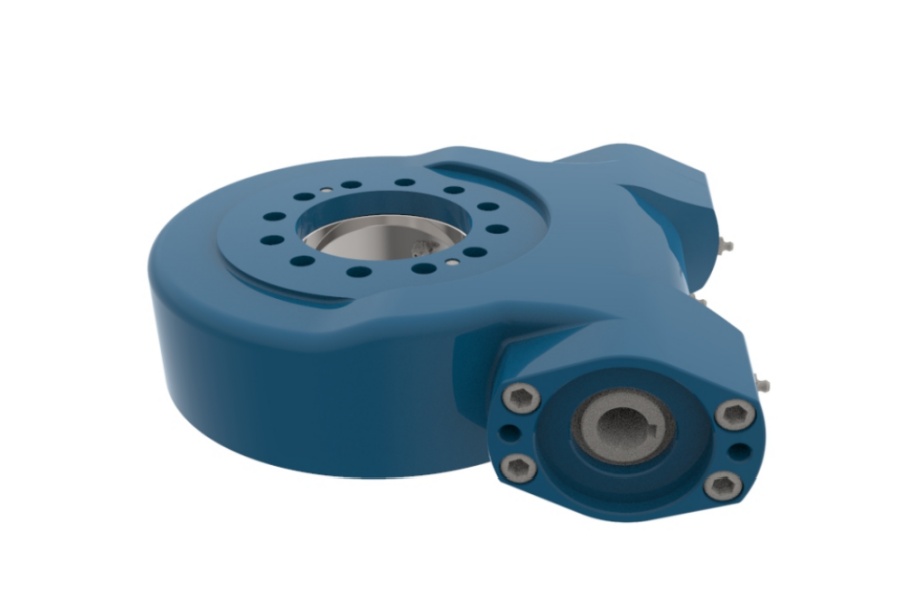
What is a slew drive? It is a compact rotation unit that combines a slewing bearing, a worm or spur gear set, a housing, and a motor interface. It turns and holds loads on cranes, solar trackers, turntables, and similar machines.
When you find rust on one during a walk-around, the question is simple. Can the machine keep working, or must it stop? A structured slew drive inspection answers that with what you can see, feel, and measure, not with guesses. This article gives you the order of checks and the point where you stop and escalate.
What the Inspection Has to Decide
Rust is a symptom. It is not a diagnosis. The same orange stain can come from worn paint, a failed seal, or a crack that lets moisture in. Your job in the field is to sort the finding into one of three outcomes.
- Accept: the damage is cosmetic and the drive keeps running on its normal schedule.
- Monitor: the damage is early or unclear. Keep running, shorten the check interval, and record changes.
- Escalate: the damage may affect strength, sealing, or load transfer. Stop the machine or call engineering before the next duty cycle.
In 30 years of heavy machinery design, I have seen the same mistake repeatedly. People judge corrosion by how much area it covers. Location and depth matter far more than area. A palm-sized patch of surface rust on a painted housing is usually minor. A hairline mark at a flange corner is not.
Preliminary Checks Before You Touch the Drive
Start with what you can learn without tools or disassembly. These steps fit a maintenance engineer's normal access, and they keep you from cleaning away evidence. Follow this order for any slew drive inspection.
- Pull the records. Note the install date, working environment (salt spray, desert dust, wash-down, indoor), last greasing date, and last bolt torque check.
- Photograph first. Take wide and close shots of every corroded area. Put a ruler or coin in frame for scale and mark the edges of the rust with a paint pen.
- Lock out the machine before you reach near the gear, housing joints, or mounting flange.
- Wipe one small area with a clean rag and solvent. Do not grind or wire-brush yet. Aggressive cleaning can smear a crack closed or hide pit edges.
- Check seals and grease points. Look for rust-colored or milky grease, dried seal lips, and cracked or displaced seals.
- Check the mounting joint. Look for rust trails from under bolt heads, fine brown dust between flange and structure, and any visible gap.
- Rotate the drive under supervised, low-risk conditions. Listen and feel for roughness, clicking, or binding.
Stop at step 2 if you see a linear crack. Do not continue running the machine to "see what happens."
Surface Corrosion vs. Cracks, Pitting, and Mounting-Face Damage
This is the boundary that matters most. Surface corrosion lives in the coating or the outer skin of the metal. Cracks, pitting, and mounting-face damage affect how loads travel through the drive. The table below uses observable criteria only. Exact limits for your model come from the manufacturer's drawing and manual.
| What you see or feel | What it may mean | Decision |
|---|---|---|
| Light orange film on painted housing; wipes off; metal underneath is smooth | Coating wear or minor weathering | Accept. Clean, touch up the paint at next service. |
| Rust bloom at a seal lip or grease port; grease still normal color | Early seal aging or a coating break at a joint | Monitor. Re-inspect at a shorter interval and compare photos. |
| Rust-colored, milky, or watery grease; seal lifted or cracked | Moisture ingress to the gear or raceway area | Escalate. Contact the supplier for a service review. |
| Rough patches you can feel with a fingernail on exposed teeth, shaft, or machined faces | Pitting (corrosion has eaten into the metal) | Escalate. Pitting concentrates stress and can grow under load. |
| Fine line in the housing, flange, or weld area that stays visible after wiping | Crack | Stop and lock out. Engineering review required. |
| Rust trails under bolt heads; brown fretting dust; gap or shiny contact marks at the mounting face | Loose joint or corroded mating surface | Stop. Check torque and flatness before restart. |
| Rough turning, new noise, or metal flakes in grease along with any rust | Internal damage, possibly at raceway or gear | Escalate. Do not run until reviewed. |
One rule helps in the field. If the rust sits where load enters or leaves the drive (flange, bolt seat, weld toe, gear mesh), treat it as structural until proven otherwise. If it sits on a flat painted cover, treat it as cosmetic until something else suggests otherwise.
Request Your Custom Slew Drive or Bearing Spec
Tell us your load, speed, and environment — receive a tailored 100–5000 mm slewing drive or slewing bearing proposal with 3D drawings within 24 hours.
Diagnostic Branches: What to Check Next
Branch 1: Rust on housing and paint
Wipe a test patch. If the metal is smooth and the rust is only a film, log it and move on. If you find pits or flaking layers, go to the pitting row in the table. If the stain wipes off but returns within days, suspect moisture trapped under the coating or a nearby rusting part dripping onto the housing.
Branch 2: Rust around seals and grease ports
Purge a small amount of grease and check its color and feel. Normal grease with only external rust points to a coating issue. Milky, watery, or rust-tinted grease points to water getting past the seal. That is a sealing failure, and it can reach the raceway even when the outside looks fine.
Branch 3: Mounting bolts and flange face
Check bolt torque against the value in your manual, not by feel. Rust under a bolt head with loose torque suggests lost preload. Preload loss lets the joint move, which grinds the mating face and speeds up corrosion. If the flange face is no longer flat or shows fretting wear, stop and have engineering review it before retightening.
Branch 4: Gear mesh and rotation
Rotate slowly and note any change in effort or sound. Compare tooth backlash with the drawing value for your model. A smooth, quiet turn with only external rust is reassuring but does not prove the interior is clean. A rough turn with any rust means escalate.
Matching Cause, Action, and Result Check
Several causes can produce the same visible rust. Do not lock onto one before the evidence supports it. This table connects each possible cause to the evidence, a fitting action, and a way to confirm the action worked.
| Possible cause | Distinguishing evidence | Action | Result check |
|---|---|---|---|
| Coating wear | Smooth metal under rust, normal grease | Clean and recoat | No new rust at next two inspections |
| Seal failure | Contaminated grease, damaged seal lip | Service review; seal and grease replacement per the supplier | Clean grease at the purge point; no new rust trails |
| Loose or corroded mounting joint | Rust under bolts, fretting dust, torque loss | Re-torque to spec; inspect faces; engineering review if damaged | Torque holds at next check; no fresh dust |
| Crack from overload or fatigue | Linear mark that persists after cleaning | Stop; engineering review of load history | Cause identified before any restart |
| Rust from a nearby part | Stain runs from another component, metal under it is clean | Fix the source; clean the drive | Stain does not return |
Environment shapes which cause is likely. Marine deck cranes, such as the WEA9-61-25HR worm gear slew drive units we supplied to a marine equipment manufacturer in Newcastle, Australia, sit in salt air. There, seal and coating checks come first. Desert solar sites are different. Our SP-I 0841 units for a US renewable energy manufacturer are specified at IP65 for dust and sand, so seal condition and grease cleanliness matter most there.
These examples show where to look first. They do not mean any drive in those settings has a corrosion problem. Alternative explanations, such as condensation or runoff from a nearby part, still need to be ruled out.
Common Mistakes During Field Checks
- Wire-brushing before photographing. You lose the evidence and may hide a crack.
- Judging by rust area. A small crack at a flange corner is worse than a large patch on a cover.
- Re-torquing without checking the face. Tight bolts on a damaged flange only hide the problem.
- Painting over rust and calling it fixed. If the cause is a failed seal, the rust returns.
- Assuming every case is a defect. Many corrosion findings come from environment, missed greasing, or coating damage, not manufacturing.
- Running to the next shutdown with an unexplained crack. Cracks grow under cyclic load.
Prevention and When to Contact Support
Set the inspection interval by environment, not by calendar alone. Marine, wash-down, and dusty outdoor sites need shorter intervals than indoor turntables. Keep a photo log with dates so you can compare changes. A repeatable slew drive inspection record turns "it looks worse" into evidence.
You can also reduce risk when you specify the drive. Luoyang Slewring Bearing Co., Ltd. offers slew drive models with protection up to IP66 and anti-corrosion ratings up to C4H. For harsh sites, a customized slew drive lets you match sealing and coating to the real working condition. The final rating depends on the model, so confirm it at quotation.
Escalate to the supplier when you find contaminated grease, pitting, any crack, mounting-face damage, or rough rotation. Send these items so the review starts fast:
- Nameplate data and drawing number
- Close-up and wide photos with scale
- Working environment and duty cycle
- Last greasing and bolt torque records
- A short description of noise, backlash, or rotation changes
Our factory works under an ISO 9001:2015 quality system. Each slewing bearing we build goes through CMM three-coordinate inspection and dynamic load testing, as described on our quality control page. We offer a 48-hour technical response and a 2-year extended quality warranty. Confirmed manufacturing defects get free replacement. Corrosion from site conditions or missed maintenance is judged case by case from the evidence you send.
If you are looking for a slew drive or slewing bearing supplier, contact Luoyang Slewring Bearing Co., Ltd. with your application details and we will send a technical proposal and current quotation. Standard products start at one set, and customized products at five sets.
Request Your Custom Slew Drive or Bearing Spec
Tell us your load, speed, and environment — receive a tailored 100–5000 mm slewing drive or slewing bearing proposal with 3D drawings within 24 hours.
 WhatsApp

 +8613903880726