



Choosing the wrong supplier for solar tracker slew drives introduces significant risk to utility-scale projects. A premature failure doesn't just mean replacing a component; it means lost energy production, expensive field service, and damage to your project's reputation. As a design engineer with over three decades in heavy machinery, I've seen firsthand how a drive's reliability underpins the financial viability of an entire asset. A qualified solar tracker slew drive manufacturer provides more than just a product—they provide verifiable proof of performance and long-term dependability.
Before you issue a purchase order, you need to look beyond the datasheet. You must scrutinize the manufacturer's quality control processes, material traceability, and demonstrated field performance. This guide outlines the key technical and commercial criteria for vetting a supplier, ensuring the drives you source will meet the 25-year-plus service life your solar projects demand.

Key Performance Metrics for Solar Tracker Drives
For solar applications, three performance metrics are non-negotiable: tracking precision, environmental sealing, and load-holding capability. These factors directly influence a solar plant's energy yield and operational uptime.
Tracking Precision (Backlash): High precision is essential for maximizing energy generation. The drive must accurately position the solar panel to face the sun throughout the day. Excessive backlash (the "play" in the gearing) leads to positioning errors, reducing the amount of solar irradiation captured. For single-axis trackers, a tracking precision of ≤0.15° is a common industry benchmark for high-performance systems. Our experience delivering drives for demanding applications, such as port crane systems for a South Korean client requiring ≤0.15° precision, has refined our manufacturing processes to meet these tight tolerances.
Environmental Sealing (IP Rating): Solar trackers operate in harsh environments, from dusty deserts to humid coastal areas. The slew drive's internal components must be protected from dust, water, and contaminants. An IP (Ingress Protection) rating is the standard measure for this.
- IP65: Dust-tight and protected against water jets from any direction. This is the minimum acceptable rating for most outdoor applications. We have supplied 50 units of our SP-I Slew Drive model 0841 with IP65 sealing for a US renewable energy partner's utility-scale projects in desert locations.
- IP66: Dust-tight and protected against powerful water jets. This offers a higher level of protection for sites with frequent, high-pressure cleaning or extreme weather. Our slew drives can be manufactured with protection up to IP66.
Load Capacity: The slew drive must safely handle static and dynamic loads, particularly from wind. The manufacturer should provide detailed calculations for output torque, holding torque, and tilting moment torque. Holding torque is especially important, as it determines the drive's ability to keep the panels stable during high winds, preventing structural damage. The material selection, including forged alloy steel and ductile cast iron, is directly tied to a drive's ability to withstand these heavy-duty cyclic loads over its lifetime.
Supplier Qualification Checklist: Verifying Claims Before You Commit
An impressive datasheet is only the starting point. As a procurement manager or engineer, you must verify a manufacturer's claims. Requesting specific documentation is the most effective way to separate qualified partners from unqualified suppliers. Here is a checklist of items to demand during your vetting process.
| Document/Record to Request | What to Look For | Why It Matters |
|---|---|---|
| Dynamic Load-Test Records | Reports showing performance under simulated operational loads. Check for data on torque, backlash stability, and temperature rise over a set duration. | This validates the drive's durability and confirms it can perform consistently under real-world stress, not just in ideal static conditions. It's a direct measure of reliability. |
| Material Traceability Certificates | Mill test reports (MTRs) for key raw materials like alloy steel (e.g., 42CrMo) or slewing bearing steel (e.g., 50Mn). | Guarantees that the specified material grade was used. Incorrect material can lead to premature wear, gear tooth failure, or catastrophic structural failure under load. |
| Sealing Validation (IP Test Reports) | Third-party or in-house reports certifying the IP rating (e.g., IP65, IP66). The report should detail the testing procedure and results. | Provides objective proof that the drive's seals will protect internal components from dust and water ingress, which is critical for long-term survival in outdoor environments. |
| Quality Management System Certificates | A valid ISO 9001:2015 certificate. Check the scope of the certification to ensure it covers the design and manufacture of slew drives. | An ISO 9001 certification indicates that the manufacturer has established, documented, and maintains a system for ensuring consistent quality and continuous improvement. Our facility is ISO 9001:2015 certified. |
| Inspection Reports (CMM) | Coordinate Measuring Machine (CMM) reports for critical components like the slewing ring and worm shaft. Look for dimensional accuracy and geometric tolerances. | CMM inspection is a cornerstone of precision manufacturing. It verifies that components meet the exact design specifications. We perform CMM three-coordinate inspection on every Slewing Bearing to enforce military-grade quality control. |
| Export Documentation Samples | Examples of a Bill of Lading, Certificate of Origin, and packing list. For European clients, ask for the Declaration of Conformity for CE Marking. | Confirms the manufacturer's experience with international logistics and customs compliance, preventing costly delays and legal issues with your shipment. We hold CE Marking for the European market. |
A transparent manufacturer will readily provide this documentation. Reluctance to share these records should be considered a major warning sign.
Request Your Custom Slew Drive or Bearing Spec
Tell us your load, speed, and environment — receive a tailored 100–5000 mm slewing drive or slewing bearing proposal with 3D drawings within 24 hours.
Spur Gear vs. Worm Gear Drives for Solar Tracking
Solar trackers primarily use two types of slew drives: spur gear and worm gear. The choice between them involves a trade-off between precision, efficiency, and cost. From an engineering standpoint, neither is universally "better"; the optimal choice depends on the tracker design and project goals.
Spur Gear Slew Drives: These drives use a spur gear pinion to rotate an external slewing ring. They are known for their high mechanical efficiency (typically >70%) and ability to be back-driven. This back-drivability is a double-edged sword: while it reduces energy consumption, it requires an external braking system to hold position, especially in high winds.
- Best for: Large-scale, utility projects where maximizing energy efficiency across thousands of units provides significant financial returns. The cost of the added brake is offset by the energy gains.
- Real-World Example: We have successfully supplied our SP-I series Spur Gear Slew Drive for multiple large solar projects in South America (Brazil, Argentina, Chile), where they helped boost energy yield by up to 40%.
Worm Gear Slew Drives: These drives use a worm shaft to engage a worm wheel. Their primary advantage is their self-locking characteristic. The gear geometry prevents the output from back-driving the input, eliminating the need for an external brake. However, they are less efficient (typically 30-50%) due to higher friction between the gear surfaces.
- Best for: Applications where holding torque and simplicity are paramount, such as decentralized trackers, rooftop installations, or concentrated solar power (CSP) dishes.
- Real-World Example: While more common in industrial machinery like truck-mounted cranes for our clients in the Netherlands, the self-locking principle of the Worm Gear Slew Drive is highly valued in applications requiring absolute position-holding without external power.
Balancing Cost and Performance: Localization of Proven Designs
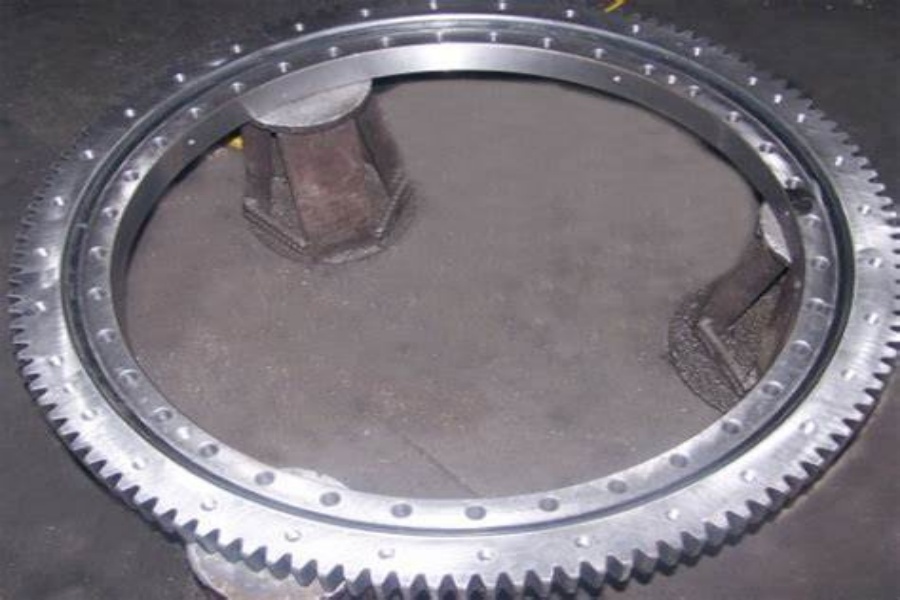
Many high-performance slew drives originated from German engineering. While these imported brands set the standard for quality, their cost can be prohibitive for large-scale solar projects where every dollar per watt matters. A key strategy for EPCs and tracker OEMs is to partner with a manufacturer that has successfully localized these proven designs.
Localization is more than just copying a design. It involves re-engineering the product to be manufactured with local supply chains and processes while maintaining the original performance specifications. This approach can yield significant cost savings without compromising on quality.
At Luoyang Slewring Bearing Co., Ltd., we have focused on localizing German-standard SE and WE series slew drives. By optimizing our manufacturing processes and leveraging our supply chain, we can offer P0-P4 precision grades that match the performance of international first-tier brands at a 30-50% lower cost. This isn't about cutting corners; it's about intelligent engineering and efficient production. This strategy provides our clients with a competitive advantage, allowing them to reduce the Levelized Cost of Energy (LCOE) for their projects without taking a risk on unproven technology.
From Proposal to Production: Evaluating a Manufacturer's Operational Capacity
Finally, a supplier's operational capabilities determine their ability to deliver on promises. Before engaging a partner, assess their entire workflow, from initial engineering support to mass production and after-sales service.
Here are the key operational benchmarks to evaluate:
- Engineering Response Time: How quickly can they provide a technical proposal for your application? A responsive engineering team is a sign of a well-organized company. We commit to delivering technical proposals within 24 hours.
- Prototyping and Production Lead Times: Speed is critical in project development. Ask for timelines for both prototypes and standard production runs. Our process includes a 3-day rapid prototyping cycle and a 9-day standard production cycle.
- Minimum Order Quantity (MOQ): Flexibility is important. A supplier willing to provide single units for testing shows confidence in their product. We welcome sample orders and have an MOQ of 1 set for standard products and 5 sets for a Customized Slew Drive.
- Production Capacity: Can the manufacturer scale with your needs? A large facility and multiple production lines indicate readiness for high-volume orders. Our 8,000 m² facility has an annual capacity of 100,000 sets.
- Warranty and Technical Support: A strong warranty is a statement of quality. Look for a warranty period that exceeds the industry standard and a clear process for technical support. We back our products with a 2-year extended quality warranty and a 48-hour technical response commitment, with free replacement for confirmed manufacturing defects.
Choosing the right manufacturing partner is a strategic decision that impacts project performance for decades. By focusing on verifiable evidence of quality, engineering depth, and operational capacity, you can build a reliable supply chain and ensure the long-term success of your solar energy assets.
Request Your Custom Slew Drive or Bearing Spec
Tell us your load, speed, and environment — receive a tailored 100–5000 mm slewing drive or slewing bearing proposal with 3D drawings within 24 hours.
 WhatsApp

 +8613903880726