



 About the Author: Lewis is a Senior Mechanical Design Engineer with over 30 years of experience in heavy machinery and power transmission design. He has led the mechanical design of more than 200 heavy-equipment projects, specializing in components like slewing bearings and slew drives for applications ranging from industrial automation to port cranes.
Selecting a slew drive for a solar tracker project is more than a simple component choice. The wrong decision can lead to tracking inaccuracies, premature field failures, and significant downtime across an entire solar array. A datasheet might look promising, but it reveals nothing about the supplier's ability to deliver consistent quality at scale. Before placing a purchase order with any solar tracker slew drive manufacturer, you must verify their production capacity and quality control systems.
Failing to do this homework is a common and costly mistake. It can leave you with a supplier who cannot meet your project deadlines or, worse, delivers drives that fail under real-world wind loads and environmental stress. As an engineer who has designed and specified power transmission systems for three decades, I've seen firsthand how a robust verification process separates reliable partners from risky ones.
Key Performance Indicators for Solar Tracker Slew Drives
For solar applications, three performance metrics are non-negotiable: tracking precision, environmental durability, and load-holding capacity. Tracking precision directly impacts energy yield. Durability ensures a 20+ year design life in exposed environments. Load-holding capacity allows the drive to withstand static and dynamic forces, especially wind loads, without damage.
The type of gearing inside the slew drive heavily influences these characteristics. While worm gears offer high gear ratios and self-locking capabilities, spur gears provide higher efficiency and are often preferred for certain single-axis tracker designs. Our SP-I Slew Drive series, for example, uses spur gear technology and has been successfully deployed in large-scale projects across South America.
This table compares the two primary options for solar applications:
| Parameter | Spur Gear Slew Drive | Worm Gear Slew Drive |
|---|---|---|
| Primary Advantage | High mechanical efficiency (typically >95%) | High gear ratio in a compact package; often self-locking |
| Tracking Precision | Good; backlash can be controlled with precision manufacturing | Excellent; minimal backlash is achievable, providing smooth motion |
| Best-Fit Scenario | Single-axis trackers where energy efficiency is a top priority; high-speed rotation needs | Dual-axis trackers and applications requiring high torque and holding capacity (e.g., concentrated solar) |
| Example Application | Utility-scale projects in Brazil and Argentina using our SP-I 0229 drives, which boosted energy yield up to 40% | Heavy-duty positioning systems requiring high holding torque and precision, similar to our WEA series |
For many utility-scale solar tracker systems, a Spur Gear Slew Drive offers the right balance of performance and cost. A U.S.-based renewable energy equipment manufacturer selected 50 units of our SP-I 0841 model specifically for its IP65 rating, ensuring reliable operation in harsh desert sites.
How Factory Audits Reduce Field Failure Risk
A factory audit is your best tool for mitigating risk. It moves beyond paper promises and provides direct evidence of a manufacturer's processes. When our customers visit our 8,000 m² facility, we encourage them to scrutinize our operations. A thorough audit focuses on specific checkpoints that directly correlate to the long-term reliability of a slew drive.
Here’s how a structured audit of machining, assembly, testing, and traceability can prevent field failures:
- Audit Checkpoint: Raw Material Verification & Traceability
- What to Look For: A dedicated raw material inspection area with equipment for testing hardness and chemical composition. Ask to see material certificates for incoming batches of forged alloy steel or ductile cast iron. Check that each batch is assigned a unique tracking number.
- How It Prevents Failure: Using incorrect or substandard material is a primary cause of premature gear tooth wear and bearing fatigue. Verifying material at the source ensures the foundation of the slew drive is sound and meets design specifications for load and service life.
- Audit Checkpoint: CNC Machining and Gear Cutting
- What to Look For: A workshop of modern CNC machining centers. Inquire about their tolerance capabilities and how they verify the precision of critical components like the worm shaft and slewing ring raceway. Ask to see quality control records from the production line.
- How It Prevents Failure: Inaccurate machining leads to poor gear contact, increased backlash, and lower tracking precision. It also causes concentrated stress points that can result in catastrophic gear failure. Consistent CNC machining is essential for performance.
- Audit Checkpoint: Assembly Line and Sealing Process
- What to Look For: A clean, organized assembly environment. Observe how seals are installed—are they properly lubricated and seated? Are bolts tightened to specific torque values using calibrated tools? Improper sealing is a major cause of failure in outdoor applications.
- How It Prevents Failure: A contaminated assembly or improperly installed seal will compromise the IP rating. This allows dust and moisture to enter the gearbox, leading to corrosion, lubricant degradation, and rapid component failure. Our drives with IP66 protection undergo rigorous sealing checks.
- Audit Checkpoint: Final Inspection and Load Testing
- What to Look For: A final inspection station with a CMM (three-coordinate measuring machine) for dimensional verification. Ask about their dynamic load testing protocol. Every one of our slew drives undergoes both CMM inspection and dynamic load testing to simulate real-world conditions.
- How It Prevents Failure: Final testing is the only way to confirm that all components work together as a system under load. It validates the drive's output torque, holding torque, and tracking precision, catching any manufacturing or assembly defects before the unit ships. This rigorous Slew Drive Quality Control is why our failure rate is below the 0.5% industry standard.
Request Your Custom Slew Drive or Bearing Spec
Tell us your load, speed, and environment — receive a tailored 100–5000 mm slewing drive or slewing bearing proposal with 3D drawings within 24 hours.
A Buyer's Checklist for Qualifying Slew Drive Suppliers
When evaluating potential suppliers, use a systematic approach. This checklist covers the essential areas you need to investigate to ensure you partner with a capable and reliable manufacturer. Don't just ask "yes" or "no" questions—request documentation, reports, and specific data.
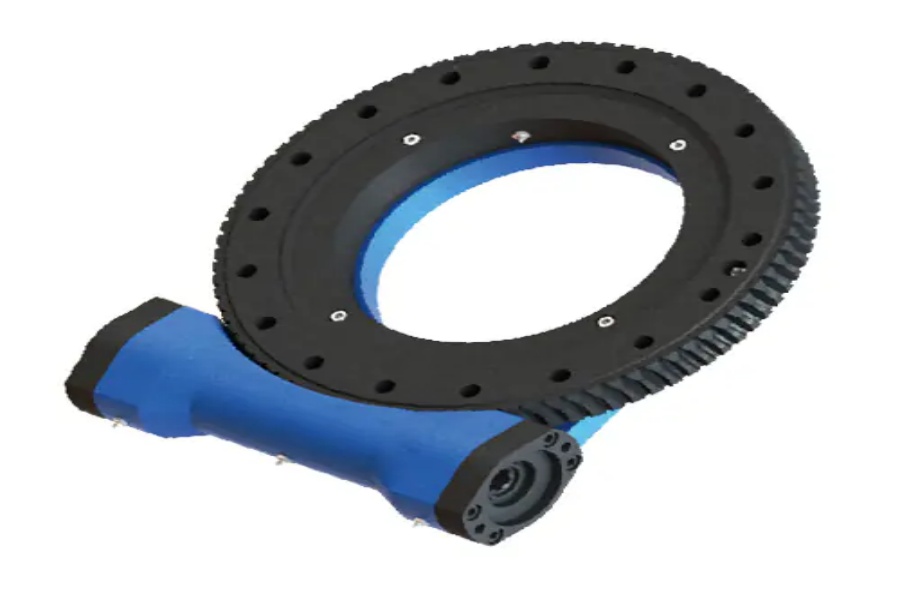
Use this as a guide during your supplier qualification process:
-
Quality Management System:
- [ ] Is the manufacturer ISO 9001:2015 certified? Request a copy of the certificate.
- [ ] Do they hold other relevant certifications, like the CE Marking for the European market?
-
Technical and Engineering Capability:
- [ ] What is the experience level of their engineering team? (Our team has over 15 years of focused R&D experience in slew drives and bearings).
- [ ] Can they provide a technical proposal quickly? (We deliver proposals within 24 hours).
- [ ] Do they offer rapid prototyping? (Our lead time is 3 days for prototypes).
-
Manufacturing and Production:
- [ ] What is their annual production capacity? (We can produce 100,000 sets annually across 6 production lines).
- [ ] What is their standard production cycle? (Ours is 9 days).
- [ ] Can you request a factory audit report if an in-person visit isn't possible?
-
Quality Control and Testing:
- [ ] Do they perform 100% inspection on critical dimensions?
- [ ] Do they use a CMM for final inspection? Request a sample report.
- [ ] Is every unit subjected to a dynamic load test?
-
Commercial and After-Sales Support:
- [ ] What is the Minimum Order Quantity (MOQ)? (Our standard MOQ is 1 set).
- [ ] What are the warranty terms? (We offer a 2-year extended quality warranty).
- [ ] What is their guaranteed technical response time? (We guarantee a response within 48 hours).
Balancing Cost and Performance with Localized Manufacturing
Many project developers default to well-known, and often expensive, imported slew drive brands. However, significant cost savings can be achieved without sacrificing quality. The key is to find a manufacturer that has successfully localized production based on established international standards.
For example, we have invested heavily in localizing the production of German-standard SE and WE series slew drives. By optimizing our manufacturing processes and supply chain, we can offer these high-precision drives at a 30-50% lower cost compared to imported European brands. This isn't about cutting corners; it's about intelligent engineering and efficient production.
This cost advantage is achieved while matching the performance parameters of first-tier international suppliers. We offer precision grades from P0 to P4, ensuring a fit for even the most demanding solar tracking applications. For engineering teams in the UK, Australia, and the US, this approach provides access to world-class technology without the premium price tag and long lead times associated with overseas brands.
Partnering with a manufacturer that has a proven track record is essential. From supplying WEA series drives for marine cranes in the UK to providing double worm slew drives for mining excavators in Australia, our components are validated in some of the world's most demanding heavy-equipment projects. This same military-grade quality control is applied to every solar tracker drive we produce.
Request Your Custom Slew Drive or Bearing Spec
Tell us your load, speed, and environment — receive a tailored 100–5000 mm slewing drive or slewing bearing proposal with 3D drawings within 24 hours.
 WhatsApp

 +8613903880726