



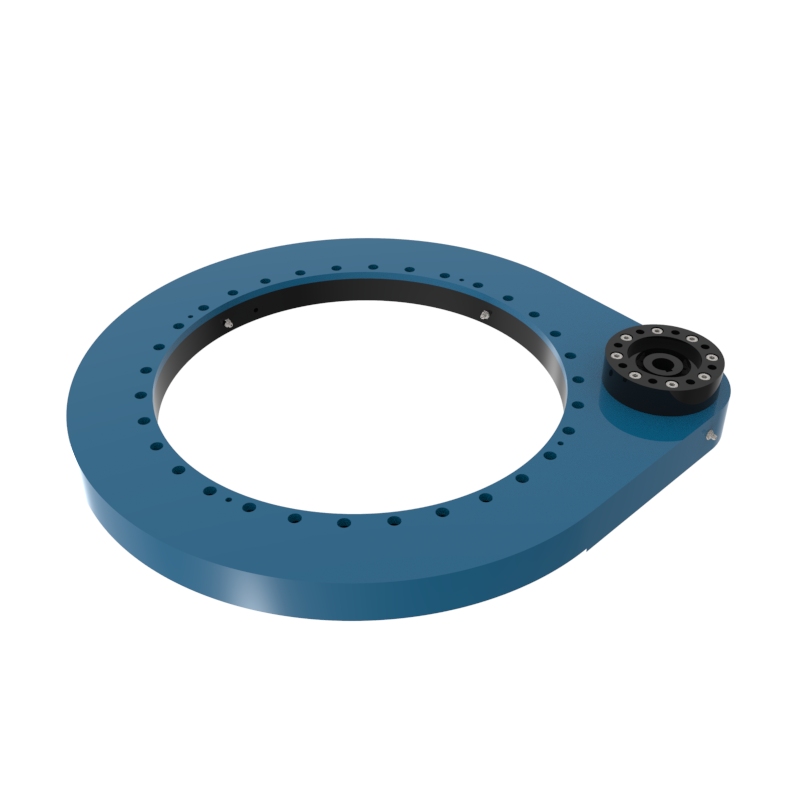
What is a crane slew drive? It is the geared rotation unit that turns a crane upper structure, boom, platform, or working attachment around its base. It commonly combines a slewing bearing, gear system, housing, mounting interface, and drive motor or hydraulic input.
When inspectors find rotational play, vibration, clicking, or unusual movement, the first question is not always whether the bearing has failed. In crane slew drive troubleshooting, the same visible symptom can come from loose mounting bolts, worn bearing raceways, gear backlash, a distorted mounting surface, or more than one problem at once.
The practical difference matters. Loose connections may be corrected by a controlled inspection and retorque procedure if no damage has occurred, while bearing wear may require deeper inspection, load assessment, or replacement planning. Retightening bolts without finding the true movement path can hide a serious condition for a short time.
Start by Finding Where the Movement Actually Occurs
The best first step is to separate movement at the mounting joint from movement inside the slewing bearing. A loose slew drive can shift between the drive housing and its support structure, or between the bearing ring and the mounting plate. Bearing wear, by contrast, is usually seen as internal relative movement between the inner and outer rings.
Use a fixed reference point before any retorque work. Place an indicator, pointer, or other suitable measuring reference so that it can show whether the housing, mounting ring, or bearing ring moves first as the crane is gently loaded and unloaded. Record the location of the reference and the crane position so the test can be repeated.
Movement found at a bolt circle points toward a connection problem, but it does not prove that the bearing is healthy. A loose joint can allow repeated impact loading, and that loading can later damage raceways, rolling elements, gear teeth, or fastener holes. The right conclusion is therefore conditional: repair the connection only after checking whether it has already caused secondary damage.
Internal movement that remains after mounting connections are verified is stronger evidence of bearing wear or internal clearance change. This condition fits applications with cyclic overturning loads, such as crane booms operating at varying outreach. It does not automatically identify the failed component, because gear mesh clearance and structural deflection can also contribute to apparent rotational play.
Mark the components before testing
Paint marks or witness marks across the mounting interface can make later movement easier to identify. Put marks across the slew drive housing and supporting structure, and where accessible, across the bearing ring and its mounting surface. If the marks shift after a controlled movement test, the interface has moved.
Do not rely on a visual check alone. Rust staining, polished contact areas, fretting debris, elongated bolt holes, and damaged paint can indicate micro-movement, but they do not show the full amount or direction of displacement. A recorded movement test gives maintenance planners evidence they can compare at the next inspection.
Compare Movement Vibration and Fastener Evidence Before Naming the Fault
Loose mounting connections and bearing wear can both create noise, vibration, and unwanted motion. The differentiator is where the evidence appears and whether the motion changes after the fasteners and mounting surfaces are inspected. Treat bolt condition, movement location, and vibration pattern as one diagnostic set rather than separate maintenance tasks.
| Evidence to Check | More Consistent With Loose Mounting Connections | More Consistent With Bearing Wear | What the Evidence Means in Practice |
|---|---|---|---|
| Visible relative movement | Movement occurs at the housing-to-frame or bearing-ring-to-mounting-surface joint. | Movement occurs between the bearing’s inner and outer rings after the mounting joint is verified. | Locate the moving interface before deciding on retorque work or bearing inspection. |
| Fastener condition | Loose bolts, damaged threads, missing preload evidence, fretting around bolt holes, or shifted witness marks may be present. | Fasteners may remain secure and witness marks may remain aligned. | Fastener findings support a joint problem, but they do not rule out damage caused by prior looseness. |
| Vibration pattern | Impact-like vibration may occur when the structure changes direction or load reverses. | Vibration or roughness may repeat through rotation and may be associated with a particular bearing position. | Repeatability matters. Record crane position, direction, load condition, and sound location. |
| Noise source | A sharp knock near the mounting interface can occur as a loose joint shifts. | Grinding, rumbling, or repeating roughness near the bearing can suggest internal damage or poor lubrication. | Noise alone is not a repair decision. Confirm it with movement and fastener evidence. |
| Effect of controlled fastener inspection | Symptoms may reduce if the joint is restored and no damage exists. | Internal play or rough rotation remains after the mounting connection is verified. | Do not treat symptom reduction as proof that the bearing is undamaged. |
The main misunderstanding is assuming that any slew play means bearing wear. In many crane installations, a mounting joint that has lost clamp load can imitate bearing clearance because the whole drive or bearing ring moves under load. This is why inspectors should identify the moving boundary before requesting a replacement Slew Drive or approving a teardown.
The opposite mistake is just as costly. If a loose joint is retorqued after repeated movement has already damaged the mounting surface or bearing, the crane may run more quietly for a time while the internal fault continues. Retorque is a corrective action for a verified connection issue, not a substitute for checking bearing condition.
Use a Controlled Inspection Sequence Before Scheduling Repairs
A short, repeatable sequence gives inspectors and maintenance planners a better basis for deciding whether the next work order should be fastener service, bearing inspection, structural repair, or component replacement. Keep the crane in a safe inspection condition and follow the equipment manufacturer’s lockout, lifting, and access procedures.
- Review the inspection history. Check prior bolt retorque records, lubrication records, vibration reports, overload events, and prior observations of play. A recent change in symptoms can point to a developing fault, while a long-standing condition may require a broader condition review.
- Inspect the mounting interfaces. Look for witness-mark movement, fretting, corrosion between clamped surfaces, cracked paint around bolt holes, distorted washers, damaged threads, and signs that bolt holes have moved. These findings support a loose-connection diagnosis, but they must be checked against movement testing.
- Check fasteners to the applicable specification. Use the crane or slew drive manufacturer’s specified tightening method, sequence, and torque requirement. Do not select a torque value from a different bolt grade, joint design, or lubrication condition.
- Measure movement under controlled loading. Observe the marked interfaces while the crane is moved through a limited, safe operating range. Note whether movement begins at the mounting joint, inside the bearing, or at the gear and drive connection.
- Rotate through multiple positions. Record whether roughness, vibration, or noise repeats at the same rotational location. A recurring location can support further bearing or gear investigation, while random movement at a loose joint may change with load direction.
- Inspect lubrication and sealing condition. Check for leakage, contamination, blocked grease paths, or damaged seals according to the equipment requirements. Poor lubrication can worsen bearing damage, but adding lubricant does not correct worn raceways or loose bolts.
- Document the repair decision. Record photos, movement observations, bolt findings, rotational position, and recommended action. This evidence helps the maintenance team decide whether a retorque is sufficient or whether the crane should be held for further inspection.
This procedure fits routine inspections where play or vibration has been found before a major failure occurs. It does not replace a structural engineering review when the mounting frame is cracked, distorted, or visibly damaged. In that situation, restoring bolt preload without evaluating the supporting structure may create another repeat failure.
For cranes using a separate ring bearing and drive arrangement, the bearing itself should be assessed as its own assembly. Product configuration matters because a Slewing Bearing carries load through its rings and rolling elements, while the drive transmits torque into that system. A fault at either interface can appear as rotational looseness.
Request Your Custom Slew Drive or Bearing Spec
Tell us your load, speed, and environment — receive a tailored 100–5000 mm slewing drive or slewing bearing proposal with 3D drawings within 24 hours.
Understand How Load Direction and Mounting Condition Change the Diagnosis
Crane slew systems do not see one simple load. They see axial load, radial load, overturning moment, torque, shock, and repeated direction changes. Each load can expose looseness differently, so an inspection performed only at one boom position or one rotation direction can miss the condition that operators notice during normal work.
Overturning moment is especially useful in diagnosis because it tends to load one area of the bearing and mounting joint more heavily than another. If movement becomes more obvious at a certain boom angle or load direction, record that condition. The result may indicate localized bearing wear, localized mounting-surface damage, or a structural deflection that needs further review.
Gear backlash must also be kept separate from bearing play. Some rotational movement may be felt when torque reverses because the worm, gear, pinion, or reducer changes contact side. That motion does not by itself prove a loose bearing or loose bolt, and it should be checked by observing whether the bearing rings and mounting interfaces remain stationary.
A worm-driven crane unit can add another factor: self-locking behavior may limit back-driving in certain operating conditions, yet it does not prevent damage from loose mounting bolts or a worn bearing. For applications requiring higher torque distribution or added support against operating loads, the system design may use a Double Worm Slew Drive. The correct configuration depends on the crane duty, load path, mounting geometry, and operating environment; it cannot be selected from apparent play alone.

When retorque is not an adequate remedy
- Stop at retorque only when the joint is verified as the moving interface and no damage is found. This fits a connection issue caught early. It does not fit elongated holes, cracked supports, fretting damage, or continued motion after fasteners are checked.
- Plan a bearing-focused inspection when internal ring-to-ring movement remains. This fits repeatable roughness, internal clearance symptoms, or noise linked to rotation position. It does not confirm a bearing replacement until gear condition, lubrication, and structural deflection are also reviewed.
- Escalate to structural review when the mounting surface is distorted or cracked. This fits cranes exposed to repeated high moment loads or impact events. A replacement bearing mounted on an unsuitable surface can develop the same symptoms again.
- Inspect the drive train when motion is limited to torque reversal. This fits backlash-related complaints where bearing rings remain stable. It does not rule out bearing wear if the system also shows roughness or internal movement under load.
Build a Repair Scope From Evidence Instead of Replacing Parts by Symptom
A good repair scope states what moved, what evidence supports that finding, and what remains unconfirmed. This keeps the maintenance planner from ordering a bearing for a fastener problem or approving a retorque when the mounting surface has already deteriorated. It also gives purchasing teams clearer information when requesting replacement components.
| Inspection Result | Recommended Next Action | Reasoning | Limit of the Recommendation |
|---|---|---|---|
| Witness marks shifted and movement occurs at the mounting interface | Inspect fasteners, threads, holes, washers, and contact surfaces before applying the specified tightening procedure. | The joint appears to be the source of motion. | Further work is needed if fretting, distortion, or bearing roughness is found. |
| Fasteners remain secure but internal movement persists | Schedule detailed bearing and gear assessment. | The evidence points beyond a simple mounting connection issue. | The inspection must still separate bearing damage from drive backlash and structural deflection. |
| Roughness repeats at one rotational position | Document the position and inspect bearing raceway, rolling elements, gear teeth, and lubrication condition. | Position-specific symptoms can indicate localized internal damage. | Do not assume one damaged zone without physical inspection. |
| Cracked or distorted mounting support | Hold component replacement until the support structure and mounting geometry are evaluated. | A sound bearing needs a sound mounting surface. | The repair approach depends on the crane structure and manufacturer requirements. |
Luoyang Slewring Bearing Co., Ltd. supports crane and heavy-equipment buyers with Slew Drive, Slewing Bearing, and Customized Slew Drive options matched to working conditions. Material selection can include ductile cast iron, alloy steel, stainless steel, or forged alloy steel based on load, speed, and environment. That selection process should begin with the inspection record, not only the outside diameter or a photo of the existing unit.
For replacement planning, provide the drive model if available, mounting dimensions, bolt pattern, gear arrangement, operating load description, speed, environment, and photos of the damaged interfaces. If the application requires a nonstandard housing, mounting geometry, or output arrangement, a Customized Slew Drive may be more suitable than modifying a standard unit in the field.
Our facility is ISO 9001:2015 certified and uses CNC machining centers plus CMM three-coordinate inspection. Every slewing bearing is subject to CMM inspection and dynamic load testing under our stated quality-control process, with a 2-year extended quality warranty for confirmed manufacturing defects. These controls support replacement sourcing, but they do not remove the need to correct damaged crane mounting surfaces before installation.
Application evidence also matters when reviewing duty requirements. A South Korean port equipment manufacturer placed a repeat order for WEA9-62-25HR single worm slew drives used in port crane systems, specified for no more than 0.15° tracking precision, IP65 sealing, and self-locking. That case shows why crane duty, sealing needs, and positioning requirements should be included in the repair request rather than treated as secondary details.
For a replacement inquiry, include the inspection evidence first: where movement occurred, which fasteners were checked, whether vibration repeated by rotation position, and whether the support structure showed damage. Luoyang Slewring Bearing Co., Ltd. can provide a technical proposal within 24 hours, while standard production is stated as a 9-day cycle. A clear diagnosis helps ensure that the selected component addresses the actual fault instead of only the symptom.
Request Your Custom Slew Drive or Bearing Spec
Tell us your load, speed, and environment — receive a tailored 100–5000 mm slewing drive or slewing bearing proposal with 3D drawings within 24 hours.
 WhatsApp

 +8613903880726