



What is a worm slew drive? It is a sealed rotation unit that combines a slewing bearing, a ring gear, and a worm shaft in one housing. The worm turns the ring gear, and the ring gear turns the load.
The design question is how many worms the job needs. One worm is simpler and cheaper. Two worms share the tooth load, but they add parts, width, and setup work. This article sets out where the line falls, so you can decide before you request quotes.
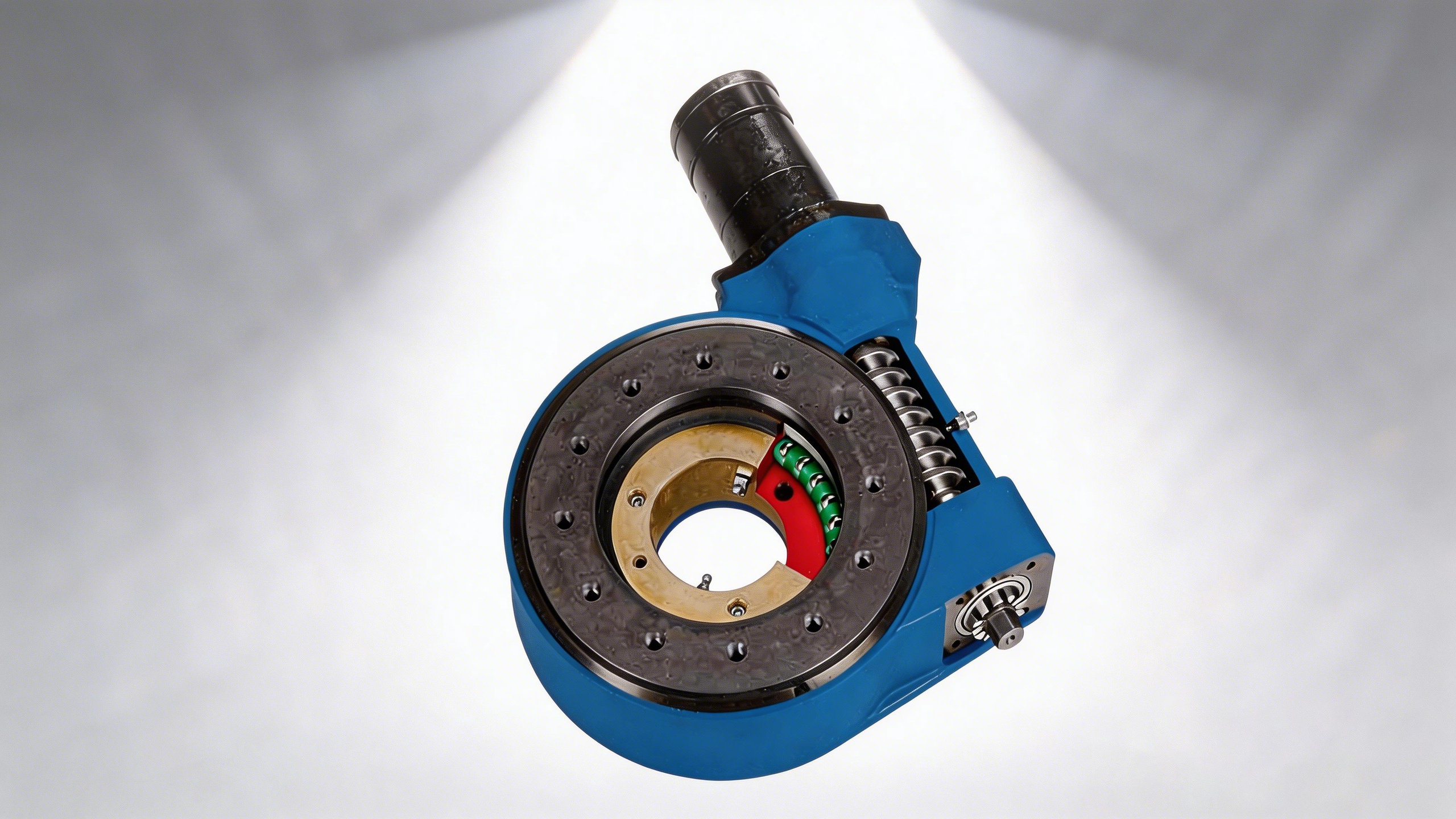
How One Worm and Two Worms Carry the Load
In a single-worm unit, all tangential tooth force passes through one mesh zone. That one worm and its bearings also take the reaction loads. Every driven torque value depends on that single contact area.
A double-worm layout puts two worms on the same ring gear. The driving force is split across two mesh zones, which can lower contact stress at each zone. Depending on the layout, the reaction forces on the housing and the slewing bearing can also become more balanced.
The split is never a perfect 50/50. It depends on how well the two meshes are aligned and how closely their backlash is matched. A poorly set double-worm unit can overload one worm while the other idles, so the second worm only helps when assembly and tolerances support it.
For background on the single-worm family, see our Worm Gear Slew Drive page. The rotation itself is supported by a slewing bearing, which has its own load limits. Do not size the worm stage without checking the bearing stage.
What the Evidence Covers, and What It Does Not
Public supplier pages tend to promote double-worm units for higher torque and load capacity. Other pages simply describe standard worm-driven slewing systems. We found little that sets practical decision boundaries for choosing one worm or two. That gap is why this article exists.
Product marketing is not proof of an industry shift. Nothing here shows that double-worm designs are replacing single-worm ones. The accurate statement is narrower: both layouts are in active use, and each fits certain duty profiles.
Our own shipment records give scoped illustrations. They show where each layout has been supplied. They do not show why each buyer chose it, and they do not represent market demand.
| Customer / Region | Model | Application | Layout |
|---|---|---|---|
| Houston, Texas engineering machinery maker | WED17-104-25HR (150 units) | Heavy-duty wheel steering | Double worm |
| British Columbia, Canada forestry equipment maker | WED14-86-25BHR.5 (30 units, ≤0.13° precision) | Forestry grapple machines | Double worm |
| Australian heavy equipment maker | HWE21-94-25HR.1 | Mining excavators | Double worm |
| South Korean port equipment maker | WEA9-62-25HR (20 units, ≤0.15° tracking, IP65, self-locking) | Port cranes | Single worm |
| Netherlands material handling maker | WEA9-62-25HR (50 units) | Truck-mounted loader cranes | Single worm |
| UK Ocean Marine Systems | WEA17-104-25H-R-REV.D (20 units) | Shipboard cranes | Single worm |
One pattern is worth noting. The two double-worm cases with stated precision or duty, steering and forestry grapples, involve repeated reversing loads. But a few cases cannot prove a rule. Treat them as prompts for your own load analysis, not as evidence of a trend. You can browse the double-worm series on our WED Slew Drive page.
Boundary Analysis: When Two Worms Improve Torque Sharing and When They Add Needless Complexity
The honest answer is "it depends on the load case." The table below turns that into checks you can run on your own data.
| Factor | A double-worm layout helps when... | A single worm is enough when... |
|---|---|---|
| Peak torque | Peak torque, after the service factor, exceeds the rating of the largest single-worm size that fits your envelope | Peak torque sits comfortably inside a single-worm rating with margin |
| Load pattern | Shock loads, frequent starts, or reversing loads concentrate stress on one mesh | Loads are smooth, slow, and mostly one direction |
| Stability | The platform sees tilting moments or side forces, as on steering or grapple heads | The load is light and well centered, as on a small turntable |
| Positioning accuracy | You need tight, repeatable backlash control across wear life | A moderate tracking tolerance is acceptable |
| Duty cycle | Long, heavy duty would overheat one worm mesh | Duty is intermittent, with cooling time between moves |
| Space | Housing width and a second shaft fit the design | The envelope is tight and every millimeter counts |
| Cost target | Downtime or a field failure costs far more than the unit | The unit is price-sensitive and the load margin is already healthy |
Four rules of thumb, with their limits
- Move to two worms when the single-worm margin is thin. The reason is that torque shares across two meshes. This fits steering systems and heavy grapples. It does not apply if the weak link is the bearing, the bolts, or the structure, because a second worm cannot fix those.
- Stay with one worm when the load is smooth and steady. The reason is that you avoid extra cost and alignment risk. This fits cranes with moderate duty and light turntables. It does not apply if shock events are hidden in the duty cycle, such as emergency stops.
- Choose two worms when backlash control must last. Two meshes can be set to hold position more evenly. This fits tracking and positioning tasks. It does not apply if the application tolerates a few degrees of play.
- Do not pick two worms just to be safe. Over-specifying adds cost, width, and set-up steps. A properly rated single-worm unit with a verified margin often performs better than a poorly matched pair.
Our Double Worm Slew Drive range covers the first and third cases. The single-worm WEA series covers the second.
Request Your Custom Slew Drive or Bearing Spec
Tell us your load, speed, and environment — receive a tailored 100–5000 mm slewing drive or slewing bearing proposal with 3D drawings within 24 hours.
Backlash, Stiffness, and Self-Locking Tradeoffs
Backlash is the small gap between worm and ring-gear teeth. In a single-worm unit, you set it once at one mesh, and wear opens it over time. In a double-worm unit, you have to set two meshes, and they need to match.
That matching is the main extra task. If the two meshes differ, one worm takes most of the load and the sharing benefit shrinks. Ask your supplier how the two worms are adjusted, and how the final backlash is verified before shipment.
Self-locking needs care in both layouts. A worm with a low lead angle can hold a load at rest. Vibration can still reduce that holding ability, so do not assume it for safety-critical holds. If a dropped or drifting load would be dangerous, specify a brake and treat self-locking as a backup only.
The South Korean port cases list self-locking as a requirement on a single-worm unit. That shows a single worm can meet it for that application. It does not mean all single-worm drives lock under all conditions. Check the lead angle and the vibration level of your own duty.
Cost, Packaging, and Maintenance Compared
Two worms cost more to make. There are more shafts, more bearings, and more machining and inspection steps. The housing is usually wider, which affects your frame design.
| Item | Single worm | Double worm |
|---|---|---|
| Unit price | Lower | Higher; ask for both quotes |
| Housing width | Narrower | Wider; check frame clearance |
| Drive inputs | One motor or hydraulic input | Depends on layout; confirm how both worms are driven |
| Setup | One mesh to adjust | Two meshes to match |
| Lubrication and sealing points | Fewer | More; plan service access |
| Failure exposure | One mesh carries everything | Load is shared, but a mismatch can overload one side |
Compare the extra unit cost with the cost of a field failure. For a mining excavator or a steering axle, a stoppage can cost more than the price gap. For a light turntable, it rarely does.
A Worked Example and a Buyer Checklist
Here is a hypothetical example, with illustrative numbers only. Say the largest single-worm unit that fits your envelope is rated at 1.0 unit of output torque. Your calculated peak load is 0.85 units, and your design standard requires a 1.3 service factor. The required rating is then about 1.1 units, so the single worm falls short and a double-worm unit is worth quoting.
Change one input and the answer flips. If the peak is 0.6 units, the required rating is 0.78, and the single worm passes with margin. The extra worm would add cost without a clear benefit.
Steps to follow before you request a quote
- Calculate peak output torque, including start, stop, and shock events.
- Apply your service factor and compare the result with the single-worm rating that fits your envelope.
- Check the tilting moment, axial load, and radial load against the slewing bearing rating.
- Define the backlash and positioning accuracy you need over the full wear life.
- Decide whether you need self-locking, a brake, or both.
- Confirm the width and mounting space for each layout.
- Request quotes for both layouts and compare price against downtime risk.
Common mistakes
- Sizing from average torque instead of peak torque.
- Assuming two worms double the capacity. Sharing is never perfect, and the bearing may still limit the system.
- Relying on self-locking where vibration is present.
- Ignoring the wider housing until the frame is already fixed.
- Comparing unit prices without comparing quality records and warranty terms.
On the supplier side, ask how each unit is verified. Every slew bearing we ship passes CMM inspection and dynamic load testing, and our reported failure rate is below the 0.5% industry standard. Our factory is ISO 9001:2015 certified, with audit reports available on request. See our Slew Drive Quality Control page for the inspection steps.
Open Questions and Signals That Would Change the Call
Some questions cannot be settled from a catalog. How evenly two worms share load in your specific assembly depends on tolerances and mounting stiffness. The best check is a prototype test under your real load cycle.
Our prototyping takes 3 days, and standard production runs 9 days. A technical proposal follows within 24 hours of your inputs. The minimum order is 1 set for standard products and 5 sets for customized ones, so a test unit of each layout is a practical path.
These signals would justify a different decision:
- Test data shows uneven sharing. Revisit mesh adjustment, or reconsider whether two worms are worth the cost.
- The bearing proves to be the limit. Change the bearing or the frame, not the worm count.
- Duty turns out smoother than assumed. A single worm may be enough.
- Precision requirements tighten. A double-worm layout or a customized design may become necessary.
If your load case does not fit a catalog size, a Customized Slew Drive can match the worm count, ratio, and sealing to your duty. Send us your peak torque, duty cycle, and envelope. We cover this with a 2-year extended quality warranty, 48-hour technical response, and free replacement for confirmed manufacturing defects.
Request Your Custom Slew Drive or Bearing Spec
Tell us your load, speed, and environment — receive a tailored 100–5000 mm slewing drive or slewing bearing proposal with 3D drawings within 24 hours.
 WhatsApp

 +8613903880726