



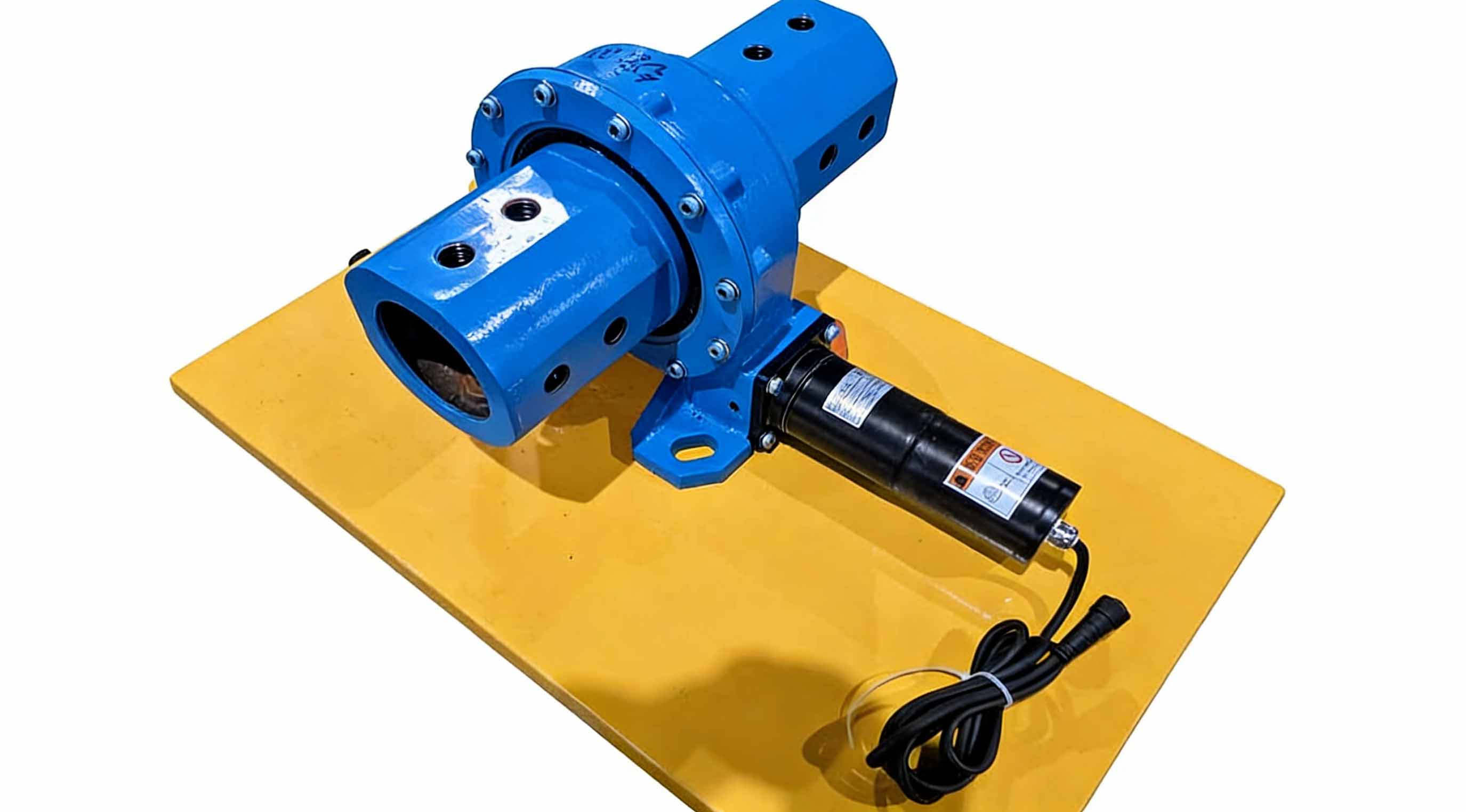
What is a slew ring bearing for demolition shear? It is a large-diameter rotation bearing that lets a hydraulic shear head turn on its carrier while carrying shock loads and tilting moments. A slewing bearing like this has raceways, rolling elements, and seals. In demolition work, the seals decide how long the raceways stay clean.
The question many attachment buyers ask is simple. Will a standard seal and grease arrangement survive concrete fines, rebar dust, and wet slurry? This article gives a bounded answer, shows where the limits are, and lists what to check before you approve a drawing.
Why Concrete Dust Is Harder on a Rotation Bearing Than Ordinary Dirt
Scope first. This is an evergreen engineering analysis. It does not rely on dated market data, and none of the customer cases we cite below is a demolition shear project. They are scoped illustrations of sealed rotation hardware in dusty or heavy-duty service.
Observation: crushed concrete produces very fine, hard, angular particles. A shear works at the point of breakage, so the bearing sits close to where that dust is created. Rebar cutting adds steel fines and sharp slivers.
Interpretation: these particles act like lapping compound once they pass the seal. They mix with grease and scratch raceways. Because a shear rotates intermittently and in short arcs, the same raceway spots see repeated load and repeated contamination.
Water changes the picture. Dust that stays dry mostly stays out. Wet slurry is alkaline, it clings, and it can be pushed past a lip by pressure washing or by pressure changes inside the housing.
Boundary Analysis: When Standard Seal-and-Grease Arrangements Fail
A standard arrangement means one elastomer lip or contact seal per raceway gap, with factory grease and a routine lubrication schedule. It works well in many cranes and excavators. The table shows where we expect it to reach its limit in demolition duty. This is engineering reasoning, not published test data.
| Exposure | How it gets past a standard seal | Likely effect | Boundary: standard setup is marginal when… | What to ask for |
|---|---|---|---|---|
| Concrete fines (dry) | Settles on the seal lip, then works in with each reversal and ring flex | Abrasive wear on raceways and seal lip | The ring is mounted low and dust falls on it continuously, with no guard or shroud | Secondary dust lip or labyrinth, plus a protective cover |
| Rebar dust and slivers | Cuts or nicks the lip; steel fines mix with grease | Torn seal, local pitting | Cut debris can strike the seal directly | Debris shield; harder or thicker seal profile |
| Wet slurry | Wicks past the lip, drawn in as the ring cools after work | Grease washout, corrosion, hard cement paste in the gap | Slurry stays on the ring between shifts or is hit by a pressure washer | Sealed, purgeable grease path; corrosion protection on exposed surfaces |
| Grease purge cycle | Old grease pushes out, but new grease pulls in dirt if the lip is damaged | Contaminated grease charge | Lubrication is done on dirty fittings or skipped between jobs | Clear purge points and a written regreasing interval |
| Shock and tilt | Ring deflection opens a momentary gap at the seal | Pumping of dust into the raceway | The mounting structure is not stiff or flat enough | Flatness and stiffness limits on the mating surfaces |
The pattern is consistent. A single lip is rarely the weak point by itself. The weak point is a single lip combined with unprotected exposure, deflection, and loose greasing habits.
Where this does not apply: if the shear works mostly on light structures, in dry conditions, and with a guard over the ring, a standard seal setup may be enough. Do not pay for extra sealing you cannot justify.
Request Your Custom Slew Drive or Bearing Spec
Tell us your load, speed, and environment — receive a tailored 100–5000 mm slewing drive or slewing bearing proposal with 3D drawings within 24 hours.

Alternative Explanations: Not Every Early Failure Is a Seal Failure
Before blaming the seal, rule out other causes. In my own design reviews over three decades, contamination often got the blame for damage that began elsewhere. A seal can fail because the ring was already moving more than it should.
- Bolt preload loss. A loose mounting bolt lets the ring lift at the edge and pumps dust in. Fix: check preload and the re-torque schedule.
- Uneven mating surface. A warped or dirty flange deforms the ring and opens seal gaps. Fix: set flatness limits in the drawing.
- Overload or side-load shock. Cutting a jammed beam can exceed the load case the bearing was sized for. Fix: confirm the load case with the shear maker.
- Wrong grease. Water-washed grease may leave the raceway dry even with good seals. Fix: ask for a water-resistant grade and a purge interval.
- Raceway type mismatch. A ball design may run short on capacity where a roller design would not. See three-row roller slewing bearings for the high-capacity option.
The limit of this list is that we cannot tell you which cause applies to your machine without teardown photos. Wear patterns tell the story. Embedded grit near the seal suggests ingress, while edge loading on one side suggests a structural or preload problem.
What This Changes in Your Specification
The analysis turns into questions. Each question below affects a specific decision.
| Evaluation question | Decision it affects |
|---|---|
| Where is the ring mounted relative to the cut zone and debris path? | Whether you need a shroud or guard in addition to seals |
| Is it a single or a double seal arrangement? | Cost versus ingress margin |
| Can grease be purged from a clean, reachable point? | Service interval and field maintenance practice |
| What are the flatness and stiffness limits for the mating structure? | Whether the seal can hold under ring deflection |
| What material and surface protection suit the washdown and slurry exposure? | Corrosion resistance of exposed surfaces |
| What inspection data comes with each ring? | Acceptance criteria for incoming parts |
Material choice follows the working condition: load, speed, and environment. Luoyang Slewring Bearing Co., Ltd. works with ductile cast iron, alloy steel, stainless steel, and forged alloy steel. We select among them per application rather than by default.
Common Mistakes We See on Specification Sheets
- Listing only static and dynamic load ratings and leaving seals unspecified.
- Copying an excavator bearing spec onto a shear without checking the debris path.
- Skipping a regreasing interval because the first fill was "lifetime."
- Approving a seal drawing without asking what happens during pressure washing.
- Treating dust protection as a bearing-only issue when the mounting structure drives deflection.
A Worked Example: Reviewing a Seal Spec in Six Steps
This is an illustrative scenario, not a customer case. An attachment OEM wants a ring for a shear used on bridge deck demolition, where concrete dust, rebar offcuts, and water spray are all present.
- Map the exposure. Sketch the debris path and spray direction. Mark where the ring sits relative to both.
- Define the load case. Confirm axial, radial, and tilting moment loads, including shock. Decide whether the load calls for a heavier design such as a heavy load slewing bearing.
- Choose sealing level. If the ring is exposed to direct debris and spray, request double sealing and a shield. If it is guarded and dry, a single seal may do.
- Set grease rules. Specify a water-resistant grease, a purge point, and a regreasing interval tied to operating hours.
- Control the interface. Put flatness limits and bolt preload steps in the drawing.
- Set acceptance data. Request dimensional inspection records for each batch.
Where this fails: if the real load case is unknown, steps 3 and 4 are guesses. Get field duty data before you freeze the design.
What We Can Show, and What Remains Uncertain
Luoyang Slewring Bearing Co., Ltd. has focused on slew bearing and slew drive R&D for 15+ years, with more than 2,000 heavy-equipment projects. Every slew bearing passes CMM three-coordinate inspection and dynamic load testing. You can read more on our slew drive quality control page. The company is ISO 9001:2015 certified, and factory audit reports are available on request.
Our cases are relevant only as scoped illustrations. A US renewable energy customer ordered 50 units of SP-I 0841 slew drives for utility-scale solar trackers with IP65 sealing for desert sites. An Australian heavy equipment manufacturer uses HWE21-94-25HR.1 double worm drives on mining excavators. A Houston engineering machinery customer ordered 150 units of WED17-104-25HR for heavy-duty wheel steering. These show experience with sealed rotation hardware in dust and heavy duty. They do not prove performance on a demolition shear.
For drive-integrated designs, our slew drives offer protection up to IP66 and anti-corrosion ratings up to C4H. That applies to the drive, not to every bearing. If your design needs a custom ring or drive, see our customized slew drive options. Customized MOQ is 5 sets, standard MOQ is 1 set, and a technical proposal follows within 24 hours.
Open questions remain. We have no supplied field data comparing seal types on shears, so we cannot rank them by service life. Evidence that would change our advice includes teardown photos from your machines, your regreasing records, and measured deflection at the mounting flange. Send those with your drawing, and our engineering team will review them. Warranty terms include 2 years of extended quality coverage, 48-hour technical response, and free replacement for confirmed manufacturing defects.
Request Your Custom Slew Drive or Bearing Spec
Tell us your load, speed, and environment — receive a tailored 100–5000 mm slewing drive or slewing bearing proposal with 3D drawings within 24 hours.
 WhatsApp

 +8613903880726