



What are slew bearings? They are large rolling-element bearings that let one structure rotate on another. They carry axial load, radial load, and tilting moment at the same time. You find them under crane booms, excavator upper structures, and mining machine turntables.
A small ring is a purchased part. A very large ring becomes a project with its own transport plan, surface requirements, and installation procedure. So at what size does that change happen, and what should you ask your supplier before you order?
No single diameter answers it. This article explains which design features add risk, which alternative explanations you should rule out first, and which checks protect your schedule.
Why Size Changes the Risk Profile
Here is what we can observe. Many top-ranking product pages list size ranges, heavy-force capability, and stiffness. One of them notes that very large bearings may be segmented for transport.
Here is how we read it. That coverage shows what suppliers choose to advertise. It does not prove where field problems occur, and it is not a market trend report. This article is an evergreen engineering analysis, not a review of current market data.
The engineering reasoning is simple. As the ring diameter grows, its cross-section does not grow at the same rate. A large ring is more flexible, so it follows the shape of the mounting surface instead of forcing that surface to be flat. If the surface is uneven, the raceway is bent and the load concentrates in a few rolling elements.
In my own design reviews, the pattern is consistent. Problems blamed on the bearing often begin with the structure under it. A stiffer bearing tolerates less of that error, not more.
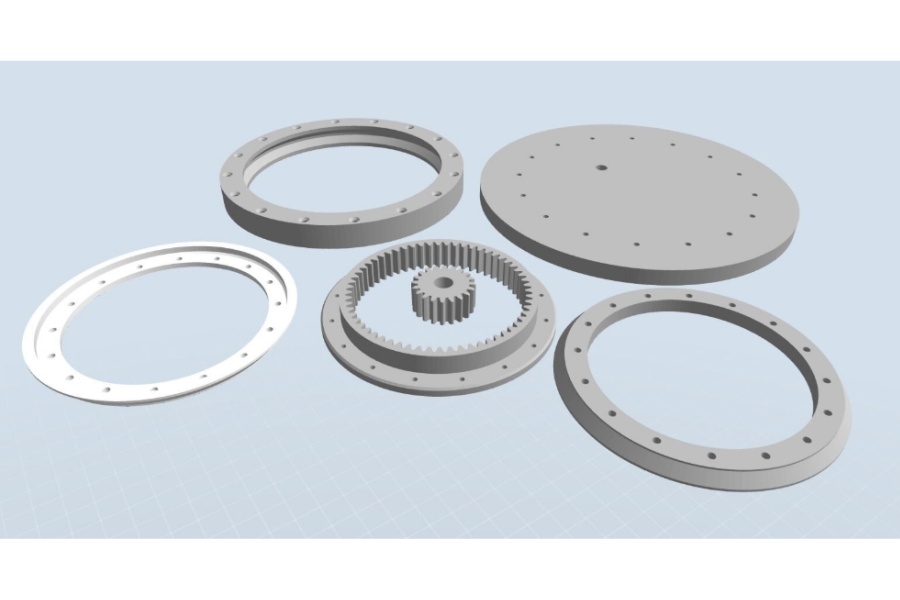
Where Large, Segmented, and High-Moment Designs Add Risk
Three design choices shift risk from the factory floor to your shipping route and your assembly bay. The table below compares them. It shows where each one can fail and what to verify.
| Design feature | Transport risk | Mounting-flatness risk | Installation risk | What to verify |
|---|---|---|---|---|
| Large-diameter one-piece ring | Oversize loads, limited route options, ring distortion if lifted or stored at the wrong points | Flexible ring conforms to an uneven surface, which bends the raceway | Needs a lifting plan and a long, controlled bolt-tightening sequence | Transport envelope, lifting points, allowable flatness on the drawing |
| Segmented ring | Smaller pieces ship more easily, but each piece needs protection and match marking | Joints must line up and the assembled ring must sit flat on both faces | Field assembly replaces factory assembly, so quality depends on site conditions | Who assembles, joint alignment method, inspection after assembly |
| High-moment design (for example, a three-row roller type) | Heavier and wider section, more handling stress | Stiff, heavily loaded raceways are sensitive to uneven support | Bolt preload matters more because loads concentrate at the bolted joint | Preload method, bolt grade, support structure stiffness |
| Integrated large gear teeth | Teeth can be dented by slings, forks, or stacking | Mounting deflection changes backlash around the circle | Pinion alignment must be set after the ring is fully bolted | Backlash measurement at several positions after mounting |
Notice that size is not the only trigger. A moderate-diameter ring under a high tilting moment can be as sensitive to flatness as a larger ring under light load. Treat diameter, moment, and structure stiffness together.
Where this does not apply: A compact ring that one crew can lift and bolt onto a machined, stiff flange carries much lower handling and flatness risk. For those cases, standard selection by load rating is usually enough.
For high-moment work, three-row roller slewing bearings are a common choice. They also demand the most from the mounting structure.
Drivers, and Other Explanations You Should Rule Out
The drivers below are documented engineering relationships, not company claims. Ring flexibility relative to the structure, handling mass, and the number of bolts to tighten all rise with size.
The interpretation is where buyers go wrong. When a large bearing wears early, the easy conclusion is a bearing quality problem. Several other causes produce the same symptoms:
- Uneven mounting face. Welded frames can move after machining, especially with heat or stress relief skipped.
- Lost bolt preload. Wrong tightening order or no re-check after the first load cycles lets bolts relax.
- Transport damage. Seal lips, gear teeth, or raceway surfaces can be hit during lifting or stacking.
- Load spectrum above design. Real duty cycles, such as repeated shock loading in mining, can exceed the calculated case.
- Lubrication gaps. Large rings need more grease and a clear method for distributing it.
What would change this assessment? Measured flatness data from the mounting face, a bolt torque record, and photos of the packaging on arrival. Without them, the cause stays unproven. Our sources hold no public dataset that ties ring diameter directly to failure rates, so we do not claim one.
Request Your Custom Slew Drive or Bearing Spec
Tell us your load, speed, and environment — receive a tailored 100–5000 mm slewing drive or slewing bearing proposal with 3D drawings within 24 hours.
How Size Should Change Your Purchasing Requirements
Once a ring passes the point where it needs a lifting plan, the purchase order should say more than "diameter, load rating, and quantity." The table links each question to the decision it affects.
| Question to ask | Decision it affects |
|---|---|
| What is the largest piece your route and port can handle? | One-piece versus segmented design |
| What flatness does the supplier require on the mounting face? | Machining specification for your frame and its cost |
| How is the ring lifted, stored, and supported in transit? | Packaging, crating, and arrival inspection plan |
| What bolt grade, preload, and tightening order apply? | Assembly procedure and tooling |
| What inspection records come with the ring? | Acceptance criteria and warranty claims |
| Which checks follow installation (rotation torque, backlash)? | Commissioning sign-off |
Our real cases give scoped illustrations of how these requirements appear in practice. They are not proof of an industry trend. A Houston, Texas engineering machinery manufacturer ordered 100 units of SEA21-125-25HR(2) for slewing platform and turntable systems. An Australian heavy equipment manufacturer chose HWE21-94-25HR.1 double worm slew drives for mining excavators.
Precision requirements also show up in the order. A British Columbia forestry equipment manufacturer ordered 30 units of WED14-86-25BHR.5 with ≤0.13° precision. A South Korean port equipment manufacturer placed a 20-unit repeat order of WEA9-62-25HR drives at ≤0.15° tracking precision. Tight angular precision only holds if the mounting surface supports it.
On our side, every slew bearing passes CMM three-coordinate inspection and dynamic load testing. Our facility holds ISO 9001:2015 certification. You can read more on our slew drive quality control page. Factory audit reports are available on request.
Common Mistakes When Specifying Large Turntable Bearings
- Specifying load only. A drawing with no flatness or stiffness requirement leaves the biggest risk undefined.
- Choosing segmentation only for shipping. It solves the transport problem but moves assembly quality to your site.
- Ignoring the structure. A stiff ring on a flexible frame will carry uneven load whatever its rating.
- Skipping arrival inspection. Damage found at install time is hard to assign to the carrier, the supplier, or the site.
- Tightening bolts in a circle. A cross-pattern, staged sequence spreads clamp force more evenly.
- Treating a heavy duty cycle like a light one. A heavy load slewing bearing and a light load slewing bearing are built for different load cases, so confirm the real duty before choosing.
What to Check Now and What Would Change the Plan
Here is a short procedure you can run before you place an order for a large ring.
- Write down the transport route limits, including port, road, and site access.
- Measure or specify the flatness of your mounting face and note how the frame will be machined.
- Decide who lifts, assembles, and tightens, and write the bolt sequence into the work instruction.
- Request the inspection record and the material grade for the ring. We select ductile cast iron, alloy steel, stainless steel, or forged alloy steel based on load, speed, and environment.
- Plan a rotation torque and backlash check after mounting, and again after the first operating cycles.
Two uncertainties remain. First, no single threshold diameter applies to every application, so be wary of anyone who gives one without your load case. Second, if your site cannot be machined flat or your route cannot take the full ring, the design may need to change.
An integrated option is sometimes worth a look. A customized slew drive combines the bearing, gear, and housing, which can simplify alignment at installation. It is not a fit for every application, and the structural checks above still apply.
For next steps, Luoyang Slewring Bearing Co., Ltd. returns a technical proposal within 24 hours of receiving your drawings and load case. Standard products start at 1 set, and customized products at 5 sets. Our standard production cycle is 9 days, and the schedule for a large custom ring is confirmed in the proposal. Confirmed manufacturing defects are replaced free, and every order carries a 2-year extended quality warranty and 48-hour technical response.
Request Your Custom Slew Drive or Bearing Spec
Tell us your load, speed, and environment — receive a tailored 100–5000 mm slewing drive or slewing bearing proposal with 3D drawings within 24 hours.
 WhatsApp

 +8613903880726