



What is a slew bearing? A slew bearing, also called a slewing bearing or slewing ring, is a large rolling bearing that supports axial load, radial load, and overturning moment while allowing a machine structure to rotate.
Before approving a repair quote or issuing a new-unit RFQ, buyers need to identify damage that cannot be safely restored. The slew bearing replacement cost is not only the price of the ring itself. It also includes machine downtime, removal labor, installation labor, alignment work, possible gear-drive damage, and the risk of another shutdown.
For fleet owners, maintenance managers, and equipment buyers, the defensible choice is usually simple: repair only when the bearing’s primary load paths and mounting interfaces remain sound. Replace the unit when raceway damage, gear damage, or bolt-hole damage can affect load capacity, rotation accuracy, or safe mounting.
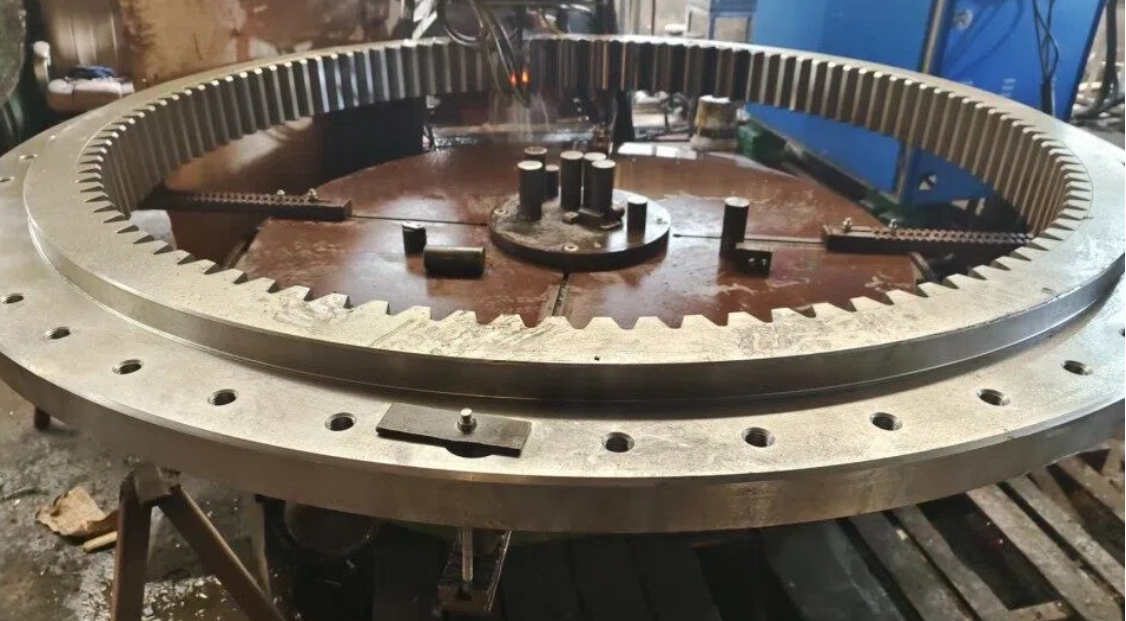
When should a buyer repair a slew bearing instead of replacing it?
Repair is worth reviewing when inspection shows limited, non-structural damage and the bearing can be restored without changing the load-bearing raceways, gear engagement, or mounting connection. Examples may include seal replacement, lubrication correction, cleaning, or controlled work on minor external issues. The service provider must confirm the repair scope in writing.
Repair should not be treated as a default option just because the bearing still turns. A ring can rotate while internal raceway surfaces have pitting, spalling, brinelling, or uneven wear that will progress under cyclic load. In that situation, a lower initial repair invoice can create a higher total cost if the machine returns to service only briefly before another failure.
Ask the repair provider to state what was inspected, what will be restored, what cannot be restored, and what warranty applies after the work. If the supplier cannot provide a clear assessment of raceway condition, gear condition, and mounting-hole condition, a new Slewing Bearing is normally the safer procurement path.
What repair work may be reasonable?
- Seal or lubrication-related problems: Consider repair when contamination has been caught early and inspection confirms no raceway damage. Do not assume new seals solve a bearing that has already developed rough rotation or internal debris.
- Minor external corrosion: Consider repair if corrosion is limited to non-functional outside surfaces and does not affect gear teeth, mounting faces, bolt holes, or sealing areas. Replace when corrosion has reduced structural sections or damaged interfaces.
- Localized gear concerns: Review repair only when the gear condition and the mating pinion condition can both be verified. A repaired ring gear paired with a worn pinion can repeat the failure.
- Installation-related looseness: Correcting bolt torque, mounting-face flatness, or structural distortion can be sensible only after confirming that the bearing itself has not suffered raceway or bolt-hole damage.
What damage findings set the repair-versus-replacement decision boundary?
The repair-versus-replacement boundary should be based on five findings: raceway damage, gear condition, bolt-hole integrity, lead time, and warranty risk. These factors matter more than the appearance of the bearing or the fact that it can still rotate by hand.
| Inspection factor | Repair may be considered when | Replacement is normally the better choice when | Buyer action before approval |
|---|---|---|---|
| Raceway damage | No confirmed pitting, spalling, brinelling, cracking, or load-path damage is found. | Raceway surfaces show damage, rough rotation, debris-related scoring, cracking, or evidence of progressive wear. | Request a documented inspection result and identify whether the rolling contact surfaces were examined. |
| Gear condition | Gear teeth remain usable, and the mating pinion can be inspected for matching wear or tooth damage. | Teeth are broken, heavily worn, cracked, misaligned, or likely to damage the mating pinion. | Inspect the ring gear and pinion together. Do not purchase one component without checking the other. |
| Bolt-hole integrity | Holes, threads, and mounting faces show no elongation, cracking, distortion, or loss of clamping support. | Holes are elongated, cracked, stripped, corroded, or unable to hold the required clamp load. | Measure mounting interfaces and inspect both the bearing ring and machine structure. |
| Lead time | A defined repair scope can return the equipment to service sooner without reducing required reliability. | Repair assessment, transport, rework, and reinstallation create similar or longer downtime than a new unit. | Compare total downtime from removal through recommissioning, not only supplier production time. |
| Warranty risk | The repair provider gives a written scope and warranty that covers the exact repaired condition. | The repair has exclusions that leave raceway, gear, or mounting failure risk with the equipment owner. | Compare warranty wording, exclusions, and responsibility for repeat removal labor. |
The firm conclusion is this: confirmed raceway damage or compromised bolt-hole integrity usually moves the decision toward replacement. Those areas transmit the machine’s working loads. Surface cleaning, grease changes, or external touch-up cannot restore a damaged rolling contact path or a weakened bolted joint.
Gear damage also deserves a hard review. A bearing with an external gear is part of a drive system, not an isolated component. If tooth wear came from incorrect backlash, pinion misalignment, poor lubrication, or a damaged drive, replacement without correcting the root cause can shorten the life of the next bearing.
How should buyers compare the real cost exposure of repair and replacement?
Do not compare a repair quote with a bearing purchase price alone. Compare the full cost of returning the machine to reliable service. A repair can be the lower-cost path when the scope is limited and verified, but it becomes a poor value when repeat downtime or uncertain warranty coverage is likely.
| Cost element | Repair path | New-unit path | Why it changes the decision |
|---|---|---|---|
| Initial supplier charge | May be lower if only limited service is required. | Usually includes a new bearing manufactured to the agreed drawing or specification. | Use this as one line item, not the final decision. |
| Inspection and transport | May require shipment for evaluation before a fixed scope is possible. | Requires confirmation of dimensions, mounting pattern, gearing, and operating condition. | Unknown repair scope can delay approval. |
| Removal and installation labor | Often required once, but may be repeated if the repair does not address the failure mechanism. | Required once when the replacement selection and installation process are correct. | Downtime labor is often more significant than buyers expect. |
| Associated components | Pinion, seals, mounting bolts, and structural interfaces may still need correction. | The same checks are needed before fitting a new unit. | A new bearing cannot compensate for a damaged mating structure or drive. |
| Warranty exposure | Coverage depends on the repair provider’s documented scope and exclusions. | Coverage should be confirmed against the new supplier’s stated warranty terms. | Clarify who pays if a confirmed manufacturing defect causes another removal event. |
For a heavy-duty application, the cost of a second shutdown can outweigh the apparent savings of remanufacturing. This is especially true when access equipment, crane time, production stoppage, or safety permitting is needed to remove the upper structure.
Luoyang Slewring Bearing Co., Ltd. supports new bearing sourcing with standard product MOQ from one set and customized product MOQ from five sets. Sample orders are also available for testing and evaluation. These terms can help a buyer approve a controlled replacement path rather than delaying a decision while waiting for a broad repair estimate.
Request Your Custom Slew Drive or Bearing Spec
Tell us your load, speed, and environment — receive a tailored 100–5000 mm slewing drive or slewing bearing proposal with 3D drawings within 24 hours.
What information is needed for an accurate replacement quotation?
A supplier cannot responsibly quote a like-for-like replacement from an outside diameter alone. The bearing type, internal structure, gear arrangement, bolt pattern, mounting dimensions, operating load, rotation speed, environment, and drive arrangement all affect selection.
Provide photos of the identification marking if available, plus clear images of the raceway area, gear teeth, bolt holes, mounting faces, and the mating pinion. If the original drawing is unavailable, dimensional inspection and application data become more important.
Buyer checklist for a replacement RFQ
- Identify the bearing type. State whether it is a ball bearing, roller bearing, crossed-roller design, or another arrangement. For high load applications, review whether a Heavy load slewing bearing matches the machine duty.
- Record all mounting interfaces. Include inner and outer ring dimensions, bolt-hole quantity, hole positions, thread details, mounting-face condition, and available installation clearance.
- Confirm the gear arrangement. Identify internal gear, external gear, or gearless construction. Supply the mating pinion details where available.
- Describe operating conditions. State axial load, radial load, overturning moment, rotation speed, work cycle, shock loading, temperature exposure, contamination, and corrosion exposure.
- Report the failure symptoms. Mention noise, backlash change, rough rotation, grease leakage, bolt loosening, tooth damage, vibration, or visible metal particles.
- Check the drive system. If the bearing works with a worm drive, motor, hydraulic drive, or gearbox, report the drive model and mounting arrangement. The mating drive may need inspection as well.
- Set the required delivery decision date. Separate the date you need a technical proposal from the date the equipment must return to service.
Our engineering team can provide a technical proposal within 24 hours when the available application data is sufficient for review. Standard production is listed at a 9-day cycle, while rapid prototyping is available in 3 days. Those are production capabilities, not a blanket shipping promise, because final timing depends on the confirmed design and order conditions.

When is a customized bearing the safer purchase than a standard replacement?
A standard replacement is suitable when the original drawing, dimensions, load case, gearing, and mounting pattern are known and remain correct for the machine. It is the faster selection route when the failure was caused by age or normal wear and the surrounding structure has passed inspection.
A customized unit is safer when the original bearing failed because the application changed, the mounting arrangement was modified, corrosion conditions worsened, or the original design does not meet the actual work cycle. In that case, copying the failed part without reviewing its operating conditions can reproduce the same problem.
Luoyang Slewring Bearing Co., Ltd. selects materials according to load, speed, and environment, including ductile cast iron, alloy steel, stainless steel, and forged alloy steel. This does not mean one material fits every application. The purchase specification should connect material selection to the machine’s actual duty and exposure.
For example, crane, excavator, and platform applications may require different bearing arrangements because their loading patterns differ. A buyer replacing a crane component can review a Truck Crane Slewing Bearing design path, while an application with a self-contained transmission may need a complete Slew Drive review instead of a bearing-only purchase.
How do quality control and warranty change the purchase decision?
Quality documentation matters most when a bearing is replacing a failed unit in a safety-sensitive or high-downtime machine. Ask for inspection records that match the agreed drawing, especially for mounting geometry, gear condition, and functional checks. Do not accept a generic certificate as a substitute for application-specific verification.
Luoyang Slewring Bearing Co., Ltd. operates an ISO 9001:2015 quality management system and has CE marking for the European market. The company states that every slew bearing passes CMM three-coordinate inspection and dynamic load testing. Buyers can review the supplier’s Slew Drive Quality Control process when comparing documentation requirements.
The company also offers a 2-year extended quality warranty, a 48-hour technical response, and free replacement for confirmed manufacturing defects. Buyers should still distinguish this coverage from damage caused by improper installation, inadequate mounting support, incorrect gear mesh, contamination, overload, or poor lubrication. Those conditions should be addressed before the replacement unit is installed.
What is a defensible final decision for fleet owners and maintenance buyers?
Approve repair only when the inspection confirms sound raceways, usable gear teeth, intact bolt holes, a defined repair scope, and warranty coverage that matches the operational risk. This route fits a bearing with limited serviceable issues and a short, verified return-to-service plan. It does not fit a unit with uncertain internal damage or a history of repeated failure.
Approve a new unit when the bearing has raceway damage, gear damage that threatens drive engagement, compromised bolt holes, unclear repair accountability, or downtime risk that makes a second removal unacceptable. This is the stronger decision for equipment that operates under heavy cyclic load or where access for replacement is difficult.
A useful approval record should include inspection photos, the repair or replacement rationale, the expected downtime sequence, drive-system findings, warranty terms, and the selected supplier’s technical proposal. That file gives maintenance, procurement, and management a clear basis for the decision rather than relying on the lowest initial quote.
Luoyang Slewring Bearing Co., Ltd. has focused on slew bearing and slew drive research and development for more than 15 years, with solutions applied across more than 2,000 heavy-equipment projects. For buyers replacing a failed component, the practical goal is not simply to reduce the immediate slew bearing replacement cost. It is to return the machine to safe, dependable rotation with a selection that can be supported by inspection evidence.
Request Your Custom Slew Drive or Bearing Spec
Tell us your load, speed, and environment — receive a tailored 100–5000 mm slewing drive or slewing bearing proposal with 3D drawings within 24 hours.
 WhatsApp

 +8613903880726