



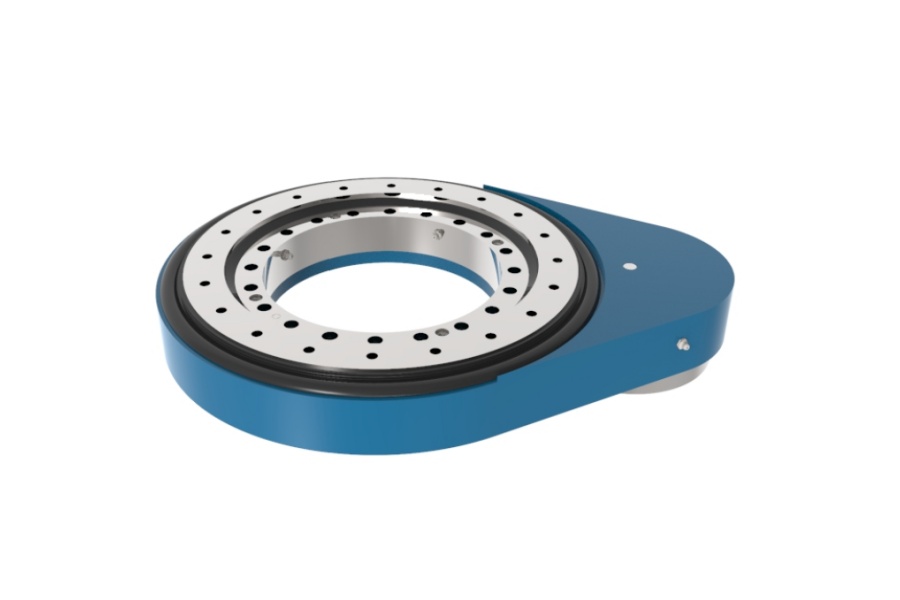
What is mounting bolt tightening? It is the controlled installation of a fastener so the bolt creates enough clamp load to hold a mounted assembly together under operating loads. For a slewing bearing, slew drive, gearbox, or rotating platform, the method used to tighten bolts can affect joint stability, bearing support, and later service inspection.
The direct answer is simple: use torque-only control when the fastener, lubrication condition, joint surfaces, and assembly process are stable and well controlled. Use torque-angle control when more repeatable bolt stretch is needed and the process can define a reliable snug point, turning angle, and reuse rule. Neither method is automatically better. The joint design and production controls decide which method is suitable.
At Luoyang Slewring Bearing Co., Ltd., fastening process definition is considered part of mounted assembly quality. A high-capacity Slewing Bearing or a geared drive can perform as designed only when its mounting structure is flat, sufficiently stiff, and clamped correctly by the complete bolt pattern.
Start With the Clamp Load the Joint Must Maintain
A bolt does not secure an assembly because it reaches a torque number. It secures the assembly because tightening stretches the bolt and creates preload, also called clamp load. That clamp load presses the mounting faces together and helps prevent separation, movement, fretting, and uneven load transfer.
For mounted rotating equipment, the fastening method must match the joint behavior. A slewing bearing ring, adapter plate, and equipment frame may see overturning moment, vibration, reversing rotation, shock, and cyclic loading. If clamp load drops, the interfaces can slip microscopically even when the bolts still appear installed.
Specify the tightening method only after the joint inputs are available. The process owner should collect the bolt grade, diameter, thread condition, washer use, lubrication condition, seating-face material, joint stiffness, access for tools, and whether bolts may be reused. Without these inputs, a torque value or angle instruction is only an incomplete work instruction.
What torque actually controls
Torque is the twisting effort applied to a bolt. During tightening, much of that effort is consumed by friction at the threads and under the bolt head or nut. Only part of the input creates useful bolt stretch.
This means the same torque can produce different preload when friction changes. Oil, wax, plating, coating, dirt, thread damage, washer finish, and repeated use can all change friction. A torque-controlled assembly is therefore only as repeatable as the friction condition it controls.
Torque control fits a production process when the parts and conditions are standardized. It is often practical for service work and for assemblies where the approved bolt specification provides torque guidance. It does not fit well when installers use mixed lubricants, mixed fastener sources, or unknown reused bolts.
What angle control actually controls
Angle control begins after a defined snug point. The fastener is first seated with an initial torque, then rotated through a specified angle. Once the joint faces are seated, additional rotation is intended to advance the threads and stretch the bolt more predictably than final torque alone.
Angle is not a direct measurement of preload. The resulting bolt stretch still depends on thread pitch, joint compression, surface embedment, bolt length, tool accuracy, and the accuracy of the snug point. If the snug point is inconsistent, the same final angle can produce inconsistent clamp load.
Angle control fits a well-engineered production process where the engineering team has validated the fastener and joint combination. It is less suitable for field replacement work when the assembly condition, original lubricant, and existing bolt history are unknown.
Comparison of Torque-Only and Torque-Angle Methods by Friction Sensitivity, Preload Consistency, and Reuse Limitations
The key difference is where each method places its control point. Torque-only control uses applied twisting effort as the final acceptance value. Torque-angle control uses a seating step plus additional rotation, which reduces—but does not remove—the influence of friction on final preload.
| Selection Factor | Torque-Only Method | Torque-Angle Method | Process Decision |
|---|---|---|---|
| Primary controlled value | Final applied torque | Snug torque followed by specified rotation | Choose the measure your tools and work instructions can control and record. |
| Friction sensitivity | High, because thread and under-head friction consume much of the applied torque. | Lower after seating, but still affected by the snug stage and joint settlement. | Use angle control when friction variation cannot be adequately controlled but the joint has been validated for angular tightening. |
| Preload consistency | Can be acceptable with consistent fasteners, coating, lubrication, washers, and tools. | Often more consistent when the snug point, angle, and joint geometry are controlled. | Do not assume angle always gives better preload. Verify it on the actual joint. |
| Tooling need | Calibrated torque tool and a clear tightening sequence. | Torque tool plus angle measurement or an angle-capable tightening system. | Use torque-only where production volume or service access does not justify angle tooling. |
| Joint seating effect | Surface settling is included in the torque reading and can mask bolt stretch. | The snug stage seats parts; later rotation is more closely related to additional bolt extension. | Angle control is useful where seating behavior has been studied and controlled. |
| Bolt reuse limitations | Reuse may be possible only when the approved specification permits it and threads are undamaged. | Reuse is often restricted, especially if the prescribed angle brings the bolt near or beyond its elastic range. | Never create a reuse rule from appearance alone. Follow the fastener and equipment specification. |
| Best-fit setting | Stable production or service assembly with controlled friction conditions. | Repeat production assemblies requiring tighter control of clamp load variation. | Match the method to validated joint behavior, not to a preference for one tool. |
The practical misunderstanding is that torque-angle control eliminates friction as a variable. It does not. Friction strongly affects the torque required to reach the snug point. It also affects whether surfaces seat normally or bind before the specified angle is applied.
Another misunderstanding is that a tighter bolt is always safer. Excessive tightening can overload threads, distort a mounting ring, damage seating faces, or move a bolt into permanent deformation. The correct target is the approved preload range for the joint, not the highest torque a tool can deliver.
Define the Snug Point Before You Specify an Angle
Torque-angle control succeeds or fails at the snug point. The snug point is the condition where the components are seated and further turning begins to create meaningful bolt stretch. If one operator reaches that condition earlier than another, the final angle no longer represents the same fastener extension.
A good process definition states the initial seating torque, tightening pattern, angle target, angle direction, tool type, lubrication condition, and acceptance record. It should also state whether the angle is applied in one continuous operation or after a pause. These details matter because settling may occur between stages.
A practical process-definition procedure
- Identify the joint function. Determine whether the bolts retain a static cover, support a rotating bearing ring, secure a slew drive housing, or hold an adapter structure. The more cyclic and reversing the load, the more carefully preload variation must be controlled.
- Freeze the fastener configuration. Define bolt type, grade, finish, washer, nut if used, thread engagement, lubrication, and whether parts are new. Do not validate one condition and assemble under another.
- Confirm mounting-face readiness. Check that contact faces are clean, supported, and free from raised burrs, damaged coating buildup, or debris. A clean bolt cannot compensate for an uneven interface.
- Set the tightening sequence. Use a cross-pattern or another engineering-approved pattern that brings the ring or housing down evenly. For circular mounting patterns, make several progressive passes rather than fully tightening one area first.
- Choose and validate the control method. For torque-only, verify the torque tool and friction condition. For torque-angle, establish the seating torque and validate the specified rotation on representative assemblies.
- Record acceptance evidence. Retain tool calibration status, final torque or angle data when available, operator identification, and any exceptions. This supports later failure analysis and process audits.
- Define the reuse rule. State whether removal requires new bolts, inspection, or a revised tightening procedure. Do not leave reuse to installer judgment.
This procedure is especially relevant for a Worm Gear Slew Drive mounted to an equipment frame. Housing alignment and clamp load affect how the drive transfers operating forces into the structure. The bolt procedure should therefore be released with the mounting drawing, not added after installation problems appear.
Luoyang Slewring Bearing Co., Ltd. can provide a technical proposal within 24 hours for defined applications, but the proposal should include the real mounting information. Send the bolt pattern, frame material, load direction, operating cycle, installation orientation, and environmental condition. That information helps separate a fastening question from a bearing or drive selection question.
Request Your Custom Slew Drive or Bearing Spec
Tell us your load, speed, and environment — receive a tailored 100–5000 mm slewing drive or slewing bearing proposal with 3D drawings within 24 hours.
Use Torque Control When Friction Can Be Managed
Torque-only control is a sound choice when the assembly environment is controlled and the fastener condition is repeatable. This may include factory assembly with one approved bolt source, one lubricant condition, calibrated tools, documented washer use, and trained operators following the same sequence.
The reason is straightforward. When friction is stable, the relationship between applied torque and bolt preload becomes more predictable. The method is also easy to communicate in service documents because technicians can use common calibrated torque equipment.
Torque-only control does not apply well when installers may use dry bolts on one shift, lubricated bolts on another shift, or bolts with different coatings from multiple suppliers. In those cases, the same torque target can generate materially different clamp loads. The better response may be tighter process control, a validated torque-angle method, or a redesigned joint.
Common torque-control mistakes that change preload
- Using an unspecified lubricant: Lubricant changes friction, so the approved torque may no longer produce the intended bolt tension. Use only the documented assembly condition.
- Mixing new and reused bolts: Reused threads and seating surfaces can have a different friction response. Separate them unless the approved process allows reuse.
- Tightening one bolt fully before the others: This can pull a ring or housing down unevenly. Use progressive passes in the approved pattern.
- Skipping torque-tool verification: A tool that has not been checked may not deliver the setting shown on its scale. Maintain calibration records as part of the work instruction.
- Ignoring seating-face contamination: Paint flakes, burrs, and debris can settle after tightening and reduce preload. Inspect the interface before assembly.
- Treating a torque value as universal: A value for one bolt grade, lubricant, washer, or joint stack cannot be copied safely to another configuration.
For heavy assemblies, this check should be connected to incoming and final inspection. Our ISO 9001:2015-certified facility uses CMM three-coordinate inspection and dynamic load testing for every slewing bearing. Fastener tightening does not replace component inspection, but both controls are needed to protect the mounted system.

Use Torque-Angle Control When Repeatability Justifies the Added Control
Torque-angle control is a stronger candidate when the application requires a tightly defined assembly process and the production team can control the initial seating condition. It is often selected for repeat production where tool data can be recorded and the same joint stack is assembled many times.
The benefit is not that angle directly measures clamp load. The benefit is that, after consistent seating, a known amount of rotation can be more closely tied to bolt extension than a final torque value alone. This helps reduce the effect of friction variation during the later portion of tightening.
Its limit is equally important. If the joint contains soft coatings, variable spacer thickness, changing paint layers, or parts that settle differently from unit to unit, the angular turn can be consumed by joint compression rather than bolt extension. In that situation, angle control must be revalidated or may not be the right method.
Reuse requires a written decision
A torque-angle procedure can be designed to keep bolts within their elastic range, or it can intentionally use a greater stretch region for a specific application. The tightening instruction alone does not tell an operator which case applies. The engineering release must state whether removed bolts can be reused.
When the process may place a bolt near permanent deformation, replacement is normally the safer rule unless the approved specification says otherwise. Even when elastic reuse is permitted, inspect threads, head markings, corrosion, seating surfaces, and signs of elongation or damage. A reused bolt with altered friction can also invalidate a torque-only process.
For customized equipment, bolt strategy should be included early. A Customized Slew Drive may use a different mounting interface, housing arrangement, or operating load direction than a catalog unit. That can change joint stiffness and the fastening method that gives stable results.
Verify the Method on the Actual Mounted Assembly
Process validation should prove that the instruction works on the real assembly, not only on a single bolt in a test fixture. The mounted parts should represent production materials, surface finish, coating state, washers, lubrication, tools, and tightening sequence.
Review the evidence in three groups: fastener condition, installation data, and joint response. Fastener condition includes source control and reuse status. Installation data includes tool calibration, torque values, angle records, and tightening sequence. Joint response includes whether the interface seats evenly and whether the equipment shows movement, loss of clamp force, or abnormal operating behavior after the required test cycle.
| Verification Question | Why It Matters | What to Request or Check |
|---|---|---|
| Are bolts, washers, and lubricants controlled? | These items affect friction and the torque-to-preload relationship. | Approved part list, lubrication instruction, and lot traceability where required. |
| Is the mounting structure sufficiently supported? | Local bending or uneven contact can reduce clamp stability and distort the mounted part. | Mounting drawing, flatness review, support layout, and assembly inspection record. |
| Can the tool reach every bolt correctly? | Extensions, poor access, and hand positioning can change the actual applied torque or angle. | Tool access study and production trial on the complete assembly. |
| Is bolt reuse addressed? | Reuse changes friction and may be unsafe after specified angular tightening. | Written replacement or inspection criteria in the work instruction. |
| Does the supplier provide inspection support? | Fastening issues can be confused with component manufacturing issues unless records are available. | Quality documentation and defined technical response process. |
Supplier quality evidence also matters for high-load rotating assemblies. Luoyang Slewring Bearing Co., Ltd. has six production lines, an 8,000 m² manufacturing facility, and annual capacity of 100,000 sets. Standard products have an MOQ of one set, so a buyer can evaluate a sample order before standardizing an assembly process.
For applications exposed to dust, moisture, or corrosive service, joint verification should include the full operating environment. Our slew drives can be specified with protection up to IP66 and anti-corrosion performance up to C4H, but the mounting bolts, mating frame, coating system, and installation practice must also suit the environment. A protected drive cannot correct a mounting joint that was assembled with unsuitable or poorly controlled hardware.
Choose the Method That Your Work Instruction Can Actually Control
Select torque-only control when you can standardize friction, tool calibration, fastener supply, and installation sequence. It is practical, familiar, and effective within those limits. Do not use it as a shortcut when fastener condition varies from unit to unit.
Select torque-angle control when the joint has been engineered and tested for a defined snug point and angular rotation. It can improve preload consistency in repeat production, but it requires better instructions, suitable tools, and an explicit reuse rule. It is not a general replacement for torque control in field repair work.
For slewing systems, the final decision should connect the fastener procedure to the mounted component, the frame, and the duty cycle. Luoyang Slewring Bearing Co., Ltd. supports Slew Drive, Slewing Bearing, and customized drive projects with a standard production cycle of nine days and a two-year extended quality warranty. Before releasing the work instruction, verify the bolt condition, joint interfaces, sequence, tool capability, and the evidence needed to confirm the selected method was followed.
Request Your Custom Slew Drive or Bearing Spec
Tell us your load, speed, and environment — receive a tailored 100–5000 mm slewing drive or slewing bearing proposal with 3D drawings within 24 hours.
 WhatsApp

 +8613903880726