



What is a slew bearing for medical equipment? It is a large-diameter rotary bearing that lets a gantry, table, arm, or analyzer carousel turn smoothly around one axis while carrying load. The real design question is whether that bearing should be a grease-free polymer type or a sealed steel type.
The short answer: grease-free polymer works well when loads are light, moments are small, and the device must stay very clean. Sealed steel is still the safer choice once tilting moment, stiffness, long life, or harsh cleaning and sterilization enter the picture. The rest of this article shows where that line sits and how to check it before you freeze a concept.
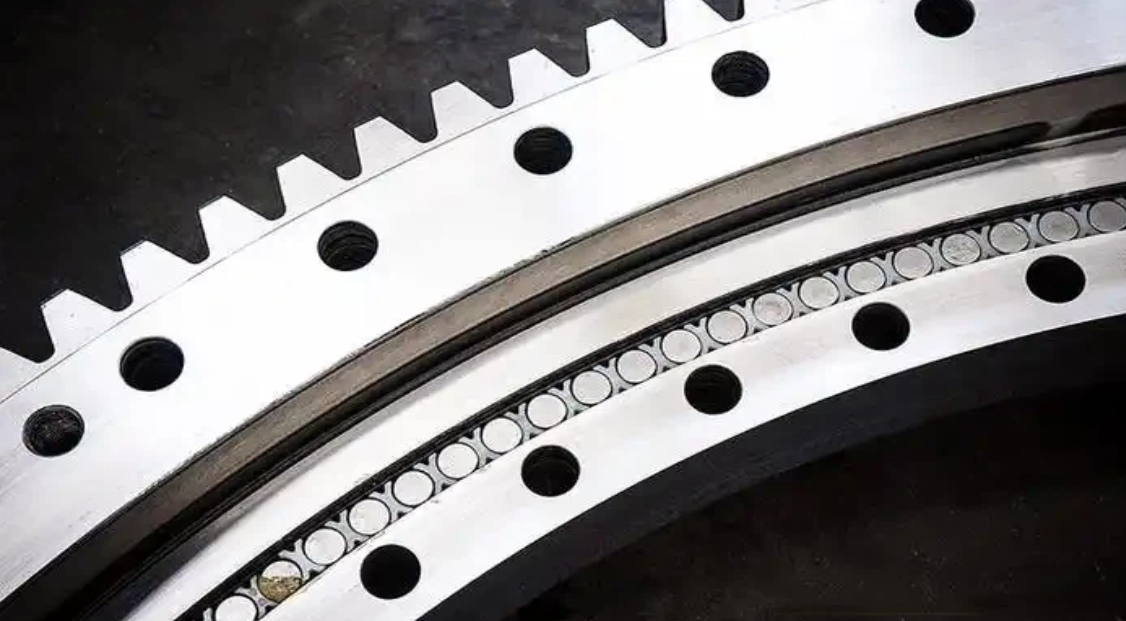
What Each Design Actually Is
A grease-free polymer bearing uses sliding or low-friction polymer elements instead of rolling steel elements and grease. There is no lubricant to migrate, drip, or need refilling. That is the main appeal for laboratory analyzers and clean-motion devices.
A sealed steel bearing still uses rolling elements, such as balls or crossed rollers. Seals keep the grease in and contaminants out. Lyra supplies this steel family, including slewing bearing types made from alloy steel, stainless steel, and forged alloy steel, with the material chosen per load, speed, and environment.
We should be clear about scope. Our product range is steel slewing bearings and slew drives. Polymer designs from other makers can be the right answer in some cases, and we say so when the application points that way.
Where Grease-Free Polymer Designs End and Sealed Steel Bearings Begin
This is the boundary most product pages skip. It depends on five factors: moment load, stiffness, life, temperature, and sterilization exposure.
| Factor | Grease-free polymer fits when... | Sealed steel is still needed when... |
|---|---|---|
| Moment load | The load is mostly axial and centered, with small tilting moment | The payload sits off-center or tilts, as on patient tables and heavy gantries |
| Stiffness | Small deflection is acceptable and positioning is coarse | Image alignment or positioning accuracy depends on low deflection |
| Life | Duty cycle is low and the device is replaced or serviced on a known schedule | Many continuous or cyclic rotations are expected, with little service access |
| Temperature | The device runs in a stable, moderate range | Heat from motors, X-ray tubes, or wash-down cycles pushes the bearing outside polymer limits |
| Sterilization exposure | The bearing is shielded from sterilants and cleaning chemicals | The bearing sees repeated wipe-down or chemical exposure and needs a sealed, corrosion-resistant body |
Treat the table as a screening tool, not a rating chart. Polymer grades vary a lot between suppliers. Ask for the grade's data under your own load, temperature, and cleaning chemicals.
When the boundary is unclear
If two or more rows point to steel, start with steel. If every row points to polymer, test a polymer sample first. A mixed result usually means you need a calculation, not a guess.
How the Key Parameters Affect Each Other
Parameters rarely act alone. Here is what each one does and where it pulls against another.
Moment load and stiffness
Moment load is the tilting force from an off-center payload. It drives bearing size more than weight alone. A bearing that handles a heavy centered load can still deflect badly under a smaller off-center load.
Stiffness decides how much the rotating platform tips under that moment. In imaging, even small tilt can shift alignment. Crossed roller designs, such as crossed roller slewing bearings, carry axial, radial, and moment loads in one compact section, which is why they appear in precision rotary stages.
Life and maintenance access
Life depends on load, speed, contamination, and lubrication. A grease-free design removes the relubrication task, which helps when the device is sealed inside a housing. But "maintenance-free" does not mean "wear-free." Polymer surfaces wear, and the wear rate rises with load and heat.
A sealed steel bearing needs correct grease at the start. For cleanroom or clinical spaces, ask about grease type and seal design, not just the seal's presence.
Temperature and sterilization
Heat changes polymer clearance and wear. It also changes grease behavior in steel bearings. Check the bearing's temperature range against the hottest point near the bearing, not room temperature.
Sterilization and cleaning chemicals can attack seals, polymers, and bare steel in different ways. Stainless steel or a protective coating helps steel bearings. Our slew drives are available with protection up to IP66 and anti-corrosion ratings up to C4H, which shows the sealing and coating options we can apply to harsh environments. These ratings come from industrial duty, so confirm medical cleaning-agent compatibility separately.
Interaction summary
- High moment plus tight alignment: stiffness becomes the deciding factor, which favors steel.
- Light load plus no service access: grease-free may win on cleanliness and simplicity.
- Frequent chemical wipe-down: material and seal compatibility matter more than load.
- Heat from nearby components: can overrule an otherwise good polymer choice.
Request Your Custom Slew Drive or Bearing Spec
Tell us your load, speed, and environment — receive a tailored 100–5000 mm slewing drive or slewing bearing proposal with 3D drawings within 24 hours.
Common Misunderstandings and How to Verify Them
Search results often praise maintenance-free polymer bearings for cleanliness and reliability. Those benefits are real, but they are measured in light-duty settings. Here is where engineers get misled.
- "No grease means no contamination." Polymer wear can shed particles. Ask for particle data if the device sits in a clean zone.
- "Sealed means sterilization-proof." A seal blocks dust and splash. Repeated chemical or steam exposure can still harm it.
- "Higher load rating is always better." Ratings are tested under set conditions. Compare ratings only when the test method matches.
- "Maintenance-free means life-free." It means no relubrication. Wear life still depends on duty.
- "Moment load is secondary." It is often the first sizing limit for tables and gantries.
What to request from a supplier
- Load data split into axial, radial, and moment values for your duty cycle.
- Material and coating details for every wetted or exposed surface.
- Grease type, seal material, and temperature range for sealed steel options.
- Inspection records. For steel bearings, ask how dimensions and raceways are checked.
- A clear answer on what the data does not cover, such as sterilization cycles.
On inspection: every Lyra bearing goes through CMM three-coordinate checks and dynamic load testing, under an ISO 9001:2015 quality system. You can read more on our slew drive quality control page. These records show dimensional accuracy and load behavior. They do not prove sterilization compatibility, so that still needs its own test.
Worked Example: A Patient-Positioning Rotary Stage
This is an illustrative scenario, not a customer case. In my work on medical imaging platforms, the same pattern comes up again and again. A rotating table carries a patient plus accessories, and the load sits off-center.
Step one is to estimate the moment from the farthest reasonable load position. Step two is to check how much tilt the imaging or treatment alignment can tolerate. If tilt tolerance is tight and the moment is large, a polymer bearing is the wrong starting point. A steel crossed roller or single row slewing ring ball bearing with proper seals is the safer concept.
Now take a different case: a laboratory analyzer carousel that turns light sample racks inside an enclosure. Loads are small, moments are minimal, and nobody can reach the bearing for relubrication. Here a grease-free design is reasonable, and a light load slewing bearing in steel remains an option if life or temperature data worry you.
Related proven applications
Lyra has no medical customer case to cite here. But related platform work shows the type of duty our steel products handle:
- A Manchester, UK automation equipment manufacturer ordered 100 units of SP-I 0841-32.1 for automated turntable systems.
- A Houston, Texas engineering machinery manufacturer ordered 100 units of SEA21-125-25HR(2) for slewing platform and turntable systems.
Both are industrial rotating platforms. They show repeatable production of turntable drives, but they do not replace medical validation.
Decision Checklist Before You Request a Quote
Use this list to decide which design to pursue, and what to send us.
- Is the load centered or off-center? Estimate the moment.
- How much tilt or deflection can the function tolerate?
- How many rotations or cycles per day, and over what service life?
- Can the bearing be reached for service, or is it sealed inside?
- What is the highest temperature at the bearing?
- Which cleaning or sterilization agents touch the bearing, and how often?
- Do you need a drive built in? If so, consider a customized slew drive with the bearing, gear, and housing designed together.
What working with Lyra looks like
Luoyang Slewring Bearing Co., Ltd. was established in 2012 and runs six production lines in an 8,000 m² facility with CNC machining centers. We send a technical proposal within 24 hours and can complete 3-day rapid prototyping. Standard products start at a 1-set MOQ, and customized products at 5 sets. Sample orders are welcome for testing.
Standard production runs about 9 days. Our products carry a 2-year extended quality warranty, a 48-hour technical response, and free replacement for confirmed manufacturing defects. Factory audit reports are available on request.
If you are looking for a slew bearing for medical equipment or a custom slew drive supplier, send us your load, moment, temperature, and cleaning requirements. We will review them and reply with a technical proposal and the latest quote.
Request Your Custom Slew Drive or Bearing Spec
Tell us your load, speed, and environment — receive a tailored 100–5000 mm slewing drive or slewing bearing proposal with 3D drawings within 24 hours.
 WhatsApp

 +8613903880726