



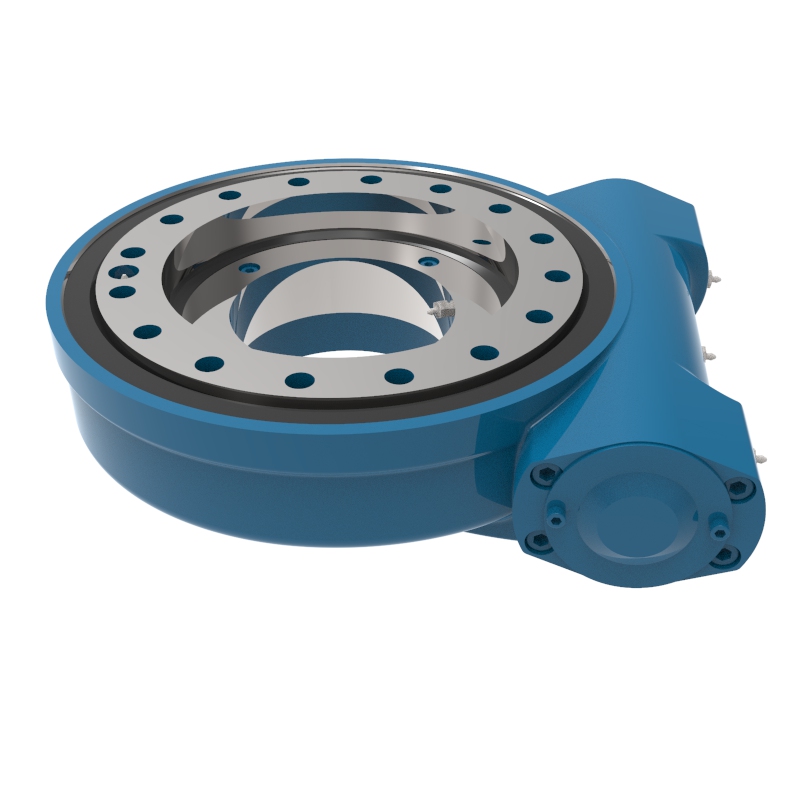
What is a hydraulic slew drive? It is a compact rotation unit that combines a slewing bearing, a gear set, a housing, and a hydraulic motor interface to turn a load around an axis. A standard slew drive carries axial load, radial load, and tilting moment in one package.
Here is the sourcing risk. A supplier page can promise strong load capacity, custom options, and a downloadable 3D model. None of that proves the unit will fit your frame, survive your duty cycle, or match the lot you receive. The documents are what prove it, and buyers usually find the gaps after the purchase order is signed.
Which documents should you request before approving a supplier?
Ask for the documents that answer three questions. Will it fit? Will it carry the load? Can we trace what we received? Everything else is secondary.
After 30+ years in heavy machinery design, I rank them in this order. A drawing mismatch stops an assembly line on day one. A weak load rating shows up months later as a field failure.
| Document | What it verifies | Needed at | Limit to remember |
|---|---|---|---|
| Dimensional drawing (2D plus 3D) | Mounting bolt pattern, flange heights, motor interface, housing envelope | Technical approval | A 3D model alone does not carry tolerances |
| Load rating sheet | Axial, radial, tilting moment, output torque, holding torque | Technical approval | Ratings assume a stated test basis and duty cycle |
| Hydraulic interface data | Motor flange, port size, brake option, flow and pressure window | Technical approval | The circuit schematic often belongs to the OEM |
| Material and heat-treatment record | Grade of ring, gear, and housing material | PO and incoming inspection | Must match your lot, not a generic datasheet |
| Inspection report | Measured dimensions and test results for your lot | Incoming inspection | Agree the report format before ordering |
| Warranty terms | Coverage period, defect definition, remedy | Contract review | Wear from misuse is usually excluded |
| Quality system and audit records | Process control at the factory | Supplier qualification | Shows the system, not your specific part |
Document FAQ for drawings, schematics, load ratings, traceability, inspection, and warranty
What should a dimensional drawing show for a hydraulic slew drive?
It should show the mounting bolt circle, bolt count and size, flange thickness, overall height, housing outline, and the motor mounting face. It should also list tolerances and the gear backlash range.
A 3D file helps with CAD checks, but it rarely carries tolerances. Request the signed 2D drawing and compare it with your frame drawing before you release any tooling.
Does the supplier provide a hydraulic schematic?
Often, the supplier gives interface data, not a full circuit. A slew drive does not usually contain the pump, valves, or counterbalance circuit. Those belong to your machine design or your motor supplier.
So ask for what the drive side must meet: motor flange, port size, maximum pressure, brake release needs, and self-locking behavior. If you need the schematic reviewed against the drive, say so in writing and name the motor model.
How do you read a load rating sheet?
Check that axial load, radial load, and tilting moment are all listed. Then check whether the figures are static or dynamic, and what safety factor the supplier applied.
Compare the rating with your worst-case load, not your average load. A rating for continuous slow rotation does not cover frequent shock loads or long oscillation on one small arc of the gear. If your duty cycle is unusual, send it to the supplier and ask for a written review.
What does material traceability mean for this part?
It means you can link the part in your hands to a material grade and a production lot. Luoyang Slewring Bearing Co., Ltd. selects ductile cast iron, alloy steel, stainless steel, or forged alloy steel per working condition, so the grade on your drawing should be confirmed per order.
Write the grade into the purchase order. Then ask that the lot or serial number on the nameplate match the paperwork. Traceability will not prove the steel is good. It only proves you can find the cause if something goes wrong.
Which inspection reports are worth asking for?
Ask for a dimensional report from coordinate measuring and a record of load or running tests. Our process passes every slew bearing through CMM three-coordinate inspection and dynamic load testing, so ask for the results that apply to your lot. For background on the process, see our slew drive quality control page.
Agree on the report format and the sampling plan before production. A report that arrives after shipment cannot prevent a bad lot.
What should warranty terms cover?
Read four things: the coverage period, the definition of a defect, who pays for freight and labor, and what is excluded. Our terms include a 2-year extended quality warranty and free replacement for confirmed manufacturing defects.
That commitment covers manufacturing defects. It does not cover damage from wrong installation, overload beyond the agreed rating, or missing lubrication. Make sure your duty cycle is documented so a future claim is judged against the right conditions.
How do real orders show which documents matter?
Different applications stress different documents. The examples below come from our own order history. They show what a buyer on a similar project should check, not a promise about every order.
- Port crane, South Korea. A port equipment manufacturer placed a 20-unit repeat order of WEA9-62-25HR single worm drives. The spec called for tracking precision of 0.15° or better, IP65 sealing, and self-locking. For this job, the load sheet, backlash data, and sealing rating matter most.
- Forestry grapple, Canada. A forestry equipment maker in British Columbia ordered 30 units of WED14-86-25BHR.5 double worm slew drives at 0.13° precision or better. Here the drawing tolerances and inspection report carry the most weight.
- Wheel steering, Houston. An engineering machinery manufacturer ordered 150 units of WED17-104-25HR for heavy-duty steering. With volume this high, lot traceability and a consistent inspection report matter more than any single sample.
Notice the pattern. Precision-driven jobs need measured data. High-volume jobs need lot records. Outdoor jobs need a sealing rating you can verify.
Request Your Custom Slew Drive or Bearing Spec
Tell us your load, speed, and environment — receive a tailored 100–5000 mm slewing drive or slewing bearing proposal with 3D drawings within 24 hours.
What mistakes do buyers make when checking supplier documents?
- Accepting a catalog page as a load rating. Catalogs show families of products. Ask for the sheet for the exact model and ratio.
- Using the 3D model as the only fit check. Models often omit tolerances and motor flange details.
- Expecting the supplier to supply the full hydraulic circuit. Confirm the scope in writing, or the gap will appear at commissioning.
- Skipping lot-level reports. A first sample report does not describe the production lot.
- Ignoring environment ratings. If the site is dusty, wet, or salty, confirm the protection level. Our slew drives reach up to IP66 and anti-corrosion rating up to C4H, but only the model you order carries its own rating.
- Reading warranty headlines only. Check exclusions and the claim process.
How do you verify documents step by step before a production order?
- Send your duty data. Include peak load, tilting moment, rotation speed, oscillation angle, and environment. Without these, no supplier can confirm a rating honestly.
- Request the drawing and load sheet for the exact model. Compare every mounting dimension against your frame.
- Confirm the motor interface. Match flange, ports, pressure, and brake needs against your hydraulic design.
- Name the material grade in the PO. Ask that the grade and lot number appear on the shipping paperwork.
- Agree on inspection items. List the dimensions and tests you want reported, and the format.
- Review warranty and exclusions. Have your quality team sign off.
- Plan incoming inspection. Check the nameplate, bolt pattern, rotation torque, and backlash on receipt. Compare them with the report.
What if you need a non-standard drive or more document detail?
Standard models have fixed drawings, so documents are quicker to review. A customized slew drive needs a new drawing approval, and you should treat that approval as a gate before cutting any metal.
Our terms differ by product type. Standard products start at 1 set, and customized products start at 5 sets. We issue a technical proposal within 24 hours, and technical questions get a response within 48 hours. Standard production runs about 9 days, and 3-day rapid prototyping is available for sample work. These are general company terms. The final schedule for your order depends on the model and specification.
Material choice also affects which documents you need. A worm gear slew drive used for self-locking duty needs a holding-torque statement. A drive that sits on a slewing bearing with a special raceway may need extra heat-treatment records.
What should go into your RFQ package?
A complete request lets the supplier answer with documents, not guesses. Use this checklist:
- Application and machine type, such as port crane, marine crane, or steering platform
- Peak axial load, radial load, and tilting moment
- Required output torque, speed, and positioning precision
- Motor model and hydraulic supply data, if known
- Environment: dust, water, salt, temperature range
- Required documents: drawing, load sheet, material record, inspection report, warranty terms
- Order quantity and target delivery date
- Market requirements, such as CE marking for Europe
Factory audit reports are available on request, and our facility holds ISO 9001:2015 certification. Ask for them during supplier qualification. For a hydraulic slew drive RFQ, send your duty data with the request so we can return a matched drawing and load sheet.
Request Your Custom Slew Drive or Bearing Spec
Tell us your load, speed, and environment — receive a tailored 100–5000 mm slewing drive or slewing bearing proposal with 3D drawings within 24 hours.
 WhatsApp

 +8613903880726