



What is a dual axis slew drive? It is a motion unit that combines two independently controlled rotational axes, commonly a horizontal axis and a vertical axis, so a mounted structure can point, tilt, rotate, or track in two directions.
Before issuing a production order, buyers should verify more than torque, gear ratio, and exterior dimensions. Alignment errors between the two axes can cause uneven motion, unexpected backlash at the payload, high motor load, mounting stress, and poor repeatability after installation.
A preliminary offer may look acceptable on paper while leaving the most important assembly questions unanswered. The dual axis slew drive should be evaluated as an assembled motion system, not as two separate gearboxes placed on one frame.
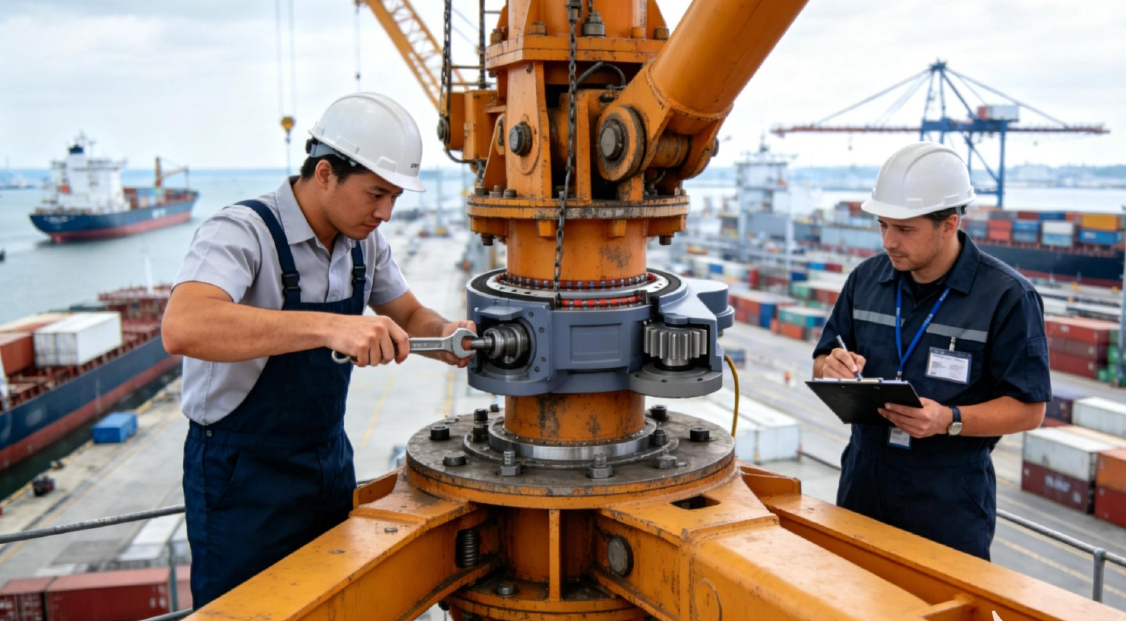
Confirm whether the supplier can support the required two-axis configuration
Start by defining the physical motion arrangement before comparing quotations. A supplier needs to know whether the two axes are stacked, side-mounted, connected through a common frame, or installed on separate customer-made brackets.
Luoyang Slewring Bearing Co., Ltd. supplies Slew Drive, Slewing Bearing, and Customized Slew Drive products for industrial motion applications. Its engineering team can provide a technical proposal within 24 hours, but the buyer must first provide enough application information to make that proposal meaningful.
The first decision is whether a standard unit can fit the application or whether the frame, mounting pattern, input position, sealing level, or gear arrangement needs customization. Standard products have an MOQ of 1 set, while customized products have an MOQ of 5 sets. Sample orders are welcome for testing and evaluation.
Separate a dual-axis assembly from a double-worm design
Do not use the terms “dual axis” and “double worm” as if they mean the same thing. A double-worm unit uses two worms to drive one rotational axis, while a two-axis assembly provides motion around two different rotational centers.
A Double Worm Slew Drive can be a suitable component within a two-axis machine if one axis needs higher holding stability or a balanced drive arrangement. It does not, by itself, prove that the complete two-axis structure has been aligned or tested.
| Buyer question | Why it matters | Information to provide with the RFQ |
|---|---|---|
| Which axis carries the main overturning moment? | The more heavily loaded axis may need a different drive size, bearing arrangement, or frame stiffness. | Payload mass, center-of-gravity position, arm length, and operating orientation. |
| Do both axes move at the same time? | Simultaneous motion can expose frame deflection and control-related position errors that do not appear during one-axis operation. | Motion sequence, duty cycle, start-stop frequency, and required positioning behavior. |
| Is self-locking required? | Worm-driven units may be selected where holding behavior is needed, but the actual application condition must be reviewed. | External load direction, safety requirement, brake arrangement, and power-loss condition. |
| Will the structure work outdoors? | Sealing and corrosion protection must match the exposure condition rather than the catalog appearance. | Dust, rain, salt exposure, temperature range, and maintenance access. |
| Who supplies the connecting frame? | Alignment responsibility can become unclear when the drive supplier and equipment builder make different parts. | Assembly drawing, datum surfaces, mounting-hole positions, and responsibility for final machining. |
For applications with a high moment load on one axis, do not select two identical drives only because the layout is symmetrical. The axis that supports the cantilevered payload may need a different solution than the axis that only changes tilt angle.
Material selection should also follow the working condition. Luoyang Slewring Bearing Co., Ltd. uses ductile cast iron, alloy steel, stainless steel, and forged alloy steel according to load, speed, and environment, but the buyer should confirm the selected material and component scope in the final technical proposal.
Set alignment acceptance criteria before the sample or tooling release
The correct time to define alignment is before a sample is built or tooling is approved. Once the supplier has machined housings and the buyer has made mating brackets, a disagreement about datum locations can become expensive.
Use the mounting interfaces as the reference, not the painted external housing. The acceptance drawing should identify the base mounting plane, the second-axis mounting plane, bore centers, shaft centers, and the direction from which each measurement is taken.
Build an alignment requirement around functional datums
For a stacked arrangement, the lower-axis mounting plane is usually the first functional datum. The upper-axis mounting face, the centerline of the rotating structure, and the payload interface should then be related to that datum.
For a side-by-side arrangement, the frame may be the first datum instead. In that case, require the supplier and the equipment builder to agree which mounting faces are machined references and which surfaces are only nonfunctional enclosure features.
- Provide a 3D model or dimensioned assembly drawing showing both rotational centers.
- Mark the mounting faces that control final position and identify their datum letters.
- State the allowed relation between the two axes, including perpendicularity or the intended non-90-degree angle.
- Define whether the reading is taken before or after gear backlash is removed in one direction.
- State the payload condition for motion verification, including the position of the center of gravity.
- Require the test report to identify the serial number or other traceable unit reference.
A perpendicularity value without a datum scheme is not enough. For example, a report that says “axis angle passed” has little value if it does not state whether the reading was taken from a bearing centerline, an output flange, a shaft, or an external fabricated bracket.
Do not demand a tight axis relationship when the customer’s own welded frame will distort during final assembly. In that situation, the better approach is to define machining allowances, adjustable shims, or a final alignment procedure at the machine-builder level.
Buyers who need an enclosed worm-driven solution can compare the design approach of a Worm Gear Slew Drive with other gear arrangements. The best choice still depends on load direction, holding needs, operating speed, and the accuracy required at the final payload.
Request factory evidence for axis perpendicularity, backlash, and loaded motion
The supplier-evidence approach is simple: request records that show how the assembled unit was checked, not only a catalog specification. Factory audit reports are available on request from Luoyang Slewring Bearing Co., Ltd., and buyers should use that option alongside product-specific evidence.
The company states that every slewing bearing passes CMM three-coordinate inspection and dynamic load testing. That is relevant evidence for bearing quality control, but a buyer should separately confirm which records are available for the finished two-axis assembly because bearing inspection alone does not prove final assembly alignment.
| Evidence to request | What the record should show | Why the buyer needs it | When it may not be enough |
|---|---|---|---|
| Factory inspection record | Part number, serial number or traceable identifier, inspection date, measured items, pass/fail result, and inspector identification. | Links the acceptance evidence to the exact delivered unit. | It is not enough if it lists only visual checks and no functional measurements. |
| Axis-perpendicularity measurement | Defined datums, measurement method, actual reading, allowed limit, and whether the reading is made at no load or under an agreed condition. | Shows whether the two rotational axes match the intended geometric relationship. | It may not represent final machine accuracy when the buyer adds a flexible frame or adapter. |
| Backlash reading for each axis | Measurement point, direction of reversal, output position, reading method, and the configuration of the drive during measurement. | Helps the buyer estimate lost motion and compare units on the same basis. | Backlash alone does not predict tracking accuracy because structure stiffness and controls also affect final motion. |
| Loaded-motion video | Unit identifier, visible payload or agreed test condition, motion in both directions, reversal behavior, and a view of the two-axis assembly. | Can reveal binding, uneven movement, interference, or abnormal response that a static report may miss. | A video is not a substitute for a measurement report or a defined acceptance limit. |
| Mounting-interface report | Flatness, hole pattern, bore center, and key interface dimensions where applicable. | Confirms that the supplied drive can mate with the buyer’s frame without forced assembly. | It does not verify that the buyer’s own mating structure is within drawing requirements. |
Ask for the raw reading and the acceptance limit together. A supplier statement such as “backlash is normal” cannot be compared between quotes, while a documented measurement method gives the engineering team something concrete to approve.
Loaded-motion videos are especially useful for equipment that reverses frequently, such as tracking platforms, positioning fixtures, and camera or antenna structures. The video should show both axes moving independently and, if required by the application, moving together under the agreed test condition.
There is an important boundary. If a supplier cannot provide a requested record, the buyer should not assume the condition has been verified; instead, agree whether the check will be added to the sample acceptance plan, completed by the machine builder, or omitted with documented risk acceptance.
Request Your Custom Slew Drive or Bearing Spec
Tell us your load, speed, and environment — receive a tailored 100–5000 mm slewing drive or slewing bearing proposal with 3D drawings within 24 hours.
Use documented company capability without overstating case evidence
Luoyang Slewring Bearing Co., Ltd. was established in 2012 and operates six production lines in an 8,000 m² manufacturing facility. The company reports annual capacity of 100,000 sets, supported by CNC machining centers, CMM three-coordinate inspection, and an experienced engineering team.
These are useful supplier-fit signals for buyers that need repeatable industrial components and technical communication. They do not remove the need to qualify the exact two-axis design, especially where the customer supplies the connecting structure, motors, control system, or payload frame.
The company offers German-standard SE/WE series slew drive localization with P0-P4 precision grades and states a cost saving of 30% to 50% versus imported brands while matching international first-tier performance parameters. Buyers should request the applicable precision grade, configuration, and comparison basis for their proposed model rather than applying that range to every design.
Use relevant cases carefully
Real project references can help a buyer assess whether a supplier has served comparable industries, but they must not be treated as proof of an unlisted requirement. For example, a South Korean port equipment manufacturer placed a repeat order for 20 WEA9-62-25HR single-worm units for port crane systems, specified with IP65 sealing, self-locking behavior, and tracking precision of no more than 0.15 degrees.
For heavy equipment, an Australian manufacturer used HWE21-94-25HR.1 double-worm slew drives for mining excavators. In Canada, a forestry equipment manufacturer used 30 WED14-86-25BHR.5 double-worm drives for forestry grapple machines, with stated precision of no more than 0.13 degrees.
Those references show experience in demanding equipment sectors, but neither case should be described as a documented two-axis alignment test. A buyer with independent horizontal and vertical motion should request evidence for the proposed assembly rather than infer it from a single-axis or double-worm project.
For solar tracker applications, the company supplied SP-I 0229 spur gear drives for projects in Brazil, Argentina, and Chile, where the stated result was energy yield improvement of up to 40%. That project result belongs to those applications and should not be used as a universal performance claim for another tracker layout.
Where the application uses a spur-driven axis, review the available Spur Gear Slew Drive options alongside the required axis relationship and mounting structure. The drive choice should follow the whole machine design, not a case-study label.

Agree commercial boundaries and production checks before placing the order
A workable purchase order should state what is included in the supplied scope. Confirm whether the quotation includes the drive units only, a connected two-axis frame, motors, adapters, fasteners, protective covers, inspection documents, and packed spare parts.
Luoyang Slewring Bearing Co., Ltd. lists a 9-day standard production cycle and 3-day rapid prototyping. These stated timelines are useful planning references, but customized designs, special materials, special inspection needs, or buyer-requested documentation should be confirmed in the specific quotation.
| Order-stage item | What to agree in writing | Buyer risk if omitted |
|---|---|---|
| Technical proposal | Final part number, drawing revision, operating condition, interface dimensions, and exclusions. | Supplier and buyer may evaluate different configurations. |
| Sample acceptance | Which measurements, video evidence, documents, and visual checks are required before approval. | Arguments may start after the sample has already been shipped. |
| Production acceptance | Whether every unit, a defined inspection quantity, or only the first article requires recorded checks. | Evidence level may change between the sample and bulk order. |
| Warranty responsibility | Failure definition, installation requirements, evidence needed for review, and replacement scope. | Both parties may interpret a field issue differently. |
| Packaging and transport | Corrosion protection, lifting points, package identification, and shipping terms. | Damage or mix-ups can occur before installation. |
The company provides a 2-year extended quality warranty, a 48-hour technical response, and free replacement for confirmed manufacturing defects. These terms address confirmed manufacturing issues; they do not automatically cover errors created by an unsuitable customer frame, incorrect installation, overloading, or a mismatch between the approved design and actual operating conditions.
For outdoor equipment, ask whether the quoted configuration meets the required protection level. Slew drives are available with protection up to IP66 and corrosion resistance up to C4H, but the buyer should state the site exposure and confirm the exact offered specification instead of assuming the maximum rating applies.
Avoid common sourcing mistakes that hide alignment risk
- Comparing only unit price: A lower offer may omit the connecting frame, inspection records, or special mounting machining. Compare the full supply scope before deciding; price comparison is useful only when the configurations match.
- Approving a 3D model without datums: A model can show two axes at the intended angle but still fail to define how the supplier must measure it. Use drawing datums and acceptance points for any configuration where alignment affects performance.
- Using a bearing report as final assembly proof: CMM and dynamic testing of a slewing bearing are valuable records, but they do not automatically cover the geometry of the finished two-axis structure. Request assembly-level evidence where the application requires it.
- Ignoring backlash direction: A backlash reading taken in one direction may not explain reversal response at the payload. Specify the measurement location and reversal method when positioning quality matters.
- Assuming a double-worm unit creates two-axis motion: Double-worm describes the drive arrangement for one rotational axis. Use it when the application needs that design, not as a substitute for a separate second axis.
- Leaving final frame responsibility unclear: If the buyer supplies brackets or weldments, the delivered drive may meet its own drawing while the complete machine remains misaligned. Assign responsibility for final assembly geometry before production begins.
The best supplier fit is one that can discuss the motion layout, provide a technically defined offer, and agree on evidence that matches the buyer’s risk. Luoyang Slewring Bearing Co., Ltd. can support standard and customized slew drive requirements, while the final acceptance plan should be matched to the actual payload, frame design, environment, and positioning target.
For applications that need separate bearing selection around a larger fabricated structure, review the company’s Slewing Bearing range as part of the full motion-system design. This is most relevant when the machine builder needs to separate bearing, drive, and structural-frame responsibilities.
Request Your Custom Slew Drive or Bearing Spec
Tell us your load, speed, and environment — receive a tailored 100–5000 mm slewing drive or slewing bearing proposal with 3D drawings within 24 hours.
 WhatsApp

 +8613903880726