



What is an OEM slewing bearing? It is a large-diameter rotating bearing made to your drawing or specification, so it fits your machine's mounting, gearing and load case instead of a catalog size.
Here is the sourcing risk. Once tooling is cut and a first lot is in production, a weak supplier is expensive to replace. You lose weeks, and sometimes the whole launch window. The fix is to ask for proof before you approve tooling, not after the parts arrive.
I have spent over 30 years on the design side of heavy machinery and power transmission. In that time, the worst bearing failures I have seen rarely came from a bad drawing. They came from missing records: material that was never traced, raceways that were never checked, and a first sample nobody measured against the print. This article lists those records and shows how to read them.
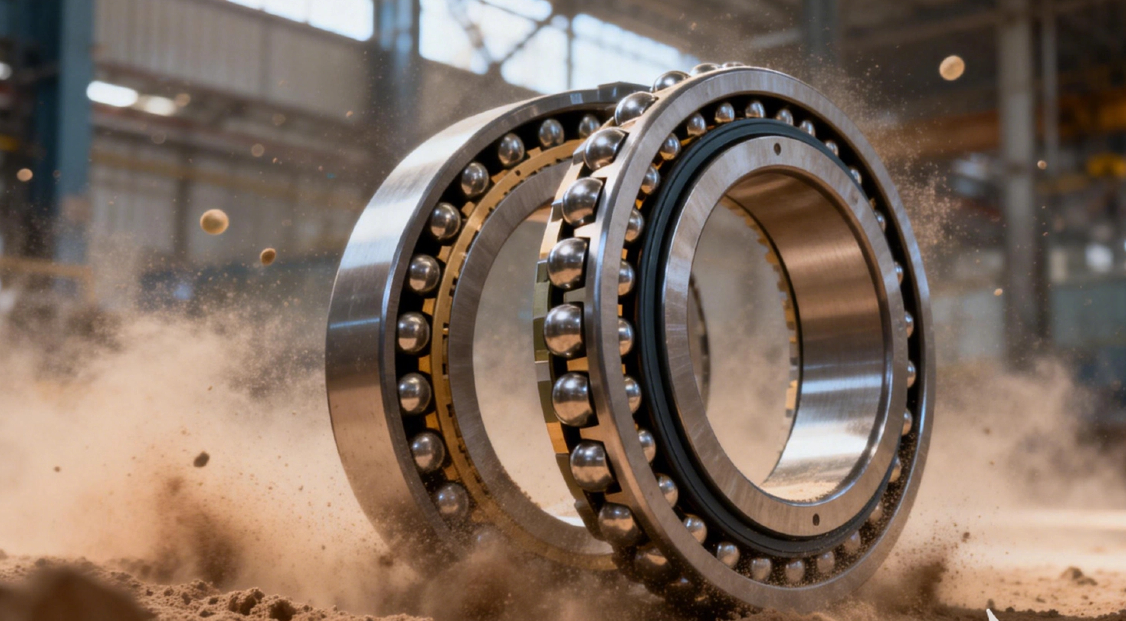
What Luoyang Slewring Bearing Can Support, and What to Confirm
Luoyang Slewring Bearing Co., Ltd. offers slewing bearings, standard slew drives and customized slew drives. The company was established in 2012 and runs 6 production lines in an 8,000 m² facility. It uses CNC machining centers and CMM three-coordinate inspection, and it has an engineering team that works from customer drawings.
Certifications on file are ISO 9001:2015 and CE marking for the European market. Factory audit reports are available on request. These are the scope limits to keep in mind: we only claim what is listed here, and we cannot make any claim about approvals that your end market may require beyond that. If your project needs a specific third-party approval, state it in your inquiry so it can be checked against your order.
Standard products start at a 1-set MOQ. Customized products start at 5 sets. That matters if you want to test a design before committing to volume.
A Supplier-Verification Path From Raw Material to First-Article Approval
This is the core of any OEM slewing bearing qualification. Work through the stages in order, because each record supports the next one. A gap early in the chain makes later records harder to trust.
| Stage | Record to request | What it proves | Red flag |
|---|---|---|---|
| 1. Raw-material traceability | Material certificate matched to a heat or batch number for the rings; grade stated against your drawing | The steel or iron grade is what you specified (ductile cast iron, alloy steel, stainless or forged alloy steel) | Certificate with no batch number, or a grade that differs from the drawing |
| 2. Raceway hardening records | Surface hardness and hardening depth results for the raceway, compared to your drawing requirement | The raceway can carry the rated load without early surface fatigue | "Hardened to standard" with no measured values |
| 3. Dimensional and runout checks | CMM report for key dimensions, plus axial and radial runout readings | Mounting fit, gear position and rotation smoothness meet the print | Hand-measured data only, or no report tied to your part number |
| 4. Load and rotation testing | Dynamic load test result for the sample or lot | The assembled bearing behaves correctly under load | Test described in words but no result sheet |
| 5. First-article approval | Signed first-article report: every drawing dimension, measured value and pass or fail, plus your written sign-off | The sample matches the print before volume starts | Production begins before you have signed off |
Three limits apply to this table. First, the right hardness and runout limits come from your drawing and load case, not from a generic number. Second, not every application needs every record at full depth; a light-duty turntable needs less than a mining excavator. Third, tell the supplier which records you need at the quoting stage, so the cost and lead time include them.
Step-by-step: how to run the check
- Send your drawing, load case and duty cycle with the inquiry.
- Ask the supplier to list which records they can issue for this part number.
- Compare the material certificate batch number with the batch on the rings.
- Review the hardening and CMM data against your drawing, line by line.
- Approve tooling only after you have signed the first-article report.
Matching Capability Claims to Buyer Concerns
Many supplier pages use words like precision, durability and flexibility. Those words are not evidence. Here is how the supplied facts line up with the concerns a sourcing team usually has.
| Buyer concern | Supplied fact | How to verify it |
|---|---|---|
| Will the part match my print? | Every slew bearing passes CMM three-coordinate inspection | Ask for the CMM report on your first article |
| Will it hold under load? | Dynamic load testing; failure rate below the 0.5% industry standard | Ask what the test covers and request your sample's result |
| Is the quality system audited? | ISO 9001:2015; factory audit reports on request | Request the certificate and the audit report |
| How fast can I see a sample? | 3-day rapid prototyping; 9-day standard production cycle; technical proposal within 24 hours | Get the schedule for your part confirmed in writing, since complexity changes it |
| What if a defect shows up? | 2-year extended quality warranty; free replacement for confirmed manufacturing defects | Agree on how a defect is confirmed before you order |
Note the wording on timelines. The 3-day and 9-day figures are the company's stated prototyping and standard production cycles. They are not a promise for every custom part, so confirm them against your drawing.
Request Your Custom Slew Drive or Bearing Spec
Tell us your load, speed, and environment — receive a tailored 100–5000 mm slewing drive or slewing bearing proposal with 3D drawings within 24 hours.
Customer Cases That Show Scope and Repeat Business
Cases do not replace records, but they show what kinds of programs a supplier has handled. These are the ones we can cite.
- Houston, Texas engineering machinery manufacturer: 100 units of SEA21-125-25HR(2) for slewing platform systems, and a separate 150 units of WED17-104-25HR double worm slew drives for heavy-duty wheel steering.
- South Korean port equipment manufacturer: a 20-unit repeat order of WEA9-62-25HR single worm slew drives for port cranes, with tracking precision of 0.15° or better, IP65 sealing and self-locking.
- British Columbia forestry equipment manufacturer: 30 units of WED14-86-25BHR.5 double worm slew drives for grapple machines, with precision of 0.13° or better.
- US renewable energy equipment manufacturer: 50 units of SP-I 0841 for utility-scale solar trackers, with IP65 protection for desert sites.
Most of these cases are slew drive programs, not bare bearings. They still tell you something useful: repeat orders and batch sizes of 20 to 150 units show the supplier can hold a drawing across a lot. Ask for the closest match to your application, and ask what was inspected on that order.
Common Mistakes Before Tooling Approval
- Judging by unit price alone. A low quote often leaves out hardening records, CMM reports or first-article time. You pay for them later, in rework.
- Accepting a photo as a first article. Photos show appearance. They say nothing about runout or raceway hardness.
- Skipping the load case. A supplier cannot confirm the right bearing type without your loads and duty cycle. For heavy or shock loads, the choice may move toward three-row roller slewing bearings, while lighter, compact units may suit other designs.
- Not defining "defect." Warranty terms only help if both sides agree how a manufacturing defect is confirmed.
- Approving tooling before sign-off. If volume starts first, you have lost your leverage on any deviation.
One worked example. Say you are building a turntable that carries a fixed payload with moderate speed. You send the drawing and ask for a 5-set custom sample lot. Before tooling, you ask for the material certificate, the raceway hardness result and the CMM report on set one. If runout on that set drifts from the print, you correct it at 5 sets, not at 500.
Cooperation Terms and Items to Agree in Writing
The supplied terms are simple. Standard products have a 1-set MOQ, and customized products have a 5-set MOQ. Sample orders are welcome for testing and evaluation. The warranty is 2 years, and technical questions get a response within 48 hours.
Beyond those, we have no fixed company workflow to quote, so settle these points in your purchase agreement instead of assuming them:
- Which records ship with the first article, and which ship with each lot.
- The acceptance criteria, using the drawing tolerances as the standard.
- Who pays for re-inspection or rework if the first article fails.
- How a confirmed manufacturing defect is documented under the warranty.
- Who owns the tooling and drawings once they are made.
For quality system details, see our quality control slew drive page. It outlines how inspection is handled across the product range.
What to Send for a Qualified Quote
If you are shortlisting a supplier for an OEM slewing bearing, the quickest way to a useful answer is a complete package. Send these items so the engineering team can respond with a technical proposal.
- Drawing or specification, with mounting and gear data.
- Axial, radial and tilting loads, plus rotation speed and duty cycle.
- Operating environment: temperature, dust, moisture, salt exposure.
- Material preference, if you have one.
- Records you need at first article and for each lot.
- Target quantity and sample plan.
If you also need a drive unit with the bearing, add the gear type and torque requirement. Our slew drive range covers worm and spur gear designs, with protection up to IP66 and anti-corrosion rating up to C4H. If you are looking for an OEM slewing bearing supplier, send us your drawing and requirements, and we will reply with a quote and a list of the records we can supply.
Request Your Custom Slew Drive or Bearing Spec
Tell us your load, speed, and environment — receive a tailored 100–5000 mm slewing drive or slewing bearing proposal with 3D drawings within 24 hours.
 WhatsApp

 +8613903880726