



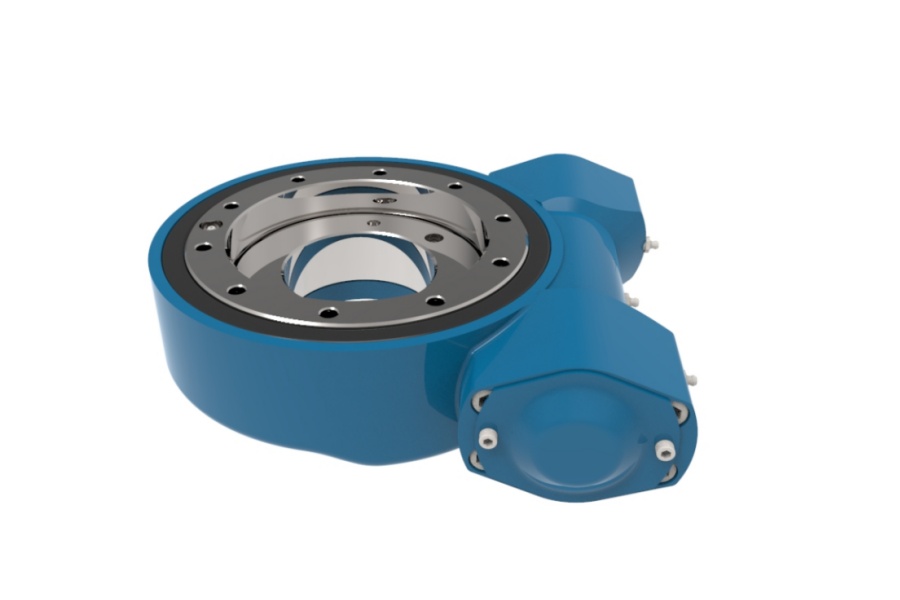
What is a WEA slew drive? It is an enclosed worm-gear rotation unit that combines a slewing bearing, worm shaft, housing, and gear interface into one assembly for controlled low-speed rotation.
Before placing an RFQ, buyers should confirm more than output torque. A WEA slew drive may look suitable on a catalog page but fail to fit if the mounting direction, combined loads, motion frequency, or environmental exposure were not defined early.
For high-duty rotation systems, the main sourcing risk is choosing a model from its size or a single load figure alone. OEM engineers need to establish the actual operating condition first, then ask a supplier to confirm the selected configuration, mounting interface, material choice, and protection requirements.
Luoyang Slewring Bearing Co., Ltd. supplies Slew Drive, slewing bearing, and customized rotation solutions for equipment builders. The company has focused on slew bearing and slew drive research and development for more than 15 years, with solutions used across more than 2,000 heavy-equipment projects.
Start with the application duty instead of the drive size
Choose the application duty first, because a larger-looking unit is not automatically the right answer. A compact platform that rotates often under offset load can place more demanding conditions on the drive than a larger platform that turns only occasionally under centered load.
For an RFQ, define what rotates, how it is supported, how often it moves, and what happens when the machine is stopped. This suits cranes, turntables, forestry attachments, construction equipment, solar mechanisms, and other systems where rotation affects machine safety or production uptime.
Do not treat a general product category as a final selection. A standard Worm Gear Slew Drive can be a practical starting point when the application needs enclosed gearing and controlled rotation, but the supplier still needs the actual load case and installation details.
Define the motion pattern in operational terms
- Intermittent indexing: Use this description when the platform moves in short steps and remains stationary between movements. It fits automated turntables and positioning equipment, but it does not describe a continuously cycling crane or excavator mechanism.
- Repeated directional rotation: Identify whether the unit reverses frequently. Reversing motion can change wear patterns and backlash expectations, so a one-way rotation assumption should not be used for this case.
- Long holding periods: State whether the drive must hold a suspended, offset, or wind-exposed load while stopped. This matters for worm-drive applications, but holding needs must be reviewed as part of the whole machine system rather than assumed from a product name.
- High cycle frequency: Report cycles per shift, day, or operating period. This is the right description for production machinery, while a machine used only for occasional positioning may need a different duty assessment.
A good requirement statement separates normal operation from abnormal but expected events. Include startup, stopping, reversing, transport condition, vibration, wind exposure where relevant, and any manual override requirement. Do not expect a supplier to infer these conditions from the equipment name alone.
Match duty cycle, mounting orientation, and combined loads before selecting a WEA model
The selection boundary is clear: match duty cycle, mounting orientation, and combined loads before selecting a WEA model. This prevents a drive from being evaluated as if it sees only vertical force when the real installation also applies radial force and overturning moment.
Combined loading is common in real equipment. A boom, bracket, grapple, or elevated platform may create axial load, radial load, and overturning moment at the same time, especially when the center of gravity sits away from the rotation axis.
| Selection factor | What the buyer should provide | Why it changes the selection | When this information is not enough |
|---|---|---|---|
| Axial load | Downward or upward force on the rotating structure | It affects bearing support and housing loading | Add radial force and moment data when the load is off-center |
| Radial load | Side force acting across the rotation axis | It can increase bearing and gear interface demands | Do not assess it alone if shock or vibration occurs |
| Overturning moment | Load offset and distance from the rotation center | It often governs elevated or cantilevered equipment | Include full operating and parked positions, not one position only |
| Mounting orientation | Horizontal, vertical, tilted, or rotating-frame installation | It changes the direction of gravity-related loading | Provide drawings if the frame moves through several angles |
| Duty cycle | Motion duration, pauses, starts, stops, and reversals | It affects heat, wear, and service expectations | Include peak operation, not only average production use |
For a horizontal turntable with a centered load, axial force may be the first item to define. That approach does not apply to a truck-mounted crane, forestry grapple, or marine crane where the load can be offset and motion direction can change during use.
Mounting bolts and structural flatness also need agreement. A correctly selected drive can still perform poorly if the machine frame distorts under load, if the mounting surface is uneven, or if the bolt pattern is changed without review.
Luoyang Slewring Bearing Co., Ltd. uses ductile cast iron, alloy steel, stainless steel, and forged alloy steel according to working conditions such as load, speed, and environment. Material selection should therefore be discussed with the full application condition, not requested as a fixed default material for every project.
Use a combined-load worksheet before requesting quotations
- Identify the rotating structure and attach a dimensioned layout showing the rotation center.
- List the payload, attachment weight, and any load that remains offset during rotation.
- State axial load, radial load, and overturning moment for each meaningful operating position.
- Describe the mounting direction and whether the assembly changes orientation during operation.
- Record the motion pattern, including starts, stops, reversals, holding periods, and peak-use conditions.
- Provide the intended motor, gear interface, control requirement, and available installation envelope.
- Ask the supplier to identify any missing inputs before comparing quotations.
This procedure works well at the early specification stage because it gives engineering and procurement teams one shared record. It does not replace machine-level verification, especially where structural deflection, safety factors, or external system loads need a separate calculation.
Request Your Custom Slew Drive or Bearing Spec
Tell us your load, speed, and environment — receive a tailored 100–5000 mm slewing drive or slewing bearing proposal with 3D drawings within 24 hours.
Choose the gear arrangement and protection level for the real environment
Select a single-worm arrangement when the application has one primary drive input and the reviewed load case fits that arrangement. Do not assume it is the best choice for every high-duty project, particularly where the equipment requires additional load distribution or tighter control under demanding combined loads.
A Double Worm Slew Drive is worth discussing when the duty, load direction, or precision target calls for a different configuration. The limit is that configuration selection still depends on the machine’s actual loads, mounting structure, and operating conditions; a double-worm design is not a universal upgrade.
Environmental exposure should be specified with the same care as mechanical loads. Dust, washdown, salt-laden air, rain, temperature changes, and outdoor storage can affect housing, seals, corrosion protection, lubricant condition, and maintenance planning.
| Operating condition | Buyer decision | Reason to include it in the RFQ | Boundary to remember |
|---|---|---|---|
| Outdoor dust or rain | State required ingress protection and exposure duration | Protection needs depend on the site condition | Do not assume one protection class covers every installation detail |
| Marine or corrosive atmosphere | Request corrosion-protection review | Salt and moisture can change material and coating choices | Site-specific maintenance practices still matter |
| Heavy cyclic loading | Provide peak and recurring combined-load cases | Repeated loading affects the service requirement | A single static condition is not a full duty definition |
| Precision positioning | State allowable tracking or positioning error | Precision expectations must be measurable | Drive accuracy alone cannot correct a flexible machine frame or control issue |
The company supplies drives with protection up to IP66 and anti-corrosion rating up to C4H for harsh industrial environments. Specify the required level rather than simply writing “outdoor use,” because outdoor locations range from sheltered equipment yards to coastal installations.
Real application evidence helps buyers assess relevance. A South Korean port equipment manufacturer placed a repeat order for 20 WEA9-62-25HR single-worm units for port crane systems, specified with IP65 sealing, self-locking, and tracking precision of no more than 0.15 degrees. That case supports discussion of crane-related requirements, but it should not be treated as proof that the same model fits every crane geometry or duty cycle.
Check supplier evidence before comparing price and delivery terms
A low unit price is not a useful comparison if one quotation lacks defined inspection, material, warranty, or configuration scope. The better purchasing approach is to compare what each supplier has agreed to supply, how the product will be checked, and which machine inputs remain unverified.
Luoyang Slewring Bearing Co., Ltd. operates an ISO 9001:2015 certified quality management system and holds CE marking for the European market. Factory audit reports are available on request, which can help procurement teams that need supplier qualification documents before approval.
The company has an 8,000 square meter manufacturing facility, six production lines, CNC machining centers, and CMM three-coordinate inspection. Its stated annual capacity is 100,000 sets, but capacity alone does not confirm that a particular configuration is available or suitable for an individual project.
For quality evidence, every slewing bearing is stated to pass CMM three-coordinate inspection and dynamic load testing. The company also reports a failure rate below the 0.5% industry standard and provides a two-year extended quality warranty; buyers should still agree on acceptance criteria for their own model and application.
Compare quotations using this supplier checklist
- Technical fit: Confirm the quoted model matches the stated duty cycle, mounting orientation, combined loads, rotation range, and installation envelope. Reject a quote that identifies only a series without addressing missing load inputs.
- Configuration scope: Check the housing, gear arrangement, motor interface, mounting pattern, sealing requirement, and corrosion-protection requirement. This avoids comparing differently configured units as if they were equal.
- Inspection evidence: Ask which inspection records apply to the supplied unit and whether dimensional or functional requirements can be documented. Use the company’s Slew Drive Quality Control information as a starting point, not as a substitute for project-specific acceptance requirements.
- Lead-time fit: The company states a three-day rapid prototyping capability and a nine-day standard production cycle. Confirm whether the requested design is standard or customized, because these stated timeframes should not be assumed for every order.
- Commercial terms: Standard products have an MOQ of one set, while customized products have an MOQ of five sets. Sample orders are welcome for testing and evaluation, but testing scope and acceptance responsibility should be agreed before order placement.
- Support boundary: Technical proposals are available within 24 hours and technical response is stated within 48 hours. Provide complete application information so the response can address the actual selection question.
Price should be reviewed after technical scope is aligned. Luoyang Slewring Bearing Co., Ltd. localizes German-standard SE and WE series drives with P0 to P4 precision grades, stating a cost saving of 30% to 50% versus imported brands while matching international first-tier performance parameters. That comparison is useful for buyers considering an imported-brand alternative, but it is not a substitute for reviewing the exact model, specification, and commercial terms.
Set the RFQ boundary for standard and customized supply
Use a standard model request when the mounting interface, duty, environment, and required configuration are already covered by an available product. This can shorten the specification process, but it does not apply if the machine has a special mounting layout, unusual operating direction, or a requirement not addressed by the standard configuration.
Use a Customized Slew Drive discussion when the interface, housing, input arrangement, protection requirement, or load condition needs a project-specific solution. The buyer should provide drawings and stated conditions early, because customization cannot be properly defined from a short request such as “high torque rotation drive.”
A practical RFQ should include the machine type, rotating mass, load positions, combined loads, duty cycle, mounting drawing, environmental condition, requested protection level, motor details, quantity, and target delivery need. Add any required certificates, inspection records, packaging needs, or destination-market documentation at the same time.
The company has an experienced engineering team and can provide a technical proposal within 24 hours based on the information received. The most suitable fit is an OEM or equipment builder that can define its working conditions clearly and wants a supplier with prototype capability, low MOQ options, documented quality controls, and support for standard or customized rotation assemblies.
For a high-duty rotating system, the right choice is not simply the biggest enclosed drive. It is the unit whose duty cycle, mounting orientation, combined loading, environmental exposure, inspection scope, and cooperation terms have all been reviewed before the purchase order is released.
Request Your Custom Slew Drive or Bearing Spec
Tell us your load, speed, and environment — receive a tailored 100–5000 mm slewing drive or slewing bearing proposal with 3D drawings within 24 hours.
 WhatsApp

 +8613903880726