



What is a WE slew drive? It is a worm-driven rotary unit used to turn and hold equipment under combined radial, axial, and overturning loads. For an OEM buyer, the main risk is not simply selecting a drive size. The larger risk is releasing an RFQ before the supplier has confirmed the load case, required holding behavior, sealing condition, mounting interface, and inspection evidence.
A WE slew drive can be a suitable option for cranes, mining equipment, marine equipment, turntables, solar equipment, and other machines that require controlled rotation. However, product naming alone does not prove that a unit fits a specific duty cycle. The buyer must translate machine requirements into documents that can be checked before an order is placed.
Luoyang Slewring Bearing Co., Ltd. supplies Slew Drive, slewing bearing, and customized slew drive solutions for OEM equipment. The company has operated since 2012 and runs six production lines in an 8,000 m² manufacturing facility. Its engineering team can provide a technical proposal within 24 hours, which helps purchasing and design teams start a focused supplier review rather than exchange vague product requests.
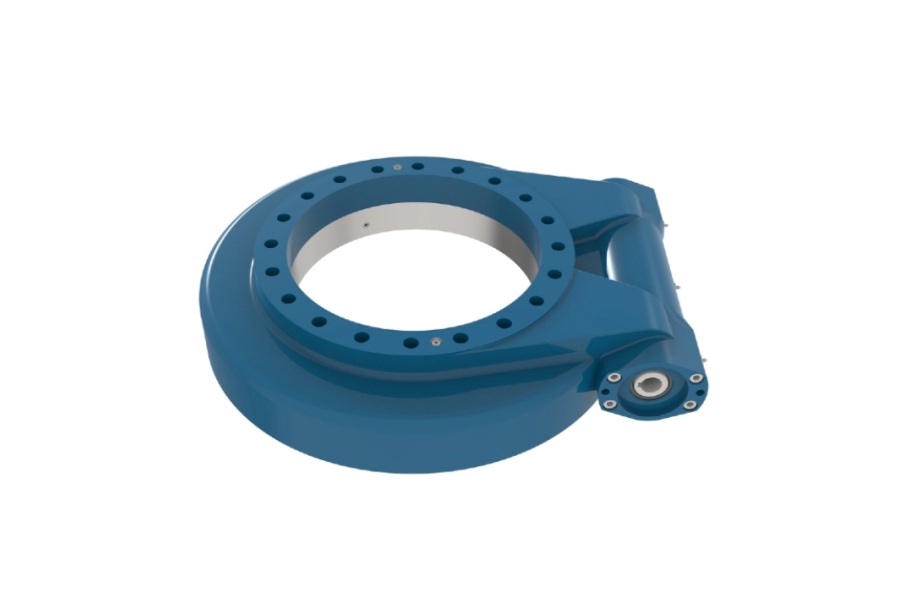
Define the Equipment Duty Before Requesting a Model
The first sourcing decision is to define the actual machine duty, not just the equipment category. A port crane, forestry grapple, excavator attachment, and industrial turntable may all rotate, yet their shock loads, operating angles, holding requirements, and environmental exposure are very different. A supplier cannot responsibly select the same drive configuration for all four.
Start with the maximum working loads and how they act on the mounting plane. The buyer should identify axial load, radial load, overturning moment, rotational speed, operating direction, start-stop frequency, and any external force that can back-drive the worm system. These inputs allow the supplier to compare the application against load charts and torque curves instead of choosing only by outside diameter.
Separate continuous rotation from holding duty
Choose a worm-driven solution when the equipment needs controlled angular movement and may need to resist reverse motion under load. This fits many lifting, positioning, and solar tracking applications. It does not automatically fit every continuously rotating machine, especially where duty cycle, speed, heat generation, or external back-driving conditions have not been verified.
For example, a truck-mounted crane requires careful review of overturning load and safe holding behavior at operating positions. A solar tracker may instead place more emphasis on repeatable positioning, environmental sealing, and long outdoor exposure. The equipment function may look similar from a distance, but the design inputs are not interchangeable.
Choose the drive arrangement based on the load path
| Configuration to evaluate | Best-fit condition | Why it may fit | Limit before selection |
|---|---|---|---|
| Single worm drive | Applications with a defined direction of rotation and standard positioning duty | Provides compact worm-based rotation and can support self-locking requirements where the design is verified | Do not assume self-locking under every load, lubrication condition, vibration level, or installation angle |
| Double Worm Slew Drive | Heavy equipment with higher torque demand or a need for improved stability across the drive | Two worms can distribute the driving function and support demanding equipment layouts | Requires supplier confirmation of load distribution, backlash needs, motor arrangement, and mounting design |
| Spur Gear Slew Drive | Systems where the equipment design calls for a spur gear arrangement | Can suit selected tracker and automated positioning applications | Do not replace a worm-drive requirement with a spur gear version without reviewing holding and control needs |
| Customized Slew Drive | Nonstandard mounting, torque, sealing, corrosion, or output interface requirements | Allows the supplier to match the unit to the machine rather than force a near-fit standard model | Customized products have a stated MOQ of 5 sets and need defined technical requirements before quotation |
The clear recommendation is to request a standard unit only when the mounting, loads, environment, and motion duty already match a published configuration. Use a customized approach when the interface or duty is outside that range. This distinction prevents a low initial purchase price from becoming a redesign cost later.
Build an RFQ That Produces Comparable Supplier Answers
An RFQ should make suppliers respond to the same engineering question. If one supplier receives only “slew drive for crane” while another receives load values, installation drawings, and duty details, the quotations will not be comparable. The buyer may then select a lower-priced offer that was based on less responsibility.
For a heavy-duty application, include the drive orientation and the location of the load relative to the mounting surface. Overturning moment is often the overlooked item because it depends on both force and distance from the center. A supplier should be asked to state which load inputs were used in its recommendation.
Use this pre-RFQ input checklist
- Equipment function: State whether the unit rotates a crane, turntable, excavator structure, tracker, grapple, or other mechanism.
- Load case: Provide maximum axial load, radial load, and overturning moment, including the direction and whether the values occur together.
- Motion data: Specify required rotation range, speed, starts and stops, duty cycle, and whether movement is one-way, reversing, or intermittent.
- Holding condition: Explain whether the system must resist movement when power is removed and identify any possible back-driving load.
- Mounting information: Attach the interface drawing, bolt pattern, available installation space, and drive orientation.
- Environment: State temperature range, dust, rain, salt exposure, cleaning method, and corrosion expectation.
- Drive package: Identify whether motors, brakes, encoders, hydraulic motors, or control components are already specified.
- Acceptance needs: List the drawings, certificates, inspection records, packaging needs, and delivery destination required before purchase approval.
This checklist is especially useful when procurement and engineering work in separate teams. Procurement can use it to prevent incomplete RFQs, while the design team can use it to identify missing assumptions. It does not replace final machine-level verification, because the final structure, fasteners, and control system also affect safe operation.
Luoyang Slewring Bearing can support material selection based on load, speed, and environment, using materials including ductile cast iron, alloy steel, stainless steel, and forged alloy steel. Buyers should still ask which material is proposed for their specific project and why. Material names alone do not establish suitability without the associated load and exposure conditions.
A Supplier Documentation Map for OEM Order Approval
Before placing an OEM order, require documents that connect the quoted drive to the actual machine duty. This is the practical gap between a catalog comparison and an engineering-qualified purchase. The documentation should be reviewed before approving a model number, especially for lifting, marine, mining, and outdoor equipment.
| Required document | What the buyer should verify | Why it matters | When it may be insufficient |
|---|---|---|---|
| Load chart | Permitted axial load, radial load, and overturning moment for the proposed unit | Shows whether the drive is being selected for the actual combined load case | A chart alone is not enough when shock loading, unusual mounting, or changing load direction is present |
| Torque curve | Available output torque across the relevant operating condition and the supplier assumptions behind it | Helps match the drive to acceleration, resistance, and holding needs | It does not prove motor, brake, or controller suitability unless those parts are included in the review |
| General arrangement drawing | Mounting holes, envelope size, gear location, shaft direction, and connection interfaces | Prevents interference with frames, guards, hydraulic lines, and motor assemblies | It must be checked against the buyer’s current machine drawing, not an outdated layout |
| Material certificate | Declared material for the relevant housing, gear, bearing, or structural part requested in the RFQ | Supports traceability where material choice affects strength, corrosion resistance, or project approval | A certificate should not be treated as a full fatigue-life calculation |
| Sealing details | Seal arrangement, stated ingress protection level, lubrication points, and environmental limitations | Protects against early contamination damage in dust, rain, or marine exposure | IP rating does not by itself confirm chemical resistance or suitability for continuous salt spray |
| Inspection records | Dimensional inspection, CMM results where applicable, and dynamic load testing evidence requested for the order | Provides evidence that the delivered unit was checked rather than only designed on paper | Records must identify the supplied product or agreed inspection lot to be meaningful |
Ask the supplier to state any assumptions beside each document. For example, a torque curve may depend on a particular motor arrangement, while a sealing statement may depend on correct installation and maintenance. This protects the buyer from treating a technical document as a blanket guarantee outside its stated conditions.
Luoyang Slewring Bearing operates an ISO 9001:2015 quality management system and has CE marking for the European market. Its facility also uses CMM three-coordinate inspection, and the company states that every slewing bearing passes CMM inspection and dynamic load testing. For a project-specific order, buyers should define which records must accompany the shipment and when those records must be submitted for approval.
Request Your Custom Slew Drive or Bearing Spec
Tell us your load, speed, and environment — receive a tailored 100–5000 mm slewing drive or slewing bearing proposal with 3D drawings within 24 hours.
Check Heavy-Duty Evidence Against Your Application
Supplier evidence should resemble the operating problem you are trying to solve. A solar tracker reference is useful for outdoor positioning and sealing discussions, but it does not by itself qualify a drive for an excavator or port crane. Match each case to the load type, environment, motion pattern, and required precision of your equipment.
Luoyang Slewring Bearing has documented projects across several relevant sectors. A South Korean port equipment manufacturer placed a repeat order for 20 WEA9-62-25HR single worm slew drives for port crane systems, with stated tracking precision of no more than 0.15°, IP65 sealing, and self-locking. That case is relevant when a buyer needs a sealed, controlled worm-drive solution for a port crane, but it does not establish that the same model fits every crane load or boom geometry.
For high-load mobile equipment, an Australian heavy equipment manufacturer used HWE21-94-25HR.1 double worm slew drives for mining excavators. A Canadian forestry equipment manufacturer used 30 WED14-86-25BHR.5 double worm units for forestry grapple machines, with stated precision of no more than 0.13°. These examples support a discussion about double-worm configurations in demanding equipment, yet the buyer still needs a project-specific load and mounting review.
Marine sourcing requires special care because water, salt exposure, and crane duty can combine. Documented marine references include 20 WEA17-104-25H-R-REV.D units supplied to UK Ocean Marine Systems for shipboard crane systems and WEA9-61-25HR units for ship deck cranes in Newcastle, Australia. Ask for sealing details and corrosion requirements early; do not assume that a marine customer case automatically matches your vessel’s exposure level.
For solar equipment, a U.S. renewable energy equipment manufacturer ordered 50 SP-I 0841 units for utility-scale tracker systems with IP65 stated for desert sites. South American solar projects in Brazil, Argentina, and Chile used SP-I 0229 spur gear slew drives for single-axis trackers, with reported energy yield improvement up to 40%. That project outcome belongs to those specific installations and should not be used as a universal output forecast for another tracker design.
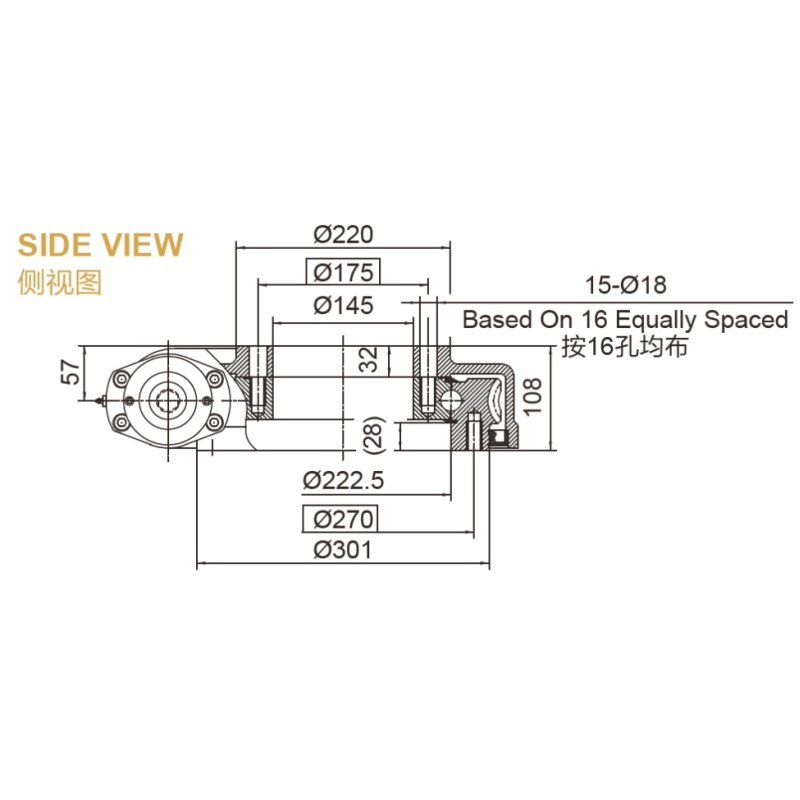
Compare Supplier Fit Beyond Unit Price
A lower unit price can be attractive, but it should be compared against the documents, inspection scope, lead time, MOQ, and warranty terms that are actually included. The right supplier is the one that can answer the RFQ with evidence tied to the intended machine. This is particularly true when downtime or redesign carries more cost than the drive itself.
| Commercial or technical factor | Luoyang Slewring Bearing stated terms or capability | Buyer action |
|---|---|---|
| Standard-product MOQ | 1 set | Suitable for evaluation purchases, replacement needs, and low-volume machine programs; confirm model availability and documentation scope. |
| Customized-product MOQ | 5 sets | Use when the machine requires a nonstandard interface or duty-specific design; provide complete engineering inputs before expecting a firm offer. |
| Prototype and production timing | 3-day rapid prototyping and 9-day standard production cycle are stated capabilities | Ask whether these timelines apply to your model, quantity, documentation needs, and current production schedule before committing dates. |
| Quality assurance | 2-year extended quality warranty and free replacement for confirmed manufacturing defects | Agree on defect confirmation, evidence requirements, freight responsibility, and the warranty start point in the purchase terms. |
| Technical support | Technical proposal within 24 hours and 48-hour technical response | Use the early proposal to test whether the supplier has understood the load case and has identified unanswered questions. |
The company states annual capacity of 100,000 sets and offers sample orders for testing and evaluation. A sample can reduce uncertainty when the drive must fit an existing machine interface or when the buyer needs to verify assembly conditions. A sample is not a substitute for confirming production drawings, acceptance criteria, and the final bill of materials for the OEM order.
The stated German-standard SE/WE series localization capability includes P0-P4 precision grades and is presented as offering cost savings of 30% to 50% compared with imported brands while matching international first-tier performance parameters. Treat this as a supplier capability to discuss, not as an automatic price result for every RFQ. The buyer should request an apples-to-apples comparison covering configuration, documentation, inspection scope, warranty, and freight terms.
Prevent Common WE-Series Sourcing Mistakes
The best procurement process catches technical gaps before a purchase order is released. The following mistakes are common because they appear minor during quotation review but can create delays after the drive arrives. Each can be avoided with a direct question and a documented answer.
- Selecting by model name only: A model code does not confirm combined load capacity. Request the load chart and identify the exact operating case used for selection.
- Ignoring overturning moment: A drive may carry a vertical load but still be unsuitable when that load sits far from the rotation center. Provide the load arm and maximum operating position.
- Assuming self-locking without conditions: Ask the supplier to address back-driving risk in your application. This is especially relevant for cranes, elevated loads, and equipment exposed to vibration.
- Requesting an IP rating without sealing details: Ask what the rating covers and how installation, lubrication, and maintenance affect the sealed condition.
- Comparing only headline price: Confirm whether drawings, material documents, inspection records, motors, packaging, and warranty terms are included in the offered scope.
- Using a similar customer case as final proof: A case supports supplier relevance, but your machine still needs its own selection review, interface check, and acceptance requirements.
- Releasing a custom order before drawings are agreed: For a customized unit, define mounting dimensions, interfaces, load assumptions, and required records before production approval.
A well-prepared RFQ makes sourcing faster and safer. Provide the load data, drawings, environment, and acceptance requirements first; then ask the supplier to identify any assumptions that remain. Luoyang Slewring Bearing can be a practical fit for OEM buyers that need documented slew drive options, small standard-order quantities, customized products from 5 sets, and engineering input tied to the working condition.
Request Your Custom Slew Drive or Bearing Spec
Tell us your load, speed, and environment — receive a tailored 100–5000 mm slewing drive or slewing bearing proposal with 3D drawings within 24 hours.
 WhatsApp

 +8613903880726