



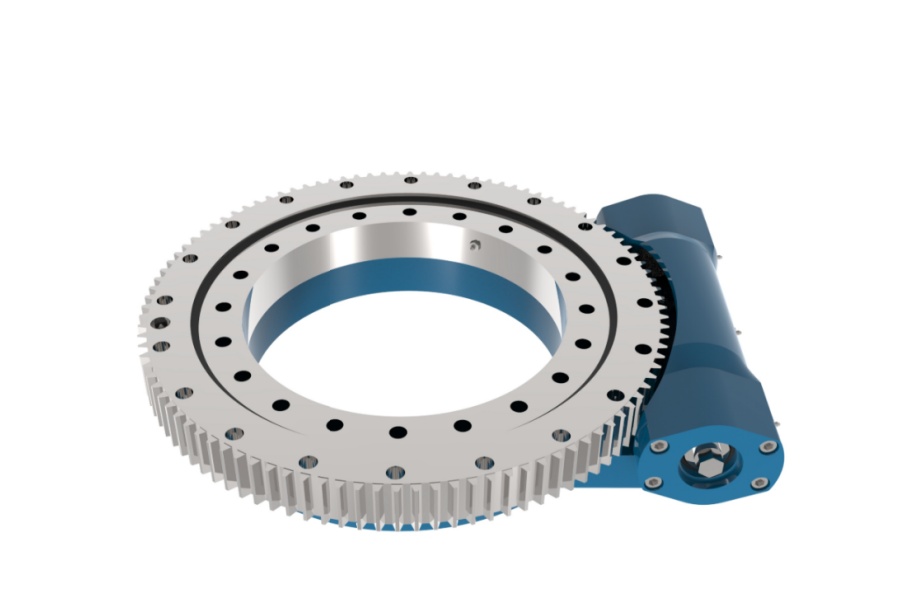
What is a WE slew drive? It is a geared rotary unit that combines a slewing bearing, worm gear set, housing, and mounting interfaces to turn a load while carrying applied forces. Buyers commonly use this type of drive in equipment that needs controlled rotation, such as cranes, turntables, solar trackers, and mobile machinery.
Before placing an order, a buyer should avoid selecting a WE slew drive from torque alone. A drive can show enough torque on paper yet still be unsuitable if its overturning moment rating, mounting bolt layout, environmental sealing, or input arrangement does not match the machine. The right model is the one that works as a complete interface between the rotating structure, drive motor, and operating environment.
For machine builders, the practical goal is simple: send an RFQ that lets the supplier check the actual application rather than make assumptions. Luoyang Slewring Bearing Co., Ltd. supports standard and customized slewing solutions, with a technical proposal available within 24 hours when the working conditions and interface details are provided.
Which application details should be defined before choosing a model?
Start with the load path, not the product catalog. Define what is mounted above the drive, where its center of gravity sits, how the load moves, and whether the machine sees shock, vibration, wind, or repeated starts and stops. These details determine which ratings need the most attention.
A small centered load and a large offset load may have similar total weight, but they do not place the same demand on the drive. An offset boom, platform, or grab tool creates overturning moment. That moment can govern the selection even when the drive has adequate output torque.
Use this application-input list before requesting a quotation
- Rotating equipment: State whether the application is a platform, crane, solar tracker, excavator attachment, turntable, antenna, or another mechanism.
- Total supported load: Include the rotating structure, payload, tooling, and any attachments carried by the drive.
- Center-of-gravity position: Give the horizontal and vertical offset from the slewing center. This is needed to assess overturning moment.
- Motion requirement: Specify rotation angle, operating speed, starts per cycle, duty cycle, and whether the load must hold position without power.
- Input source: Identify hydraulic motor, electric motor, manual input, or another drive source. Include available input speed and required interface details when known.
- Installation direction: State horizontal, vertical, tilted, or rotating-axis installation. Orientation can affect load distribution and sealing exposure.
- Environment: Describe dust, rain, salt spray, washdown, temperature conditions, corrosion exposure, and outdoor storage requirements.
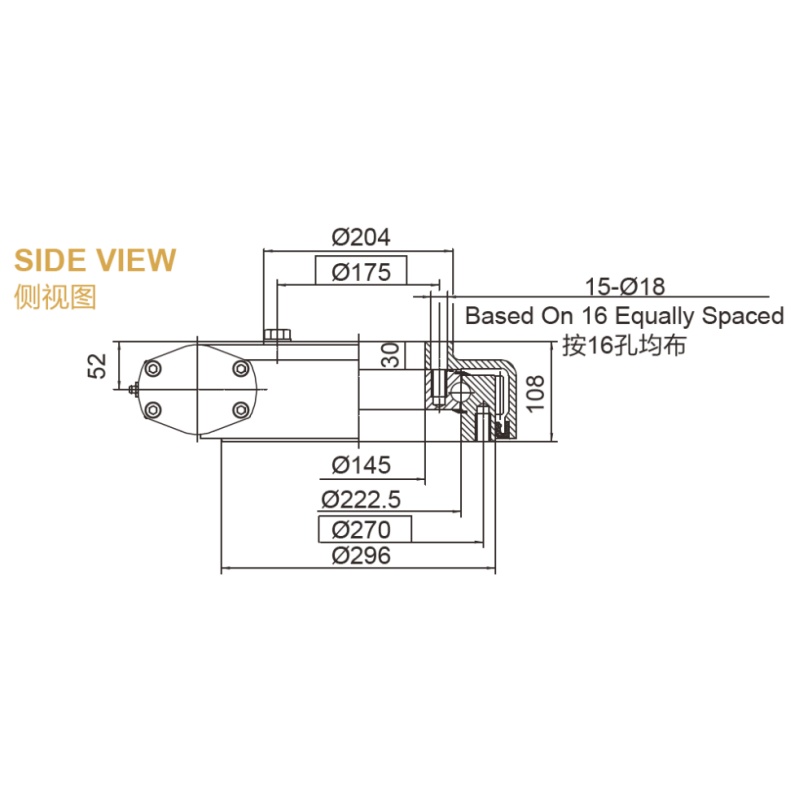
- Mounting interfaces: Provide bolt-hole drawings, pilot diameters, support-frame dimensions, and clearance limits.
For a standard product, Luoyang Slewring Bearing Co., Ltd. accepts orders from one set. A customized design has a minimum order quantity of five sets, so it is usually best to first determine whether a standard housing and mounting pattern can meet the equipment need.
When the equipment requires a nonstandard housing, gear interface, mounting flange, or protection arrangement, review a Customized Slew Drive option early. This route fits a production machine with fixed interface limits, but it may not be necessary for an initial test rig that can accept a standard unit.
Buyer FAQ for comparing ratings as a connected system
Which specification should be checked first? Check the loading condition first, then confirm torque, ratio, mounting, and sealing around that condition. No single rating can prove that a drive is suitable because the forces act together through the bearing, housing, gear set, and mounting bolts.
| Specification | What it answers | What must be checked with it | When it can mislead a buyer |
|---|---|---|---|
| Holding torque | Whether the drive can resist rotation under an external turning force when held in position. | Actual external torque, expected shock, duty cycle, brake or self-locking needs, and the motor arrangement. | It does not show whether the bearing can carry an offset load or whether the mounting structure is stiff enough. |
| Overturning moment | Whether the drive can support a load acting away from the slewing center. | Center-of-gravity offset, boom length, payload position, support-frame stiffness, and bolt layout. | A drive may carry the total weight but still be unsuitable when the load is far from the rotation axis. |
| Radial load | Whether the drive can carry force acting sideways toward or away from the center axis. | Side loading, tool reaction force, installation orientation, and moment loading. | Radial load should not be treated as a substitute for overturning-moment capacity. |
| Axial load | Whether the drive can carry force acting parallel to the slewing axis. | Equipment weight, vertical acceleration, mounting direction, and combined radial or moment loads. | Vertical weight alone does not describe the full application if the center of gravity is offset. |
| Gear ratio | How input rotation is reduced to output rotation and how the input source is matched to output speed. | Available motor speed, required output speed, torque demand, control accuracy, and cycle time. | A higher ratio may support a different speed-torque match, but it does not automatically solve load-capacity limits. |
| Mounting pattern | Whether the drive physically fits and transfers load correctly into the machine frame. | Bolt size and location, pilot features, flatness, support stiffness, clearance, and access for tightening. | Matching outside dimensions without matching bolt interfaces can create an installation delay or unsafe load transfer. |
| IP sealing | How well the enclosure resists specified ingress exposure. | Dust, water exposure, washdown, cable entries, motor protection, corrosion conditions, and maintenance practice. | An IP rating does not by itself define corrosion resistance or suitability for every marine or chemical exposure. |
Is holding torque the same as working torque? No. Holding torque concerns resistance to external rotation when the mechanism is held, while working torque concerns the torque needed to move the application. A correct selection checks both, especially where wind, suspended loads, or changing tool forces may act on the rotating structure.
Does a self-locking arrangement remove the need for a safety review? No. Self-locking behavior can be useful in certain applications, but the complete system still needs review of load case, motor, control method, mounting, and operating conditions. For example, the WEA9-62-25HR single worm drives supplied for a South Korean port crane system were specified with self-locking, IP65 sealing, and tracking precision of no more than 0.15 degrees; those case details should not be treated as a universal fit for every crane.
When should a double-worm configuration be considered? Consider it when the application calls for the characteristics of a dual worm arrangement and the supplier confirms it against the actual load and motion requirements. It is not simply an upgrade for every project. For example, a forestry grapple application in British Columbia used WED14-86-25BHR.5 double worm units with precision of no more than 0.13 degrees, while an Australian heavy-equipment manufacturer selected HWE21-94-25HR.1 double worm units for mining excavators.
For projects where the basic design direction is still open, compare a Worm Gear Slew Drive with a Double Worm Slew Drive against the same load sheet. Do not compare only housing size or output torque.
Request Your Custom Slew Drive or Bearing Spec
Tell us your load, speed, and environment — receive a tailored 100–5000 mm slewing drive or slewing bearing proposal with 3D drawings within 24 hours.
How should torque, load, and ratio be evaluated for the actual machine?
The best approach is to identify the worst credible operating condition and use that as the selection basis. This condition may occur during lifting, acceleration, braking, wind exposure, a tool impact, or an offset payload position. Normal running conditions alone may hide the governing case.
Worked selection scenario for an offset rotating platform
Assume a machine builder is designing a rotating platform with equipment mounted to one side. The drive must rotate the platform to a set position, stop accurately, and resist external turning force while the platform is stationary. The buyer should not begin by asking only for the largest torque model in a catalog.
- List the full rotating mass, including the platform, mounted equipment, payload, fasteners, and guards.
- Measure the center-of-gravity location from the slewing center in all operating positions.
- Identify the largest offset condition, because it produces the greatest moment demand.
- Record the required rotation speed, available motor input speed, cycle frequency, and stopping requirement.
- Define radial and axial forces from the equipment operation, not just static weight.
- Provide the base-frame drawing and bolt pattern so the mounting interface can be checked.
- State indoor or outdoor exposure, dust level, water exposure, and corrosion requirement.
- Ask the supplier to review the combined load case rather than confirming one isolated catalog rating.
This process fits turntables, truck-mounted equipment, handling systems, and crane-related structures. It does not replace machine-level structural verification, especially where the supporting frame can flex or where shock loading is present. The drive can only perform as intended when the frame transfers load evenly through the mounting interface.
In applications with high structural loading, the bearing type inside the rotating system may need separate attention. A Heavy load slewing bearing is a relevant product path when the project calls for a bearing solution rather than an enclosed drive, but the same questions about moment, radial force, axial force, mounting, and environment still apply.
What mounting and environmental checks prevent costly fit problems?
Confirm the mounting pattern before finalizing the model. Ask for the drive outline, bolt-hole locations, mounting-face requirements, gear or motor interface, and clearance envelope. A drive that fits the available diameter may still conflict with nearby structure, hoses, guards, or motor space.
The support frame matters as much as the bolt pattern. A mounting surface that is not adequately supported can distort under load, affecting bearing operation and bolt-load distribution. The supplier needs the actual support concept, not only a list of desired performance ratings.
Common specification mistakes to avoid
- Choosing by torque only: This misses overturning moment and combined loads. Use a complete load case instead.
- Sending total weight without center-of-gravity data: Weight does not show how far the load acts from the slewing axis.
- Assuming an IP rating covers corrosion: Sealing and corrosion protection answer different questions. Describe salt, chemicals, humidity, and outdoor exposure separately.
- Ignoring the motor interface: The gear ratio must work with the available motor speed and desired output motion.
- Copying a prior model number: A previous design may have a different duty cycle, frame stiffness, payload, or environment.
- Leaving mounting drawings until after model selection: This can force rework when bolt holes, pilots, or clearances do not align.
- Using one customer case as a design rule: A port crane, solar tracker, forestry grapple, and marine crane have different loading and environmental demands.
Protection requirements should be stated in the RFQ, not added later. Luoyang Slewring Bearing Co., Ltd. offers slew drives with protection up to IP66 and anti-corrosion rating up to C4H, but the appropriate option depends on the stated environment and project requirements. A dusty inland site, a washdown area, and a salt-exposed ship deck should not be treated as the same service condition.
Marine and port equipment requires especially clear environmental information. One UK Ocean Marine Systems order used 20 WEA17-104-25H-R-REV.D units for shipboard crane systems, and a Newcastle marine equipment manufacturer used WEA9-61-25HR units for ship deck cranes. These examples show why equipment type and exposure should be included in the inquiry, rather than assuming a general outdoor specification is enough.
What should a technically complete RFQ include?
A complete RFQ should allow the supplier to assess suitability without filling gaps with assumptions. It should also let the buyer compare quotations on the same basis. If two suppliers receive different load information or different drawings, their offers may not be technically equivalent even if the model names look similar.
| RFQ item | What to send | Why it affects the proposed model |
|---|---|---|
| Application description | Machine type, function, installation position, and rotation range | Sets the operating context and likely loading direction. |
| Load information | Axial load, radial load, overturning moment, center-of-gravity location, and shock conditions | Allows combined-load assessment instead of a torque-only comparison. |
| Motion requirement | Output speed, input source, duty cycle, starts and stops, and positioning need | Guides ratio and input-interface selection. |
| Interface drawings | Mounting holes, pilot details, base-frame layout, clearance limits, and motor connection data | Prevents fit issues and supports proper load transfer. |
| Environmental conditions | Dust, water, washdown, salt exposure, corrosion concern, and storage conditions | Defines needed sealing and surface-protection direction. |
| Commercial requirement | Quantity, test sample need, target delivery requirement, and customization need | Helps determine whether a standard or custom route is more suitable. |
Buyers who require initial validation can request a sample order for testing and evaluation. Luoyang Slewring Bearing Co., Ltd. has a standard-product MOQ of one set, a three-day rapid prototyping capability, and a nine-day standard production cycle. Actual delivery planning should still be confirmed against the selected model, order quantity, drawings, and production schedule.
Quality documentation should be part of the sourcing discussion for heavy-duty equipment. Our ISO 9001:2015 quality management system certification and CE marking for the European market support formal procurement requirements, while factory audit reports are available on request. Every slewing bearing passes CMM three-coordinate inspection and dynamic load testing under our stated quality-control process; see our Slew Drive Quality Control information when defining inspection expectations.
When is a standard model suitable and when is customization the better choice?
A standard model is usually the better starting point when the machine can accept its mounting pattern, dimensions, input arrangement, and environmental option. It can reduce engineering changes and is appropriate for prototypes, replacement projects, and equipment with flexible interface design.
Customization is the better choice when a standard drive would require adapters, compromises in mounting, an unsuitable motor connection, or a housing arrangement that conflicts with the machine frame. Customization should solve a specific interface or operating problem. It should not be requested simply because a buyer has not yet prepared the application data.
Luoyang Slewring Bearing Co., Ltd. has operated since 2012 and has six production lines within an 8,000 m² manufacturing facility. The company’s annual capacity is 100,000 sets, and its engineering team can support drawing review, material selection, and tolerance verification for projects where the machine interface is already defined.
For comparison, the German-standard SE/WE series localization program offers P0 to P4 precision grades and is stated to save 30% to 50% compared with imported brands while matching international first-tier performance parameters. That comparison can help sourcing teams evaluate total procurement cost, but the final choice must still be based on the required rating, documentation, service conditions, and interface fit.
A technically complete inquiry gives the supplier enough information to recommend a suitable solution rather than a guess. Include your load case, speed, mounting drawing, environment, quantity, and any target inspection or documentation needs when requesting a WE-series quotation.
Request Your Custom Slew Drive or Bearing Spec
Tell us your load, speed, and environment — receive a tailored 100–5000 mm slewing drive or slewing bearing proposal with 3D drawings within 24 hours.
 WhatsApp

 +8613903880726