



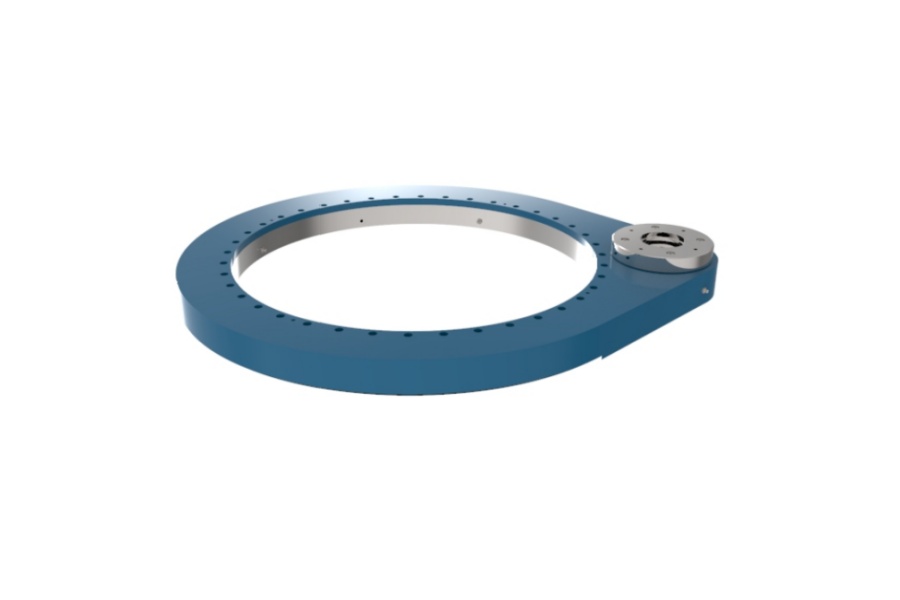
What is a slew drive? It is a compact unit that combines a slewing bearing, a gear (usually worm or spur), a housing and a motor interface. It rotates a load, such as a crane boom, a solar tracker or a turntable, and holds it in position.
A sample that passes your test bench tells you little if the next batch drifts. When you choose a slew drive manufacturer, the real risk is inconsistent backlash, torque, sealing or bolt-pattern quality between lots. This article shows what to inspect on the factory floor and in the records, so you can judge whether a validated drive can be reproduced.
Why a Good Sample Does Not Prove Batch Consistency
A sample is one unit, often built with extra attention. It shows the design works. It does not show that the process behind it is stable.
In my three decades of mechanical design on cranes, port equipment and automation lines, I have seen the same pattern. The prototype passes, the first batch passes, and the fifth batch shows loose backlash or a seal that weeps. The cause is almost always a drifting process, not a bad drawing.
So the question changes. Instead of "Does the sample work?" ask "What keeps the 50th unit the same as the first?" The answer lives in machining control, gear meshing checks, sealing checks, load testing and the records that tie each unit to its results.
Audit the Production Checkpoints That Prevent Inconsistent Backlash, Torque, Sealing, and Bolt-Pattern Quality
Use the table below during a factory visit or a remote video audit. Each row names a checkpoint, what to ask to see, and the defect it guards against. Ask to see the actual record, not a description of it.
| Checkpoint | What to ask to see | Defect it prevents | Limit of this check |
|---|---|---|---|
| Machining of housing, raceway and mounting faces | CNC machine in operation, a fixture or datum plan, first-piece and in-process dimension records | Bolt-pattern mismatch, uneven mounting face, rough rotation | Shows geometry only. It does not prove gear contact quality. |
| CMM three-coordinate inspection | A CMM report for a recent lot, with bolt-hole position, flatness and bore data | Bolt holes that do not match your frame, pilot fit problems | Ask which features were measured and whether it was every unit or a sample. |
| Gear meshing and backlash measurement | The method, the fixture, the number of measuring positions, and recorded values per unit | Loose or tight spots in one revolution, positioning error in tracking use | One measuring point can hide a local tight spot. |
| Rotation torque check | Recorded running torque per unit, and the acceptance range | Binding, uneven grease fill, wrong preload | Compare units against each other, not just against a limit. |
| Sealing check | Seal installation step, seal part numbers, and the test or inspection used for the protection level you need | Water or dust ingress, grease leakage | A seal inspection does not replace a full ingress test for IP66 duty. |
| Dynamic load test | Test rig, load and speed settings, pass criteria, and the stored result | Early wear, noise, overheating under cyclic load | Rig loads may differ from your duty cycle. Share yours. |
| Final inspection and traceability | A completed record linked to a serial number, plus the rule for nonconforming units | Untraceable defects, mixed-up lots | Records only help if they are kept and shared on request. |
Luoyang Slewring Bearing Co., Ltd. states that every slew bearing passes CMM three-coordinate inspection and dynamic load testing, and that its failure rate is below the 0.5% industry standard. Those are claims you can test. Ask for the report format and a sample record during your audit. Our Slew Drive Quality Control page outlines the framework.
How to read the backlash record
Look for a value per unit, not a single "pass" stamp. Check whether the values cluster tightly across a lot. A wide spread means the process is not stable, even if every unit sits inside the limit.
This matters most where positioning is tight. One South Korean port equipment manufacturer reordered 20 units of WEA9-62-25HR single worm drives for port cranes, with tracking precision of 0.15° or better, IP65 sealing and self-locking. A British Columbia forestry equipment maker bought 30 units of WED14-86-25BHR.5 double worm drives for grapple machines at 0.13° or better. Precision targets like these only hold when the backlash record stays tight from unit to unit.
Request Your Custom Slew Drive or Bearing Spec
Tell us your load, speed, and environment — receive a tailored 100–5000 mm slewing drive or slewing bearing proposal with 3D drawings within 24 hours.
Evidence a Buyer Can Verify at Luoyang Slewring Bearing
Capability claims need a document or a visible process behind them. These are the facts we can support, and what each one answers.
| Buyer concern | Supplied fact | How to verify |
|---|---|---|
| Is there a managed quality system? | ISO 9001:2015 certified; CE marking for the European market | Request the certificate copy and check scope and validity dates |
| Can the plant machine and measure its own parts? | 8,000 m² facility, 6 production lines, CNC machining centers, CMM inspection | Factory audit reports are available on request; walk the lines during a visit |
| Can volume be sustained? | Annual capacity of 100,000 sets; established 2012 | Ask for current load on the line that would build your model |
| Is the design experienced? | 15+ years of slew bearing and slew drive R&D, validated across 2,000+ heavy-equipment projects | Ask for application references close to your duty |
| Is there field history in similar duty? | Cases in port cranes, marine cranes, solar trackers, mining excavators, wheel steering | Ask which model and what environment, then compare to yours |
Some of our cases give a useful read on batch work. A Houston, Texas machinery manufacturer ordered 150 units of WED17-104-25HR double worm drives for heavy-duty wheel steering. A US renewable energy maker ordered 50 units of SP-I 0841 for utility-scale solar trackers, with IP65 sealing for desert sites. These are single-customer results, not a promise for every order, but they show the scale of runs we handle.
Match the Drive Type to the Checks You Request
Different drive types put the risk in different places. Tell your supplier which one you are buying so the audit looks at the right features.
- Worm Gear Slew Drive: self-locking is common. Focus on worm-to-wheel contact, backlash and running torque. Fits cranes and tracking platforms. Not ideal where very high speed is needed.
- Double Worm Slew Drive: two worms share the load or reduce backlash. Ask how the two worms are aligned and how that is recorded. Fits heavy-duty steering and grapple work.
- Spur Gear Slew Drive: used in solar trackers and turntables, such as the SP-I 0229 and SP-I 0841 cases. Focus on gear tooth accuracy and sealing for outdoor duty. Check whether self-locking is handled elsewhere in the system.
For a general overview of the range, see our slew drive page. If your frame or motor interface is unusual, a Customized Slew Drive may fit better than a standard model.
Common Mistakes During Factory Assessment
- Accepting a certificate as proof of process. ISO 9001:2015 shows a quality system exists. It does not show your backlash limit is held. Ask for product records too.
- Checking only the sample. Ask to see records from a recent production lot of the same model.
- Skipping the bolt-pattern check. Many field complaints are mounting problems. Compare the CMM report to your own drawing.
- Not defining the sealing test. "IP66" on a data sheet is not a test. Agree how it will be verified for your site.
- Sharing no duty cycle. A supplier cannot set load test conditions without your speed, load and swing angle.
- Leaving acceptance criteria vague. Write the backlash and torque limits into the order.
A Step-by-Step Sequence From Sample Approval to Batch Release
This is a suggested sequence you can agree on in writing. It is not a claim that every order follows one fixed workflow. Adjust it to your risk level.
- Send the drawing, load data, duty cycle, environment and target protection level.
- Receive the technical proposal. We can provide one within 24 hours.
- Agree the critical features: backlash, running torque, bolt pattern, seal type and finish.
- Build and test a sample. Rapid prototyping can take as little as 3 days, depending on the design.
- Review the sample's measured records, not just its performance on your bench.
- Approve the sample and freeze the drawing, materials and test method.
- Run the batch. Our standard production cycle is 9 days, and a custom design may differ.
- Compare the batch records with the sample records before shipment.
Step 8 is where most buyers save themselves trouble. If the batch values drift from the approved sample, you catch it before the drives reach your assembly line.
Cooperation Terms and What Still Needs Agreement
These are the supplied terms. Standard products have an MOQ of 1 set, so you can order a unit for testing. Customized products have an MOQ of 5 sets. Sample orders are welcome for evaluation.
After delivery, we offer a 2-year extended quality warranty, a 48-hour technical response and free replacement for confirmed manufacturing defects. Materials are selected by working condition, from ductile cast iron to alloy, forged alloy and stainless steel. Slew drives can reach IP66 protection and C4H anti-corrosion rating, depending on the model.
Several points are not fixed by these terms and need your agreement. They include the exact acceptance limits, which records ship with each batch, who pays for retesting, and how a "confirmed" defect is judged. Put them in the purchase agreement. Do not assume them.
What to Send With Your RFQ
A short, complete request lets an engineer check fit quickly. If you are looking for a slew drive supplier, include the items below when you ask for a quote from Luoyang Slewring Bearing Co., Ltd.
- Application and machine type, such as port crane, solar tracker or wheel steering
- Axial, radial and tilting moment loads, plus swing speed and duty cycle
- Required backlash or tracking precision and whether self-locking is needed
- Protection and corrosion targets, such as IP65 or IP66 and C4H
- Mounting drawing with bolt pattern and motor interface
- Order quantity, sample needs and the inspection records you expect
With that information we can say whether a standard model fits or a custom design is needed. We will also tell you plainly where a requirement falls outside what we can support. Send the details to us for the latest quote, and bring your audit questions along.
Request Your Custom Slew Drive or Bearing Spec
Tell us your load, speed, and environment — receive a tailored 100–5000 mm slewing drive or slewing bearing proposal with 3D drawings within 24 hours.
 WhatsApp

 +8613903880726