



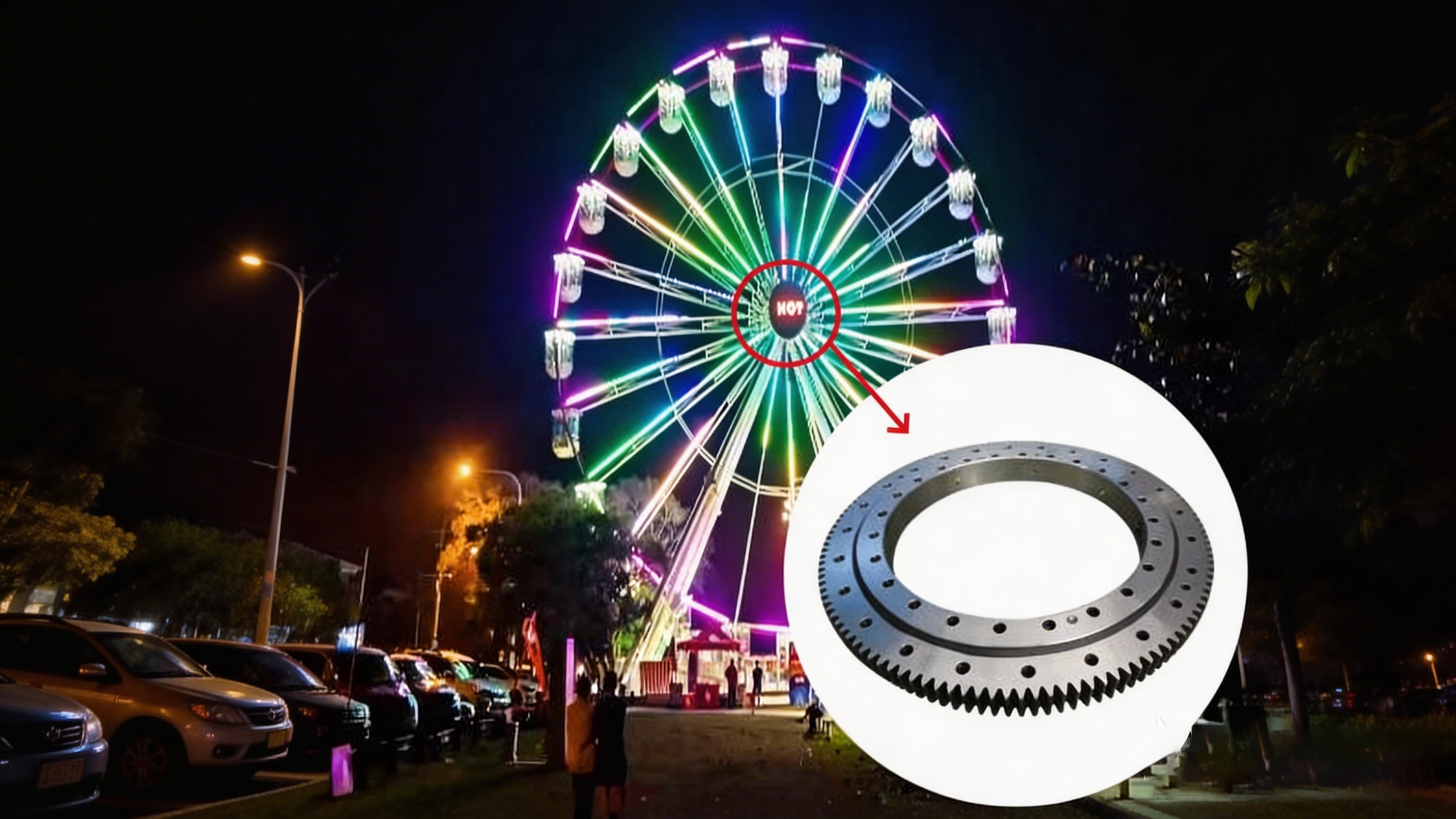
The Heart of the Sky: Slewing Bearing Technology for Ferris Wheels
The Ferris wheel is more than just an amusement ride; it is an iconic landmark that brings joy and wonder to cities around the world. As it gracefully rotates against the skyline, few people realize that this smooth, majestic movement depends on a critical component hidden at its very heart: the large slewing bearing.
What Are Slewing Bearings?
A slewing bearing is a large-sized, heavy-duty rotational component designed to handle immense loads. Unlike standard small bearings, a slewing bearing can simultaneously manage axial loads (thrust, like the weight of the structure), radial loads (side forces, like wind), and a high tilting moment (the overturning force). It essentially acts as a robust, precision pivot point.
Typically, a slewing bearing consists of an inner ring and an outer ring, one of which usually integrates gear teeth to act as a driven gear. It contains rolling elements (balls or rollers) within the raceways, along with cages, sealings, and lubrication fittings. They are the standard solution for any application requiring slow, heavy, and precise rotation, such as cranes, excavators, wind turbines, and of course, Ferris wheels.
The Critical Role of Slewing Bearings in Ferris Wheels
In a Ferris wheel, the slewing bearing serves as the crucial connection between the rotating wheel structure and its stationary support legs. It is, without exaggeration, the mechanical heart of the entire system.
During operation, the bearing must withstand:
The enormous dead weight of the steel structure and cabins (axial load).
Dynamic forces from passengers and wind (radial and tilting loads).
The precise torque required to start, rotate, and stop the wheel smoothly.
The bearing's performance directly dictates the ride's comfort, the system's energy efficiency, and most importantly, the long-term safety of the attraction. A high-quality slewing bearing ensures decades of reliable, trouble-free service.
Key Design Features: What Makes Ferris Wheel Bearings Unique?
While based on standard slewing bearing principles, bearings for Ferris wheels have unique design features that distinguish them from those used in general industrial machinery:
Extreme Scale & Load Capacity: They are true giants, with outer diameters often ranging from 1 meter to over 5 meters, designed to carry loads of several hundred tons.
Ultra-Low Speed Operation: Ferris wheels rotate at less than 1 revolution per minute (RPM). The bearing must ensure vibration-free and stick-slip free motion even at these extremely slow speeds for passenger comfort.
Exceptional Durability & Long Life: These bearings are engineered for the long haul, with a design life often exceeding 20 to 30 years, and are expected to operate for over a decade without major maintenance.
Advanced Sealing Systems: To survive decades outdoors, they feature multi-stage labyrinth seals and heavy-duty dust and water shields. This prevents rain, humidity, and contaminants from entering the raceways and washing away lubricant.
Corrosion Resistance: Materials are carefully selected. High-strength alloy steels with protective coatings (like nitriding or specialized anti-corrosion paints) are standard to withstand rain, sea breeze, and temperature extremes.
Integrated Gear Teeth: The inner or outer ring is precision-machined with gear teeth, designed to mesh perfectly with the slew drive pinion, forming a complete and efficient rotation system.
How Do Slewing Bearings Enable Smooth Rotation?
The magic of smooth rotation lies in the precise interaction of several components. A hydraulic or electric motor provides the power, which is transferred through a speed reducer to a small pinion gear. This pinion engages with the large gear teeth cut directly into the slewing bearing's ring.
As the slew drive motor turns the pinion, the force is transmitted to the bearing's gear. Because the bearing is securely bolted between the stationary base and the rotating structure, the pinion's movement forces the bearing's inner (or outer) ring—and thus the entire Ferris wheel—to rotate.
The rolling elements (balls or rollers) inside the bearing's raceways carry the immense loads with minimal friction, ensuring that the powerful, slow rotation from the slew drive is translated into the smooth, graceful arc passengers experience.
Core Advantages for Ferris Wheel Applications
Using a dedicated, high-quality slewing bearing in a Ferris wheel offers several non-negotiable advantages:
Unmatched Safety: The primary advantage is the ability to safely and reliably support extreme, multi-directional loads for decades.
Compact Integration: The bearing combines load carrying, rotational support, and often the drive gear into a single, pre-engineered unit, simplifying the overall structural design.
Smooth & Quiet Operation: Precision manufacturing of raceways and gears ensures low noise and vibration-free rotation, enhancing the ride experience.
Low Maintenance Requirements: Designed with centralized lubrication systems and superior seals, they minimize the need for frequent, costly on-site maintenance.
Design Flexibility: Slewing bearings can be customized to fit specific wheel diameters, load requirements, and integration with various slew drive systems.
Maintenance Best Practices for Longevity
To ensure a Ferris wheel slewing bearing reaches its full design life, a proactive maintenance routine is essential:
Regular Lubrication: This is the most critical task. An automatic centralized grease system should be checked and refilled regularly to ensure fresh lubricant constantly flushes and protects the raceways and gear teeth.
Visual Inspections: Periodically inspect the seals for damage and check for any signs of grease leakage or contamination around the bearing.
Bolt Torque Checks: The mounting bolts are under tremendous stress. Their torque should be checked according to the manufacturer's schedule to ensure they haven't loosened.
Monitor Operation: Be alert to any changes in operation, such as new noises (grinding, clicking), increased vibration, or changes in the drive motor's power consumption, as these can be early signs of a bearing issue.
Periodic Professional Inspection: Every few years, a thorough inspection by a specialist, which may include non-destructive testing (NDT) of the bearing rings and gear teeth, is highly recommended.
Engineering Challenges & Solutions
Designing and manufacturing bearings for Ferris wheels presents unique engineering hurdles:
Challenge: High-Precision Machining at a Massive Scale. Maintaining extremely tight tolerances on raceways and gear teeth across a 5+ meter diameter is exceptionally difficult.
Solution: Utilizing large, specialized CNC machining centers and rigorous quality control, including gear measurement and 3D coordinate inspection, ensures final precision.
Challenge: Extreme Environmental Resilience. The bearing must withstand rain, UV radiation, sea salt, and temperature swings for decades.
Solution: Employing advanced material science—using high-alloy steels, protective nitriding, and specialized multi-layer coating systems—combined with robust, multi-stage seal designs.
Challenge: Complex Transport and Installation. Moving and mounting a bearing that is several meters wide is a logistical challenge.
Solution: Careful engineering of lifting points and clear, detailed installation instructions are provided. Sometimes, bearings are shipped in segments for final on-site assembly.
Custom Solutions: Get Your Free 3D Drawing at LyraDrive
At LyraDrive, we understand that every Ferris wheel project is unique. As a leading Chinese manufacturer with over 15 years of specialized experience in producing high-quality slew drives and slewing bearings, we are your ideal partner for bringing your vision to life.
We offer a comprehensive range of slewing bearing series to meet any design requirement:
Light-Type Series
Flange-Type Series
What truly sets us apart is our commitment to customized solutions. We don't just sell standard products; we engineer precision components for your specific application.
If you have sample data or a reference drawing for your project, our expert engineering team can utilize advanced 3D technology to analyze your requirements, model the perfect slewing bearing or complete slew drive system, and validate the design before any metal is cut.
We will work closely with you to deliver a finished product that integrates seamlessly, performs reliably, and meets your exact specifications. From concept to creation, LyraDrive is here to provide the expert support and high-quality manufacturing your project deserves.
Contact us today to discuss your Ferris wheel project and request your free, no-obligation 3D drawing and consultation.
Frequently Asked Questions (FAQs)
Q1: What is the typical lifespan of a Ferris wheel slewing bearing?
A: High-quality slewing bearings for Ferris wheels are designed for very long life, typically 20 to 30 years or more, assuming proper maintenance is performed.
Q2: Can a slewing bearing be repaired if damaged?
A: Minor damage to seals or gear teeth can sometimes be addressed in situ. However, damage to the raceways usually requires major disassembly and is often not economically feasible, making prevention through maintenance critical.
Q3: How often should the bearing be lubricated?
A: Most modern Ferris wheels use an automatic centralized lubrication system that may grease the bearing daily or weekly. The specific interval depends on the grease type, operating conditions, and manufacturer recommendations.
Q4: What is the difference between a slew drive and a slewing bearing?
A: A slewing bearing is the large bearing that carries the load and rotates. A slew drive is a complete drive unit that typically includes a worm gear or planetary gearbox, a motor, and a housing, with its output pinion engaging the slewing bearing's gear to turn it. They work together as a system.
Q5: How do I choose between a ball bearing and a roller bearing for my Ferris wheel?
A: This depends on the specific load requirements. Three-row roller bearings offer the highest load capacity and rigidity for the largest wheels. Single or double-row ball bearings are often suitable for smaller to medium-sized wheels. LyraDrive's engineers can help you select the optimal type based on your load calculations.
 WhatsApp
 sales@lyradrive.com
 +8613903880726