



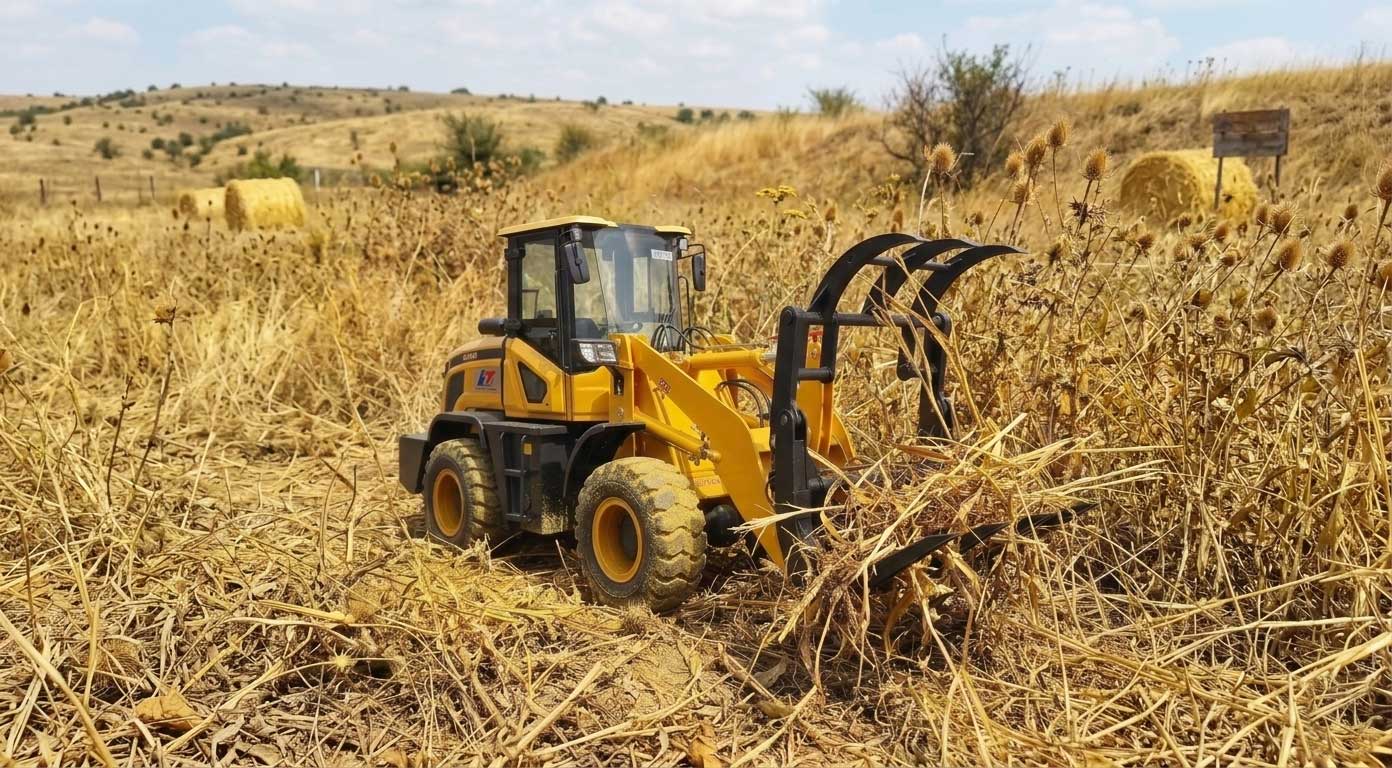
Spur Gear Slew Drive for Grass Grab
What Is a Spur Gear Slew Drive for Grass Grab?
A spur gear slew drive is a compact rotary actuation device that combines a spur gear train with an integrated slewing bearing. Unlike traditional worm gear slew drives, which use a worm and wheel configuration, spur gear slew drives rely on direct gear meshing between a pinion and a large-diameter ring gear.
For grass grab applications — typically mounted on excavators, tractors, or material handlers — the spur gear slew drive sits between the boom and the grab itself, enabling 360° rotation of the grabbing mechanism. This rotation allows operators to precisely position the grass grab for picking up hay bales, loading silage, or handling green waste without repositioning the entire machine.
The fundamental difference between a spur gear slew drive and a standard slewing bearing lies in the integration of the driving pinion. A slewing bearing alone provides passive rotation; a spur gear slew drive actively transmits torque from a hydraulic motor to the rotating outer ring, making it a complete actuation solution.
Key Features of the Spur Gear Slew Drive in Grass Grab Equipment
Spur gear slew drives offer several features that make them exceptionally well-suited for grass grab operations:
High Output Torque Density – Despite their compact form factor, spur gear slew drives deliver substantial torque, allowing grass grabs to handle heavy, wet grass bales weighing several hundred kilograms.
Low Backlash – Precision-ground spur gears minimize play between teeth, ensuring accurate positioning of the grab. This is critical when picking up individual bales from a stack.
Smooth Rotation – Spur gear meshing provides continuous, vibration-free motion, reducing shock loads on both the hydraulic motor and the grab structure.
High Efficiency – With mechanical efficiency typically exceeding 85%, spur gear drives waste less energy as heat compared to worm gear alternatives.
Bi-directional Capability – Unlike self-locking worm drives, spur gear designs rotate freely in both directions, matching the frequent reversing motion of grass grab cycles.
These features translate directly into faster cycle times, lower fuel consumption, and reduced operator fatigue.
How Does a Spur Gear Slew Drive Work for Grass Grab?
The working principle of a spur gear slew drive is straightforward yet robust. A hydraulic or electric motor connects to the input shaft of the slew drive. This shaft drives a small spur pinion gear, which meshes directly with the internal spur teeth of the outer ring — effectively a large-diameter gear integrated into the slewing bearing structure.
As the pinion rotates, it drives the outer ring around the fixed inner ring. The grass grab mounting flange attaches to this rotating outer ring. When the hydraulic motor turns, the outer ring rotates, and the grass grab spins accordingly.
The integrated slewing bearing within the spur gear slew drive simultaneously handles three types of loads:
Axial loads (vertical weight of the grab plus the grasped material)
Radial loads (side forces from off-center picking)
Tilting moment loads (when the grab holds a heavy bale at an extended radius)
By combining gear reduction and load bearing into a single, compact unit, the spur gear slew drive eliminates the need for separate gearboxes, bearings, and mounting adapters — simplifying both initial design and field maintenance.
Spur Gear Slew Drive vs. Worm Gear Slew Drive for Grass Grab
The choice between spur gear and worm gear slew drives significantly impacts grass grab performance. The table below summarizes key differences:
| Feature | Spur Gear Slew Drive | Worm Gear Slew Drive |
|---|---|---|
| Efficiency | High (≥85%) | Low (≤70%) |
| Back-driving Capability | Easy | Difficult / Not possible |
| Shock Load Resistance | Excellent | Poor (wear accelerates) |
| Self-locking | No (brake required) | Yes (inherent) |
| Suitability for Reversing Motion | Ideal | Not ideal |
| Hydraulic Control Complexity | Simple (direct valve control) | Complex (requires crossover relief) |
| Heat Generation | Low | High |
| Typical Service Life in Grass Grab | 5–8 years | 2–3 years |
For grass grab applications, the absence of self-locking in a spur gear slew drive is not a disadvantage — it is an advantage. Grass grabs constantly reverse direction: open, rotate, close, lift, rotate back, release. A worm gear slew drive resists being back-driven, meaning the hydraulic system must forcefully override the self-locking effect, generating heat and wasting energy. A spur gear drive rotates freely in either direction, responding instantly to hydraulic flow changes.
Main Advantages of Using a Spur Gear Slew Drive for Grass Grab
Deploying a spur gear slew drive in a grass grab delivers measurable operational benefits:
Energy Saving – Higher mechanical efficiency means less hydraulic power is wasted as heat. Operators typically report 15–20% lower fuel consumption compared to worm gear-equipped grabs.
Faster Response – Without the friction and self-locking resistance of worm gears, spur gear drives react immediately to control inputs. Cycle times for picking, rotating, and stacking can improve by 30%.
Lower Maintenance – Spur gears experience less sliding friction and generate less wear debris. Lubrication intervals extend to 500–1000 operating hours, whereas worm drives often require quarterly attention.
Higher Reliability in Dusty/Wet Environments – Grass grab operations occur in fields, barns, and waste yards — environments full of dust, mud, and organic debris. The open gear mesh of a spur drive is less prone to contamination trapping than the tight sliding contact of worm gears.
Simplified Hydraulic Control – A standard directional valve suffices for spur gear drive control. Worm drives often need cross-port relief valves or counterbalance valves to manage back-driving, adding cost and failure points.
How to Select the Right Spur Gear Slew Drive for Your Grass Grab?
Selecting the correct spur gear slew drive requires careful evaluation of several parameters:
Static Load Rating (C0) – Must exceed the maximum vertical load when the grass grab holds a fully loaded bale at maximum reach. Include a safety factor of at least 1.5.
Dynamic Load Rating (C) – Determines bearing life under continuous rotation. For grass grabs operating at 3–5 rotations per minute, calculate L10 life to ensure at least 5000 operating hours.
Gear Ratio – Typical grass grab applications use ratios between 4:1 and 10:1. Lower ratios yield faster rotation speed (but require more hydraulic flow); higher ratios increase torque (but slow cycle times).
Mounting Interface – Bolt patterns must match your grass grab’s existing flange or your custom design. Spur gear slew drives are available with standard or OEM-specific patterns.
Sealing Class (IP Rating) – For outdoor grass grab use, IP65 minimum is recommended to exclude dust and water jets. IP66 offers protection against high-pressure washing.
Operating Temperature – Consider both ambient temperature (winter freezing, summer heat) and self-generated heat. Spur gear drives typically operate from -20°C to +80°C with standard grease.
Input Shaft Type – Match your hydraulic motor’s output shaft (spline, keyed, or parallel). Misalignment here causes premature seal failure.
Always request static and dynamic torque curves from the supplier. Verify that the selected spur gear slew drive can deliver rated torque at your hydraulic system’s available flow and pressure.
Common Applications & Performance Validation of Spur Gear Slew Drive for Grass Grab
Spur gear slew drives are field-proven across multiple grass grab configurations:
Tractor-Mounted Front Loader Grabs – A 3-ton compact tractor equipped with a 400 mm spur gear slew drive achieved 50,000 rotation cycles over 18 months of hay bale handling with no measurable backlash increase.
Stationary Material Handlers – Fixed-position grass grab units at composting facilities use spur gear drives with IP66 sealing. After 10,000 operating hours in humid, corrosive conditions, seal integrity remained intact with only annual grease replacement.
Excavator-Mounted Rotating Grabs – A 5-ton excavator fitted with a 600 mm spur gear slew drive demonstrated 85% efficiency during dynamometer testing, compared to 63% for an equivalent worm gear unit — directly translating to 22% lower hydraulic oil temperature.
Independent lab tests confirm that spur gear slew drives maintain backlash below 0.2 mm for over 100,000 reversing cycles, whereas worm gear drives often exceed 0.5 mm after just 20,000 cycles under identical grass grab load profiles.
Installation & Maintenance Tips for Spur Gear Slew Drive in Grass Grab Systems
Proper installation and maintenance maximize service life:
Mounting Alignment – Ensure the mounting flange is flat within 0.1 mm per meter. Use a dial indicator to check runout after bolting. Misalignment introduces edge loading that rapidly destroys the slewing bearing raceways.
Lubrication Intervals – For standard NLGI #2 lithium grease, relubricate every 500 operating hours or six months, whichever comes first. For severe dusty conditions, reduce to 250 hours. Use the supplied grease fittings until fresh grease emerges from all seals.
Backlash Inspection – Annually, measure backlash by locking the output ring and applying torque in both directions. If backlash exceeds 0.3 mm, gear wear has progressed. Contact the supplier for inspection.
Sealing Replacement – Inspect lip seals every 2000 hours for cracking or hardening. Replace immediately if contamination enters the bearing cavity. Seal failure is the leading cause of premature slewing bearing failure in grass grab applications.
Bolt Torque Verification – Retorque mounting bolts after the first 50 hours of operation. Loose bolts induce vibration that damages both the spur gear teeth and the slewing bearing race.
LyraDrive: Custom Spur Gear Slew Drive Supplier for Your Grass Grab
LyraDrive is a professional slew drive supplier dedicated to designing and delivering high-quality, competitively priced rotary actuation solutions. We specialize in both slew drive and slewing bearing technologies, offering full-scope customized solutions to match your unique grass grab requirements.
Our customized slew drive capabilities cover all core parameters: dimensions, output torque, gear ratio, mounting flange, housing structure, sealing grade, protection level, and motor integration. Whether you need a spur gear slew drive for heavy-load agricultural grabs, dust-proof construction site handlers, or corrosion-resistant marine waste collectors, we tailor every detail for stable, reliable performance.
We support precision grades reaching P5, P4, and even P2 for applications demanding minimal backlash. Our customized slew drive size range extends from 100 mm to 5000 mm, accommodating grass grabs from mini loaders to large excavator attachments.
To request a custom design for your grass grab, simply submit your specifications via email. We will provide a complete proposal including 3D CAD files, torque calculations, and sealed drawings — all at competitive pricing with rapid lead times.
FAQ about Spur Gear Slew Drive for Grass Grab
Q1: Why can't I use a worm gear slew drive for my grass grab?
Worm gear drives have low efficiency (≤70%) and resist back-driving, which hinders the fast reversing motion required for grass grab operations. Spur gear slew drives offer higher efficiency (≥85%) and smooth bi-directional rotation, directly reducing cycle times and fuel consumption.
Q2: Does a spur gear slew drive require a brake for holding position?
Yes, because spur gear drives are not self-locking. An external mechanical brake or hydraulic holding valve is recommended to maintain position when the grass grab is stationary under a loaded bale. LyraDrive can integrate brake interfaces upon request.
Q3: What is the typical maintenance interval for a spur gear slew drive on a grass grab?
Under normal grass grab conditions (500–1000 operating hours per year), lubrication should be checked every 500 hours. Full grease replacement is recommended annually. Seals and bolts should be inspected every 2000 hours or two years.
Q4: Can LyraDrive supply a custom spur gear slew drive for my specific grass grab model?
Absolutely. LyraDrive specializes in custom solutions including non-standard bolt patterns, gear ratios, output torques, IP66-rated sealing, and precision grades up to P2. Submit your grass grab specifications via email, and we will deliver a tailored design with 3D files and torque validation.
 WhatsApp
 sales@lyradrive.com
 +8613903880726