



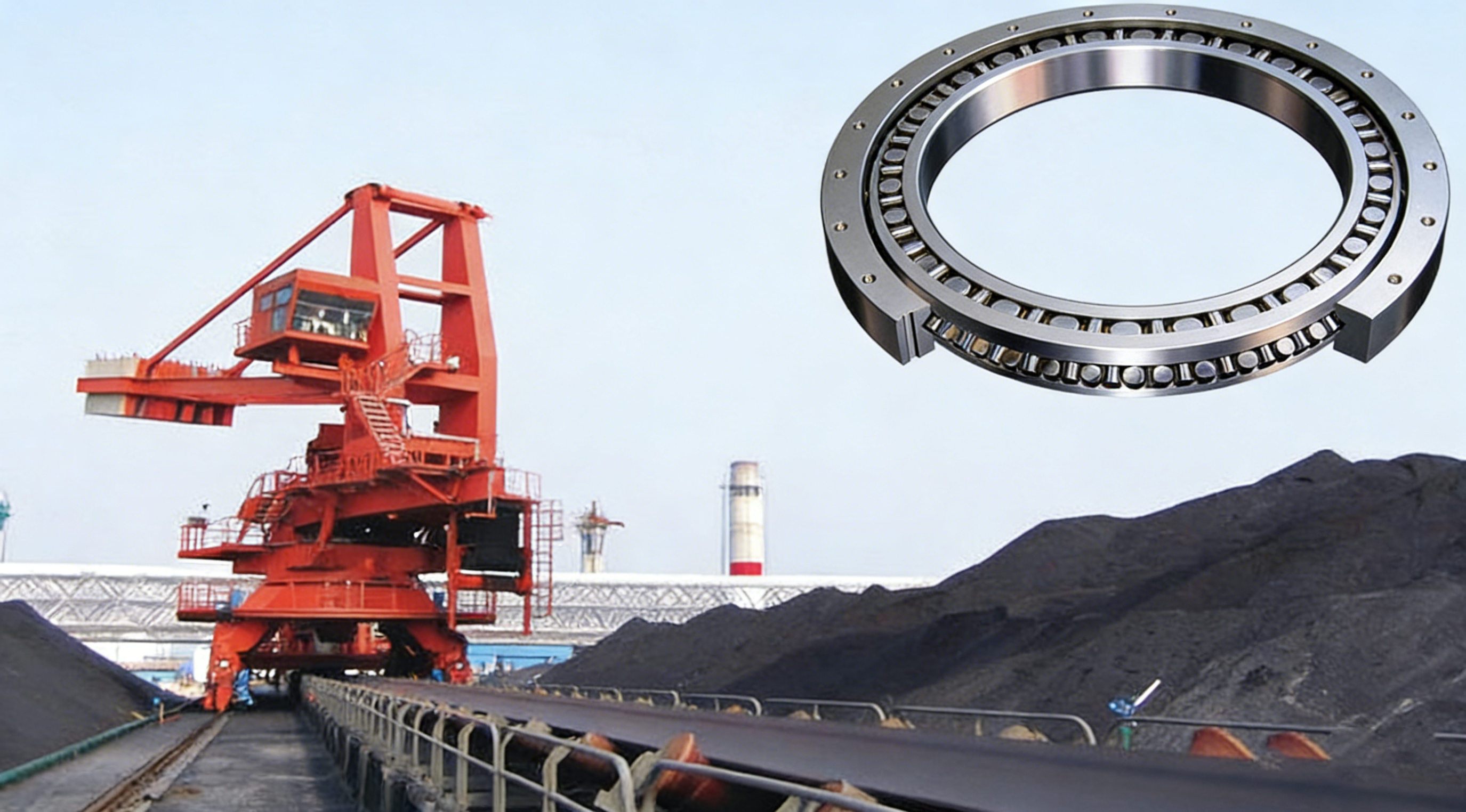
Slewing Bearings: The Core of Every Stacker & Reclaimer
In the vast landscapes of ports, mines, and stockyards, immense machines tower over mountains of coal, iron ore, and grain. Stackers and reclaimers are the workhorses of bulk material handling, tirelessly building and recovering stockpiles to keep global industries supplied. These machines perform a complex dance of movement, traversing rails, luffing their booms, and most critically, rotating their superstructures to reach every corner of the stockyard. At the heart of this rotational capability lies a component so fundamental yet so often overlooked: the slewing bearing. Understanding the design, function, and selection of these critical components is essential for maximizing equipment uptime, ensuring operational safety, and optimizing the efficiency of any bulk material handling operation.
What is a Slewing Bearing for Stackers and Reclaimers?
A slewing bearing, also commonly referred to as a slewing ring, is a large-scale rotational element that serves as the pivotal connection between the upper revolving structure of a stacker or reclaimer and its underlying chassis or pedestal. Unlike conventional bearings found in motors or conveyors, these components are engineered on a massive scale, often exceeding several meters in diameter.
The basic architecture consists of several key elements working in unison. Two concentric rings, one inner and one outer, create the primary structure. Between these rings, an array of rolling elements, either balls or rollers, is arranged within a cage or spacer that maintains proper separation and alignment. What distinguishes slewing bearings for heavy equipment is the integration of gear teeth directly cut into either the inner or outer ring, transforming the bearing itself into a massive gear that engages with a pinion driven by hydraulic or electric motors.
These bearings are fundamentally different from standard industrial bearings in their capacity to handle complex, multi-directional loads while operating at slow, often oscillating rotational speeds. They must accommodate not just rotation, but the immense forces generated by machines reaching out hundreds of meters with booms laden with heavy conveyor systems and digging equipment.
How Does a Slewing Bearing Work in a Stacker-Reclaimer?
The operational environment of a stacker or reclaimer subjects the slewing bearing to a complex combination of forces that must be understood to appreciate its engineering sophistication. Three distinct types of loads act upon the bearing simultaneously during operation.
The axial load represents the vertical force transmitted through the bearing. This includes the considerable dead weight of the machine's entire rotating superstructure, the cab, the boom, the counterweights, and all associated mechanical and electrical systems. This constant downward force must be distributed evenly across the bearing's raceways to prevent localized overloading.
Radial loads act horizontally, pushing against the bearing from the sides. These forces originate from several sources: the reaction force generated as the bucket wheel digs into a material pile, wind loads pressing against the large surface area of the boom, and the lateral forces created as the machine traverses curved tracks or navigates uneven terrain.
The most demanding and technically challenging load is the tilting moment, also known as the moment load. This overturning force is created by the lever action of the long boom extending outward from the center of rotation. As the boom reaches out to access stockpiles, it acts as a giant lever, attempting to tip the entire superstructure forward. The slewing bearing must resist this constant overturning force through its wide diameter and the separation of its rolling elements.
Rotation is achieved through the interaction of the drive pinion with the bearing's integral gear teeth. As the hydraulic or electric motor turns the pinion, the gear teeth engage and drive the rotation of the entire upper structure with precise control, allowing the operator to position the boom exactly where needed.
Features of High-Quality Slewing Bearings for Heavy Industry
The demanding service conditions of stackers and reclaimers require slewing bearings with specific engineering features that distinguish high-quality components from standard alternatives.
Material selection forms the foundation of bearing performance. Premium bearings utilize forged or rolled rings manufactured from high-strength alloy steels such as 42CrMo4, which provide the necessary combination of toughness, hardness, and fatigue resistance. The metallurgical quality directly influences the bearing's ability to withstand repeated stress cycles over decades of service.
The gear teeth, whether cut into the inner or outer ring, require specialized treatment to survive the high torque loads encountered during digging and reclaiming operations. Precision gear cutting ensures smooth engagement with the drive pinion, while induction hardening of the tooth flanks creates a wear-resistant surface that maintains a durable core toughness to resist tooth breakage under shock loads.
Environmental sealing represents a critical feature often underestimated in its importance. Stackers and reclaimers operate in some of the harshest environments imaginable, with constant exposure to dust, mud, water, and abrasive particles. Labyrinth seals combined with heavy-duty lip seals create multiple barriers that protect the precision-ground raceways and rolling elements from contamination. Effective sealing directly determines bearing life, as contamination remains a primary cause of premature failure.
Proper internal clearance, both axial and radial, must be engineered into the bearing to accommodate the structural deflections that occur as the machine operates and as ambient temperatures fluctuate. Insufficient clearance can lead to binding and excessive stress, while excessive clearance compromises stability and accelerates wear.
Corrosion protection through advanced coating systems, typically involving multiple layers of zinc-rich primers and durable topcoats, shields the exposed surfaces of the bearing from the corrosive effects of marine environments, chemical exposure, and constant moisture.
Key Considerations for Selecting Slewing Bearings for Stackers and Reclaimers
Selecting the optimal slewing bearing for a stacker or reclaimer requires careful evaluation of multiple interrelated factors that will determine the component's long-term performance and reliability. Making the right choice at the design or replacement stage prevents premature failures and minimizes costly downtime.
Load analysis stands as the primary consideration. Engineers must accurately calculate all forces the bearing will encounter during operation, including maximum static loads, dynamic loads during normal operation, and peak loads that may occur during extreme conditions such as storms or equipment malfunctions. The tilting moment often proves to be the limiting factor, and understanding its magnitude under all operating scenarios is essential for proper sizing.
Operating environment dictates material selection and protection requirements. Bearings destined for coastal ports face constant salt spray that accelerates corrosion, while those serving inland mines contend with abrasive dust that attacks seals and raceways. Temperature extremes, humidity levels, and the presence of chemicals all influence the choice of materials, seals, and lubricants necessary for reliable operation.
Duty cycle analysis examines how the machine will be used over its lifetime. A reclaimer that operates continuously through multiple shifts experiences far different fatigue demands than a stacker used intermittently. The frequency of rotation, the typical rotation angles, and the number of starts and stops all affect bearing life and should influence the selection of internal geometry and raceway hardness.
Mounting structure design significantly impacts bearing performance. The supporting structure must be sufficiently rigid to distribute loads evenly around the bearing circumference without excessive deflection. Flexible mounting structures concentrate loads on small portions of the raceway, leading to premature fatigue and failure. The flatness and stiffness of mounting surfaces require careful specification and verification.
Maintenance accessibility influences design choices regarding lubrication systems and seal configurations. Bearings installed in locations with limited access may benefit from centralized lubrication systems that deliver grease through drilled passages, eliminating the need for personnel to reach confined spaces during maintenance intervals.
Cost considerations extend beyond initial purchase price to encompass total lifecycle costs. A bearing with superior materials, better seals, and more robust gear teeth may command a higher price but deliver significantly longer service life and reduced maintenance requirements, ultimately proving more economical over decades of operation.
Advantages of Specialized Slewing Bearings in Stacker-Reclaimer Applications
The integration of specialized slewing bearings into stacker and reclaimer designs offers distinct advantages that justify their selection as the preferred rotational solution for heavy equipment.
Compact integration of multiple functions represents perhaps the most significant advantage. A single slewing bearing simultaneously supports the full weight of the superstructure, resists radial and moment loads, and provides the geared interface for rotational drive. This multifunctional capability simplifies machine design, reduces the number of components requiring maintenance, and creates a more compact and efficient structural arrangement.
High load capacity relative to size results from optimized internal geometries. Advanced designs such as the three-row roller configuration separate the load paths for axial, radial, and moment forces, allowing each raceway to be optimized specifically for the loads it must carry. This separation enables maximum load capacity within minimal dimensional envelopes, a critical consideration when designing machines where every millimeter of height affects stability and clearance requirements.
Precision manufacturing delivers smooth, accurate rotation that reduces stress on the entire machine structure. When the bearing rotates with minimal friction and consistent engagement, the drive system operates more efficiently, structural members experience lower dynamic loads, and the overall machine experiences reduced vibration and wear. This precision translates directly to extended service life for the bearing and every component connected to it.
Maintainability features incorporated into quality bearings enable extended service intervals and simplified maintenance procedures. Centralized lubrication systems deliver grease precisely to each raceway through drilled passages, ensuring all load-carrying surfaces receive adequate lubrication without requiring access to the bearing interior. Inspection ports allow maintenance personnel to monitor internal conditions and assess wear without the need for disassembly.
Customization capabilities allow bearings to be engineered specifically for the unique duty cycle, load profile, and environmental conditions of each application. Rather than forcing a standard bearing into demanding service, manufacturers can optimize internal geometry, material selection, heat treatment, and sealing arrangements to match exactly what the specific stacker or reclaimer requires for reliable long-term performance.
LyraDrive: Get Stackers and Reclaimers Slewing Bearings 3D Drawings for Your Project
When engineering critical equipment like stackers and reclaimers, having precise technical data at the earliest design stage can significantly accelerate development and reduce costly errors. LyraDrive specializes in the design and manufacture of both slew drives and slewing bearings, offering comprehensive engineering support to help customers integrate the perfect rotational solution into their projects.
Understanding that every stacker and reclaimer application presents unique challenges, LyraDrive manufactures a diverse range of slewing bearing types to meet varied operational demands. Our product portfolio includes single row ball slewing rings for lighter duty applications, double row ball slewing rings for enhanced load capacity, and crossed roller slewing bearings for applications requiring maximum rigidity and precision. This extensive selection ensures that whether your machine requires compact design, high moment load resistance, or smooth oscillation, the appropriate bearing configuration is available.
What truly distinguishes LyraDrive is our commitment to engineering collaboration through advanced 3D technology. Rather than providing only catalog specifications, we work directly with customers to analyze their specific load data, operating parameters, and mounting constraints. Based on this analysis, our engineering team develops accurate 3D drawings and digital models that integrate seamlessly into your project's existing CAD environment. This approach eliminates guesswork, verifies fit and function before manufacturing begins, and significantly reduces design cycle time.
By combining manufacturing expertise with digital engineering capabilities, LyraDrive ensures that your stacker or reclaimer project receives not just a component, but a fully integrated rotational solution backed by technical precision and industry experience.
Conclusion
The slewing bearing stands as the central pivot upon which all stacker and reclaimer functionality depends. This single component must simultaneously support immense weights, resist complex multi-directional forces, enable precise positioning, and survive decades of exposure to harsh environments without failure. Understanding the engineering principles behind these bearings, how they manage axial loads, radial forces, and tilting moments, provides the foundation for proper selection, operation, and maintenance.
Returning to the backbone analogy, the slewing bearing provides both the strength to support the massive structure above and the flexibility to enable the smooth, controlled rotation essential for efficient operation. When this critical component performs reliably, the entire machine performs reliably. When it fails, operations grind to a halt.
Investing in quality slewing bearings engineered specifically for the demands of stacker and reclaimer applications represents not an expense but a strategic necessity. The true cost of a bearing extends far beyond its purchase price to encompass the operational reliability, maintenance requirements, and service life it delivers. For the machines that keep global industries supplied with raw materials, the humble slewing bearing truly remains the backbone of bulk handling.
FAQ About Slewing Bearings for Stackers and Reclaimers
What is the typical lifespan of a slewing bearing in stacker and reclaimer applications?
The lifespan varies significantly based on operating conditions, maintenance practices, and duty cycles. With proper installation, regular maintenance, and appropriate lubrication, a high-quality slewing bearing can last 20 to 30 years or more. Factors that reduce lifespan include inadequate lubrication, seal failure allowing contamination ingress, and operation beyond design load limits.
How often should slewing bearings be lubricated?
Lubrication intervals depend on operating intensity and environmental conditions. For continuously operating machines in harsh environments, weekly lubrication may be necessary. For intermittent service in cleaner conditions, monthly intervals may suffice. Most manufacturers recommend automatic centralized lubrication systems that deliver small, frequent grease quantities to maintain optimal raceway coverage without overheating.
What are the warning signs of slewing bearing failure?
Operators should watch for several indicators: unusual noises during rotation such as grinding or rumbling, increased vibration, visible gear tooth wear or damage, increased drive motor current draw indicating higher friction, lubricant contamination with metal particles, and visible corrosion or seal deterioration. Regular oil analysis and vibration monitoring can detect problems before catastrophic failure occurs.
Can slewing bearings be repaired, or must they be replaced?
Minor damage such as surface corrosion or seal deterioration can often be repaired in place. However, significant raceway spalling, gear tooth breakage, or structural cracking typically requires complete replacement. Some manufacturers offer reconditioning services for large-diameter bearings, including raceway grinding and new rolling elements, though this option depends on the extent of damage and remaining ring integrity.
What is the difference between single row ball and crossed roller slewing bearings?
Single row ball bearings use a single raceway of ball elements and are suitable for moderate loads with primarily axial and tilting moment forces. Crossed roller bearings arrange cylindrical rollers perpendicular to each other in a single raceway, providing higher load capacity and rigidity in a compact cross-section. For stacker and reclaimer applications, crossed roller and three-row roller configurations are often preferred due to the high moment loads involved.
How important is mounting surface flatness for slewing bearing performance?
Mounting surface flatness is critical for proper bearing performance. Excessive deviation from flatness causes localized overloading of raceways, leading to premature fatigue and failure. Most manufacturers require mounting surface flatness within 0.1mm per meter and overall flatness appropriate to the bearing diameter. Grinding or machining of mounting surfaces is typically necessary to achieve these tolerances.
What gear cutting options are available for slewing bearings?
Gear teeth can be cut on either the inner or outer ring, depending on machine design requirements. Teeth may be full-depth or shallow-depth profiles, with various pressure angles available. Induction hardening of tooth flanks provides wear resistance while maintaining core toughness. For high-torque applications, through-hardened teeth may be specified, though this requires careful material selection to maintain adequate toughness.
How do environmental conditions affect slewing bearing selection?
Coastal environments require enhanced corrosion protection through advanced coating systems and stainless steel options. Desert environments demand superior sealing against fine abrasive dust. Extreme cold requires special lubricants and material selection to prevent brittleness. Tropical humidity necessitates enhanced corrosion protection and biocide-treated lubricants. Each environment drives specific design choices that directly impact bearing life.
 WhatsApp
 sales@lyradrive.com
 +8613903880726