



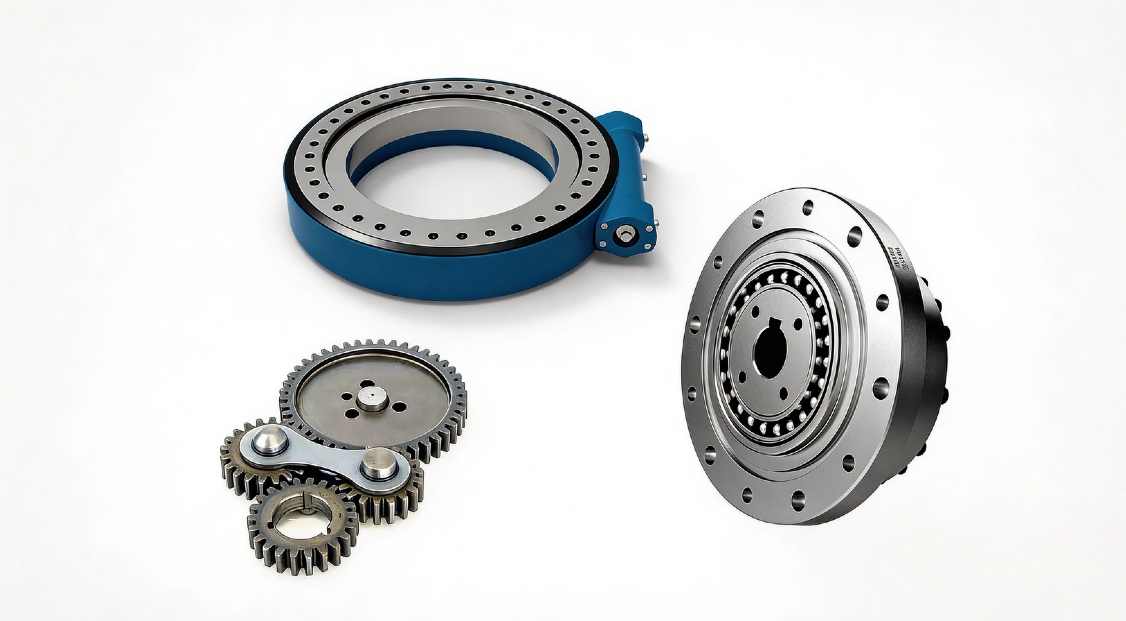
Slew Drives vs. Other Rotary Actuators: When to Choose Which
What Is a Slew Drive?
A slew drive is a compact, ready to install rotational mechanism that combines a slewing bearing, a worm gear (or other gear type), and a housing into a single integrated unit. It is designed to handle heavy axial loads, radial loads, and tilting moments simultaneously while providing controlled rotational movement. Slew drives are essential components in applications ranging from solar tracking systems and construction cranes to industrial automation and marine equipment .
How Does a Slew Drive Work?
A slew drive operates on a simple yet effective principle. The input shaft rotates a worm gear (or pinion), which engages with the gear teeth on the slewing bearing. As the worm rotates, it drives the bearing ring to rotate, converting high speed, low torque input into low speed, high torque output .
The worm gear design provides several functional benefits. The sliding action between the worm and the gear teeth creates smooth, quiet operation. The gear reduction ratio determines the balance between output speed and torque higher ratios produce greater torque at slower rotational speeds. Most worm gear slew drives offer natural self locking capability, meaning the drive cannot be back driven by external forces, which provides inherent safety in lifting and positioning applications .
The integrated slewing bearing within the drive contains raceways and rolling elements that handle the complex combination of axial loads, radial loads, and tilting moments that occur during operation. This integration eliminates the need for separate bearing supports and simplifies overall system design .
What Are the Other Types of Rotary Actuators?
Rotary actuators encompass a broad family of devices that produce rotational motion from various power sources. Understanding these alternatives helps in making informed selection decisions.
Hydraulic Motor with Slewing Bearing systems combine a separate hydraulic motor and gearbox with an independent slewing bearing. The motor generates torque through hydraulic fluid pressure, which is transmitted through a pinion gear to the bearing ring. These systems offer extremely high power density and smooth operation but require separate hydraulic power units, valves, and complex piping .
Harmonic drives are precision actuators that use a flexible spline deformed by an elliptical wave generator to achieve motion. They provide zero backlash, exceptional accuracy measured in arc seconds, and compact design. However, they have limited load capacity compared to slew drives and are best suited for lighter duty applications .
RV reducers combine planetary gears with a cycloidal stage to deliver high rigidity, excellent impact resistance, and long service life under cyclic loading. They offer better durability than harmonic drives for industrial robot joints but come with higher complexity and cost .
Traditional gear drives use separate pinion and gear ring arrangements without integrated bearings. The pinion, driven by a motor, engages directly with a large gear ring mounted to the rotating structure. These systems are simple and cost effective for basic applications but require careful alignment and external bearing support .
Servo rotary actuators integrate brushless motors with encoders and sometimes gearboxes for closed loop precision control. They excel in applications requiring programmable positioning and dynamic response but may lack the load capacity of dedicated slew drives .
How to Choose: Key Selection Criteria
Selecting the right rotary actuator requires careful evaluation of multiple factors that influence performance, safety, and total cost.
Load capacity is perhaps the most critical consideration. You must evaluate axial loads (thrust along the rotation axis), radial loads (side forces), and tilting moments (overturning forces). Slew drives excel at handling high tilting moments because of their integrated bearing design, while other actuator types may require external support structures .
Precision requirements determine acceptable backlash levels. For applications like solar tracking or antenna positioning, backlash in the range of arc minutes may be acceptable. For robotic surgery or semiconductor equipment, zero backlash harmonic drives are necessary. Standard slew drives offer moderate precision suitable for most industrial applications .
Self locking capability is essential for safety in many applications. Worm gear slew drives naturally resist back driving, holding loads securely when power is removed. Other actuator types typically require external brakes, adding cost and complexity .
Installation environment affects material selection and sealing requirements. Outdoor applications need corrosion protection and weather sealing. Marine environments demand stainless steel components or special coatings. High temperature or washdown applications require specialized seal materials and lubricants .
Space constraints favor integrated solutions. Slew drives combine bearing, gearing, and housing in one compact package. Separate component systems require more space and complex mounting arrangements .
Power source availability influences actuator choice. Hydraulic systems make sense where hydraulic power is already present. Electric drives are simpler for standalone applications. 12V DC systems suit mobile and solar powered equipment .
Total cost of ownership includes initial purchase price, installation labor, maintenance requirements, and expected service life. While some alternatives may have lower upfront cost, integrated slew drives often reduce overall project expense when installation and design time are factored in .
Advantages of Slew Drives Over Other Actuators
Slew drives offer distinct advantages that make them the preferred choice for many applications.
Integrated design combines bearing, gearing, and housing in one unit, eliminating the need to source and assemble separate components. This simplifies procurement, reduces engineering time, and ensures proper fit and alignment from the start .
Superior load handling capability comes from the integrated slewing bearing, which is specifically engineered to manage high axial loads, radial loads, and tilting moments simultaneously. This integrated approach provides better load distribution and longer service life compared to separate bearing arrangements .
Natural self locking in worm gear designs provides inherent safety for lifting and positioning applications. The drive holds its position even when power is removed, preventing dangerous unintended movement. This feature eliminates the need for external brakes in many applications .
Compact footprint saves valuable space in equipment design. The integrated construction packs high torque capacity into a relatively small package, enabling more compact machinery layouts .
Environmental protection is built in through sealed housings that keep contaminants out and lubricant in. Slew drives can operate reliably in harsh conditions including dust, moisture, salt spray, and extreme temperatures .
Low maintenance requirements result from sealed for life lubrication options and durable construction. Many slew drives operate for years without attention, reducing downtime and maintenance costs .
Easy installation with simple bolt on mounting and plug and play connectivity reduces assembly time and eliminates the complex alignment procedures required for separate component systems .
Customization flexibility allows manufacturers to tailor drives to specific applications with options for gear ratios, motor types, seals, coatings, and accessory mounting .
Applications of Slew Drives
Slew drives serve critical functions across diverse industries, demonstrating their versatility and reliability.
Solar tracking systems represent one of the largest and fastest growing applications for slew drives. Single axis and dual axis trackers use slew drives to orient photovoltaic panels toward the sun throughout the day, increasing energy capture by 30 to 45 percent compared to fixed installations. The drives must withstand outdoor exposure, provide precise positioning, and operate reliably for decades with minimal maintenance .
Construction and lifting equipment relies heavily on slew drives for rotational motion. Excavators, cranes, aerial work platforms, and man lifts all use slew drives to rotate booms and platforms. These applications demand high torque capacity, reliable self locking for safety, and durability under shock loading conditions .
Wind turbines employ slew drives in yaw systems to orient the nacelle toward the wind and in pitch control systems to adjust blade angles. The drives must operate reliably in remote locations under extreme weather conditions .
Marine and offshore equipment including ship cranes, radar mounts, and satellite communication antennas depend on corrosion resistant slew drives that withstand salt water exposure and constant motion .
Industrial automation applications such as robotic positioners, rotary tables, and material handling equipment benefit from the precision and reliability of slew drives in manufacturing environments .
Mobile equipment including utility vehicles, drilling rigs, and agricultural machinery uses compact slew drives for various positioning functions where space is limited and reliability is essential .
Communication systems for satellite dishes, radar antennas, and directional radio towers require precise positioning that slew drives provide, often in remote or exposed locations .
Other Rotary Actuator Types: Advantages and Applications
Different applications call for different actuator technologies. Understanding the strengths of each helps in making optimal selections.
Hydraulic Motor with Slewing Bearing
Advantages: Mature technology with proven reliability, extremely high power density, smooth operation even under heavy loads, and natural integration with existing hydraulic systems. Hydraulic drives excel in applications requiring high torque at low speeds and can tolerate momentary overloads without damage .
Applications: Excavators, mining shovels, heavy construction machinery, and offshore equipment where hydraulic power is already available and extreme forces are common.
Harmonic Drives
Advantages: Zero backlash operation, exceptional precision measured in arc seconds, compact and lightweight construction, and high torque to weight ratio. Harmonic drives provide smooth motion without mechanical play .
Applications: Robotics, medical devices, aerospace systems, semiconductor manufacturing equipment, and precision optical positioning where accuracy is paramount.
RV Reducers
Advantages: High rigidity and stiffness, excellent impact resistance, long service life under cyclic loading conditions, and better durability than harmonic drives for demanding industrial use .
Applications: Industrial robot joints, machine tool rotary tables, heavy duty automation, and applications requiring both precision and robustness.
Traditional Gear Drives
Advantages: Simple design with minimal components, lowest initial cost for basic applications, easy maintenance and repair, and flexibility in motor placement and configuration .
Applications: Basic industrial machinery, low speed rotation applications, budget constrained projects, and situations where space allows for separate components.
Servo Rotary Actuators
Advantages: Precise closed loop control with encoder feedback, programmable positioning and motion profiles, dynamic response for high speed operation, and integration with modern control systems .
Applications: Automated assembly equipment, packaging machinery, pick and place systems, and applications requiring complex motion sequences.
Magnetostrictive Actuators
Advantages: Frictionless operation with zero wear, extremely fast response times, and ability to operate in harsh environments with vibration and temperature extremes .
Applications: Specialized industrial valves, aerospace control surfaces, and oil and gas equipment requiring high reliability in difficult conditions.
Comparison Chart: Slew Drives vs. Other Rotary Actuator Types
| Selection Criteria | Slew Drive | Hydraulic Motor + Bearing | Harmonic Drive | RV Reducer | Traditional Gear Drive | Servo Actuator |
|---|---|---|---|---|---|---|
| Load Capacity (Tilting Moment) | Excellent | Good | Low | Moderate | Good | Low to Moderate |
| Precision / Backlash | Moderate (arc-min) | Low | Excellent (arc-sec) | High | Low | High |
| Self Locking Capability | Yes (most models) | No (brake required) | No | No | No | No |
| Integration Level | Fully integrated | Requires assembly | Compact unit | Compact unit | Separate components | Integrated with motor |
| Installation Ease | Plug and play | Complex alignment | Easy | Easy | Moderate | Easy |
| Environmental Protection | Sealed standard | Varies by components | Moderate | Moderate | Open design | Moderate |
| Maintenance Requirements | Low (grease) | Moderate (hydraulic) | Moderate | Moderate | Low | Moderate |
| Cost Efficiency | High for heavy loads | Moderate | High precision cost | Moderate | Best for simple apps | Moderate to High |
| Power Source Flexibility | Electric, hydraulic | Hydraulic only | Electric | Electric | Any | Electric only |
When to Choose Each Solution
Choose slew drives when you need high load capacity with integrated bearing support, require self locking for safety, want simple installation without complex alignment, face space constraints, or need reliable operation in outdoor or harsh environments. Slew drives are ideal for solar tracking, cranes, aerial lifts, wind turbines, and marine applications.
Choose hydraulic motor systems when you already have hydraulic power available, need extremely high power density, or require smooth operation under the heaviest loads typical of mining and large construction equipment.
Choose harmonic drives when your application demands zero backlash and ultra high precision, such as in robotics, medical devices, or semiconductor manufacturing where accuracy measured in arc seconds is essential.
Choose RV reducers for industrial robot joints and heavy automation requiring both good precision and high rigidity under cyclic loading, where durability matters more than absolute zero backlash.
Choose traditional gear drives for simple, low speed applications with tight budget constraints where space allows separate components and precision requirements are minimal.
Choose servo actuators when you need programmable motion control with encoder feedback for automated manufacturing, packaging, or assembly applications requiring dynamic response.
LyraDrive: Leading Manufacturer of High Performance Slew Drives
LyraDrive is a professional manufacturer specializing in high quality slew drives and slewing bearingsfor diverse industrial applications. Our comprehensive product range includes worm gear slew drives for reliable self locking operation, double worm slew drives for enhanced torque capacity and reduced backlash, and spur gear slew drives for applications requiring alternative gear configurations. Each product line is available in multiple sizes and configurations to meet varied customer requirements across solar tracking, construction equipment, industrial automation, and marine applications.
We understand that every application has unique requirements, which is why LyraDrive offers extensive customization capabilities. Our engineering team works closely with customers to modify gear ratios, input configurations, mounting arrangements, and housing designs. We provide material selections including stainless steel components and specialized coatings for challenging environments, and can integrate accessories such as encoders, brakes, and limit switches as needed. Whether you need standard catalog products or fully custom engineered solutions, LyraDrive delivers quality, reliability, and responsive technical support throughout your project.
FAQ About Slew Drives and Rotary Actuator Selection
Q: What is the main difference between a slew drive and other rotary actuators?
A: The key difference is integration. A slew drive combines a slewing bearing, gearing, and housing into one unit that handles axial loads, radial loads, and tilting moments simultaneously. Other rotary actuators like harmonic drives or hydraulic motor systems typically require separate bearings or support structures to handle external loads.
Q: When should I choose a slew drive over a hydraulic motor with slewing bearing?
A: Choose a slew drive when you want a fully integrated, plug and play solution that requires no assembly or alignment. Slew drives are ideal for applications where space is limited, self locking is required for safety, or you want to avoid the complexity of hydraulic piping and external brakes.
Q: When does a hydraulic motor with slewing bearing make more sense than a slew drive?
A: This combination makes sense when you already have an existing hydraulic system on your equipment, need extremely high power density for heavy mining or construction applications, or prefer the smooth operation that hydraulic power provides under massive loads.
Q: What applications are better suited for harmonic drives instead of slew drives?
A: Harmonic drives are better for applications requiring ultra high precision with zero backlash, such as robotics, medical devices, semiconductor equipment, and aerospace systems where positioning accuracy measured in arc seconds is essential and loads are relatively light.
Q: Can a slew drive achieve the same precision as a harmonic drive?
A: No. Standard slew drives typically offer precision in the arc minute range, which is suitable for applications like solar tracking, crane rotation, and antenna positioning. Harmonic drives provide arc second level precision, which is approximately 60 times finer, but with much lower load capacity.
Q: What makes slew drives self locking and why does this matter?
A: Worm gear slew drives are naturally self locking because the friction angle of the worm prevents the load from back driving the input. This matters for safety in applications like cranes, aerial lifts, and solar trackers where the load must stay in position even when power is removed, eliminating the need for external brakes.
Q: Which rotary actuator type is most cost effective for simple, low speed applications?
A: Traditional gear drives with separate pinion and gear ring offer the lowest initial cost for basic applications where precision requirements are minimal, space allows separate components, and no self locking is needed.
Q: How do I decide between a single worm slew drive and a double worm slew drive?
A: Choose a single worm slew drive for standard applications with moderate torque requirements and typical precision needs. Choose a double worm slew drive when you need higher torque capacity, reduced backlash for better positioning accuracy, or enhanced load sharing for demanding heavy duty applications.
Q: What type of rotary actuator is best for solar tracking applications?
A: Slew drives are the preferred choice for solar tracking because they combine high tilting moment capacity to withstand wind loads, self locking to hold panel position, weather sealed construction for outdoor reliability, and the precision needed for optimal sun tracking over decades of operation.
Q: Can I use an electric motor with a slew drive or do I need hydraulic power?
A: Yes, slew drives can be paired with electric motors, hydraulic motors, or even manual hand cranks. LyraDrive slew drives feature input flanges that can be configured to accept various motor types and mounting patterns based on your power source preference.
Q: What are the maintenance differences between slew drives and other rotary actuators?
A: Slew drives typically require minimal maintenance with sealed for life grease lubrication options. Hydraulic motor systems need regular hydraulic fluid checks and filter changes. Harmonic and RV drives require periodic lubrication but are generally low maintenance. Traditional gear drives need regular grease application to open gear teeth.
Q: Which rotary actuator type offers the best value for heavy duty industrial applications?
A: For heavy duty applications requiring high load capacity, reliability, and easy installation, slew drives offer excellent value. They eliminate the engineering time and alignment costs associated with separate component systems while providing integrated bearing support for tilting moments.
 WhatsApp
 sales@lyradrive.com
 +8613903880726