



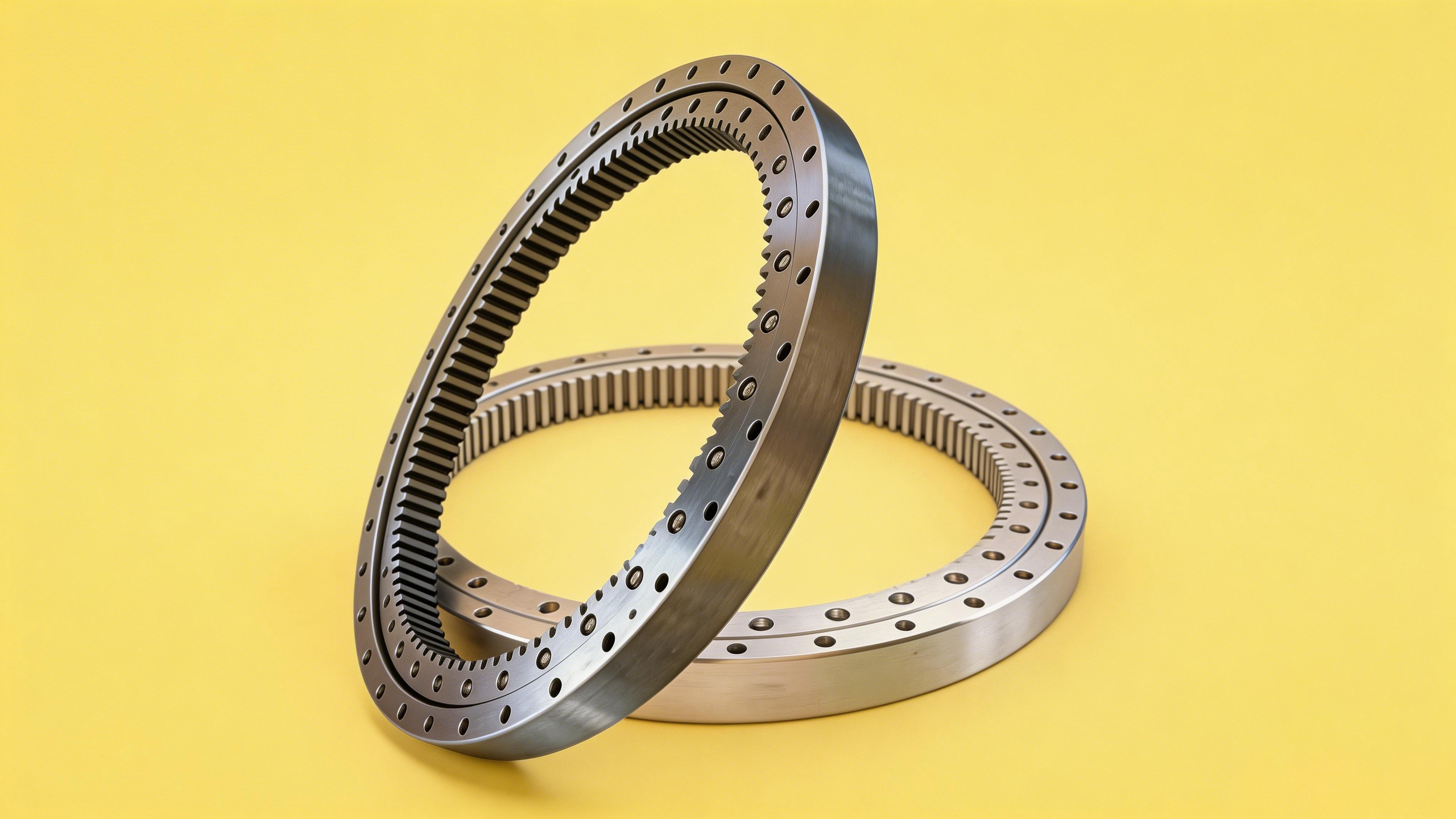
What is a slew drive? It is a compact unit that combines a slewing bearing, a gear (usually a worm gear), a housing, and a motor interface. It turns a load and holds it in position. When it steers a wheel, a platform, or a boom, any free play in the unit shows up as imprecise steering.
So where does that play come from? In a slew drive steering system, rotational slack can come from the worm mesh, the bearing, the mounting surface, the fasteners, or parts upstream of the drive. This guide gives you a diagnosis order, with observations that point to each cause and a clear point to stop and escalate.
Separate the Symptom From the Cause
"Backlash" is a symptom. It means the output moves a little before the load follows, or the load drifts after you command a stop. It does not tell you which part is loose or worn.
Write down what you actually see before you touch anything. Keep observations, suspected causes, and confirmed findings in separate columns. That habit prevents the most common error: adjusting the worm mesh when the real problem is a loose bolt.
Stop operating the machine if you see any of these:
- Visible gap opening between the drive flange and the frame while loaded.
- Metal particles or discolored grease at the housing seals.
- Knocking that changes with load direction, not just at reversal.
These point to a structural or lubrication problem. Further steering input can turn a repairable fault into a damaged gear set or bearing raceway.
Preliminary Checks Before Any Disassembly
Start with checks that need no special tools beyond a torque wrench and a dial indicator. Do them in this order, because each one rules out a cheaper cause first.
- Review recent changes. Was the drive just installed, re-mounted, or re-greased? Was the machine in a collision or overloaded? Play that appeared right after installation usually points to mounting. Play that grew over months points to wear.
- Check fastener torque. Use the torque value in your drive's manual or drawing. Mark each bolt after checking. A bolt that turns further is a finding; do not just tighten and move on.
- Inspect the interface. Look for fretting dust, shiny contact marks, or a gap at the flange. Fretting around bolts means the joint has been moving.
- Check upstream slack. Motor coupling, key, brake, hydraulic motor spline, and steering linkage can all add slack that looks like gear backlash. Lock the drive input and see whether the slack remains.
- Measure the play. Mount a dial indicator at a known radius on the output. Lock the input, apply light torque one way, zero the gauge, then reverse. Record the movement.
Compare your reading with the backlash value on the drive's drawing or datasheet. If you do not have that reference, get it first. A number without a specification cannot tell you whether the drive is out of tolerance.
Worm Mesh, Bearing Preload, Mounting Flatness, and Gear Wear: Isolating Each Source of Free Play
These four causes feel alike at the steering handle. They behave differently under test. The table shows what each one looks like and how to separate it from the others before you adjust anything.
| Source | How it creates free play | Observable sign | Isolation check | Next action |
|---|---|---|---|---|
| Worm mesh clearance | Gap between worm thread and wheel teeth lets the output move with the input locked. | Rotational play only, same in any output position or similar around the circle. | Dial indicator at output with input locked. No tilt or lift of the ring. | Compare to drawing value. Adjust only per the manufacturer's procedure. |
| Bearing preload | Loose preload allows axial lift or tilt, which also shifts the worm contact. | Axial or radial movement of the ring under hand or load; clunk when tilting moment reverses. | Indicator on the ring face and edge while applying an axial or tilting load. | Treat as a bearing issue. Do not tighten the worm to hide it. |
| Mounting flatness | Uneven or soft seat distorts the housing and bearing, so contact and clearance change around the circle. | Play that varies by angle; fretting marks; bolts that lose torque. | Check flange gap with feeler gauge; re-measure play at several angles. | Correct the seat or shim as the drawing allows, then re-torque and re-measure. |
| Gear wear | Material loss on worm or wheel teeth opens the clearance permanently. | Play grows slowly; worn zone in the most-used angle; fine metal in grease. | Play is larger in the high-use zone than elsewhere; inspection shows polished or scored flanks. | Plan replacement of the worm set or drive. Adjustment gives only a short-term fix. |
Two readings do most of the work. First, does the play change with output angle? If yes, suspect mounting flatness or localized wear. Second, does the ring move when you tilt it, not just rotate it? If yes, you are looking at bearing play, not gear clearance.
Always check the bearing and mounting first. Once the mesh is adjusted, a problem in those areas stays hidden until the next load cycle.
Request Your Custom Slew Drive or Bearing Spec
Tell us your load, speed, and environment — receive a tailored 100–5000 mm slewing drive or slewing bearing proposal with 3D drawings within 24 hours.
From Observation to Next Action
The sequence below connects what you see to what you do. Each outcome is a possibility, not a diagnosis. Keep alternatives open until a check confirms or excludes them.
| Observation | Possible meaning | Check next | Stop or escalate when |
|---|---|---|---|
| Bolts turn when re-torqued | Joint preload lost; seat may be uneven. | Flange gap, fretting marks, bolt condition. | Bolts are stretched or threads are damaged. |
| Play remains with input locked, ring does not tilt | Worm mesh clearance or wear. | Compare to drawing value; check play at several angles. | Play exceeds the specification at every angle. |
| Play disappears when drive input is locked at the drive, but remains at the motor | Coupling, key, or motor-side slack. | Coupling set screws, key fit, brake play. | Damage to the motor shaft or spline. |
| Ring lifts or tilts under load | Bearing clearance or raceway wear. | Axial and radial indicator readings; raceway condition if accessible. | Any measurable lift beyond the bearing specification. |
| Play is largest in one arc of travel | Localized gear wear or mounting distortion. | Flatness at that arc; grease condition; tooth surface. | Visible pitting, scoring, or a step in the wear pattern. |
After any corrective action, repeat the same dial-indicator measurement at the same radius and angles. Compare before and after. If the number did not change, the cause you addressed was not the main one.
A Worked Example
Say a heavy-duty wheel steering axle shows loose steering after a frame repair. Bolts check at correct torque, and the play is the same at every angle. The ring does not tilt. That pattern points to mesh clearance or upstream slack, so you lock the input and test again.
Now suppose the play drops by about half with the input locked. Then roughly half your problem sits in the coupling or motor side, and the rest is in the drive. Fix the coupling first, re-measure, and only then decide whether the drive needs work.
Common Mistakes That Waste Time
- Tightening the worm mesh first. It hides bearing play and mounting problems, then causes tight spots and heat later.
- Measuring at one angle only. A single reading cannot reveal localized wear or flange distortion.
- Ignoring the steering linkage and motor coupling. Their slack adds to the gear clearance you measure.
- Re-torquing without checking the seat. If the mounting surface is uneven, bolts will loosen again.
- Replacing the drive without records. Without before-and-after measurements, you cannot tell whether the new unit fixed the cause.
- Assuming a manufacturing defect, or assuming operator error. Both are guesses until the evidence says otherwise.
Prevention and When to Ask for Support
Once the play is corrected, keep a short record: measured play at fixed angles, bolt torque check dates, grease condition, and any shock loads. A rising trend in the numbers shows wear before the operator feels it. That is far cheaper than finding it during a failure.
Specification matters too. Precision targets differ by application. For example, a British Columbia forestry equipment manufacturer ordered 30 units of WED Slew Drive model WED14-86-25BHR.5 for grapple machines with a tracking precision of ≤0.13°. A Houston, Texas manufacturer ordered 150 units of WED17-104-25HR double worm drives for heavy-duty wheel steering. Those cases show that the drive model and the allowed play are chosen for the duty, so your measured value must always be judged against your own drawing.
The choice of drive type also affects how steering play behaves. A Double Worm Slew Drive is used where backlash control matters, while a Worm Gear Slew Drive with a single worm suits many lighter steering and slewing tasks. If your steering demands do not match the installed drive, no adjustment will fully cure the problem. A Customized Slew Drive may be the better route in that case.
Information to Send With a Support Request
- Drive model and serial number, plus the drawing or datasheet backlash value.
- Dial-indicator readings at several angles, with the measurement radius.
- Whether the ring moves axially or tilts under load.
- Bolt torque results and any loose-bolt or fretting observations.
- Photos of the flange seat, the grease, and the housing seals.
- Duty details such as load, duty cycle, shock events, and environment.
Escalate when readings exceed the specification at all angles, the ring shows axial or tilt play, or the grease carries metal debris. At that point, further field adjustment is a risk. Our engineers at Luoyang Slewring Bearing Co., Ltd. respond to technical questions within 48 hours.
Our units go through CMM three-coordinate inspection and dynamic load testing, and our Slew Drive Quality Control process is part of an ISO 9001:2015-certified system. We offer a 2-year extended quality warranty, with free replacement for confirmed manufacturing defects. Play caused by mounting, overload, or upstream slack is a separate matter, which is why the measurements above matter.
If you need a replacement or a new Slew Drive for a steering application, send us your load, duty, and precision requirements. We can propose a standard model or a custom design, with a technical proposal within 24 hours. Standard MOQ is 1 set.
Request Your Custom Slew Drive or Bearing Spec
Tell us your load, speed, and environment — receive a tailored 100–5000 mm slewing drive or slewing bearing proposal with 3D drawings within 24 hours.
 WhatsApp

 +8613903880726