



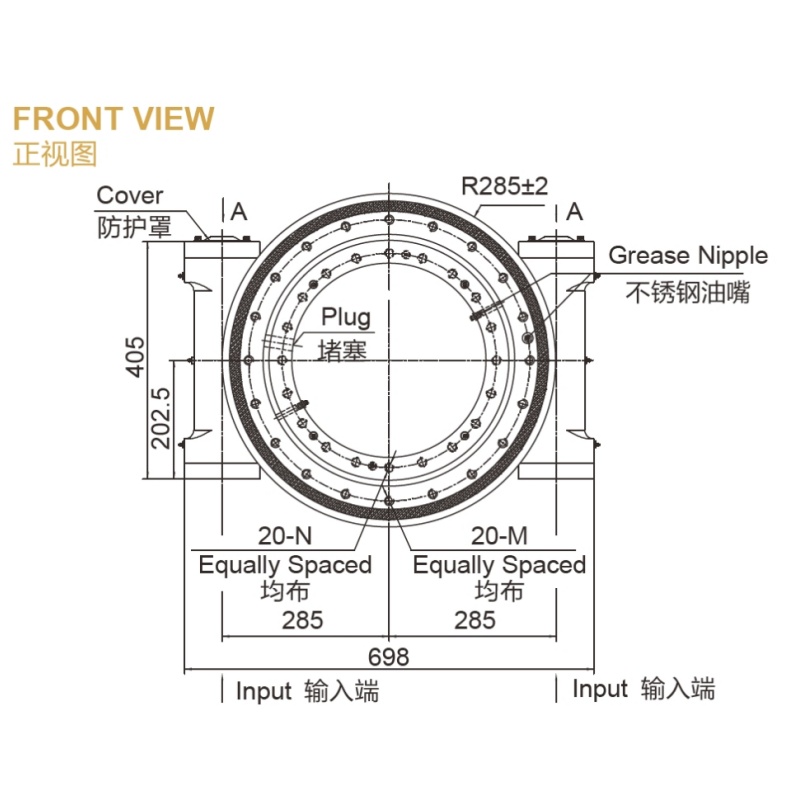
What is a slew drive? It is a compact rotation unit that combines a slewing bearing, a gear stage (usually worm or spur), a housing and a motor interface. It turns a load and carries axial, radial and tilting forces at the same time.
A high torque slew drive can run hot for many reasons, and the heat itself does not tell you which one. This article gives maintenance teams and OEM engineers a diagnostic order: what to check first, what each reading may mean, and when to stop and call for support. I have worked on slew drive and worm gear reducer design for more than 30 years, and the pattern is consistent. Most heat problems come from a mismatch between duty and design, not from a single faulty part.
Separate the Symptom From the Suspected Cause
"The drive is hot" is an observation. "The grease has failed" is a suspicion. Keep the two apart in your notes until you have evidence.
Write down what you actually see: where the heat is (housing, bearing ring, motor flange), when it appears (after minutes or after hours), and what changed recently. Changes include a new motor, a new duty cycle, a re-mounted frame, or a different site climate.
Stop the machine and do not restart it if you see any of these:
- Smoke or a burnt grease smell.
- Grinding or metallic knocking from the gear or bearing.
- Grease or oil running out of the seals in quantity.
- Repeated motor trips or a sharp rise in motor current.
Running through these signs turns a repairable heat problem into tooth or raceway damage.
Preliminary Checks Before Anyone Opens the Housing
Start with checks that need no disassembly. They are quick, and they rule out the most common causes first.
- Review the records. Compare the real duty (run time, load, speed, starts per hour) with the duty in the original technical proposal or datasheet.
- Measure surface temperature. Use an infrared thermometer at the same three points each time: housing near the worm, outer ring, and motor flange. Compare against the temperature limit in the drive's documentation.
- Check the lubricant. Confirm the grease type, the last fill date, and whether the fill amount matches the instructions. Both too little and too much can cause heat.
- Check the mounting. Look at bolt torque records and the flatness of the mounting surfaces. A distorted frame can pinch the bearing.
- Listen and feel. Rotate slowly with the load off. Note any rough spots, tight zones, or noise that repeats once per turn.
If the records show the drive was never sized for the current duty, you may already have your answer. If the records match, go to the diagnostic branches below.
Diagnostic Path: From Observation to Next Action
The table below links each observation to possible meanings and a next step. These are possible causes, not confirmed findings. Confirm with a second observation before you change anything.
| Check | What you observe | Possible meaning | Next action |
|---|---|---|---|
| Run time vs. temperature | Heat climbs steadily and never levels off | Duty exceeds what the drive can shed as heat | Add rest periods or review sizing against actual duty |
| Motor current | Current is higher than the commissioning value at the same load | Added friction in the gear mesh or bearing | Check alignment, grease condition, and bolt preload |
| Grease at the fill port or seals | Dark, dry, or contaminated grease | Lubricant breakdown or dirt ingress | Purge and refill with the specified grease; inspect seals |
| Hot spot location | Heat is strongest at one point on the ring | Local tight spot from a distorted mounting surface | Re-check flatness and bolt sequence before refitting |
| Slow, unloaded rotation | Torque is uneven through one turn | Raceway or tooth damage, or uneven preload | Stop and escalate for inspection |
| Heat only on hot days | Temperature tracks ambient conditions | Thermal margin is too small for the climate | Review ambient limits, shading, or a customized design |
Do not jump to replacement. A drive with a distorted mounting frame will run hot again after a swap.
Request Your Custom Slew Drive or Bearing Spec
Tell us your load, speed, and environment — receive a tailored 100–5000 mm slewing drive or slewing bearing proposal with 3D drawings within 24 hours.
When Duty Cycle, Ratio, Lubrication and Ambient Temperature Exceed the Thermal Limit
Every high torque slew drive has a thermal operating limit. Heat comes from friction in the gear mesh and the bearing, and it leaves through the housing and mounting structure. Overheating starts when heat in is larger than heat out for long enough.
Four conditions push a unit past that boundary. They often stack, so check all four.
| Condition | Why it adds heat | Observable sign | Limit of the explanation |
|---|---|---|---|
| Continuous duty | No rest time for heat to leave the housing | Temperature keeps rising across a long run | Short, intermittent moves rarely show this |
| High reduction ratio | More sliding contact in the worm mesh, so lower efficiency | Warm gear housing even at light load | Ratio alone does not prove a fault; it sets a higher baseline |
| Lubrication condition | Wrong grease, low fill, or aged grease raises friction | Heat falls after a correct re-greasing | Fresh grease will not fix a misaligned mounting |
| Ambient temperature | Hot air and sun reduce the temperature gap that carries heat away | Overheating only in summer or direct sun | Needs the datasheet limit for a firm conclusion |
A self-locking worm stage turns more input power into heat than a spur stage, because of sliding contact. That same trait lets it hold a load without a brake. So the right fix is not always a different gear type. Sometimes it is a lower duty, a better heat path, or a drive sized with more margin. If you need to compare options, see our Worm Gear Slew Drive and Spur Gear Slew Drive pages.
Real projects show how often ambient heat is a design input. A US renewable energy equipment manufacturer ordered 50 units of SP-I 0841 for utility-scale solar trackers, specified at IP65 for desert sites. A South Korean port equipment manufacturer placed a 20-unit repeat order of WEA9-62-25HR single worm drives for port cranes, with self-locking and IP65 sealing. In both cases the site conditions were stated up front, and that is the right habit. These cases do not tell us how those drives performed thermally, so treat them as examples of specifying conditions, not as proof of a cure.
Match the Cause to a Fix, Then Verify the Result
Each corrective action needs an outcome check. If the outcome does not change, your first diagnosis was probably wrong.
An illustrative worked example
Say a prototype turntable runs well for 10 minutes but gets too hot in a 2-hour test. Motor current at the start matches commissioning. Grease looks clean.
Current is normal and the grease is fine, so friction is not the first suspect. The duty cycle is. The test ran the drive continuously, while the design assumed intermittent moves. The fix is to match the test to the real duty, or to ask for a larger or customized unit if continuous running is real. The result check is a repeat run that levels off at a steady temperature instead of climbing.
Cause, evidence, action, result
- Distorted mounting surface: Hot spot at one location, uneven turning torque. Correct flatness, re-torque bolts in sequence. Verify with even temperature around the ring.
- Aged or wrong grease: Dark, dry grease, higher current. Purge and refill with the specified grease. Verify with lower current and cooler housing.
- Duty above design: Steady climb with clean grease and good alignment. Add rest time or resize. Verify with a temperature plateau.
- Hot climate with small margin: Heat follows ambient temperature. Improve airflow or shading, or request a design reviewed for the climate. Verify during the hottest part of the day.
Common mistakes
- Adding extra grease "to be safe." Overfilling can churn and raise temperature.
- Replacing the drive before checking frame flatness.
- Testing at no load and assuming full-load duty will behave the same.
- Blaming the manufacturer for every heat problem, or blaming the user for every one. Evidence should decide.
Prevention, Escalation and Support Boundaries
Prevention is mostly about matching the drive to the duty before it ships. Use this checklist during prototype validation and again after installation.
- Record real duty: load, speed, run time, starts per hour.
- Record site conditions: ambient range, sun exposure, dust, washdown.
- Verify mounting flatness and bolt torque, and log both.
- Log the grease type and fill date.
- Take a baseline temperature and motor current at commissioning.
The baseline matters most. Without a commissioning reading, "too hot" is a guess.
Escalate if any stop condition appears, if rotation feels uneven with the load off, or if heat remains after you correct lubrication and mounting. Send these items to the support team:
- Model number and serial number.
- Duty cycle and load description.
- Temperature readings with locations and ambient temperature.
- Motor current at commissioning and now.
- Grease type, fill date, and photos of the seals and fill port.
Luoyang Slewing Bearing Co., Ltd. offers a 48-hour technical response and a 2-year extended quality warranty. Confirmed manufacturing defects are replaced free of charge. Heat caused by out-of-spec duty or mounting is handled as an application review, which is why the records above matter. Our drives are built in an ISO 9001:2015 certified facility, and each slewing bearing is checked on a CMM. You can read more on our Slew Drive Quality Control page.
If your duty is outside what a standard Slew Drive can handle, a Customized Slew Drive may be the better path. For heavy repeated loads, one example is the 150 units of WED17-104-25HR Double Worm Slew Drive supplied to a Houston, Texas engineering machinery maker for heavy-duty wheel steering. We send a technical proposal within 24 hours, and a customized order starts at 5 sets.
Request Your Custom Slew Drive or Bearing Spec
Tell us your load, speed, and environment — receive a tailored 100–5000 mm slewing drive or slewing bearing proposal with 3D drawings within 24 hours.
 WhatsApp

 +8613903880726