



What is an OEM slewing bearing? It is a rotational bearing designed or selected to match an equipment builder’s drawing, load case, mounting pattern, gear arrangement, and operating conditions. It may be a modified version of an existing bearing series or a new design developed around the machine interface.
The biggest sourcing risk is not choosing the wrong supplier from a list. It is sending an incomplete request for quotation and receiving proposals that cannot be compared fairly. One supplier may assume a light-duty ball bearing, while another may quote a heavier roller design with different gear details, bolt requirements, or inspection scope.
For an OEM slewing bearing inquiry, the drawing is only the starting point. Procurement teams need enough application data to let each supplier evaluate the same duty cycle, overturning moment, mounting arrangement, and acceptance standard. Without that information, a low initial quote can become an expensive redesign later.
Define the bearing requirement before asking suppliers to quote
Start by separating what is fixed from what is still open. Fixed items are usually envelope dimensions, mounting interfaces, and required rotational direction. Open items may include bearing type, raceway structure, gear form, material selection, and the inspection criteria needed for the application.
The right conclusion is simple: do not ask suppliers to “quote according to drawing” if the drawing does not show the working load and interface conditions. This approach fits early-stage machine development, replacement projects with missing history, and equipment upgrades. It does not apply when you already have a fully approved bearing specification and only need a like-for-like production quote.
Identify the application duty first
A slewing ring carries more than vertical weight. It can also carry axial load, radial load, overturning moment, shock loading, and repeated cyclic loads. The supplier needs to understand how those loads act together, not just the maximum machine weight.
- Axial load: The load acting parallel to the bearing axis, such as the weight of a platform, boom, arm, or payload.
- Radial load: The force acting perpendicular to the bearing axis, often caused by side loads, wind, travel motion, or uneven material handling.
- Overturning moment: The tipping force created when the load is offset from the bearing center.
- Duty cycle: The frequency, rotation range, starts, stops, and operating hours that affect fatigue and gear wear.
- Environment: Temperature, dust, moisture, salt exposure, corrosive media, and outdoor storage conditions.
If the load data is incomplete, state that clearly instead of inserting estimates that appear final. Provide the machine arrangement drawing, payload range, arm length, center-of-gravity location, and operating sequence. This gives the bearing supplier a basis for asking focused technical questions rather than making hidden assumptions.
Luoyang Slewring Bearing Co., Ltd. selects ductile cast iron, alloy steel, stainless steel, or forged alloy steel according to load, speed, and environment. Material selection should therefore be discussed after the application conditions are defined. A stainless option may suit a corrosive environment, but it is not automatically the correct answer for every heavy-load installation.
Choose a bearing structure that matches the load path and installation space
The bearing structure should follow the load case, available space, and required motion quality. A compact machine may need a low-profile arrangement, while a high-moment industrial platform may need a bearing structure that separates load paths more effectively. The lowest-profile design is not always the best choice for a high overturning moment.
| Bearing option | Best fit | Why buyers select it | When it may not fit |
|---|---|---|---|
| Single Row Slewing Ring Ball Bearings | General rotating platforms and moderate combined loads | Provides a practical balance between size, load handling, and design simplicity | May not be suitable where very high moment capacity or higher rigidity is required |
| Double Row Ball Slewing Ring Bearing | Applications needing increased load support within a ring-bearing format | Uses two rows of rolling elements to support combined loading | May be unnecessary for a lighter duty application with limited cost allowance |
| Crossed Roller Slewing Bearings | Positioning systems that need controlled rotational behavior | Roller orientation can support combined loads in compact arrangements | Not the default choice when the machine only requires basic low-speed rotation |
| Three-row Roller Slewing Bearings | Heavy equipment with demanding axial, radial, and moment loads | Separate roller rows can be arranged to handle different load directions | May add size, weight, and cost where the load case does not justify the design |
For example, a crane turntable and a compact automated fixture should not be evaluated by the same bearing rule. The crane may need a design focused on high combined loading and repeated heavy-duty cycles. The automation fixture may place greater emphasis on rotational accuracy, mounting stiffness, and controlled gear engagement.
Luoyang Slewring Bearing Co., Ltd. has supported drawing design for three-row roller slewing bearings and mass production of worm gear drives across more than 2,000 heavy-equipment projects. That scope is relevant when the buyer needs either a ring-bearing design or a bearing-and-drive arrangement. It does not remove the need for the buyer to provide the actual machine loads and installation boundaries.
A drawing-to-first-sample RFQ checklist covering load data, mounting interfaces, gear requirements, and acceptance criteria
Use the checklist below before issuing an RFQ. The conclusion is that every supplier should receive the same technical package, even if some values are marked “to be confirmed.” This method fits procurement engineers comparing multiple suppliers and designers preparing the first custom-bearing inquiry. It is less necessary for a repeat order against an already approved drawing and documented inspection plan.
| RFQ area | Information to provide | Why it affects the quotation | Buyer check before release |
|---|---|---|---|
| Load data | Maximum axial load, radial load, overturning moment, shock condition, rotation angle, speed, and duty cycle | These inputs guide raceway, rolling-element, material, and life evaluation | Confirm whether values are operating loads, peak loads, or estimated loads |
| Mounting interfaces | Outer diameter, inner diameter, height limit, mounting-hole pattern, bolt location, flange drawings, and installation orientation | Interface dimensions determine whether the bearing can fit and transfer load correctly | Show datums and identify dimensions that cannot change |
| Gear requirements | Internal or external gear, tooth form, mating pinion details, rotational direction, backlash requirement, and tooth hardness requirement if specified | Gear geometry must match the drive system and installation position | Provide a drawing of the mating gear or pinion whenever possible |
| Operating environment | Indoor or outdoor use, dust, water, salt exposure, corrosion concerns, temperature range, and lubrication access | Environment affects sealing, corrosion protection, lubrication planning, and material selection | State whether the machine will be stored outdoors before installation |
| Acceptance criteria | Drawing revision, dimensional tolerances, rotational resistance requirement, gear inspection needs, marking, packing, and document requirements | Clear acceptance terms prevent disputes after sample or production delivery | Identify which requirements are mandatory and which are preferred |
| Commercial scope | Target quantity, sample need, expected project timing, destination country, and requested quotation format | Quantity and delivery requirements affect production planning and packing arrangements | Separate prototype quantity from future production volume |
For a first sample, attach a controlled PDF drawing and identify the revision number. If you send a STEP model, use it as supporting geometry rather than the only approval document. A supplier needs one agreed reference for dimensions, interfaces, and changes.
Acceptance criteria deserve special attention. Specify what you will inspect at incoming quality control, what documents you expect, and whether a first article requires approval before later production. Do not request “high precision” without defining the dimensions or functional behavior that must be checked.
At Luoyang Slewring Bearing Co., Ltd., every slewing bearing passes CMM three-coordinate inspection and dynamic load testing under its stated quality control program. Buyers should still define the inspection points relevant to their own drawing. General production inspection does not automatically replace an equipment maker’s project-specific acceptance plan.
Request Your Custom Slew Drive or Bearing Spec
Tell us your load, speed, and environment — receive a tailored 100–5000 mm slewing drive or slewing bearing proposal with 3D drawings within 24 hours.
Compare supplier proposals on technical scope instead of unit price alone
A comparable quote should show what each supplier has included, excluded, or assumed. The correct choice is usually the proposal with the clearest technical basis, not automatically the lowest price. This is especially true for a custom design where an omitted gear detail or mounting requirement can change the bearing after the order is placed.
| Comparison point | What to request from each supplier | Reason for checking it |
|---|---|---|
| Design basis | Confirmation of the drawing revision, load inputs, duty cycle, and environment used for the proposal | Shows whether quotations are based on the same application |
| Bearing arrangement | Proposed bearing structure, gear location, mounting concept, and any design changes | Prevents comparing different technical solutions as if they were equal |
| Inspection scope | Dimensional inspection, gear inspection, load testing, and supplied documentation | Clarifies how conformity will be demonstrated |
| Material and protection | Material proposal, surface protection, sealing approach, and lubrication provisions | Links the quote to the machine environment and service plan |
| Commercial terms | MOQ, prototype scope, production lead time, packing, warranty, and technical response terms | Helps procurement compare the total purchasing commitment |
Luoyang Slewring Bearing Co., Ltd. offers standard products from one set and customized products from five sets, with sample orders welcome for testing and evaluation. The company states a three-day rapid prototyping capability, a nine-day standard production cycle, and technical proposals within 24 hours. These are useful planning signals, but the final schedule should be confirmed against the bearing design, drawing maturity, and order scope.
The company operates an 8,000 m² manufacturing facility with six production lines and an annual capacity of 100,000 sets. It is ISO 9001:2015 certified and provides CE marking for the European market. A buyer should still confirm whether the requested product configuration, documentation, and destination-market requirements are included in the specific quotation.
Use evidence that relates to your machine type and operating environment
Relevant project evidence can help a buyer judge whether a supplier has handled a similar operating challenge. It should not be treated as proof that every new design will produce the same result. The best use of a reference case is to ask which parts of the new application are similar and which parts require a new evaluation.
For port and marine equipment, sealing, cyclic load, and corrosion exposure may be key concerns. A South Korean port equipment manufacturer placed a repeat order for 20 WEA9-62-25HR single worm slew drives for port crane systems, with stated tracking precision of no more than 0.15 degrees, IP65 sealing, and self-locking performance. UK Ocean Marine Systems also ordered 20 WEA17-104-25H-R-REV.D units for shipboard crane systems.
For heavy mobile equipment, stability under high loads and repeated motion can drive the selection. An Australian heavy equipment manufacturer used HWE21-94-25HR.1 double worm slew drives for mining excavators, while a Houston engineering machinery manufacturer ordered 150 WED17-104-25HR double worm drives for heavy-duty wheel steering systems. These cases support discussion of driven rotation systems, but they do not replace a separate review of your own bearing loads and mounting structure.
For solar tracking projects, environmental protection and controlled positioning are often central. A U.S. renewable energy equipment manufacturer ordered 50 SP-I 0841 units for utility-scale solar tracker systems with IP65 protection for desert sites. South American solar projects in Brazil, Argentina, and Chile used SP-I 0229 spur gear slew drives for single-axis trackers, where the reported energy-yield improvement was up to 40%.
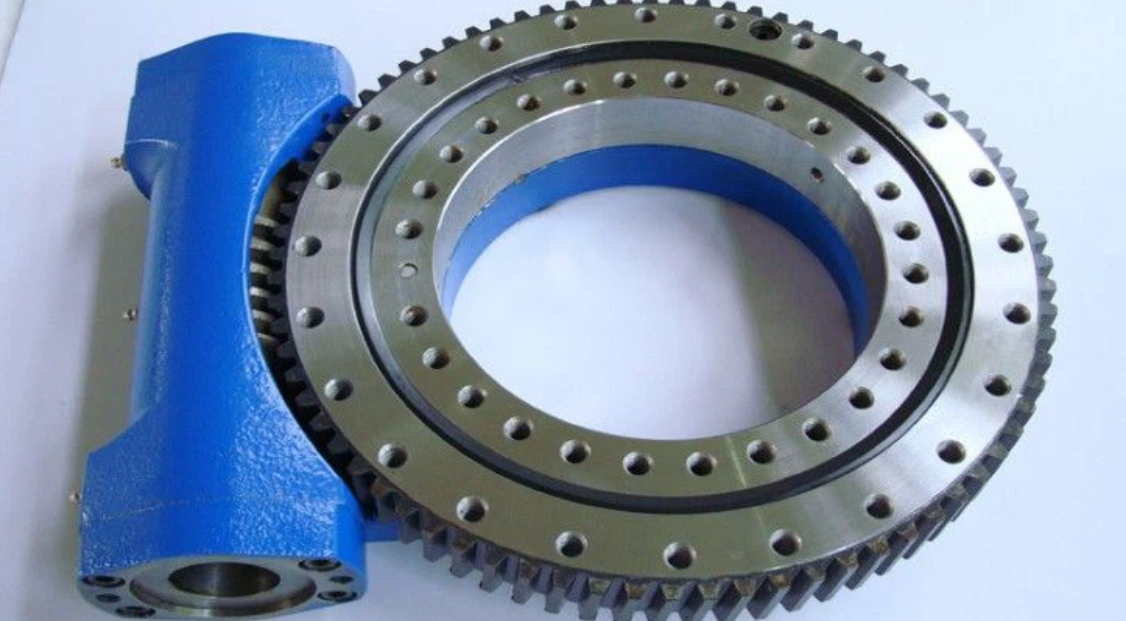
If your equipment needs an integrated rotation drive rather than a ring bearing alone, review the available Slew Drive options alongside the bearing RFQ. A worm drive may suit applications that need self-locking behavior, while a Double Worm Slew Drive can be considered where the machine design needs a different load-sharing arrangement. Final selection still depends on the actual load case, speed, precision need, and safety design.

Control revisions, sample approval, and production release
The final sourcing step is document control. A custom bearing project can fail even when the technical concept is correct if the supplier manufactures to an old drawing revision or the buyer approves a sample without recording deviations. Use one controlled drawing number and revision for every quote, technical discussion, sample, and purchase order.
- Release the RFQ package: Send the drawing, load table, interface data, gear information, operating environment, and acceptance checklist to each supplier.
- Review technical assumptions: Compare each proposal against the same input data and list every supplier assumption that needs confirmation.
- Approve the proposed design basis: Confirm the selected bearing arrangement, gear arrangement, interface changes, and inspection scope before sample production.
- Inspect the first sample: Check the agreed dimensions, mounting fit, rotational operation, gear engagement, and required documents against the approved criteria.
- Freeze the production revision: Record approved changes and identify the exact drawing revision to appear on the purchase order.
- Define production acceptance: Agree on inspection records, packing expectations, identification marks, and handling of confirmed nonconforming parts.
Luoyang Slewring Bearing Co., Ltd. provides a two-year extended quality warranty, a 48-hour technical response, and free replacement for confirmed manufacturing defects. These terms are relevant after the buyer and supplier have agreed on the product definition and defect responsibility. They do not cover design assumptions that were never included in the original RFQ.
For a replacement project, measure the existing part carefully and collect photos of the installation, gear mesh, mounting faces, and identification marks. For a new machine, provide the latest assembly model and load information instead. A replacement bearing may look similar to a catalog item but still require different gear, clearance, or bolt-interface details.
Decide whether Luoyang Slewring Bearing Co., Ltd. fits your RFQ
Luoyang Slewring Bearing Co., Ltd. is a suitable candidate when your team needs a supplier for slewing bearings, slew drives, or a Customized Slew Drive and can provide a controlled technical package. Its stated capabilities include custom product orders from five sets, sample-order support, ISO 9001:2015 certification, CMM inspection, dynamic load testing, and a technical proposal within 24 hours.
The strongest RFQ will include actual combined load data, mounting drawings, gear details, environmental conditions, expected quantity, and acceptance requirements. If those inputs are not ready, identify the open points directly and ask the supplier which information is needed to complete the technical proposal. That creates a clearer comparison, a better first sample, and fewer changes before production release.
Request Your Custom Slew Drive or Bearing Spec
Tell us your load, speed, and environment — receive a tailored 100–5000 mm slewing drive or slewing bearing proposal with 3D drawings within 24 hours.
 WhatsApp

 +8613903880726