



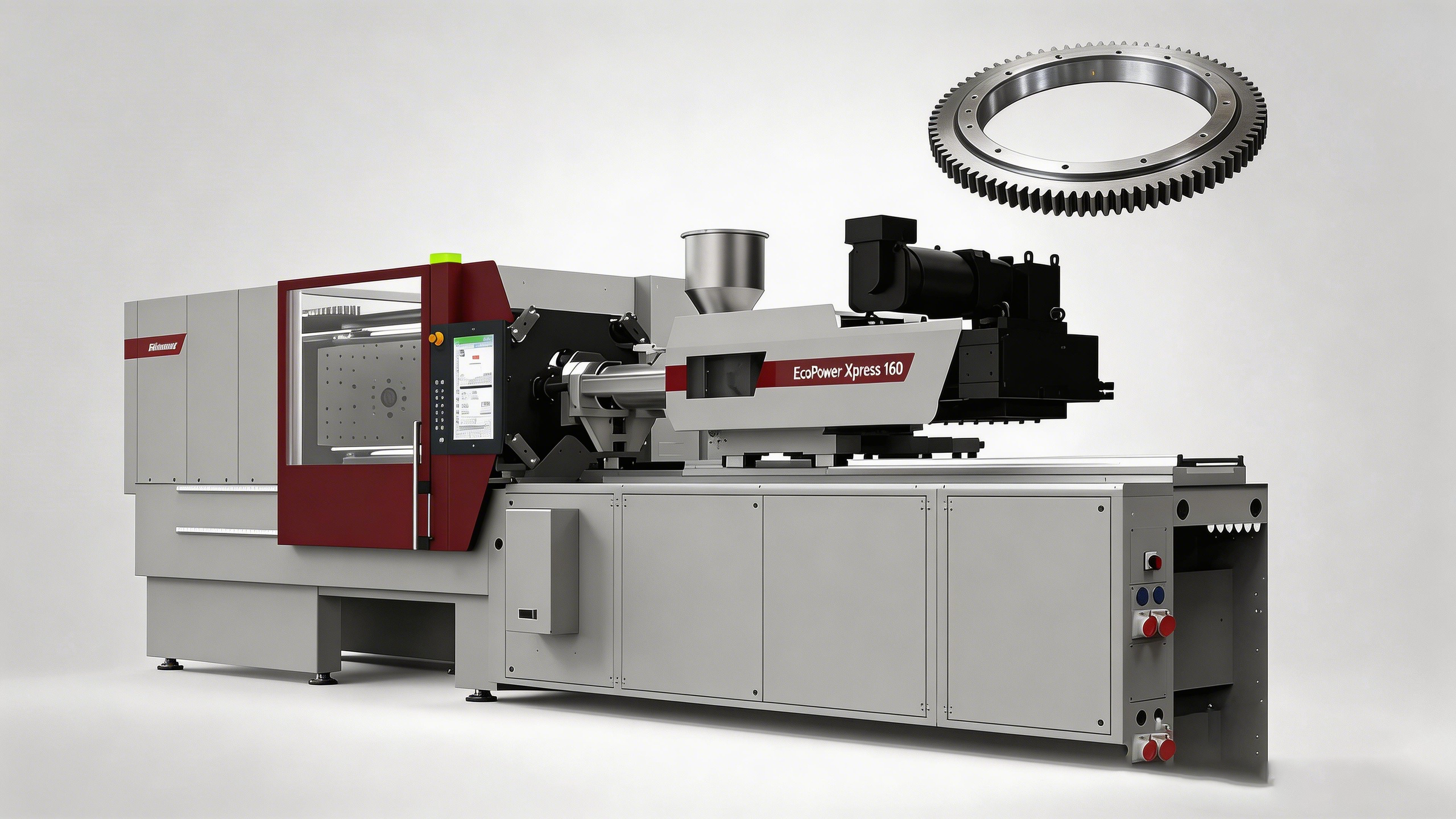
Precision in Plastics: Slewing Bearings in Injection Molding Machines
What Are Slewing Bearings in Injection Molding Machines?
In the world of plastic manufacturing, precision is not a luxury – it is an absolute necessity. From automotive interior components to medical device parts and consumer packaging, modern injection molding demands highly accurate, repeatable movements to maintain quality standards and meet production targets. At the heart of this precision lies a critical yet often overlooked component: the slewing bearing, also known as a slewing ring.
A slewing bearing is a large-scale rolling-element bearing specifically designed to support heavy loads while enabling smooth, controlled rotational movement. Unlike conventional bearings that primarily handle radial loads on a rotating shaft, slewing bearings are engineered to simultaneously manage three types of forces: axial loads (vertical force pushing downward), radial loads (horizontal force pushing from the side), and tilting moments (uneven force that tries to tip the bearing).
In the specific context of an injection molding machine, slewing bearings are installed between major moving components – such as rotary turntables, moving platens, or rotating mold carriers. Their job is to allow these heavy parts to turn smoothly and position themselves precisely, cycle after cycle, without deflection or misalignment.
Without slewing bearings, the rotating components in a molding machine would suffer from excessive friction, inconsistent movement, and premature wear. With them, manufacturers achieve the controlled, repeatable motion that high-volume plastic production demands. In short, slewing bearings are the silent enablers of precision in plastics.
Key Features of Slewing Bearings for Precision in Plastics
Not all slewing bearings are created equal. For injection molding applications – where precision, reliability, and longevity are paramount – specific design features distinguish high-quality slewing bearings from ordinary ones. Below are the key features that make slewing bearings suitable for precision work in plastics.
High Load Capacity with Rigid Support
Injection molding machines often handle molds weighing several tons. The slewing bearing must support this weight without deflecting. High-quality slewing bearings are manufactured from forged or rolled steel rings with optimized raceway geometry. This design ensures that axial, radial, and tilting loads are distributed evenly across the rolling elements, maintaining rigidity even under maximum load. Rigid support prevents misalignment during clamping and injection, directly improving part quality.
Low and Consistent Friction
Smooth rotation is essential for precise positioning. Slewing bearings with precision-ground raceways and high-grade rolling elements (balls or rollers) offer low and consistent friction. This means the rotating turntable or platen moves exactly as commanded, without sticking or jerking. Consistent friction also means that the drive motor does not have to work harder over time, preserving energy efficiency and reducing wear on other components.
Minimal Backlash
Backlash refers to the tiny gap between the rolling elements and the raceways, which allows unwanted movement before the bearing fully engages. In precision molding, even 0.1 mm of backlash can cause misalignment, leading to part defects. Precision slewing bearings are manufactured with tight tolerances and often feature preload (a slight internal compression that eliminates gaps). The result is near-zero backlash, ensuring that every rotational movement is accurate and repeatable.
Compact, Space-Saving Design
Injection molding machines are densely packed with hydraulic systems, heating elements, cooling channels, and control electronics. Space is at a premium. Slewing bearings offer an elegant solution: they integrate load support and rotation into a single, low-profile unit. Unlike traditional bearing arrangements that might require separate thrust bearings, radial bearings, and a rotation mechanism, a single slewing bearing does it all. This compact design saves valuable machine real estate and simplifies assembly.
Integrated Sealing for Harsh Environments
Plastic molding environments can be harsh. Fine plastic dust, mold release agents, coolant mist, and temperature fluctuations all pose risks to bearing performance. Quality slewing bearings come equipped with integrated seals – typically made of nitrile rubber or polyurethane – that keep contaminants out and lubrication in. Some applications may benefit from additional protection, such as corrosion-resistant coatings or labyrinth seals for extreme conditions. Proper sealing extends bearing service life and reduces maintenance frequency.
Long Service Life with Minimal Maintenance
Injection molding machines often run 24/7, with cycles measured in seconds. A slewing bearing in such an environment must withstand millions of rotations over several years. High-quality slewing bearings are designed for durability, with hardened raceways (typically 55-62 HRC) and wear-resistant rolling elements. With proper lubrication and sealing, these bearings can achieve service lives measured in decades, not just years.
Together, these features deliver the repeatability, stability, and longevity that modern injection molding requires.
How Slewing Bearings Work in Injection Molding Machines
Understanding the inner workings of a slewing bearing helps explain why they are so valuable in injection molding applications. While the concept is simple, the engineering behind it is quite sophisticated.
Basic Construction
A slewing bearing consists of two concentric rings: an inner ring and an outer ring. Between these rings run rolling elements – either balls (in ball slewing bearings) or cylindrical rollers (in cross-roller or three-row roller slewing bearings). The rolling elements are separated by spacers or cages to prevent contact and reduce friction.
One ring typically has gear teeth cut into its inner or outer diameter (internal gear or external gear), allowing it to be driven by a pinion gear connected to a motor. The other ring has mounting holes for bolting to the machine structure.
How Rotation Happens
In a typical injection molding machine rotary turntable setup:
The outer ring bolts to the stationary machine frame.
The inner ring (with internal gear teeth) bolts to the rotating turntable.
A hydraulic or electric motor turns a pinion gear that meshes with the inner ring's gear teeth.
As the pinion rotates, it drives the inner ring – and thus the turntable – to rotate.
The rolling elements between the rings ensure that this rotation occurs smoothly, with minimal friction. Depending on the design, the bearing can handle pure rotation (oscillation) or continuous rotation.
Managing Multiple Loads Simultaneously
What makes slewing bearings special is their ability to manage complex load combinations:
Axial loads (downward force from mold weight) are transmitted through the rolling elements to the opposite raceway.
Radial loads (side forces during rotation or from uneven mold distribution) are handled by the geometry of the raceways and the rolling elements.
Tilting moments (when the load is off-center) create a force couple that tries to tip the bearing. Cross-roller and three-row roller designs are particularly good at resisting tilting moments because the rollers provide line contact (rather than point contact) with the raceways.
Why This Matters for Injection Molding
In a multi-shot molding application, the turntable must rotate precisely to bring different mold cavities into alignment with the injection nozzle. If the bearing allows any wobble or deflection, the mold halves will not align perfectly. The result is flashing, part damage, or machine crashes.
Slewing bearings, with their rigid construction and precise internal geometry, ensure that the turntable remains flat and stable throughout rotation. This allows the mold to close perfectly every time, regardless of how many cycles the machine runs.
Typical Applications of Slewing Bearings for Precision in Plastics
Slewing bearings appear in several key areas of plastic injection molding. Below are the most common and important applications.
Multi-Component (Multi-Shot) Injection Molding
Multi-shot molding is a process where two or more different plastic materials are injected into the same mold to produce a single finished part – for example, a soft-grip toothbrush handle overmolded onto a rigid core. To achieve this, the mold or a section of the mold must rotate between injection shots. A slewing bearing-mounted turntable supports the rotating mold section and rotates it precisely to the next position. The bearing's low backlash ensures that the mold halves align correctly each time, preventing material bleed and part defects.
Vertical Injection Molding Machines
In vertical injection molding machines, the clamping unit is oriented vertically. Many vertical machine designs include a rotating lower platen that indexes between stations. This allows for insert molding (placing metal inserts or electronic components into the mold before injection), automated part removal, or multiple mold cavities in a carousel configuration. Slewing bearings support the rotating platen, handling the weight of the mold and the insert while maintaining alignment with the stationary upper platen.
Rotary Stack Molds
Stack molds are an advanced mold design where multiple mold faces are stacked in parallel, allowing the machine to produce two or more layers of parts simultaneously. Rotary stack molds take this concept further by rotating the center section of the mold. As the mold opens, the center block rotates 180 degrees, aligning different cavity sets with the injection unit. Slewing bearings support the rotating center block and provide the rotational axis. This application demands extremely low backlash and high rigidity, as any misalignment affects all layers of parts.
Injection Blow Molding
Some hybrid machines combine injection molding and blow molding to produce hollow parts like bottles and containers. In this process, a rotating station moves preforms (injection-molded test-tube-like shapes) from the injection station to the blow station. Slewing bearings enable this transfer with high positional accuracy, ensuring that preforms are correctly oriented before blowing.
Rotary Table Insert Molding
For high-volume insert molding of small parts (such as connectors, switches, or medical components), rotary table machines use a large rotating table with multiple mold stations. Operators or robots place inserts into molds at one station, the table rotates to bring the loaded mold under the injection unit, and after injection and cooling, the table rotates again for part ejection. A large-diameter slewing bearing supports the entire rotary table, handling the combined weight of all molds and inserts while providing smooth, indexed rotation.
In each application, the goal is the same: maintain alignment and repeatability across thousands – often millions – of cycles. Slewing bearings deliver that performance consistently.
How to Choose the Right Slewing Bearing for Molding Equipment
Selecting the correct slewing bearing for an injection molding machine requires careful consideration of several technical and operational factors. Making the right choice ensures optimal performance, longevity, and return on investment.
Load Analysis
Begin by calculating the loads your slewing bearing will experience:
Axial load (Fa): The total weight of the rotating turntable, mold(s), and any additional components. Include safety margins for unexpected overloads.
Radial load (Fr): Side forces during rotation, often caused by off-center mold weight or external tooling. For most injection molding turntables, radial loads are relatively low compared to axial loads.
Tilting moment (M): The most complex load to calculate. It depends on how far the center of mass is from the bearing's centerline. Off-center molds create tilting moments that try to tip the bearing.
Once you have these values, compare them against the bearing manufacturer's load ratings (static and dynamic). A reputable supplier like LyraDrive can assist with these calculations.
Precision Grade and Backlash
For precision injection molding, specify a bearing with minimal backlash. Backlash is measured in arc-minutes or arc-seconds. As a rule of thumb:
Standard industrial applications: 0.5-1.0 arc-minute backlash
Precision molding applications: 0.1-0.3 arc-minute backlash
Ultra-precision applications (medical, optics): <0.05 arc-minute backlash
Cross-roller slewing bearings generally offer lower backlash than ball bearings because the rollers provide line contact rather than point contact.
Bearing Type Selection
Choose the right internal design for your application:
Single-row ball slewing bearings: Best for moderate loads and applications where cost is a primary concern. Suitable for smaller turntables.
Cross-roller slewing bearings: Excellent for precision applications because they handle tilting moments very well. The most common choice for multi-shot molding turntables.
Double-row ball slewing bearings: Higher load capacity than single-row. Good for larger molds.
Three-row roller slewing bearings: Maximum load capacity. Used in very large or heavy-duty molding machines.
Gear Configuration
Decide whether you need an internal gear, external gear, or gearless design:
Internal gear: Gear teeth on the inner ring's inside diameter. The pinion sits inside the bearing. Compact and protected from debris. Most common for rotary turntables.
External gear: Gear teeth on the outer ring's outside diameter. The pinion sits outside. Easier to access for maintenance but more exposed.
Gearless: No gear teeth. Rotation is driven through friction or by other means. Less common in injection molding.
Mounting and Interface
Verify that the bearing's mounting hole pattern matches your machine's bolt pattern. If not, most manufacturers (including LyraDrive) offer custom bolt patterns. Also consider the flatness and rigidity of the mounting surfaces – uneven mounting surfaces can distort the bearing and reduce performance.
Sealing and Environment
Assess your operating environment:
Is plastic dust present? Use a bearing with labyrinth seals or multiple lip seals.
Are mold release agents or coolants used? Consider corrosion-resistant coatings (zinc phosphate, epoxy, or electroless nickel plating).
What is the temperature range? Standard seals work to about 80°C (176°F). High-temperature seals (silicone or fluorocarbon) are available for hotter environments.
Supplier Support and Customization
Finally, choose a supplier that offers technical support and customization. Off-the-shelf bearings may not perfectly fit your application. A supplier like LyraDrive can modify standard designs – changing bolt patterns, adding seals, applying coatings, or adjusting internal clearance – to meet your exact needs.
Conclusion
Precision in plastics is not optional – it is a competitive necessity in today's demanding manufacturing environment. Slewing bearings, also known as slewing rings, play an essential and often underappreciated role in achieving that precision within injection molding machines. They provide rigid load support, smooth rotation, and minimal backlash, all packaged in a compact, space-saving design.
From multi-shot injection molding and vertical machines to rotary stack molds and injection blow molding, slewing bearings enable the repeatable, accurate movements that produce high-quality plastic parts cycle after cycle. Without them, rotating turntables would wobble, mold halves would misalign, and part defects would skyrocket.
By understanding what slewing bearings are, how they work, and how to select the right one for your equipment, machine builders and molders can significantly improve machine performance, reduce scrap rates, increase production speeds, and lower maintenance costs.
Choosing a quality slewing bearing is not an expense – it is an investment in better molding, higher profitability, and long-term reliability. And for those seeking customized, application-specific solutions, specialized suppliers like LyraDrive stand ready to help.
LyraDrive: Customized Precision Plastic Slewing Bearing Supplier
LyraDrive is a professional one-stop slewing device manufacturer, proudly providing high-quality, customized slewing bearings, slew drives, and gear rings for various industries and fields around the world.
The main types of slewing bearings we produce include:
Single Row Slewing Ring Ball Bearings
Flanged Ball Slewing Bearings
Crossed Roller Slewing Bearings
Double Row Ball Slewing Ring Bearings
Three-row Roller Slewing Bearings
This diverse product range allows us to meet the varying needs of customers across different applications and operating conditions – and we are always excited to help you find the perfect solution!For plastic processing applications, LyraDrive offers high-quality and customized slewing bearings designed specifically for precision injection molding equipment. We are passionate about delivering exactly what you need.
Looking to specify slewing bearings in your plastic manufacturing equipment? LyraDrive offers friendly technical support and flexible customization options to help you find the right fit for your application. We look forward to working with you – contact us today!
FAQ of Precision Plastic Slewing Bearings
Q1: What is the difference between a slewing bearing and a standard bearing?
A: A standard bearing (like a deep groove ball bearing) supports a rotating shaft within a housing. A slewing bearing (slewing ring) is much larger and supports heavy loads while allowing rotation between two machine structures – for example, between a stationary frame and a rotating turntable. Slewing bearings handle axial, radial, and tilting forces simultaneously, making them ideal for turntables and rotating platens in injection molding machines.
Q2: How often do slewing bearings need maintenance in injection molding machines?
A: Maintenance intervals depend on operating conditions, but general guidelines are: relubrication every 3 to 6 months for normal duty, or every 1 to 2 months for heavy-duty, 24/7 operation. Sealed or self-lubricating bearings may require less frequent attention. Regular inspection for unusual noise, rotational resistance, or visible play helps catch issues early before they lead to failure.
Q3: Can I use a standard (off-the-shelf) slewing bearing for high-precision plastic molding?
A: Not all standard slewing bearings offer the low backlash required for precision molding. Many industrial-grade bearings have backlash of 0.5 arc-minutes or more, which may be acceptable for general rotation but not for multi-shot molding where mold alignment is critical. For high-precision applications, specify a precision-grade bearing with documented low backlash and optimized raceway geometry. Reputable suppliers like LyraDrive can provide bearings specifically manufactured for precision plastic processing.
Q4: What happens if a slewing bearing fails in an injection molding machine?
A: Bearing failure can cause a cascade of problems: misalignment between mold halves, part defects (flashing, dimensional errors, short shots), increased scrap rates, unplanned downtime, and potential damage to the mold or machine components. In severe cases, a seized bearing can stop production entirely and require expensive emergency repairs. Regular maintenance and proper selection prevent the vast majority of failures.
Q5: How do I determine what size slewing bearing my injection molding machine needs?
A: Size is determined by four factors: load requirements (axial, radial, tilting moment), available mounting space (diameter and height), rotational speed, and the machine's existing bolt pattern or interface dimensions. Start by calculating your total loads, then consult a manufacturer's load rating charts. However, the safest approach is to work directly with a supplier like LyraDrive – their engineers can perform detailed calculations and recommend the optimal diameter, cross-section, and bearing type for your specific application.
 WhatsApp
 sales@lyradrive.com
 +8613903880726