



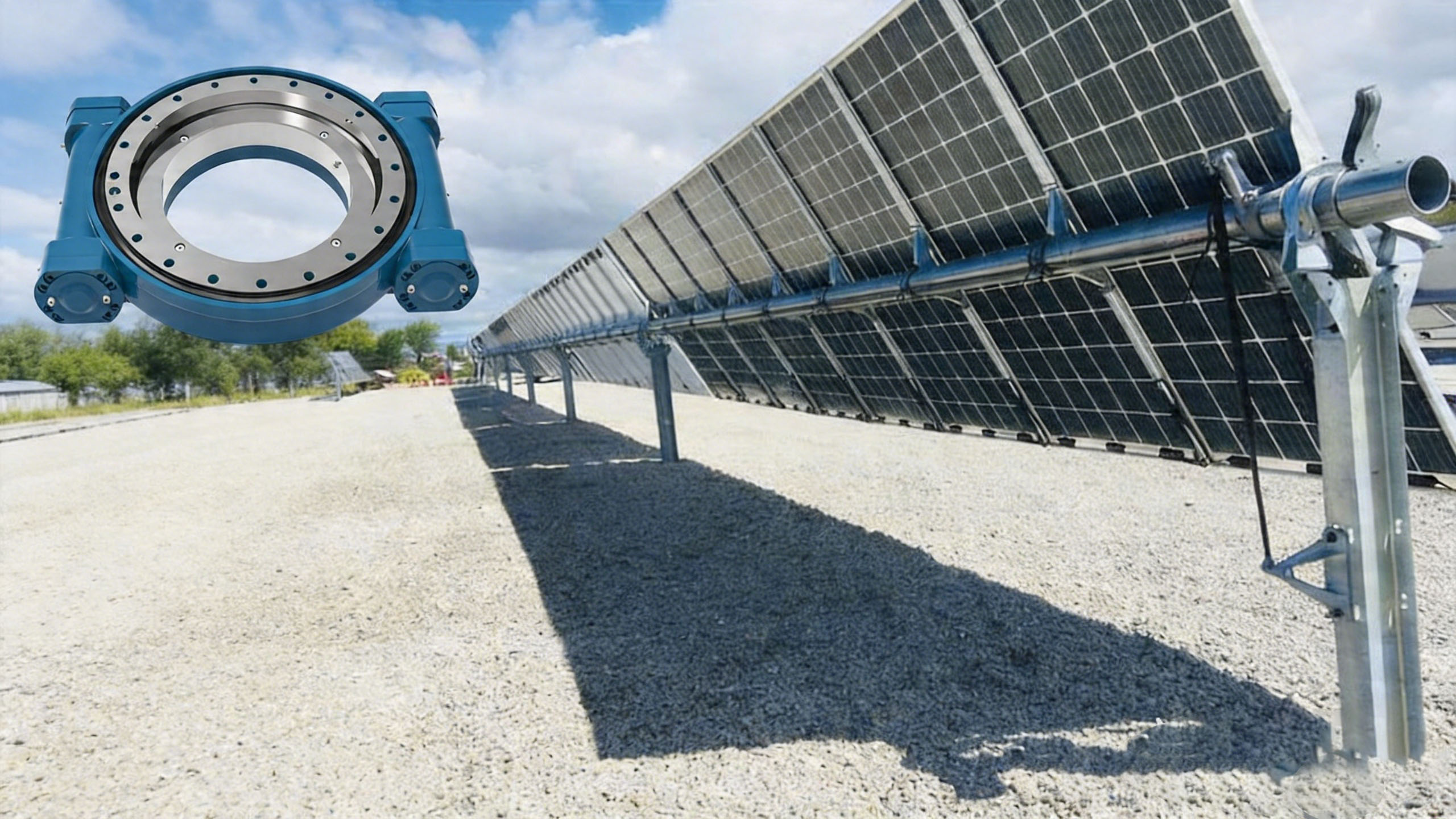
Maximizing Solar Efficiency: Slew Drives in Solar Trackers
What Is a Slew Drive?
A slew drive is a compact, precision-engineered gearbox designed to handle heavy loads, provide high torque output, and enable smooth rotational movement. It typically consists of a worm gear (or other gearing mechanism) integrated with a bearing, housing, and mounting interfaces. Slew drives are unique because they combine the functions of a gearbox and a bearing into a single unit, allowing them to support significant axial, radial, and tilting moment loads while accurately controlling rotation.
In simple terms, a slew drive is what makes heavy things turn precisely and reliably. Common applications include solar trackers, wind turbines, crane platforms, aerial lifts, and antenna positioning systems. However, one of the most impactful uses of slew drive technology today is in the renewable energy sector—specifically, in maximizing the output of solar power systems. As a professional manufacturer, LyraDrive specializes in engineering and supplying high-performance slew drives tailored to these demanding applications.
How Does a Slew Drive Work in Solar Trackers?
A solar tracker's job is to orient photovoltaic panels toward the sun as it moves across the sky. The slew drive is the electromechanical actuator that performs this orientation. Here is how it works step by step:
Signal Reception: A controller receives input from light sensors or a time-based algorithm, determining the sun's current position.
Motor Activation: The controller sends a signal to an electric, hydraulic, or pneumatic motor connected to the slew drive's input shaft.
Gear Reduction: The motor rotates a worm (a threaded cylinder) inside the slew drive. The worm turns a gear, which is attached to the output flange. Because the worm has a single thread (or a few threads) and the gear has many teeth, this creates a high gear reduction ratio.
Controlled Rotation: The output flange rotates slowly but with very high torque, moving the solar panel array mounted on top of it.
Position Holding: A key advantage of the worm gear design is that it is self-locking. The gear cannot back-drive the worm, so when the motor stops, the slew drive holds the panels firmly in place against wind and gravity without consuming power or needing a brake.
This process repeats continuously throughout the day (and resets at night), ensuring that the solar panels always face the sun as directly as possible. A single slew drive can control a single-axis tracker (moving panels east to west), while dual-axis trackers use two slew drives—one for azimuth (horizontal rotation) and one for altitude (vertical tilt).
Main Types of Slew Drives Used in Solar Trackers
Not all slew drives are the same. For solar tracking applications, two primary configurations dominate:
Single Worm Slew Drive: This is the most common type for both single-axis and dual-axis solar trackers. It uses one worm shaft to turn the main gear. Single worm drives offer an excellent balance of cost, precision, and torque capacity. They are ideal for most utility-scale solar farms where reliability and efficiency are paramount.
Double Worm Slew Drive: As the name implies, this design incorporates two worm shafts engaging the same main gear. The dual-worm configuration provides significantly higher torque output and reduced backlash (the "play" between gear teeth). Double worm slew drives are typically reserved for very large solar arrays, high-wind environments, or dual-axis trackers requiring extreme positioning accuracy.
Other less common variations include planetary gear slew drives (for very high-speed applications) and direct-drive designs. However, for the vast majority of solar projects, single worm and double worm slew drives remain the standard due to their self-locking ability, durability, and cost-effectiveness.
Top Advantages of Using Slew Drives in Solar Trackers
When you incorporate a high-quality slew drive into a solar tracker, you unlock several significant benefits:
Increased Energy Yield (Up to 30%): By keeping panels optimally aligned with the sun from sunrise to sunset, slew drives can boost electricity generation by 25–35% compared to fixed-tilt systems. This transforms marginal solar projects into highly profitable ones.
Exceptional Durability: Slew drives are built to withstand harsh outdoor conditions—extreme temperatures, high winds, dust, rain, snow, and UV radiation. A properly specified slew drive can operate maintenance-free for 15–20 years or more.
High Positioning Accuracy: Precision-ground gears allow tracking accuracies of ±0.1° or better. This ensures that even small misalignments don't erode energy capture.
Self-Locking Safety: The worm gear's inherent self-locking feature means the tracker stays put during motor stalls or power outages, preventing damage from uncontrolled movement.
Low Maintenance: Because the gearing is enclosed and lubricated for life in many designs, slew drives require no periodic adjustments or lubrication, reducing total cost of ownership.
Compact, High-Strength Design: A single slew drive replaces bulky combinations of bearings, gears, and housings, simplifying tracker design and reducing weight.
Customizing Slew Drives for Your Solar Project Needs
Every solar installation is unique. A small commercial rooftop tracker faces different loads and wind exposures than a 100 MW utility-scale farm in a desert or coastal region. That is why customization is critical.
LyraDrive offers a range of slew drives with modular configurations and multiple customization options for solar tracking systems, including:
Single & Double Worm Drives: Providing varied torque and load-handling capabilities to match different panel array sizes and wind load requirements.
Motor Options: Hydraulic, electric, and pneumatic motors to accommodate different power sources and control system preferences.
Encoders & Brakes: Enhancing positioning accuracy, control stability, and fail-safe holding when needed.
Open & Enclosed Chassis: Adapting to environmental conditions such as dust, high winds, extreme temperatures, or corrosive coastal atmospheres.
Additionally, for projects requiring unique specifications, LyraDrive's team of engineers can design custom slew drives tailored precisely to your operational needs. Whether you need a special gear ratio, a specific mounting interface, or a corrosion-resistant coating for harsh environments, we can engineer the ideal solution for your solar tracker.
How to Select the Ideal Slew Drive for Solar Applications
Choosing the right slew drive for your solar tracker involves a systematic evaluation of five key factors:
Solar Tracker Type: Single-axis horizontal or vertical trackers have different loading profiles than dual-axis trackers. Dual-axis requires two slew drives—one for azimuth and one for altitude—each with different torque requirements.
Array Size and Weight: Calculate the total dead weight of the panels plus mounting structure. Multiply by safety factors (typically 1.5–2x) to account for wind, snow, and dynamic loads.
Environmental Conditions: Wind speed (peak and sustained), ambient temperature range, humidity, dust/sand exposure, and corrosive elements (salt, industrial pollution) all influence material selection and sealing.
Desired Tracking Accuracy: Higher accuracy requires tighter gear tolerances (lower backlash), which increases cost. Most projects find ±0.5° to be sufficient, but high-concentration PV (CPV) systems may need ±0.1°.
Operational Lifetime: Define the expected years of service. Premium materials and larger bearings extend life but raise upfront cost. Balance initial investment against maintenance and replacement expenses.
A practical approach: start with the largest torque requirement (usually from wind load), then verify that the slew drive's static and dynamic load ratings (axial, radial, and moment) exceed your calculated loads by a healthy margin (e.g., 30–50%). Finally, check that the gear ratio and input speed produce the desired panel rotation speed (e.g., 1–2 degrees per second for single-axis trackers).
LyraDrive: Your High-Quality Partner for Solar Slew Drives
At LyraDrive, we specialize in the engineering, manufacturing, and global supply of premium slew drives, slewing bearings, and gear rings. Our entire business is focused on delivering the precise rotational solutions that heavy machinery, renewable energy systems, and industrial automation demand. When you choose LyraDrive, you are selecting a partner who understands that reliability and performance are non-negotiable—especially in solar applications where every kilowatt-hour counts.
For solar tracking systems, we offer fully customizable slew drive solutions tailored to your specific project parameters. Our product range includes both single worm slew drives and double worm slew drives, each designed to deliver high torque, minimal backlash, and exceptional durability in all climates. Whether you need a compact drive for a small commercial tracker or a heavy-duty unit for a utility-scale solar farm, we can engineer the ideal fit. Contact LyraDrive today to discuss your solar tracker requirements—and let us help you turn sunlight into maximum energy, day after day.
FAQs About Slew Drives in Solar Tracking Systems
Q1: How much efficiency gain can I expect from using a slew drive in a solar tracker?
A: Properly implemented solar trackers using high-quality slew drives typically increase energy harvest by 20–35% compared to fixed-tilt systems. The exact gain depends on your latitude, local atmospheric conditions, and tracker type (dual-axis provides higher gains but at higher cost).
Q2: Do slew drives require regular maintenance in solar farms?
A: Most modern slew drives for solar applications are designed as lubricated-for-life units. They require no routine maintenance beyond periodic visual inspection (e.g., checking seals for damage). After 10–20 years, some units may need regreasing or seal replacement, but many outlast the solar panels themselves.
Q3: Can a slew drive hold the solar panels in place during a power outage?
A: Yes. The worm gear mechanism inside a slew drive is inherently self-locking. Unless the motor deliberately turns the worm, the output gear cannot rotate backward due to load. This means your solar panels will stay put safely during grid outages, motor failures, or high winds—no additional brakes required.
Q4: What is the typical lifespan of a slew drive in a solar tracker?
A: With proper specification (correct load ratings, appropriate seals, and adequate corrosion protection), a slew drive should last 15–20 years in normal outdoor conditions. Premium units can exceed 25 years. The primary wear components are the worm and gear teeth, but at typical solar tracking speeds (a few rotations per day), fatigue life is very long.
Q5: Are single worm or double worm slew drives better for solar applications?
A: For the vast majority of projects, a single worm slew drive offers the best value: sufficient torque, good accuracy, and lower cost. Double worm drives are only necessary for extremely large arrays, sites with very high wind loads, or dual-axis trackers that require minimal backlash. LyraDrive offers both types and can provide expert guidance based on your specific needs.
 WhatsApp
 sales@lyradrive.com
 +8613903880726