



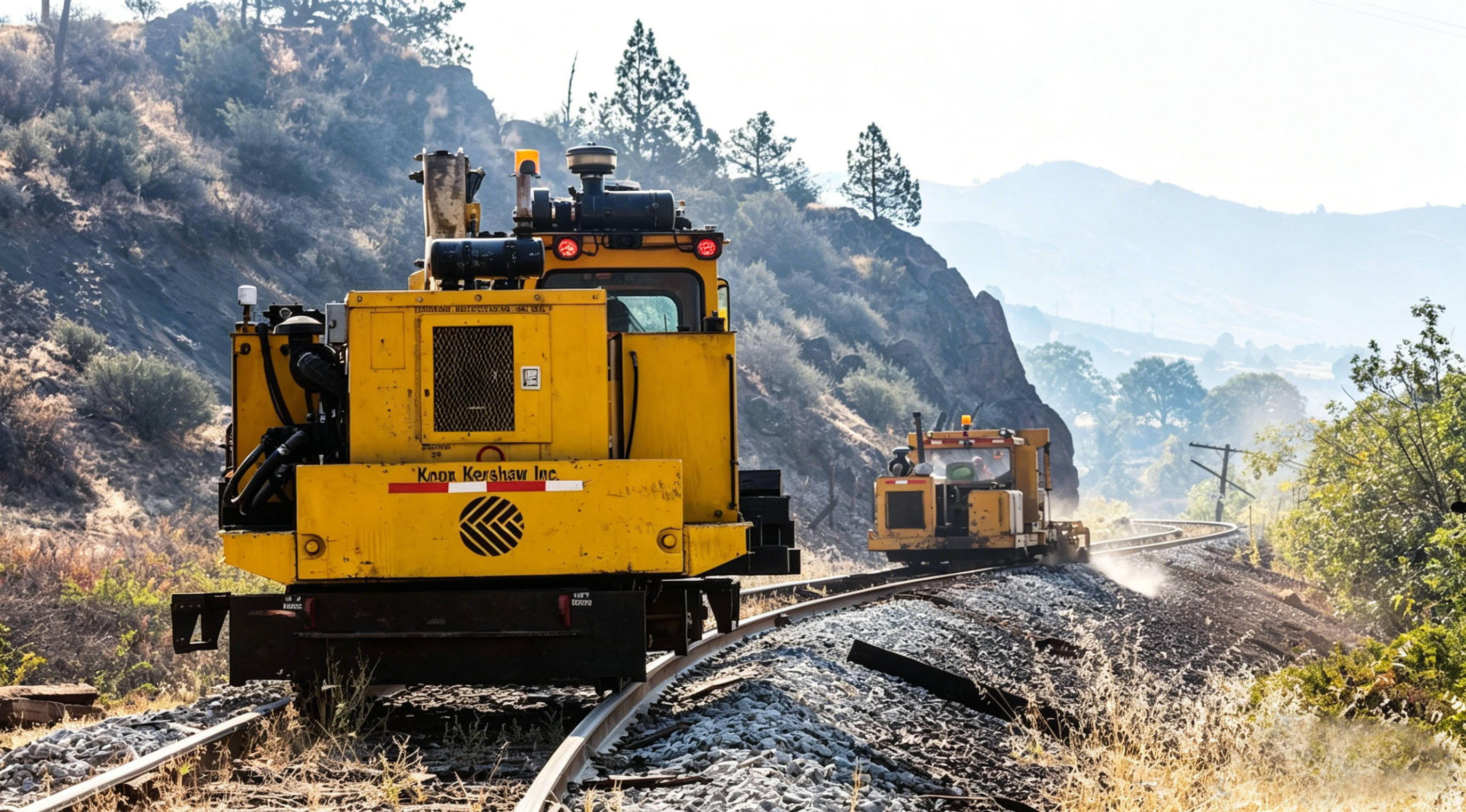
Keeping Rail Systems on Track: Slewing Bearings in Railway Maintenance Equipment
What is a Slewing Bearing?
A slewing bearing is a large-scale rolling-element bearing designed to support heavy loads, provide rotational movement, and transmit torque between two structures. Unlike conventional bearings, slewing bearings are capable of handling combined axial loads, radial loads, and tilting moments simultaneously. Typically consisting of an inner ring, an outer ring, rolling elements (balls or rollers), spacers, and sealing systems, slewing bearings are fundamental components in machinery requiring controlled oscillation or full rotation. In railway maintenance equipment, these bearings serve as the pivot point for booms, platforms, and tools, enabling precise positioning under extreme operational stresses.
The Critical Role of Slewing Bearings in Railway Maintenance Equipment
Railway maintenance equipment operates in highly demanding environments. From overhead line inspection vehicles to rail grinding trains and crane-mounted track renewal units, these machines rely on slewing bearings to perform critical rotating functions. The slewing bearing allows a maintenance platform to rotate smoothly, a lifting arm to swing under load, or a manlift basket to position workers safely near energized catenary wires.
Without high-performance slewing bearings, railway maintenance tasks such as replacing damaged rails, repairing signaling equipment, or clearing vegetation would become inefficient and unsafe. The reliability of the entire rail network often depends on the uptime of these maintenance machines, and at the heart of that uptime is the slewing bearing. Therefore, selecting the correct slewing bearing directly impacts operational availability, worker safety, and long-term maintenance costs.
How Do Slewing Bearings Work in Railway Maintenance Equipment?
A slewing bearing functions by integrating rolling elements between two concentric rings. One ring typically remains stationary while the other rotates, driven by an external power source such as a hydraulic or electric motor. In railway maintenance equipment, the slewing bearing is often mounted between a vehicle chassis and a superstructure. For example, in a rail-mounted aerial work platform, the slewing bearing enables the upper structure — including the boom and worker basket — to rotate up to 360 degrees independently of the undercarriage.
The internal gear teeth (either on the inner or outer ring) mesh with a driving pinion, converting rotary input into controlled angular motion. The slewing bearing simultaneously manages the weight of the boom, the reaction forces from lifting, and the tilting moment caused by off-center loads. Advanced sealing systems protect the rolling elements from dust, water, and debris commonly found along railway corridors. Grease or oil lubrication channels ensure consistent operation across a wide temperature range, from freezing winter rail yards to hot summer track-side environments.
Core Features of Slewing Bearings for Railway Maintenance Equipment
Slewing bearings used in railway maintenance equipment must possess several distinctive features:
High Load Capacity with Compact Dimensions: Railway equipment often has strict space and weight limits. Slewing bearings are engineered to support heavy dynamic loads while occupying minimal vertical height.
Integrated Gearing Options: Many railway applications require precise positioning. Slewing bearings with internal or external gear teeth allow direct integration with hydraulic or electric drives, eliminating separate gearing components.
Robust Sealing Systems: Rail environments expose components to ballast dust, metal filings from rail wear, deicing chemicals, and moisture. High-quality slewing bearings feature multi-lip seals that prevent contamination ingress while retaining lubricant.
Corrosion Resistance: Exposure to rain, snow, and chemical treatments demands corrosion-resistant materials or coatings on the slewing bearing rings and fasteners.
Low Maintenance Intervals: Railway maintenance schedules are tightly controlled. Slewing bearings with extended greasing intervals or lifetime lubrication reduce downtime for servicing.
Shock Load Tolerance: Track irregularities and sudden load changes generate impact forces. Slewing bearings designed for rail use incorporate robust rolling elements and raceway geometries that absorb such shocks without brinelling or fatigue.
Key Challenges Faced by Slewing Bearings in Railway Operations
Despite their robust design, slewing bearings in railway maintenance equipment encounter several persistent challenges:
Continuous Vibration and Shock: Rail travel itself produces high-frequency vibration. When the maintenance vehicle moves between work sites, the slewing bearing experiences cyclic stresses that can lead to fretting corrosion or raceway indentation if not properly designed.
Extreme Temperature Fluctuations: Railway networks operate from -40°C to +50°C. Lubricant viscosity changes dramatically across this range, potentially leading to inadequate film strength or excessive drag within the slewing bearing.
Contamination Ingress: Fine metallic dust from rail grinding operations can penetrate seals. Once inside the slewing bearing, abrasive particles accelerate wear on rolling elements and raceways.
Off-Center Loading: Many maintenance tasks involve lifting or holding tools at extended reach. The resulting tilting moment creates highly uneven stress distribution within the slewing bearing, requiring careful raceway hardening and material selection.
Limited Accessibility for Maintenance: Railway maintenance equipment often works in remote or confined areas (tunnels, bridges, yards). A slewing bearing that fails on-site requires complex recovery operations, making preventive reliability far more valuable than ease of repair.
How to Select the Right Slewing Bearing for Railway Maintenance Equipment
Selecting an appropriate slewing bearing involves evaluating multiple technical and operational parameters:
| Parameter | Consideration for Railway Equipment |
|---|---|
| Load Magnitude & Direction | Calculate static and dynamic axial, radial, and tilting moment loads under worst-case lifting or outreach conditions. |
| Rotational Speed | Most railway maintenance applications involve intermittent, low-speed rotation (<5 rpm). High-speed slewing bearings are rarely needed. |
| Duty Cycle | Frequent rotation (e.g., material handling cranes) demands hardened raceways and tighter tolerances than occasional positioning tasks. |
| Environmental Severity | Salt-laden air near coastal lines requires stainless or coated rings. Dusty ballast conditions favor double-seal designs. |
| Mounting Interface | Bolt circle diameter, bolt grade, and ring flatness must match the equipment's structural design to prevent distortion of the slewing bearing. |
| Lubrication Method | Remote or automated greasing systems are preferable for equipment that operates far from maintenance depots. |
A systematic selection process involves first determining the required static and dynamic load ratings (C0 and C), then verifying that the slewing bearing's tilting moment curve exceeds the application's peak demands. It is also wise to incorporate a safety factor of 1.5 to 2.0 for railway environments due to unpredictable shock loads.
FAQs About Slewing Bearings in Railway Maintenance Equipment
Q1: What types of slewing bearings are most commonly used in railway maintenance equipment?
A: The most common types include Single Row Slewing Ring Ball Bearings for light to medium loads, Crossed Roller Slewing Bearings for high precision and compact spaces, and Double Row Ball Slewing Ring Bearings for applications requiring increased moment capacity. For very heavy loads such as large rail cranes, Three-row Roller Slewing Bearings are preferred. Flanged Ball Slewing Bearings are also used where simplified mounting interfaces are beneficial.
Q2: How often should a slewing bearing be relubricated in railway track maintenance machinery?
A: Under normal operating conditions (weekly use, dry environment), relubrication every 3 to 6 months is typical. However, for equipment exposed to dust, moisture, or frequent pressure washing, intervals should be reduced to 1–2 months. Some modern slewing bearings feature centralized greasing systems that allow lubrication during daily pre-start checks.
Q3: Can a slewing bearing be repaired or must it be replaced entirely?
A: Minor issues such as seal damage or lubricant contamination can be repaired in situ. However, once raceway spalling, rolling element cracking, or excessive axial play develops, the entire slewing bearing should be replaced. Field repair of raceways is generally not recommended for safety-critical railway applications.
Q4: What is the typical service life of a slewing bearing in a rail maintenance crane?
A: With proper selection, correct mounting, and regular lubrication, a slewing bearing can last 10–15 years or more than 50,000 load cycles. Harsh environments or overload conditions may reduce this to 5–8 years. Monitoring running torque and periodic inspection for axial play can help predict remaining life.
Q5: Are standard industrial slewing bearings suitable for railway maintenance equipment?
A: Generally no. Railway applications require tighter tolerances, more robust sealing, and often wider temperature-range lubrication than standard industrial units. Using a non-railway-grade slewing bearing risks premature failure, unplanned downtime, and safety hazards. It is essential to select a slewing bearing specifically engineered for railway environmental and load conditions.
LyraDrive: A High-Quality Supplier of Slewing Bearings for Railway Applications
LyraDrive is a specialized manufacturer and engineering partner focused on the design and production of high-performance rotary motion components. We provide high-quality and customized slewing bearings, as well as complete slew drive assemblies, for demanding industries including mobile cranes, excavators, manlifts, aerial work platforms, and industrial automation. Our product portfolio encompasses all major configurations: Single Row Slewing Ring Ball Bearings, Flanged Ball Slewing Bearings, Crossed Roller Slewing Bearings, Double Row Ball Slewing Ring Bearings, and Three-row Roller Slewing Bearings.
For the railway maintenance sector, LyraDrive offers fully customizable slewing bearings engineered to meet the unique challenges discussed in this article — including vibration resistance, contamination exclusion, wide-temperature lubrication, and compact high-moment capacity. Whether you need a standard catalog design or a purpose-engineered solution for a track renewal crane, overhead line inspection vehicle, or rail grinding train, our engineering team can deliver a slewing bearing that maximizes your equipment's reliability and safety.
Keep your rail systems on track with LyraDrive. Contact us today to discuss your slewing bearing requirements and request a tailored proposal.
 WhatsApp
 sales@lyradrive.com
 +8613903880726