



As a design engineer with over 30 years in heavy machinery, I've seen a common scenario play out in the field. A crane, excavator, or automated turntable starts to exhibit a subtle "wobble" or excessive play during operation. The immediate suspect is often slew bearing wear. While this is a valid concern, jumping to that conclusion without a proper diagnostic process can lead to unnecessary downtime and costly misdiagnoses. The movement you feel might not be from the bearing at all.
The key is to distinguish between progressive raceway wear, loose mounting bolts, and deflection in the support structure. A single measurement can be misleading. True diagnostic power comes from performing consistent rocking tests over time and analyzing the trend. This article provides a field-tested procedure for maintenance teams to accurately identify the root cause of excessive movement and make informed decisions about maintenance or replacement.
Understanding the Three Main Sources of "Play" in a Slewing System
When a machine's rotating platform feels loose, the movement originates from one of three potential sources. Correctly identifying the source is the most important step in troubleshooting. Treating a structural problem with a new bearing will not solve the issue.
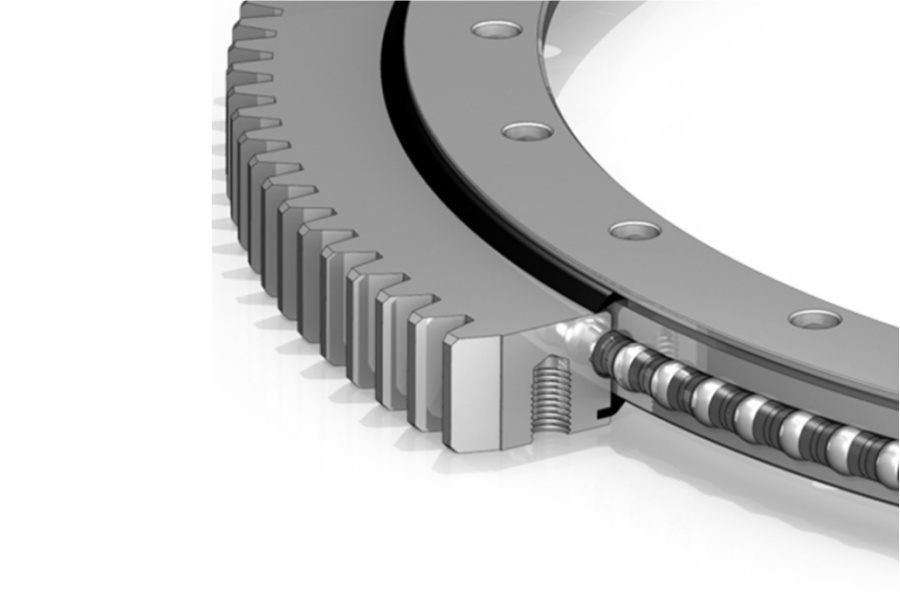
1. Internal Bearing Clearance (Wear): This is the gradual increase in the space between the rolling elements (balls or rollers) and the raceways inside the Slewing Bearing. All new bearings have a specific, engineered amount of initial clearance. Over thousands of cycles under load, this clearance slowly increases due to material fatigue and abrasion. This is expected slew bearing wear, and tracking its progression allows for planned replacement.
2. Mounting Bolt Preload Loss: Slew bearings are secured by dozens of high-strength bolts. If these bolts lose their proper tension or "preload," a microscopic gap can form between the bearing rings and the machine's mounting structure. Under load, this gap allows for movement that feels identical to internal bearing wear. This is often the most overlooked cause of sudden looseness.
3. Structural Deflection: The steel structures to which the bearing is mounted are not infinitely rigid. Under heavy or eccentric loads, these structures can flex or bend. If the mounting surface is not perfectly flat or has become damaged, or if the frame itself has developed cracks, it can cause the entire bearing assembly to tilt, mimicking a worn-out bearing.
A Step-by-Step Guide to Performing a Repeatable Rocking Test
To generate reliable data, the rocking test procedure must be consistent. Inconsistent methods will produce noisy data that makes trend analysis impossible. The goal is to measure the total tilting movement of the bearing under a defined load.
This procedure is a foundational practice for any equipment that relies on a Heavy load slewing bearing, from the port cranes we've supplied for South Korean manufacturers to the double worm slew drives used in Australian mining excavators.
Here is a standard procedure for a field service team:
- Establish a Baseline: The most important measurement is the one taken when the bearing is new and correctly installed. This "day one" reading is the benchmark against which all future measurements will be compared. If no baseline exists, take the first measurement now and use it as the starting point for future trend monitoring.
- Position the Equipment: Orient the machine's rotating structure in a fixed, repeatable position. For a crane, this might mean extending the boom to a specific angle and radius over the front of the machine. Document this position so it can be replicated exactly for every future test.
- Set Up the Dial Indicator: Place a magnetic-base dial indicator on a stationary part of the machine (e.g., the chassis or pedestal). Position the indicator's plunger perpendicular to the top surface of the bearing's rotating ring, as close to the outer edge as possible. Ensure the plunger is pre-loaded by about half its travel range.
- Apply the Tilting Moment: Use the machine's own systems to create a consistent tilting load. For an excavator, this could be done by pressing the bucket into the ground. For a crane, it involves lifting a known test weight. The goal is to apply a force that causes the bearing to rock. Then, reverse the load (e.g., lift the bucket off the ground).
- Record the Measurement: The total reading on the dial indicator from the fully loaded to the fully unloaded position is the "rocking" or "tilt" measurement. This value represents the total movement from all sources combined.
- Repeat and Document: Take measurements at three or four equidistant points around the bearing's circumference (e.g., at 0°, 90°, 180°, and 270°). Record the date, machine hours, test position, and all measurements in a maintenance log.
Request Your Custom Slew Drive or Bearing Spec
Tell us your load, speed, and environment — receive a tailored 100–5000 mm slewing drive or slewing bearing proposal with 3D drawings within 24 hours.
Interpreting Rocking-Test Data: Bearing Wear vs. Other Causes
A single high reading is an alert, not a diagnosis. The real value comes from comparing your latest readings to the baseline and previous logs. By adding a bolt torque check to your procedure, you can effectively isolate the root cause of the movement. This diagnostic logic is a critical skill for field technicians.
Here is a troubleshooting framework to separate progressive bearing clearance from bolt loosening or structural issues.
| Test Result & Observation | Likely Cause | Recommended Action |
|---|---|---|
| Sudden, significant increase in rocking measurement. After retorquing bolts to specification, the measurement returns to the previous baseline level. | Mounting Bolt Loosening. This is the most common cause of a sudden increase in play. Vibration and cyclic loads can cause bolts to lose preload. | Implement a more frequent bolt torque check schedule. Mark bolts after torquing to provide a quick visual check for rotation. No bearing replacement is needed. |
| Slow, steady, and gradual increase in measurements over time. Each test shows a small, incremental rise from the last, and the trend is consistent across all measurement points. | Normal Slew Bearing Wear. The raceways and rolling elements are wearing as expected. The bearing is approaching the end of its operational life. | Continue to monitor the trend. Once the measurement exceeds the manufacturer's specified wear limit, plan for a scheduled replacement. You can begin sourcing a replacement bearing—our standard production cycle is only 9 days. |
| Rocking measurement is high, but bolts are tight. The readings are erratic, inconsistent around the bearing, or are accompanied by groaning noises from the machine frame. | Structural Flex or Damage. The support structure is likely not flat or rigid enough. This could be due to a damaged mounting surface, a cracked weld, or a design issue. | Stop the rocking test. Perform a detailed structural inspection. Check mounting surfaces for flatness using a straightedge. Use dye penetrant or other NDT methods to check for cracks in welds and plates. |
| An abrupt, very large jump in the reading, often accompanied by grinding or popping noises. The movement feels "lumpy" or catches as it rotates. | Severe Bearing Damage. This could indicate a cracked raceway or a fractured ball/roller, possibly from a severe shock load or material defect. | Cease operation immediately. The bearing is in a critical failure state and is unsafe to operate. Arrange for an emergency inspection and replacement. This is where our 48-hour technical response can be a major asset. |
Common Mistakes to Avoid in Slew Bearing Diagnosis
Through my career, I've seen several recurring mistakes that lead to incorrect diagnoses. Avoiding these pitfalls will save you time, money, and unnecessary downtime. It ensures that the action you take actually solves the problem.
- Ignoring the Baseline: Judging a bearing's condition based on a single measurement without historical context is a guess at best. A 2.0 mm reading might be normal for one large-diameter bearing but a sign of critical failure for another. Trend data is everything.
- Forgetting to Check Bolts First: Always, always verify mounting bolt torque before concluding the bearing is worn. It's the simplest check and very often the culprit. It's far cheaper to spend an hour with a torque wrench than to replace a perfectly good bearing.
- Inconsistent Test Procedures: Using a different load, a different boom angle, or different measurement points for each test will create meaningless data. Consistency is the foundation of reliable trend analysis.
- Overlooking the Mounting Structure: A bearing is only as good as the foundation it's bolted to. A new bearing mounted on a warped or cracked surface will fail prematurely and will not solve the underlying problem of excessive movement.
- Misinterpreting Normal Clearance: New bearings are not built with zero clearance. They require a small amount of internal play to accommodate thermal expansion and elastic deformation under load. Don't mistake this designed-in clearance for wear.

From Diagnosis to Action: Ensuring Long-Term Reliability
Once you have confidently diagnosed the cause of the excessive movement, you can take targeted action. A clear diagnosis prevents wasted effort and ensures machine availability. At Luoyang Slewring Bearing Co., Ltd., we believe in empowering our partners with the knowledge to maintain their equipment effectively.
If your analysis points to normal, progressive slew bearing wear, you have the advantage of time. You can schedule the replacement during planned maintenance, avoiding costly emergency shutdowns. With our 9-day standard production cycle and annual capacity of 100,000 sets, we can ensure a replacement is ready when you need it.
If the issue was loose bolts, the solution is procedural. Incorporate regular torque checks into your preventative maintenance schedule. For critical equipment, especially in high-vibration environments like those seen by our clients with forestry grapple machines in Canada, this is a non-negotiable task.
Finally, if you diagnose severe or premature failure, it is important to investigate the "why." Was the bearing overloaded? Was there a lubrication failure? Is the sealing inadequate for the environment? Our engineering team can assist with failure analysis to prevent a recurrence. Every bearing we produce in our ISO 9001:2015 certified facility passes rigorous Slew Drive Quality Control, including CMM three-coordinate inspection, to ensure it meets design specifications. Our military-grade quality control processes result in a failure rate far below the industry standard, and we stand behind our products with a 2-year extended warranty.
Request Your Custom Slew Drive or Bearing Spec
Tell us your load, speed, and environment — receive a tailored 100–5000 mm slewing drive or slewing bearing proposal with 3D drawings within 24 hours.
 WhatsApp

 +8613903880726