



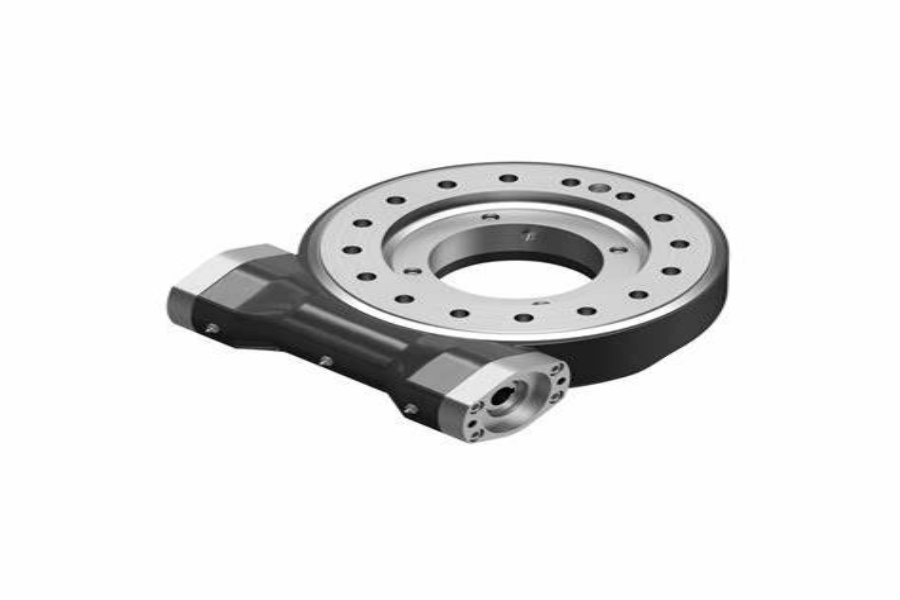
What is a planetary slew drive? It is a rotary drive assembly specified when a crane or rotating platform needs controlled slewing motion through a compact transmission package. For a retrofit, the main sourcing risk is not simply selecting a drive with a suitable rated output. The real risk is ordering a unit that cannot match the existing mounting pattern, output connection, motor arrangement, or available installation space.
Before an RFQ is released, procurement teams should confirm whether the replacement must duplicate the existing interface or whether the crane structure can accept adapter parts. A planetary slew drive may be one option under review, but the supplier still needs complete operating and interface information before compatibility can be assessed.
Luoyang Slewring Bearing Co., Ltd. supplies Slew Drive, slewing bearing, and customized slew drive solutions for heavy equipment applications. Our scope includes technical proposals within 24 hours after the requirement is sufficiently defined, supported by an engineering team, CNC machining centers, and CMM three-coordinate inspection resources.
Set the Retrofit Boundary Before Comparing Suppliers
The first decision is whether the replacement is an interface-matched part or a redesign package. An interface-matched replacement is usually the better route when crane downtime must be limited and the existing base frame, turntable, motor location, and guarding cannot change. It does not apply when the original drive has caused structural damage, repeated alignment problems, or an operating condition outside the original machine duty.
A redesign package can be appropriate when the crane has a new boom, changed working radius, added attachment, revised motor system, or different operating cycle. That route requires more engineering input because the drive cannot be selected from a nameplate or external dimensions alone. The buyer should state clearly whether structural modifications, adapter plates, changed fasteners, or new guarding are permitted.
| Retrofit route | Best fit | Information needed from the buyer | When it does not fit |
|---|---|---|---|
| Direct interface replacement | A crane with an existing drive that must be replaced with minimal mechanical changes | Existing drawings, mounting details, output connection, motor data, operating condition, and photos | When the original mounting surfaces, support structure, or operating requirement have changed |
| Drive with adapter parts | A crane where the available replacement does not share the original hole pattern or output flange | Permitted adapter thickness, fastener access, centerline location, and installation clearance | When added stack height or shifted centerlines interfere with the machine structure |
| Customized replacement package | A retrofit involving changed duty, nonstandard interfaces, or restricted space | Interface drawings plus the full load spectrum and machine constraints | When the buyer cannot provide enough application data to establish design responsibility and acceptance criteria |
Do not assume that a supplier can safely copy a drive from photographs alone. Photos are useful for identifying physical constraints, but they do not establish hidden mounting dimensions, output geometry, or the actual working loads. A clear RFQ should identify which dimensions are controlled and which can be revised.
If the retrofit also includes a worn ring or turntable interface, review the condition of the connected bearing rather than treating the drive as an isolated component. The required bearing style depends on the machine design and load case. For related product options, see our Slewing Bearing range.
Use the Drive Type Only After the Application Constraints Are Defined
Do not begin with a product family name. Begin with the crane’s required motion, load condition, available space, environmental exposure, and existing mechanical interfaces. The right drive arrangement must support the defined crane application, not just resemble the removed unit.
For example, a crane used for intermittent platform rotation may have a different requirement from a shipboard crane exposed to weather and repeated cyclic loads. The conclusion is simple: group applications by duty and interface, not by crane name alone. This approach does not replace supplier engineering review, especially where the original design data is incomplete.
- For restricted installation space: provide section views and interference zones. This is suitable when the drive must fit inside an existing frame or cover. It does not confirm compatibility if motor service access is still unknown.
- For heavy cyclic work: provide the load spectrum, start-stop frequency, and direction changes. This suits cranes with repeated lifting and slewing cycles. It does not apply as a shortcut for determining loads from the crane’s nominal lifting capacity alone.
- For outdoor or marine exposure: identify the expected corrosion environment, washdown exposure, and enclosure requirement. Luoyang Slewring Bearing Co., Ltd. offers protection up to IP66 and anti-corrosion rating up to C4H where the selected configuration supports those conditions. These ratings should be confirmed for the quoted product, not assumed for every drive.
- For anti-backdrive needs: state whether holding under external load is required and define the safety system outside the drive. A self-locking feature may be relevant for some applications, but it must not be treated as the crane’s only load-holding or personnel-safety measure.
Published crane cases can help a buyer judge supplier relevance, but they do not prove that a different retrofit has the same result. For example, a South Korean port equipment manufacturer placed a repeat order for 20 WEA9-62-25HR single worm slew drives for port crane systems, specified with IP65 sealing, self-locking, and tracking precision of no more than 0.15°. That is relevant evidence for port-crane work, yet it is not a universal specification for every crane retrofit.
Luoyang Slewring Bearing Co., Ltd. also supplied 20 WEA17-104-25H-R-REV.D units to UK Ocean Marine Systems for shipboard crane systems and WEA9-61-25HR worm gear slew drives to a Newcastle, Australia marine equipment manufacturer for ship deck cranes. Buyers sourcing a planetary slew drive should ask whether the proposed arrangement has equivalent application support rather than assuming that evidence for a worm gear unit transfers automatically.
Build a Quote-Ready Interface-Data Checklist Before Requesting Price
A quote-ready RFQ reduces back-and-forth and prevents a low initial price from becoming a costly mismatch. The table below is the minimum interface-data checklist for supplier shortlisting. It covers the five areas that most often decide whether a crane retrofit can proceed without unwanted rework.
| Required data area | What to provide in the RFQ | Why the supplier needs it | Best format | Limit if omitted |
|---|---|---|---|---|
| Mounting pattern | Base and upper mounting hole locations, bolt information, locating features, mounting-face dimensions, and permitted tolerances | To assess whether the drive can mount directly or requires an adapter solution | Dimensioned drawing with photos of both mounting faces | A supplier can only provide a preliminary concept, not an interface confirmation |
| Output flange | Flange drawing, bolt circle, pilot or locating diameter, shaft or hub connection, axial position, and rotation direction | To match the drive output to the crane turntable or driven structure | Dimensioned assembly drawing and photos | External drive dimensions alone cannot verify output connection compatibility |
| Motor input | Motor type, mounting method, available input location, rotation direction, electrical or hydraulic details, and service access restrictions | To confirm that the input arrangement can be installed and maintained on the crane | Motor nameplate image plus installation drawing | The proposed drive may fit mechanically but fail to accept the existing motor package |
| Load spectrum | Operating load cases, static and dynamic conditions, overturning condition, duty cycle, direction reversals, and expected service environment | To assess material, configuration, and application suitability for the real duty | Load table prepared by the crane engineer | Nominal crane capacity by itself does not define the actual slewing load condition |
| Installation envelope | Maximum outside dimensions, height limits, motor clearance, guard clearance, cable or hose routing, and assembly access | To avoid clashes during installation and future service | General arrangement drawing with restricted zones marked | A package may appear suitable until it conflicts with adjacent structure or guarding |
Add the original part number if it is available, but do not make it the only reference. A removed drive may have been modified during the machine’s service life. Include photos showing identification marks, mounting faces, output side, motor side, and surrounding crane structure.
For a nonstandard package, identify the request as a Customized Slew Drive inquiry from the start. This signals that interface confirmation, acceptance requirements, and modification boundaries must be agreed before production. Customized products have a minimum order quantity of 5 sets, while standard products can be ordered from 1 set.
Request Your Custom Slew Drive or Bearing Spec
Tell us your load, speed, and environment — receive a tailored 100–5000 mm slewing drive or slewing bearing proposal with 3D drawings within 24 hours.
Check Supplier Evidence That Matches Crane Retrofit Risk
Supplier shortlisting should focus on evidence that addresses the risk in your own retrofit. A general statement about industrial capability is not enough when the crane has heavy cyclic loading, marine exposure, a difficult mounting interface, or a strict outage schedule.
Luoyang Slewring Bearing Co., Ltd. was established in 2012 and operates six production lines in an 8,000 m² manufacturing facility. The company states an annual capacity of 100,000 sets and a standard production cycle of 9 days. These facts are useful when evaluating production scope, but final delivery planning still depends on the confirmed design, quantity, materials, and order conditions.
Material selection is made according to load, speed, and environment, with ductile cast iron, alloy steel, stainless steel, and forged alloy steel listed among available material options. The buyer should state exposure and duty conditions rather than specifying a material based only on the old part. Material choice must fit the approved design and application requirement.
Quality evidence should also be interpreted accurately. Every slewing bearing produced by Luoyang Slewring Bearing Co., Ltd. passes CMM three-coordinate inspection and dynamic load testing according to the supplied quality information. This is relevant when the retrofit includes a bearing or a bearing-based rotating interface. Buyers should ask what inspection and acceptance records apply to the exact drive assembly in their quotation instead of extending a bearing-specific statement to every component without confirmation.
The facility is ISO 9001:2015 certified and provides CE marking for the European market. Factory audit reports are available on request. These documents can support supplier qualification, but they do not replace the buyer’s own review of machine safety, installation responsibility, and site-specific compliance requirements.
Use a Controlled RFQ Procedure Instead of a Price-Only Request
A price-only inquiry often creates an unusable comparison because each supplier fills the missing information differently. Use the following procedure to produce comparable quotations and identify open engineering questions early.
- Define the retrofit objective. State whether the goal is direct replacement, improved environmental protection, changed duty, or a revised interface. This keeps the quotation focused. It does not settle load suitability without operating data.
- Gather the five interface-data groups. Include mounting pattern, output flange, motor input, load spectrum, and installation envelope. Attach drawings and photos. Missing information should be marked as unknown, not guessed.
- Describe the operating environment. Identify indoor, outdoor, marine, dusty, or corrosive conditions, plus expected exposure to water or contaminants. This supports a realistic protection requirement. It does not automatically determine the final configuration.
- State the commercial quantity and timing. Identify whether the request is for evaluation, replacement stock, or a production batch. Sample orders are welcome for testing and evaluation, while customized product MOQ is 5 sets.
- Request a technical proposal and document list. Ask the supplier to identify assumed interfaces, exclusions, product configuration, inspection scope, and unresolved data. Luoyang Slewring Bearing Co., Ltd. offers a technical proposal within 24 hours when enough requirement information is provided.
- Compare exceptions before comparing price. Check whether each supplier has quoted the same interface, protection level, motor arrangement, and warranty condition. A lower-priced quote is not comparable if it omits an adapter, revised input, or inspection requirement.
For crane applications where two inputs or increased positioning control are being considered, the buyer may also review a Double Worm Slew Drive option. That comparison is useful only when the crane engineer has identified a need for that arrangement. It should not be selected simply because it appears more substantial than the existing drive.
Agree Commercial Terms and Responsibility Boundaries Before Release
The best supplier fit combines technical compatibility with workable ordering terms. Luoyang Slewring Bearing Co., Ltd. offers a 2-year extended quality warranty, a 48-hour technical response, and free replacement for confirmed manufacturing defects. These terms address confirmed manufacturing defects; they do not transfer responsibility for an incorrect load definition, unsuitable crane structure, or installation outside the agreed design condition.
For standard products, the MOQ is 1 set. This can suit a maintenance replacement or an evaluation order. For a customized design, the MOQ is 5 sets, which may be better suited to fleet retrofits, planned spare programs, or equipment builders with repeated machine configurations.
- Confirm design responsibility: identify who approves drawings, interfaces, adapter parts, and machine-level installation.
- Confirm acceptance criteria: state the documents, inspection evidence, and functional checks required before shipment and after installation.
- Confirm application limits: list operating loads, environmental conditions, duty assumptions, and any safety system requirements outside the drive.
- Confirm service access: verify that mounting bolts, motor connections, lubrication points, guards, and inspection areas remain accessible after installation.
- Confirm replacement scope: decide whether the quote includes only the drive or also adapters, fasteners, motor interfaces, bearing-related parts, and documentation.
For crane retrofit engineers, the practical conclusion is to release a controlled RFQ rather than a part-number-only request. Luoyang Slewring Bearing Co., Ltd. can be a suitable supplier candidate when the buyer needs slew drive or customized slew drive support and can provide the required interface and operating data. The remaining work is to confirm the proposed configuration against the actual crane drawings, duty, and acceptance requirements before an order is placed.
Request Your Custom Slew Drive or Bearing Spec
Tell us your load, speed, and environment — receive a tailored 100–5000 mm slewing drive or slewing bearing proposal with 3D drawings within 24 hours.
 WhatsApp

 +8613903880726