



What is a hydraulic slew drive? It is a rotation assembly that uses hydraulic power to turn a platform, boom, attachment, wheel-steering unit, crane structure, or other mobile machine component around a fixed axis.
Before placing an order, buyers should confirm more than rotation torque. A poorly specified hydraulic slew drive can create mounting conflicts, slow response, heat buildup, unstable positioning, or a mismatch between the hydraulic motor and the machine’s existing circuit. Those errors often appear after assembly, when changes cost more.
For OEM engineers and procurement teams, the best sourcing process starts with the machine duty cycle and ends with documented acceptance requirements. Luoyang Slewring Bearing Co., Ltd. supports standard Slew Drive products, slewing bearings, and customized drive solutions for mobile machinery applications where load direction, installation space, environmental exposure, and control method must be reviewed together.
Confirm the machine duty before comparing suppliers
The first sourcing decision is whether the machine needs a standard unit or a customized arrangement. A standard product is often suitable when the mounting interface, rotation range, load pattern, and hydraulic motor arrangement already align with an available model. It is not the right choice when a new machine frame, unusual attachment geometry, or special sealing requirement changes the load path or mounting envelope.
Start by describing what rotates and what remains stationary. For example, a truck-mounted crane turntable, forestry grapple, aerial platform, excavator attachment, or mobile steering system may all rotate, but the direction and frequency of loading are different. A supplier cannot assess the same drive in the same way for each application.
Separate the loads that act on the rotation assembly
Provide radial load, axial load, overturning moment, and the direction of each load during normal operation. Also identify peak conditions such as lifting, braking, travel over uneven ground, side pulling, attachment impact, or wind exposure. The conclusion is simple: select by the combined working condition, not by one torque value from a motor catalog.
This approach fits mobile equipment with changing loads. It does not replace a full machine structural review when the mounting plate, frame weldment, fasteners, or support structure may be the weak point. The drive and its support must be evaluated as one system.
| Machine input | Why the supplier needs it | Best fit | Limit if omitted |
|---|---|---|---|
| Radial and axial load direction | Shows how the bearing race and mounting structure are loaded | All rotating mobile equipment | Torque alone cannot confirm bearing suitability |
| Overturning moment and load arm | Identifies tipping force acting across the rotating interface | Cranes, booms, platforms, grapples, and excavator attachments | A drive may turn the load but lack the required support margin |
| Rotation speed and duty cycle | Helps match gearing, motor behavior, heat exposure, and wear conditions | Frequent-cycle and precision-positioning equipment | Continuous operation and occasional adjustment cannot be treated alike |
| Operating environment | Guides sealing, corrosion protection, lubricant, and material selection | Marine, mining, forestry, outdoor, and dusty equipment | Indoor assumptions can shorten service life outdoors |
| Required holding behavior | Determines whether self-locking and braking conditions need review | Raised loads, cranes, lifts, and positioning equipment | Hydraulic pressure loss and external load movement may remain unresolved |
Material selection should also follow the working condition rather than habit. Luoyang Slewring Bearing Co., Ltd. uses ductile cast iron, alloy steel, stainless steel, and forged alloy steel according to load, speed, and environment. Buyers should state whether the machine will face salt spray, abrasive dust, rain, washdown, temperature swings, or corrosive process conditions.
Where the application requires a separate bearing rather than an enclosed drive assembly, the load case may point to a Heavy load slewing bearing. This is suitable when the machine design already has its own drive train. It does not remove the need to verify gear engagement, mounting stiffness, and lubrication responsibilities.
Choose the drive arrangement based on motion, holding, and installation space
Buyers should compare gear arrangement and motor integration before asking for price. A worm-based unit is often considered where controlled rotation and holding behavior matter, while a spur gear arrangement may fit other rotation layouts. The correct choice depends on the machine’s force direction, required control behavior, available envelope, and hydraulic circuit.
A Worm Gear Slew Drive can suit crane, lift, and positioning duties where a compact, enclosed rotation assembly is preferred. It is not automatically the correct answer for every mobile machine, particularly where the mounting orientation, speed requirement, or external gear arrangement points to another solution.
Double-worm configurations deserve attention when the application has demanding load distribution or positioning requirements. For example, a forestry equipment manufacturer in British Columbia ordered 30 WED14-86-25BHR.5 double worm units for grapple machines with tracking precision of no more than 0.13 degrees. That case supports evaluating a double-worm design for a forestry grapple duty, but it should not be treated as a universal accuracy result for unrelated machines.
Luoyang Slewring Bearing Co., Ltd. has also supplied HWE21-94-25HR.1 double worm slew drives to an Australian heavy equipment manufacturer for mining excavators. This is relevant evidence for buyers assessing demanding mobile equipment use. It does not establish that one model will fit every excavator because boom geometry, attachment mass, duty cycle, and hydraulic settings still vary.
Use this selection check before requesting a quotation
- Select a standard drive when the machine has a known interface and the available product configuration meets the required mounting, load, and environmental conditions. This can reduce development time. Do not force a standard design into a frame that needs nonstandard bolt locations or a different hydraulic motor interface.
- Request a customized drive when the equipment has special mounting dimensions, a unique load path, or a defined hydraulic connection requirement. Luoyang Slewring Bearing Co., Ltd. accepts customized product orders from 5 sets. Customization is not a substitute for incomplete load information.
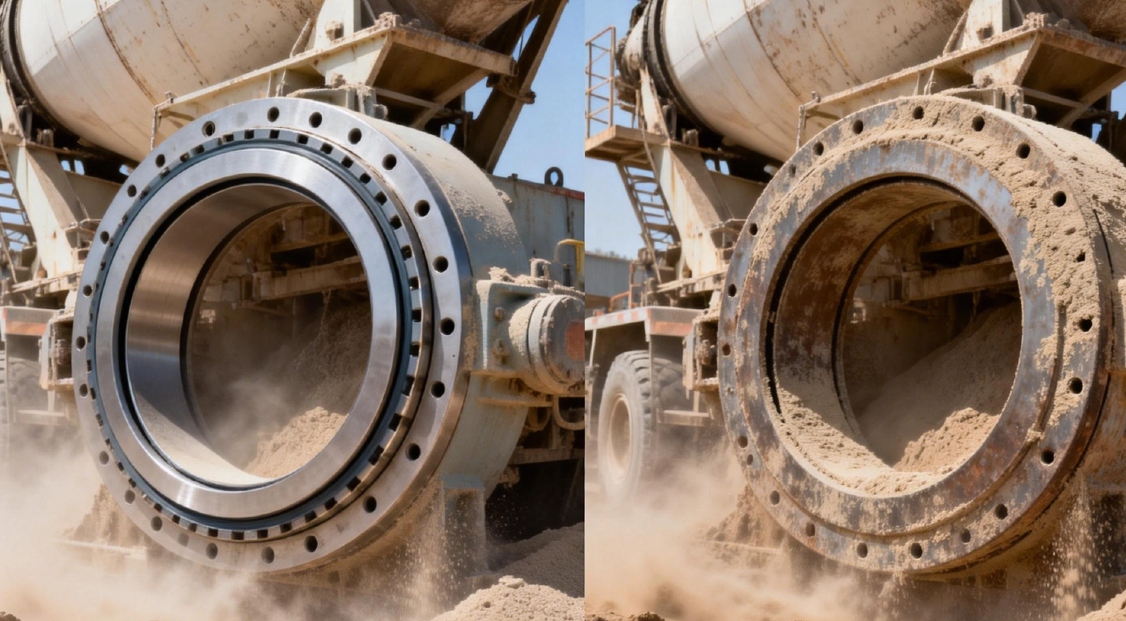
- Specify corrosion and sealing needs early when the machine works outdoors, near saltwater, in mining dust, or in wet forestry conditions. Protection is available up to IP66 and anti-corrosion rating up to C4H. Confirm the actual target condition because these maximum options may not be needed for sheltered equipment.
- Review holding and safety functions when an external load could turn the structure after hydraulic pressure changes. Self-locking may be relevant, but system safety can also depend on valves, brakes, and the full hydraulic circuit. Do not describe self-locking as a complete machine safety system without engineering review.
A quote-ready RFQ workflow linking machine load data, hydraulic circuit conditions, mounting dimensions, and acceptance requirements
A quote-ready RFQ gives the supplier enough information to judge fit before issuing a price. The clear conclusion is that buyers should send one controlled technical package rather than separate emails from procurement, hydraulic engineering, and mechanical design. This fits new equipment programs, replacement projects with changed conditions, and supplier-shortlist work. It may be excessive only for a direct replacement where the confirmed model, drawing revision, and hydraulic setup are unchanged.
- Define the rotating function. State what component rotates, the rotation angle or continuous rotation requirement, the operating speed range, and the expected duty cycle. Include normal operation and exceptional events such as transport, braking, side loading, or impact.
- Submit the machine load data. List radial load, axial load, overturning moment, load direction, center-of-gravity position, and the load arm from the rotation center. Attach a layout drawing or CAD file when available. A verbal description is not enough for an offset boom or attachment.
- Describe the hydraulic circuit conditions. Provide available hydraulic pressure, flow, motor preference if already selected, hose connection needs, control valve type, expected start-stop behavior, and whether the machine has a brake or load-holding valve. The supplier needs this information to assess motor integration and operating behavior. Do not assume that the machine’s existing pump data alone defines the motor requirement.
- Provide mounting dimensions. Include bolt-hole pattern, mounting face, center opening, maximum outside envelope, motor clearance, hose routing space, and access needed for installation and maintenance. Add the allowable mass if the rotating structure has a strict weight target.
- State environmental conditions. Identify dust, moisture, washdown, salt exposure, chemical contact, temperature conditions, storage period, and expected transport conditions. This step matters for mobile cranes, mining machinery, forestry equipment, and marine deck equipment.
- Set acceptance requirements. Define what documents, dimensional checks, inspection records, packaging, marking, drawing approval, and functional checks are required before shipment. If the application has a positioning target, identify the measurement method and test condition rather than sending only a general accuracy request.
- Agree the commercial scope. Confirm quantity, required delivery date, destination, sample requirement, warranty expectations, spare-parts needs, and responsibility for final machine validation. Standard product MOQ is 1 set, while customized product MOQ is 5 sets. Sample orders are welcome for testing and evaluation.
| RFQ section | Minimum information to send | Supplier decision supported |
|---|---|---|
| Load case | Radial load, axial load, moment, load directions, duty cycle | Drive size, bearing arrangement, material and design review |
| Hydraulic conditions | Pressure, flow, control method, motor preference, holding needs | Motor interface and operating behavior |
| Installation | Mounting drawing, bolt pattern, envelope, hose clearance | Physical fit and customized interface requirements |
| Environment | Dust, water, corrosion exposure, storage and outdoor use | Sealing and surface-protection selection |
| Acceptance | Inspection documents, dimensional records, functional criteria, packaging | Quotation scope and shipment-release criteria |
This workflow helps procurement compare quotations on the same basis. Without it, one supplier may price a basic standard assembly while another includes a motor interface, corrosion protection, inspection documentation, or custom machining. The lowest initial price can then be misleading.
Request Your Custom Slew Drive or Bearing Spec
Tell us your load, speed, and environment — receive a tailored 100–5000 mm slewing drive or slewing bearing proposal with 3D drawings within 24 hours.
Review supplier evidence that affects mobile equipment risk
For a supplier shortlist, focus on evidence connected to the intended duty. Luoyang Slewring Bearing Co., Ltd. was established in 2012 and operates six production lines in an 8,000 square meter manufacturing facility. Its annual capacity is 100,000 sets, which is relevant when an OEM needs a supplier that can support both evaluation units and planned production volumes.
Quality evidence matters most where a rotating assembly is exposed to repeated load cycles. The company’s ISO 9001:2015 certified facility and CE marking for the European market are documented qualifications buyers can consider during supplier review. Factory audit reports are available on request, which can help procurement teams that require formal supplier assessment materials.
For dimensional and load-related verification, every slewing bearing passes CMM three-coordinate inspection and dynamic load testing according to the supplied company information. Buyers should still state their own incoming-inspection and machine acceptance criteria because supplier inspection does not replace system-level validation after installation.
The company offers a 2-year extended quality warranty, a 48-hour technical response, and free replacement for confirmed manufacturing defects. These terms are relevant for buyers managing warranty exposure. They do not cover defects caused by incorrect installation, unsuitable hydraulic settings, machine frame movement, or use outside the agreed condition unless separately agreed.
Ask for evidence that matches your equipment type
Case relevance is stronger than a generic application list. A South Korean port equipment manufacturer placed a repeat order for 20 WEA9-62-25HR single worm units for port crane systems, with tracking precision of no more than 0.15 degrees, IP65 sealing, and self-locking. That example may help buyers assessing port crane rotation, but marine corrosion exposure, load spectrum, and hydraulic arrangements still need project-specific review.
For mobile steering equipment, a Houston engineering machinery manufacturer ordered 150 WED17-104-25HR double worm units for heavy-duty wheel steering systems. For truck-mounted lifting equipment, a Netherlands material handling manufacturer ordered 50 WEA9-62-25HR units for loader cranes. These cases show that the company has supplied relevant equipment categories; they are not a substitute for reviewing your own installation drawing and duty data.
Buyers who need supplier quality records can review the scope described under Slew Drive Quality Control. Ask which inspection documents can be supplied with the order and which requirements must be added to the purchase specification. This distinction avoids assuming that a standard inspection package includes every project document.
Avoid common sourcing mistakes before issuing the purchase order
Most procurement delays come from incomplete interfaces, not from the first quotation. The practical answer is to resolve the following points before releasing a purchase order. These checks fit both standard and customized orders, although the drawing-review effort is usually greater for a customized unit.
- Comparing only maximum torque. Torque does not show axial load, radial load, overturning moment, bearing life conditions, or mounting-frame stiffness. Use the complete machine load case instead.
- Leaving out hydraulic flow and pressure. A mechanical selection can still fail to meet motion expectations if the hydraulic motor and control circuit are not aligned. Include circuit data in the RFQ from the start.
- Sending an outdated mounting drawing. A changed bolt pattern, center opening, or hose clearance can stop assembly even when the drive itself is correctly made. Issue a controlled drawing revision and identify it in the RFQ.
- Assuming environmental protection is standard. Outdoor, marine, mining, and forestry machines may need different protection choices. State exposure conditions rather than using terms such as “heavy-duty” without details.
- Failing to define acceptance documents. Inspection records, packing requirements, marking, and drawing approvals should be listed before ordering. Adding them after production starts can affect schedule and cost.
- Treating a sample as final qualification. A sample can support fit and functional evaluation, but it may not represent full machine validation or production acceptance. Define what the sample is intended to prove.
Luoyang Slewring Bearing Co., Ltd. provides a technical proposal within 24 hours and has a standard production cycle of 9 days, with 3-day rapid prototyping available under the stated company terms. These capabilities can support a fast-moving program once the technical inputs are clear. They should not be read as a guarantee for every custom configuration, approval process, shipping route, or project change.
Set order terms that protect both the machine program and the supplier relationship
A good order document should identify the approved drawing, model designation, hydraulic interface, inspection scope, packaging needs, quantity, destination, and requested delivery date. It should also state who approves technical changes. This is especially useful when the buyer’s engineering team is in one location and procurement or final assembly is in another.
For a standard product, the MOQ is 1 set. That makes it practical to evaluate fit or performance before a larger release. For a customized solution, the MOQ is 5 sets, so buyers should complete load, hydraulic, and mounting reviews before committing to the initial quantity.
When the design requires a special layout, a Customized Slew Drive request should include the unresolved decisions as well as the confirmed ones. Examples include motor position, hose direction, mounting interface, coating requirement, and acceptance documents. Do not hide open questions in general notes; list them as items requiring supplier response.
The right supplier is not simply the supplier with the lowest unit price. For mobile equipment, the best fit is the supplier that can quote against the actual load case, hydraulic circuit, mounting interface, and acceptance requirements without leaving important assumptions unaddressed. A well-prepared RFQ gives engineers a clearer technical basis and gives procurement a more comparable commercial offer.
Request Your Custom Slew Drive or Bearing Spec
Tell us your load, speed, and environment — receive a tailored 100–5000 mm slewing drive or slewing bearing proposal with 3D drawings within 24 hours.
 WhatsApp

 +8613903880726